Choosing the right bulk tote bag manufacturer can make the difference between a smooth order and a costly headache. For brands, wholesalers, retailers, promotional buyers, and private label businesses, tote bags may look like a simple product, but the sourcing process is rarely that simple. Material quality, stitching, printing, lead time, sampling, and factory communication all affect the final result.
Many buyers focus only on price in the early stage, then discover problems later: weak handles, inconsistent sizing, delayed production, poor logo printing, or bags that do not match the approved sample. These issues usually do not happen by accident. They often come from avoidable mistakes made during the factory selection process.
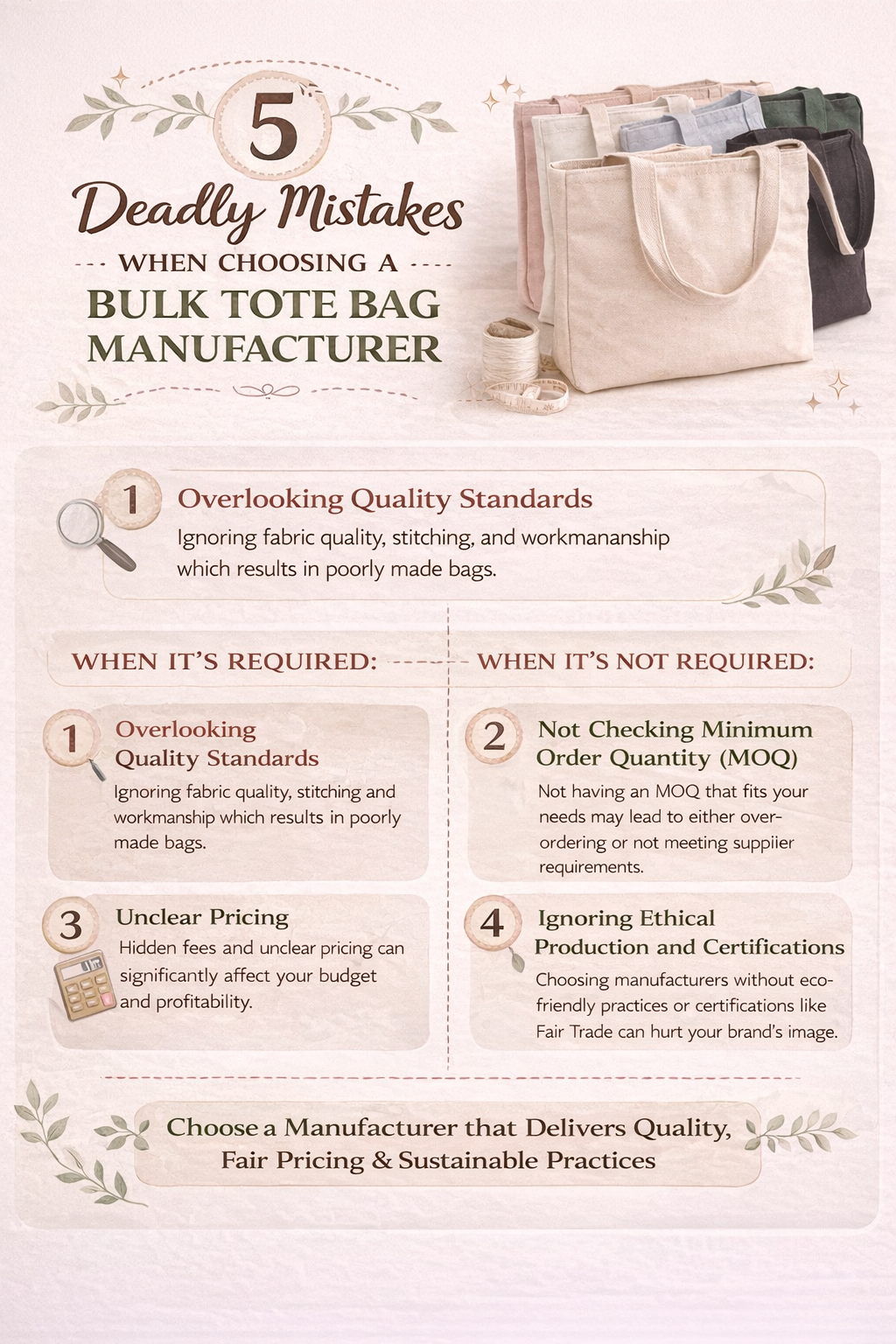
In this guide, we will look at five major mistakes buyers make when choosing a wholesale tote bag supplier, why these problems matter, and how to avoid them before placing a large order.
Why Choosing the Right Tote Bag Manufacturer Matters
A tote bag is often used as both a functional product and a branding tool. It may be sold in retail, used for events, packed with cosmetics or gift items, offered as merchandise, or developed as part of a private label bag collection. Because of that, buyers need more than just a factory that can sew fabric together. They need a supplier that understands quality standards, customization details, and reliable production control.
A strong tote bag factory can help improve fabric selection, printing results, packaging, and delivery planning. A weak supplier, on the other hand, can create problems that affect not only one order, but also customer trust and brand reputation. That is why factory selection should be treated as a key business decision, not just a price comparison exercise.
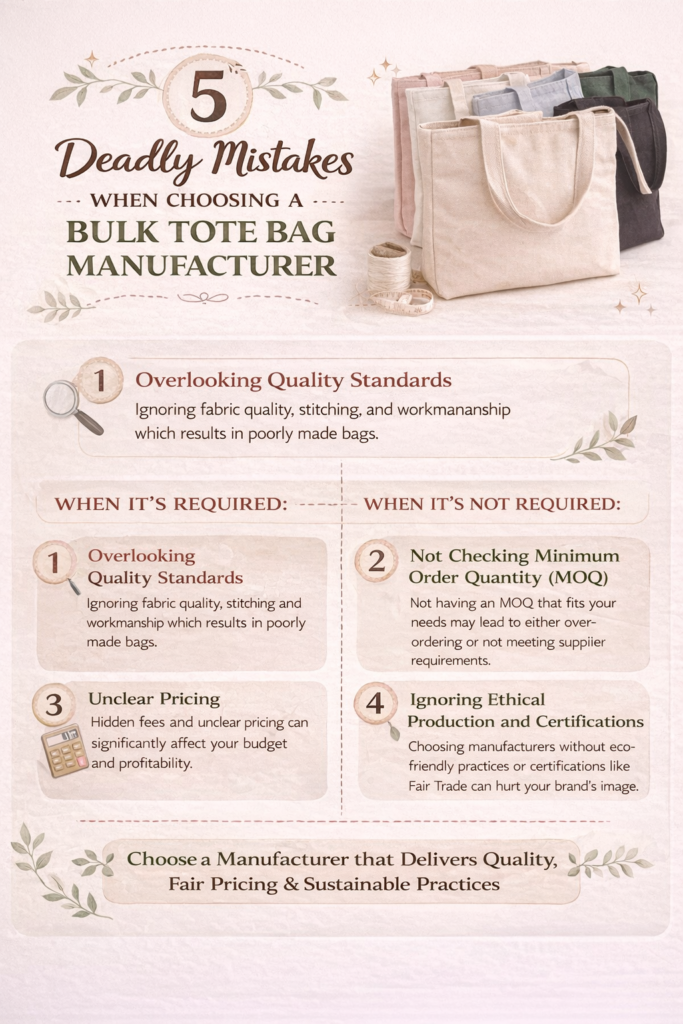
Mistake 1: Choosing Only the Lowest Price
This is one of the most common sourcing mistakes in the tote bag business. A very low quote may look attractive at first, especially for buyers working on bulk canvas bags, promotional tote bags, or low-cost reusable shopping bags. But price alone does not tell you what kind of result you will get.
In many cases, an unusually cheap offer means lower fabric weight, weaker stitching, thinner webbing, lower printing quality, or less reliable production management. Sometimes the supplier may also leave out important cost details in the first quote, then add them later. What looks cheap in the beginning can become expensive once problems appear.
A better approach is to compare value, not just number. Ask what is included in the price, what material specification is being quoted, what the print method is, whether sampling is available, and how quality inspection is handled. A slightly higher price from a dependable tote bag manufacturer is often safer than the cheapest option on the list.
Mistake 2: Not Checking the Factory’s Real Product Experience
Not every bag supplier is equally good at making tote bags. Some factories handle backpacks, pouches, cosmetic bags, or travel organizers but have limited experience with bulk tote production. Others may show many bag photos online without having strong expertise in the exact style you need.
Tote bags may look straightforward, but the details still matter. A cotton tote bag, quilted tote, laminated shopping bag, foldable grocery tote, or promotional nonwoven bag all require different handling. Handle reinforcement, gusset construction, fabric behavior, printing compatibility, and weight support can vary a lot from one style to another.
Before moving forward, review the supplier’s actual experience with similar projects. Ask for sample photos, previous production examples, custom printing references, and details about fabric options. A manufacturer with proven experience in bulk tote bag production will usually communicate more clearly and give more practical suggestions.
Mistake 3: Ignoring Material and Construction Details
Another serious mistake is approving a supplier before confirming what materials and construction methods will actually be used. Buyers sometimes assume that all canvas totes are similar, or that a recycled tote bag will perform the same as a heavier cotton style. That assumption often leads to disappointment.
Fabric weight, weave density, lining, handle width, stitching method, reinforced cross-stitching, inner pockets, zipper options, and printing surface all influence the final bag. If these points are not discussed clearly in advance, the finished product may not meet expectations even if the supplier technically followed the order.
This matters even more for custom tote bags used in retail or branded campaigns. A weak handle, poor edge finishing, or low-grade fabric can quickly make the product feel cheap. Buyers should request clear specifications for the outer material, trim, handle length, printing method, closure, and packaging before confirming mass production.
Mistake 4: Skipping Samples or Approving Them Too Quickly
Bulk orders should not move forward based only on digital mockups or chat messages. One of the biggest mistakes a buyer can make is skipping the sample stage or reviewing it too casually. A tote bag sample is not just for checking the shape. It is the chance to evaluate fabric feel, print clarity, stitching quality, proportion, color, and overall presentation.
Some buyers rush through this step to save time, then later find that the bulk order looks different from what they imagined. Others approve a sample without testing handle strength, checking print alignment, or reviewing packaging details. When production starts, it becomes much harder to correct those issues.
A proper sampling process helps reduce risk. Check the dimensions, examine the seams, review the logo application, and confirm whether the bag feels right for the intended use. If the tote bag is for retail, gifting, or private label sale, the sample should be judged as a finished product, not just as a rough reference.
Mistake 5: Overlooking Communication and Production Reliability
Even if a tote bag supplier offers a fair price and a good-looking sample, poor communication can still ruin the order. A factory that replies slowly, avoids specific answers, changes details casually, or fails to confirm timelines clearly can create major trouble once the order gets larger.
Good communication is especially important in custom tote bag manufacturing because there are often many small points to confirm: fabric color, logo artwork, sample revision, handle length, packaging requirements, shipping terms, and production lead time. If the supplier is vague at the quotation stage, the risk often becomes higher during mass production.
Reliability also includes consistency. Can the supplier deliver the same quality in bulk? Do they have quality control steps? Do they understand export packing? Can they handle deadlines for promotional campaigns or seasonal launches? A manufacturer is not just a source of bags. They are part of your supply chain, so dependability matters as much as product quality.
How to Evaluate a Bulk Tote Bag Supplier More Effectively
The best sourcing decisions usually come from asking better questions early. Instead of focusing only on MOQ and price, buyers should also ask about material options, production capacity, customization support, printing methods, sample timing, lead time, packing details, and quality inspection procedures.
It also helps to compare suppliers based on fit. One factory may be better for low-cost promotional tote bags, while another may be more suitable for premium retail totes or custom branded shopping bags. The right manufacturer is not always the cheapest or the largest. It is the one that matches your product level, quality expectations, and business needs.
A Simple Checklist Before Placing a Tote Bag Bulk Order
- Confirm the exact fabric type, weight, and color.
- Review stitching, handle construction, and reinforcement details.
- Check print method, print position, and artwork quality.
- Approve a physical sample whenever possible.
- Confirm packaging requirements and shipping terms.
- Ask about production lead time and inspection process.
- Make sure all key details are written clearly before deposit payment.
A small checklist like this can prevent large mistakes. In bulk bag manufacturing, the details that seem minor at the beginning often become the biggest problems later.
Conclusion
Choosing a bulk tote bag manufacturer is not only about finding someone who can produce a bag at a low price. It is about finding a supplier who can deliver the right quality, the right construction, reliable communication, and consistent production performance.
The five mistakes covered here are common, but they are also preventable. If you avoid chasing the lowest quote blindly, check the factory’s real tote bag experience, confirm materials carefully, take the sample stage seriously, and evaluate communication quality, you will greatly reduce sourcing risk.
For brands and buyers planning custom tote bag orders, a careful factory selection process is one of the smartest investments you can make. A better manufacturing partner does not just help you produce bags. They help you protect your product quality, timeline, and reputation.
Aries Gu is the founder of Q&N. With over 17 years of experience in cosmetic bag OEM/ODM source factory. He focuses on quality control, efficient communication, and on-time delivery for global cosmetic bag projects.