If you source bags, travel accessories, or cosmetic pouches, you will see the same question come up again and again: nylon or polyester? Both materials are common. Both are practical. Both are used in everything from travel organizers to makeup bags, tote bags, and outdoor gear. But they do not feel exactly the same, and they do not perform in exactly the same way.
Some buyers choose by price first. Some choose by look and hand feel. Others care more about weight, abrasion resistance, water resistance, or how the fabric performs in daily use. In real projects, the best choice is usually not about which material is “better” in general. It is about which one is more suitable for the product you are making.
That is why this topic matters for OEM and ODM bag development. A fabric that looks good on a laptop sleeve may not be the best fit for a travel cosmetic pouch. A material that works well for a lightweight daily bag may not be ideal for a more structured organizer. Nylon and polyester can look similar at first glance, but once you compare them in actual use, the differences become clearer.
In this guide, we will explain the difference between nylon and polyester in simple language. We will compare texture, strength, weight, drying speed, water performance, cost, and real product use. We will also look at which one may be better for bags, clothing, outdoor products, and cosmetic bags or travel accessories.
If you are developing private label bags, you can also browse Q&N Bags’ product collection or check the custom service page to see how different materials are used across cosmetic bags, pouches, toiletry bags, and travel accessories.
Introduction
Nylon and polyester are two of the most widely used synthetic fabrics in the bag and accessory industry. They are both durable compared with many natural fabrics. They are both common in travel products. And they are both good options for custom manufacturing. That is why buyers often compare polyester fabric vs nylon fabric before placing an order.
Still, they are not interchangeable in every case. Nylon fabric often feels smoother and softer. Polyester fabric often feels a little drier or firmer depending on the weave and finish. Nylon is often associated with higher abrasion resistance and flexibility. Polyester is often chosen for value, color stability, and broader cost control. In short, both work well, but they shine in different ways.
A simple way to say it is this: nylon often feels a bit more premium in touch and toughness, while polyester often gives a better balance of function and cost for many everyday products.
What Are Nylon and Polyester?
Both nylon and polyester are man-made fibers. They are engineered materials, not natural ones like cotton or linen. Because they are synthetic textiles, they can be designed for different uses, such as light weight, strength, wrinkle resistance, quick drying, or water resistance.
In the bag industry, these two materials are especially common because they are practical. They are also easy to adapt into different constructions. You can use them for soft pouches, structured cosmetic cases, travel organizers, laptop sleeves, and outdoor accessories.
What Is Nylon?
Nylon is a synthetic polymer fiber known for its strength, flexibility, and abrasion resistance. In simple terms, nylon is often chosen when the product needs to handle repeated friction, movement, and everyday wear.
Nylon fabric usually has a smoother hand feel than polyester. It can also look a little more refined or slightly more technical depending on the finish. Many buyers like nylon because it feels less dry and often a little more supple in the hand.
For bags and travel products, nylon is often used when people want:
- good strength for daily use
- a smoother and softer surface feel
- better flexibility
- a more premium-looking material in some applications
That said, nylon is usually not chosen only for appearance. It is often chosen because it performs well when the bag is used often, packed often, and handled often.
What Is Polyester?
Polyester is another synthetic fiber widely used in bags, apparel, and outdoor products. It is popular because it is versatile, stable, cost-effective, and easy to work with across many product categories.
Polyester fabric can feel firmer, drier, or more structured depending on the weave, coating, and finish. It is often used in products where buyers want good overall performance without pushing cost too high. That is one reason polyester is so common in cosmetic bags, travel pouches, laptop sleeves, and promotional bags.
On qnbags.com, polyester appears across several product styles and material descriptions, including travel and toiletry categories and padded sleeves. You can see examples in the PU leather toiletry bag with polyester lining and the quilted polyester tablet sleeve.
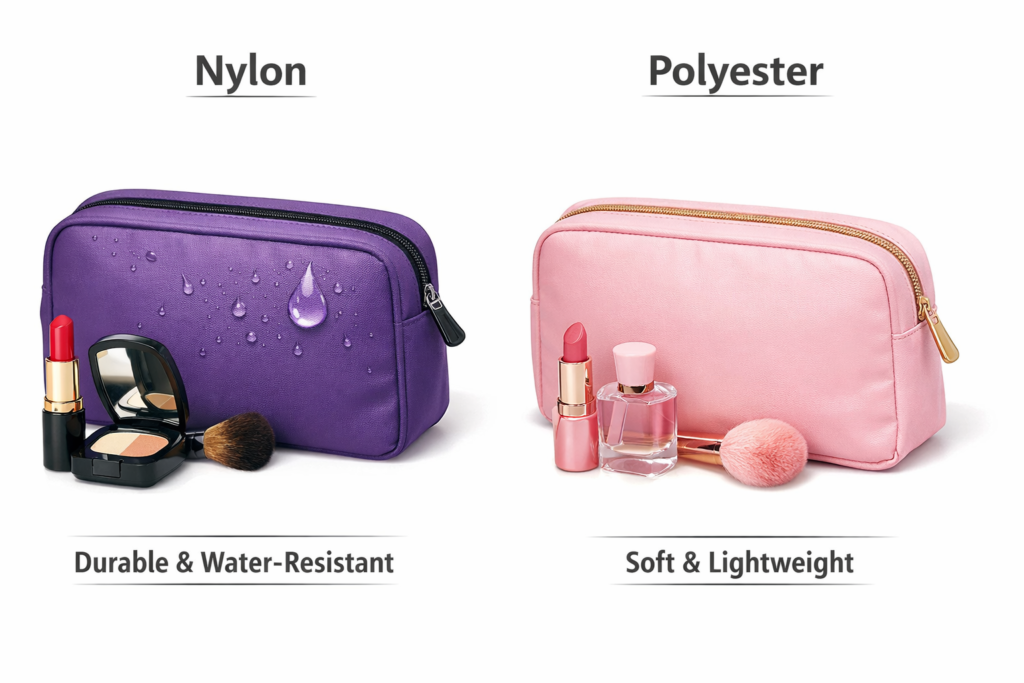
Key Differences Between Nylon and Polyester
The easiest way to compare nylon vs polyester is not by one single feature. It is better to look at several performance points together. In real product development, texture, function, appearance, and budget all matter at the same time.
Difference in Raw Materials
Nylon and polyester are both synthetic, but they are made from different chemical processes. For most buyers, this matters less than the performance result. What matters more in practice is that the different fiber structures create different feel, flexibility, moisture behavior, and wear resistance.
In simple terms, the raw material difference helps explain why nylon and polyester do not behave exactly the same even when they look similar in photos.
Difference in Texture and Feel
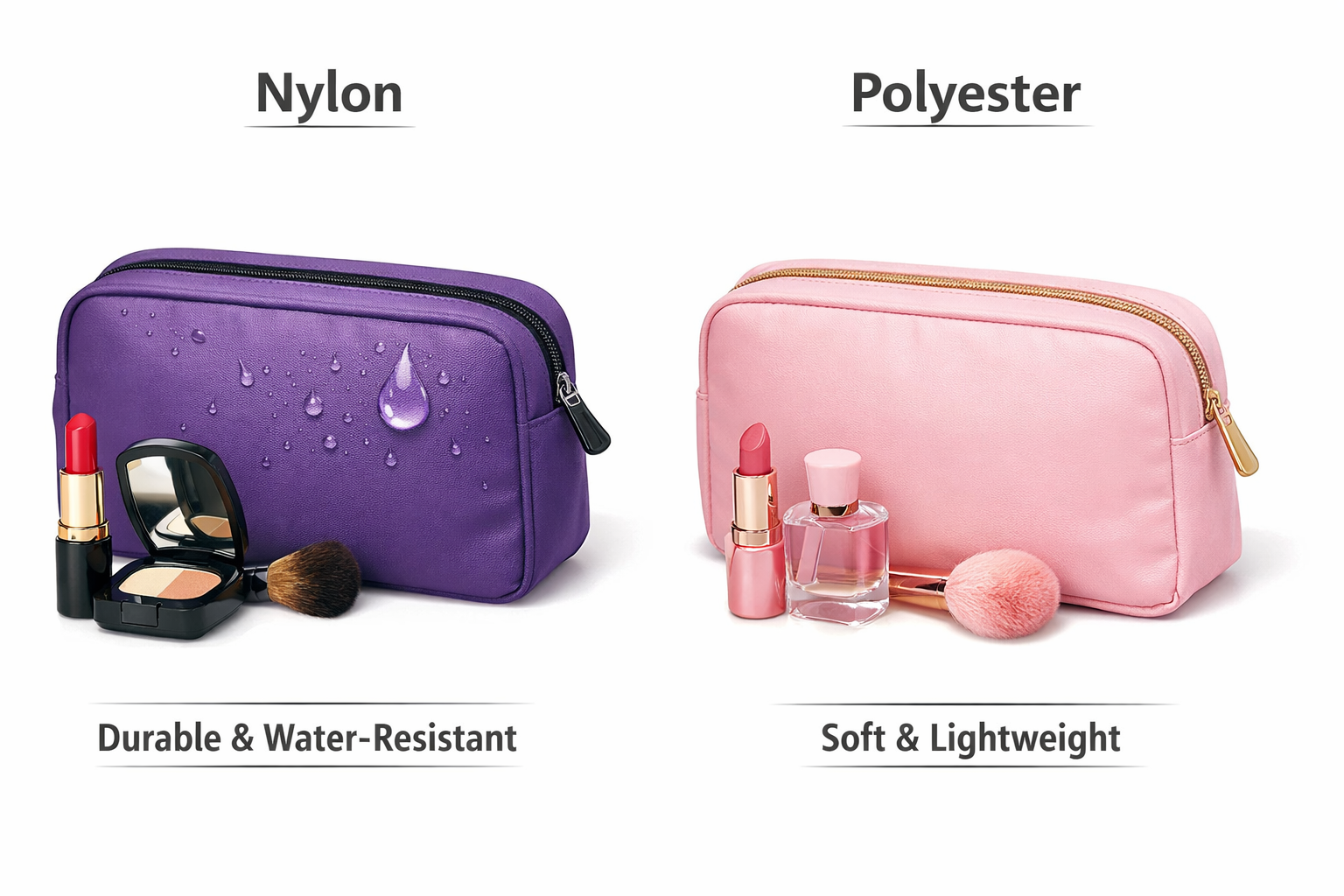
This is one of the first differences people notice by hand. Nylon usually feels softer, smoother, and a little more flexible. Polyester often feels slightly drier, crisper, or firmer.
That does not mean polyester feels cheap. A good polyester fabric can still feel premium. But if you compare common nylon cloth vs polyester cloth side by side, nylon often has the softer hand feel.
Summary: nylon usually feels smoother; polyester often feels crisper.
Difference in Strength and Durability
Nylon is often considered stronger in terms of toughness and abrasion handling. It tends to perform very well when there is repeated rubbing or long-term wear. That is one reason it is widely used in products that see frequent use.
Polyester is also durable. In fact, for many everyday bags and travel accessories, polyester is durable enough and performs very well. But when buyers ask about nylon durability vs polyester durability, nylon often has an edge in abrasion-heavy situations.
Summary: both are durable, but nylon often feels tougher under repeated friction.
Difference in Water Resistance
Many people assume one is waterproof and the other is not. That is not really the right way to think about it. Neither plain nylon nor plain polyester is automatically fully waterproof on its own. Water performance also depends on coating, backing, weave density, and surface treatment.
That said, polyester often absorbs less water than nylon. Nylon may take in a bit more moisture, while polyester usually keeps a more stable feel when exposed to damp conditions. For that reason, polyester is often preferred in products where water resistance and quick dry performance matter.
Summary: polyester often has an advantage in lower moisture absorption, but actual water resistance depends on finishing.
Difference in Breathability
For bags, breathability is usually less important than for clothing. But when the same fabrics are used in apparel or outdoor soft goods, nylon and polyester both have limited natural breathability compared with natural fibers. Breathability often depends more on fabric construction than on fiber name alone.
In simple terms, neither is chosen mainly for breathability in bag manufacturing.
Difference in Weight
Both materials can be made in lightweight versions. Still, polyester is often seen in many light, practical travel products because it offers good performance at a reasonable weight and cost. Nylon can also be very lightweight, but some buyers use polyester more often when building cost-sensitive lightweight bag programs.
Summary: both can be light, but polyester is very common in lightweight value-driven bag development.
Difference in Stretch and Flexibility
Nylon usually has better natural stretch and flexibility. This can make it feel less stiff and a bit more comfortable in certain applications. Polyester usually feels more stable and less elastic.
For soft bags and flexible travel accessories, this difference can affect how the product feels in use. A more flexible fabric can make the bag easier to squeeze into luggage or carry comfortably.
Summary: nylon is usually more flexible; polyester is usually more dimensionally stable.
Difference in Drying Speed
Polyester is often known for drying quickly. Because it tends to absorb less moisture, it usually dries fast after exposure to water or humidity. This is helpful for travel goods, outdoor use, and products used in bathrooms or wet environments.
Nylon also dries relatively fast compared with many natural fibers, but polyester often has the advantage in this comparison.
Summary: polyester usually dries faster.
Difference in UV Resistance
Polyester usually performs better in sunlight and UV exposure over time. Nylon can degrade faster under strong long-term UV exposure if not treated or protected properly. This is one reason polyester is often preferred for some outdoor or sun-exposed applications.
Summary: polyester often has better UV stability.
Difference in Abrasion Resistance
This is one of nylon’s best-known strengths. Nylon usually handles rubbing and wear very well. If the product will be dragged, rubbed, or handled heavily, nylon is often a very appealing option.
Polyester is still good, but nylon often wins in abrasion resistance when the comparison is direct.
Summary: nylon usually has stronger abrasion resistance.
Difference in Wrinkle Resistance
Both materials resist wrinkles better than many natural fibers. For bags and pouches, this is helpful because the fabric can keep a neater look in storage and shipping.
In real use, both are good enough here for most bag projects.
Difference in Cost
Cost is one of the biggest reasons many buyers compare polyester vs nylon. Polyester is often the more cost-effective choice. Nylon often costs more, especially when the project requires stronger technical performance or a more premium fabric feel.
For that reason, polyester is often chosen for large-volume orders, practical travel products, promotional items, and price-sensitive projects.
Summary: polyester is often more budget-friendly; nylon is often a higher-cost performance choice.
Nylon vs Polyester: Pros and Cons
Advantages of Nylon
- usually smoother and softer to the touch
- strong abrasion resistance
- good flexibility
- often feels a bit more premium
- good durability for repeated use
Disadvantages of Nylon
- often higher in cost
- can absorb more moisture than polyester
- usually less UV-stable over long exposure
- may not be necessary for every everyday bag project
Advantages of Polyester
- good value for money
- often dries quickly
- lower moisture absorption
- good color and shape stability
- widely used and easy to source for many bag categories
Disadvantages of Polyester
- often feels less soft than nylon
- usually less abrasion-resistant in direct comparison
- may feel slightly less premium depending on the fabric type
Nylon vs Polyester for Different Applications
The best way to decide between nylon and polyester is to match the fabric to the product type.
Which Is Better for Bags?
For everyday bags, both work well. If you want a softer hand feel and stronger abrasion performance, nylon is often attractive. If you want a reliable, practical, more cost-controlled bag material, polyester is often the easier choice.
That is why both nylon bags and polyester bags are common in the market. One supports a more performance-driven or smoother-feel direction. The other supports a broader value-driven and stable production direction.
Which Is Better for Clothing?
In clothing, the answer depends on the product. Nylon is often liked for smoothness and flexibility. Polyester is often liked for quick drying and shape stability. For activewear, outerwear, and blended performance textiles, both are common.
There is no single winner. The intended use matters more.
Which Is Better for Outdoor Products?
For outdoor use, polyester often has an advantage in UV resistance and lower moisture absorption. Nylon often has an advantage in toughness and abrasion resistance. So the best choice depends on whether the product is more exposed to sun and moisture, or more exposed to friction and wear.
Outdoor gear buyers often make this decision based on the specific environment rather than marketing terms alone.
Which Is Better for Cosmetic Bags and Travel Accessories?
For cosmetic bags and travel accessories, polyester is often the more common choice because it gives a good mix of light weight, easy care, quick drying, and price control. It also works well in many quilted, lined, and wipe-clean constructions.
Nylon is still a strong option, especially if you want a smoother fabric, a more technical feel, or a bag that handles frequent use and rubbing very well.
On qnbags.com, the material pages and product descriptions show that both polyester and nylon are available for custom bag projects, while polyester appears often in travel-ready and easy-care constructions. You can also see the broader material offer on the custom materials page and browse matching categories in cosmetic bags, toiletry bags, and padded sleeves.
How to Choose Between Nylon and Polyester
Consider the Product Use
Start with the actual product. Is it a daily cosmetic pouch? A toiletry organizer? A laptop sleeve? A travel bag? A promotional pouch? Material choice should follow use. A bag used in wet environments may benefit from polyester’s lower moisture absorption. A bag that sees more rubbing may benefit from nylon’s toughness.
Summary: choose by real use, not by fabric name only.
Consider the Desired Appearance
Do you want a smoother, softer, slightly more premium hand feel? Nylon may be a better fit. Do you want a cleaner cost structure with good everyday performance and many finishing options? Polyester may be the better answer.
Appearance is not only about color. It is also about hand feel, drape, surface texture, and the kind of impression the fabric gives in the hand.
Consider Performance Requirements
Think about the most important performance point. Is it abrasion resistance? Quick drying? UV stability? Flexibility? Water behavior? Every product has one or two priorities that matter most.
If abrasion resistance is the top concern, nylon may be stronger. If moisture behavior and UV resistance matter more, polyester may be a safer choice.
Consider Budget and Order Volume
If you are building a large-volume order or a more price-sensitive collection, polyester often gives better cost control. If you are aiming for a more premium feel or stronger wear performance and the budget allows it, nylon may be worth the added cost.
For OEM and ODM production, this is often where the decision becomes clear.
Nylon vs Polyester: Quick Comparison Table
| Point | Nylon | Polyester |
|---|---|---|
| Raw Material Type | Synthetic fiber | Synthetic fiber |
| Texture and Feel | Smoother, softer | Firmer, drier, crisper |
| Strength | Very strong | Strong |
| Abrasion Resistance | Usually better | Good |
| Water / Moisture Behavior | Can absorb a bit more moisture | Usually absorbs less moisture |
| Drying Speed | Fast | Often faster |
| UV Resistance | Usually weaker | Usually better |
| Flexibility | Usually more flexible | Usually more stable |
| Weight | Can be lightweight | Can be lightweight |
| Cost | Usually higher | Usually lower |
| Best General Use | Performance, soft-feel, abrasion-heavy use | Value, travel, quick-dry, broad everyday use |
Common Questions About Nylon and Polyester
Is Nylon Stronger Than Polyester?
In many practical comparisons, nylon is often considered stronger in abrasion resistance and toughness. That is why nylon is often favored in products that face repeated friction and heavy handling.
Simple answer: often yes, especially for abrasion-heavy use.
Is Polyester More Waterproof Than Nylon?
Polyester usually absorbs less moisture than nylon, but neither material should be called fully waterproof without the right coating or finish. In real product development, waterproof performance depends on construction and treatment, not only on fiber type.
Simple answer: polyester often handles moisture better, but waterproofing depends on finishing.
Which Material Lasts Longer?
That depends on the type of stress. Nylon may last longer where friction and rubbing are the main issue. Polyester may last better where UV exposure and moisture stability matter more. Product design, fabric quality, and finish also affect lifespan.
Simple answer: both can last a long time, but they perform differently.
Which Material Is Better for Everyday Bags?
For many everyday bags, polyester is a very practical choice because it balances performance, cost, and easy care. If you want a smoother feel and stronger abrasion performance, nylon may be the better material.
Simple answer: polyester is often the practical everyday option; nylon is often the more performance-focused option.
Conclusion
Nylon and polyester are both strong, useful, and widely used materials. That is why the question is not simply nylon or polyester. The real question is: which one is better for this product?
If you want a softer feel, more flexibility, and strong abrasion resistance, nylon is often the better fit. If you want lower moisture absorption, quick drying, good UV stability, and better cost control, polyester is often the smarter choice. For many cosmetic bags, travel accessories, and everyday organizers, polyester gives a very balanced result. For more performance-driven bags, nylon remains a strong option.
In short, nylon often feels more premium and tougher in friction-heavy use. Polyester often gives better value and broader practicality. Both are good. The right one depends on the job.
If you are choosing materials for custom bags, makeup pouches, or travel organizers, you can explore more bag material articles, browse the product collection, or contact Q&N Bags to discuss material, logo, lining, and structure options for your next OEM or ODM project.
Aries Gu is the founder of Q&N. With over 17 years of experience in cosmetic bag OEM/ODM source factory. He focuses on quality control, efficient communication, and on-time delivery for global cosmetic bag projects.