Finding a makeup bag supplier is easy. Finding a partner who can deliver consistent quality in bulk, protect your brand reputation, and support your growth is much harder. In 2026, buyers face tighter timelines, higher expectations for sustainable claims, and less tolerance for defects.
This guide gives you a repeatable system to vet wholesale makeup bag suppliers: define your spec → shortlist suppliers → run a virtual factory audit → verify certifications → approve samples with measurable standards → align inspection & packing for bulk.
Best use: Copy the checklists below into your RFQ email and supplier scorecard. You’ll get comparable answers and quickly identify “sales-only” factories.
Quick Navigation
- The 6 Costly Mistakes Buyers Make
- Step 1: Build a Supplier Shortlist (Fast)
- Step 2: 5-Point Virtual Factory Audit Checklist
- Step 3: Certification & Compliance Verification (BSCI/GRS/ISO9001)
- Step 4: Samples That Predict Bulk (Not “Pretty Samples”)
- Step 5: Bulk Inspection + Packing Standards
- Copy/Paste RFQ Template
- Supplier Scorecard (Download-Style Table)
- FAQ
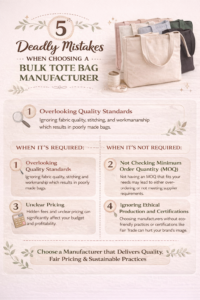
The 6 Costly Mistakes Buyers Make
- Choosing by price only (then paying in returns, delays, and rework).
- Approving samples without measurable specs (bulk “looks different” is almost guaranteed).
- Ignoring packing standards (scratches, dents, deformation happen after production).
- Assuming certifications are real (blurred screenshots are not verification).
- Not testing the supplier’s communication (slow, vague answers predict bulk problems).
- No clear inspection plan (you can’t manage defects you never defined).
Step 1: Build a Supplier Shortlist (Fast)
Before you audit anything, shortlist suppliers who match your product type and business model. Ask two questions:
- Do they build what you sell? (cosmetic pouches, travel kits, clear PVC/TPU, PU, nylon, sets)
- Can they support your channel? (retail-ready finishing, private label, stable bulk capacity)
Then request three baseline items from every supplier:
- Recent production photos/videos (not curated marketing only)
- One comparable sample or material swatch pack
- A clear list of what they can customize (logo methods, fabrics, zippers, packaging)
Step 2: 5-Point Virtual Factory Audit Checklist
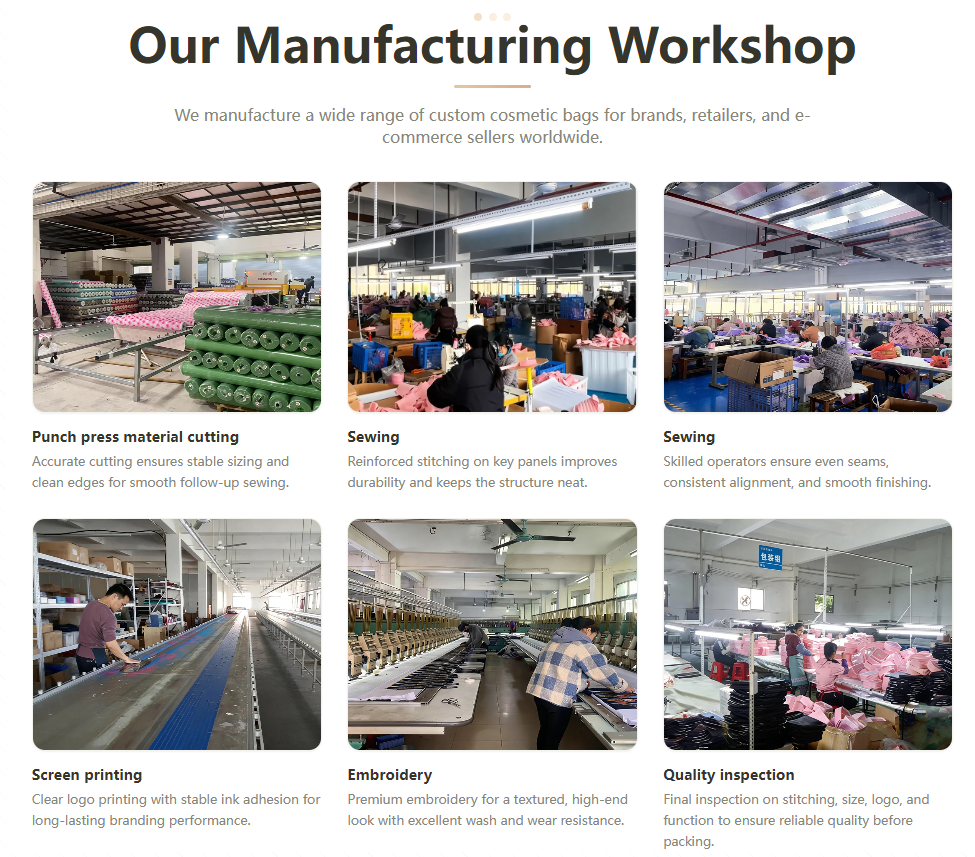
You can audit suppliers without a flight. Run a live video call and require evidence across five areas. This is the fastest way to filter out suppliers who outsource everything or cannot control quality at scale.
- Raw material warehouse
Ask to see labeling, batch tracking, and separation of special/claimed materials (e.g., recycled fabrics). The goal is preventing “mixing” and uncontrolled substitutions. - Production line
Look for stable workflow, consistent stations, and visible process standards (not chaos). Check stress-point reinforcement stations (handles, zipper ends, corner stitching). - QC capability (lab or inspection routine)
Ask what they measure during production: dimensions, seam strength, zipper function, print adhesion/rub resistance. A factory that only “final checks by eye” is higher risk for retail programs. - Sample room (problem-solving ability)
Ask how they handle revisions: can they adjust edge binding, corner finishing, zipper alignment, and lining fit based on your feedback? - Communication response
Ask technical questions and see how they respond. Good partners answer clearly with options, trade-offs, and proof (close-up photos, measurements, mini test videos).
Red flag: refusing live video, refusing close-ups of corners/zipper ends, or “we can do everything” with zero proof.
Step 3: Certification & Compliance Verification (BSCI/GRS/ISO9001)
Certifications don’t automatically mean “good factory,” but they can signal real systems when verifiable. Here’s what buyers typically use them for:
- BSCI: social compliance (labor, safety, working conditions)
- GRS: recycled-material traceability (useful when you claim recycled content)
- ISO 9001: quality management system consistency (repeatability from sample to bulk)
How to verify quickly
- Ask for verifiable documents (not blurred screenshots).
- Match the factory name/address with invoices, packing lists, or business registration details.
- Ask what exact materials are covered (GRS is about traceability, not “everything is recycled”).
Common red flags
- Only sending cropped/blurred images for audit reports
- Claiming “certified” but unable to show scope, validity period, or traceability method
- Unwilling to accept third-party inspection or audits
Step 4: Samples That Predict Bulk (Not “Pretty Samples”)
A sample is only useful if it predicts bulk consistency. Approve samples with measurable standards:
A) Appearance (retail-ready finishing)
- Edge binding width and corner finishing method
- Stitching straightness and seam allowance consistency
- Logo placement accuracy and sharpness
- Lining cleanliness and fit (no bunching)
B) Function
- Zipper smoothness, alignment, and end finishing
- Reinforcement at stress points (handles, zipper ends, corners)
- Pocket usability and access (if applicable)
C) Measurable specs you should lock
- Material composition + thickness/weight + tolerance range
- Zipper type/model + slider + puller details
- Edge finishing standard (binding width, stitch density, corner handling)
- Logo method + rub resistance expectation
- Packing method (polybag/tissue/dividers/protective film)
Retail program tip: Require a pre-production sample (PPS) before mass production if your brand is sensitive to finishing.
Step 5: Bulk Inspection + Packing Standards
Many defect spikes happen after sewing—during trimming, packing, warehousing, and shipping. Align these standards early:
- Inspection level: AQL (or your internal standard) + defect classification (critical/major/minor)
- Bulk checkpoints: dimension tolerance, zipper function, corner strength, logo rub resistance
- Packing standard: scratch prevention, shape protection, carton method, humidity controls if needed
- Third-party inspection: define timing (inline / final / pre-shipment)
Copy/Paste RFQ Template (Supplier Due Diligence)
[Supplier RFQ – Wholesale Makeup Bags]

1) Product type + target market:
   (cosmetic pouch / travel kit / clear bag / sets) + where you sell (EU/US/etc.)

2) Materials:
   outer + lining + padding (if any) + target thickness/weight + tolerance

3) Customization:
   logo methods available + MOQ per logo method + sample cost and lead time

4) Zippers & hardware:
   zipper type/model, slider, puller options, custom zipper pull MOQ

5) Quality system:
   in-process checks (what, when, how recorded) + final inspection standard (AQL?)

6) Certifications:
   BSCI / GRS / ISO9001 (provide verifiable documents + scope)

7) Capacity & timeline:
   sampling lead time, bulk lead time, monthly capacity, peak season plan

8) Packing:
   standard packing method + optional upgrades (dividers, protective film, anti-scratch)

9) Inspection:
   do you support third-party inspection? (inline/final/pre-shipment)

10) References:
   2-3 comparable products you’ve produced recently (photos/videos + key specs)
Supplier Scorecard (Download-Style Table)
Use this to compare suppliers objectively:
| Category | What to check | Score (1–5) | Notes |
|---|---|---|---|
| Product Fit | Comparable products, finishing quality, retail readiness | ||
| Materials Control | Warehouse labeling, batch tracking, substitution policy | ||
| QC & Repeatability | In-process checks, measurement routine, defect handling | ||
| Communication | Speed, clarity, ability to provide proof and trade-offs | ||
| Certifications | BSCI/GRS/ISO9001 verifiability and scope | ||
| Packing & Logistics | Anti-scratch packing, deformation control, carton standard |
FAQ
1) What’s the fastest way to spot a risky supplier?
Vague answers + no proof. If they refuse live video, refuse close-ups, or can’t explain how they keep sample-to-bulk consistency, move on.
2) Are certifications enough to trust a factory?
No. Use them as signals—not proof. Verification and process evidence matter more than logos on a PDF.
3) Should I require a pre-production sample (PPS)?
For retail programs, yes. PPS helps confirm the bulk line can match the approved sample under production conditions.
CTA: Want a supplier shortlist you can defend internally?
Send your target product type, materials, and target market requirements, and we’ll help you build a quote-ready spec, recommend an audit plan, and align sample approval + inspection standards to reduce bulk risk.
Aries Gu is the founder of Q&N. With over 17 years of experience in cosmetic bag OEM/ODM source factory. He focuses on quality control, efficient communication, and on-time delivery for global cosmetic bag projects.