If you’re sourcing a custom cosmetic bag manufacturer, the fastest way to judge reliability isn’t marketing language—it’s whether the factory can show a repeatable sampling-to-bulk process with clear workmanship standards and quality control checkpoints.
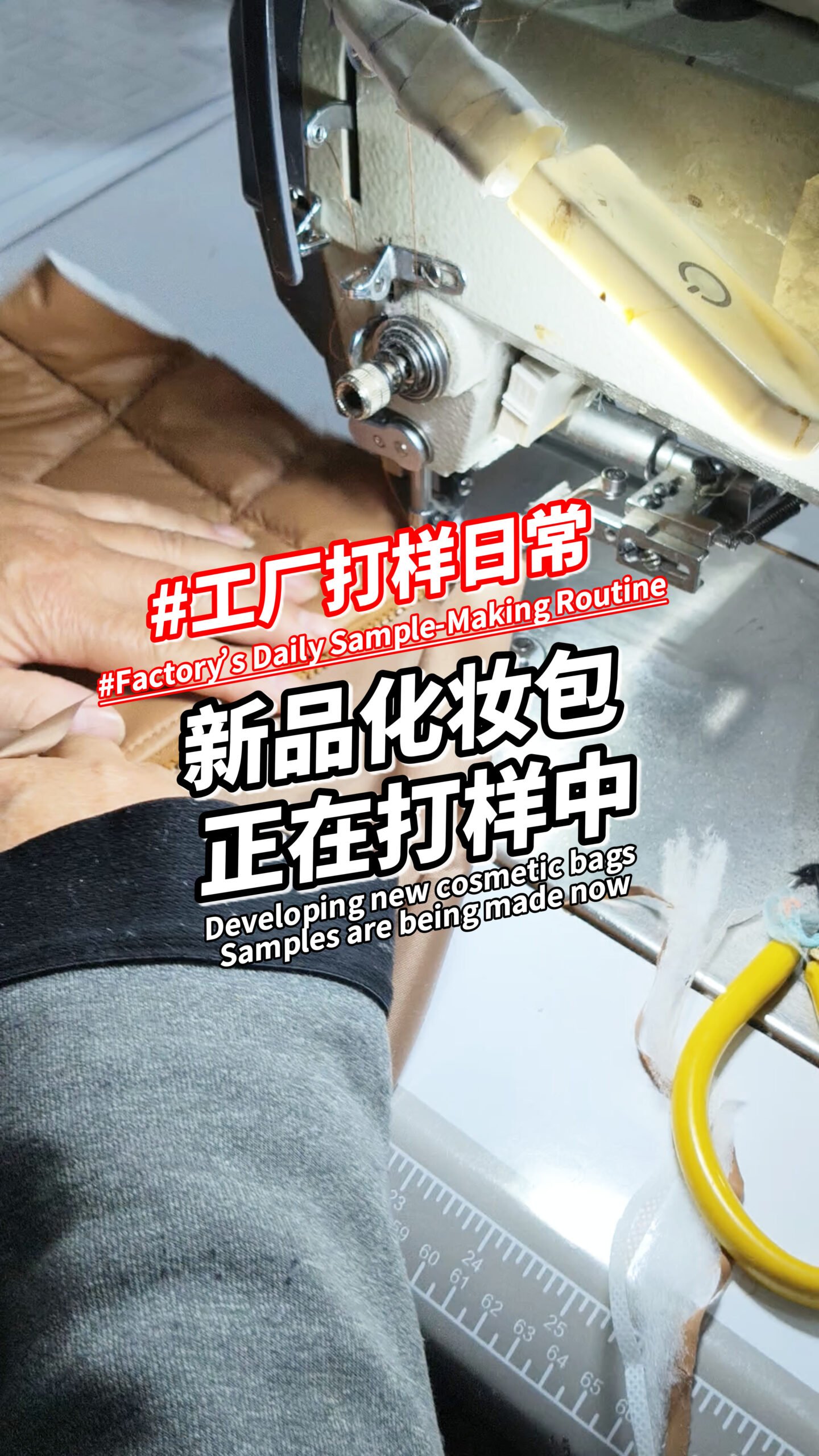
This article is built around real sampling footage from our workshop. In the clip you’ll see hands-on sewing, including panel stitching/quilting and zipper installation—two operations that directly determine how “premium” a bag feels in bulk production. Below, we explain what you’re seeing, why those steps matter, and the QC checklist you can copy into your RFQ, sample approval, or PO.
What You See in the Video (Quick Breakdown)
In this short factory clip, you can see two key sampling operations:
- Quilting / panel stitching on padded fabric (grid lines visible), sewn on an industrial machine. This locks the padding in place and keeps panels stable.
- Zipper installation on a quilted body + lining fabric. The zipper tape and teeth are clearly visible, and the operator stitches with a zipper foot for accurate alignment.
The on-screen message highlights two ideas: new product development (sampling) and experience. For B2B buyers, the important part is not the claim—it’s that the clip shows the work happening on the most failure-prone steps.
Manufacturing Process Map (From Sample to Bulk)
Below is a buyer-friendly map of the full workflow. The steps shown in the footage are marked as Shown in video.
| Stage | What Happens | What Buyers Should Confirm | Shown in Video |
|---|---|---|---|
| Design input | Size, structure, compartments, logo method, target use | Tech pack or reference images + logo file + use scenario | — |
| Material selection | Outer fabric, lining, zipper, hardware, padding/interfacing | Material spec, thickness, color tolerance, hand-feel | — |
| Pattern & cutting | Pattern making, cutting panels, preparing reinforcements | Size tolerance, symmetry, clean edges | — |
| Panel stitching / quilting | Stitch padded panels to lock structure and improve finish | Stitch density, straightness, no skipped stitches | ✅ Yes |
| Zipper installation | Attach zipper to body/lining; align ends; topstitch | Smooth zipper run, clean topstitch, no puckering | ✅ Yes |
| Assembly sewing | Join panels, bind edges, add handles/labels/pockets | Stress-point reinforcement, shape consistency | — |
| In-process QC | Check seams, zipper, alignment during production | Checklist + defect handling + rework rules | — |
| Final inspection | Full inspection before packing | Sample match + functional checks + appearance criteria | — |
| Packaging & shipment | Polybag/tissue/inner box/carton + marks + labels | Scratch protection, corner protection, carton labeling | — |
Why this matters: Most buyers only see finished photos. The footage proves the factory is doing panel stitching + zipper installation during sampling—these steps often decide whether bulk goods feel premium or “low-end.”
The 2 Operations That Decide 80% of Perceived Quality
1) Quilting / Panel Stitching (Shown in Video)
In the clip, the operator stitches along a padded panel with visible grid lines. This step:
- Locks padding in place (reduces shifting and lumpiness)
- Improves structure (helps the bag hold shape)
- Upgrades hand-feel (more “finished” and premium)
- Stabilizes panels so later assembly stays accurate
Quilting QC checkpoints you can request:
- stitch line straightness
- equal spacing (for grid/diamond patterns)
- no skipped stitches, no thread breaks
- no needle marks, no oil stains (especially on light colors)
- consistent stitch density across panels
2) Zipper Installation (Shown in Video)
The zipper portion shows zipper tape being stitched to quilted fabric + lining. This is where many suppliers fail—small misalignment becomes very visible, and poor installation causes snagging, wavy tape, and “cheap” appearance.
Zipper QC checkpoints you can request:
- zipper runs smoothly end-to-end (no snagging)
- no waves/puckering along zipper tape
- zipper stop positions consistent (left/right symmetry)
- topstitch clean, straight, and symmetrical
- zipper ends finished neatly (no exposed raw edges)
Quality Control Checklist (Copy/Paste for Your PO or Inspection Sheet)
Use this simplified QC table for sampling approval and bulk inspection. It focuses on the issues that commonly cause returns and complaints.
| Inspection Area | What to Check | Common Defects | How We Control It |
|---|---|---|---|
| Stitching | Straight lines, even tension, no skipped stitches | Loose seams, broken thread, uneven tension | In-process checks + reinforcement rules at stress points |
| Zippers | Smooth running, aligned ends, clean topstitch | Snagging, wavy tape, uneven zipper ends | Zipper-foot sewing + functional run test |
| Panel shape | Symmetry, structure holds, consistent dimensions | Warped panels, padding shift, uneven silhouette | Quilting lock + forming adjustment during sampling |
| Lining | Smooth fit, clean sewing, no exposed seams | Wrinkled lining, twisted interior, exposed raw edges | Lining pattern control + seam finishing standards |
| Logo | Correct position, clean edges, consistent placement | Crooked logo, poor adhesion, misplacement | Placement template + sample approval before bulk |
| Cleanliness | No stains, no chalk residue, clean surface | Oil marks, dirty panels, visible residue | Workstation discipline + final wipe check |
| Packaging | Correct packing method + carton marking | Crushed corners, wrong label, surface scratches | Packing SOP + carton protection + spot checks |
Compliance Notes for Brand Buyers (Clear, Practical, and Safe)
Cosmetic bags may include coated fabrics, inks, adhesives, and metal accessories. Many brands request material declarations and third-party testing for restricted substances depending on the product materials and intended use. Testing scope varies by market and product positioning, so buyers typically define requirements through their compliance team or testing partner.
In practice, a smooth workflow looks like this:
- Define materials first: outer fabric, lining, printing method, accessories
- Confirm restricted substance requirements: based on your brand’s policy and product category
- Arrange third-party testing if required: for the specific material lot used in production
Note: This section is informational and focused on product material compliance requests. It is not related to any sensitive topics.
What “15 Years of Experience” Should Mean in Practice
For B2B buyers, experience matters only when it translates into predictable execution:
- Sampling speed: can the factory turn references into stable samples efficiently?
- Control of hard operations: consistent stitching + zipper installation (as shown in the footage)
- Repeatable QC: in-process checks, not “inspect at the end only”
- Clear documentation: sample approval + agreed workmanship standards
Packaging Reliability for Retail & E-commerce (Optional but Important)
Packaging damage is a hidden cost—especially for structured bags and light-colored materials. A packaging plan should address:
- Surface protection: tissue, polybag, or protective film (as needed)
- Shape protection: prevent corner crush and zipper deformation in cartons
- Carton strength: correct carton size, void fill, and clear markings
- Warehouse handling: labeling and pack consistency for scanning/receiving
FAQ
What’s the difference between sampling and bulk production?
Sampling validates structure, materials, zipper method, and workmanship. Bulk production focuses on repeatability: same materials, same machines, and the same QC checkpoints used consistently.
Can you match our brand’s quality standard?
Yes—brands typically define quality by sample approval plus an agreed QC checklist (including zipper run tests, stitching standards, and appearance rules).
What should we send to start sampling faster?
A good “fast start” package includes: reference photos, target size, preferred structure (pockets/shape), logo file, and your target material direction (e.g., PU, nylon, canvas, TPU/PVC clear, RPET).
Ready to Develop Your Custom Cosmetic Bags?
If you want a factory partner that can show real sampling work, handle precision stitching and zipper installation (as shown in the footage), and run QC checkpoints designed for long-term cooperation, we’d be happy to evaluate your project.
Next steps (fast):
- Send your reference images / target size / logo file
- Tell us your target market and preferred materials
- We propose structure suggestions + sampling plan + timeline
About Us
Company: Guangzhou Q&N Fashion Accessory Co., Ltd
Brand: Q&N
Business: OEM/ODM Manufacturer (B2B & Wholesale)
Products: Cosmetic Bags, Toiletry Bags, Hair Accessories
Factory: 60+ sewing machines, 120+ workers
Core strengths: sampling capability, workmanship control, repeatable QC
Tip for SEO: Add the video above the “What You See in the Video” section, and embed it with a short caption and a descriptive filename/alt text. Also add internal links to your Sampling page, QC Standards page, and Custom Materials page.
Aries Gu is the founder of Q&N. With over 17 years of experience in cosmetic bag OEM/ODM source factory. He focuses on quality control, efficient communication, and on-time delivery for global cosmetic bag projects.