The Cosmetic Bag Approval Process converts a design into a repeatable manufacturing standard. Many expensive errors begin when buyers approve the overall appearance but miss a catching zipper, weak seam, misplaced logo or unsuitable retail pack.
The stakes are growing with the beauty market. Statista projects worldwide beauty and personal care revenue of about US$698.38 billion in 2026. Grand View Research values the U.S. market at US$109.56 billion in 2025 and forecasts 7.7% annual growth from 2026 to 2033. Accessories used for retail, travel and gift programs therefore need disciplined product approval.
Table of Contents
- What Is the Cosmetic Bag Approval Process?
- Step One in the Cosmetic Bag Approval Process
- Step Two: Develop the First Prototype
- Step Three: Review the Prototype
- Step Four: Submit Clear Revision Comments
- Step Five: Produce and Approve the Revised Sample
- Step Six: Create the Pre-Production Sample
- Step Seven: Approve the Golden Sample
- How the Golden Sample Controls Bulk Production
- Sample Approval Methods: Pros and Cons
- Case Study: Turning an AI Concept into an Approval Standard
- Common Sample Approval Mistakes
- Final Cosmetic Bag Approval Process Checklist
- Frequently Asked Questions
- Conclusion and Next Steps
What Is the Cosmetic Bag Approval Process?
The Role of Sampling in Custom Manufacturing
Sampling is a controlled learning stage before bulk production. It tests whether the design can be manufactured consistently with the selected materials, machinery, workmanship and cost. The sample should prove capacity, shape, zipper function, logo execution and production feasibility.
Prototype, Revised Sample and Golden Sample
| Sample Stage | Main Purpose | Materials Used | Approval Decision |
|---|---|---|---|
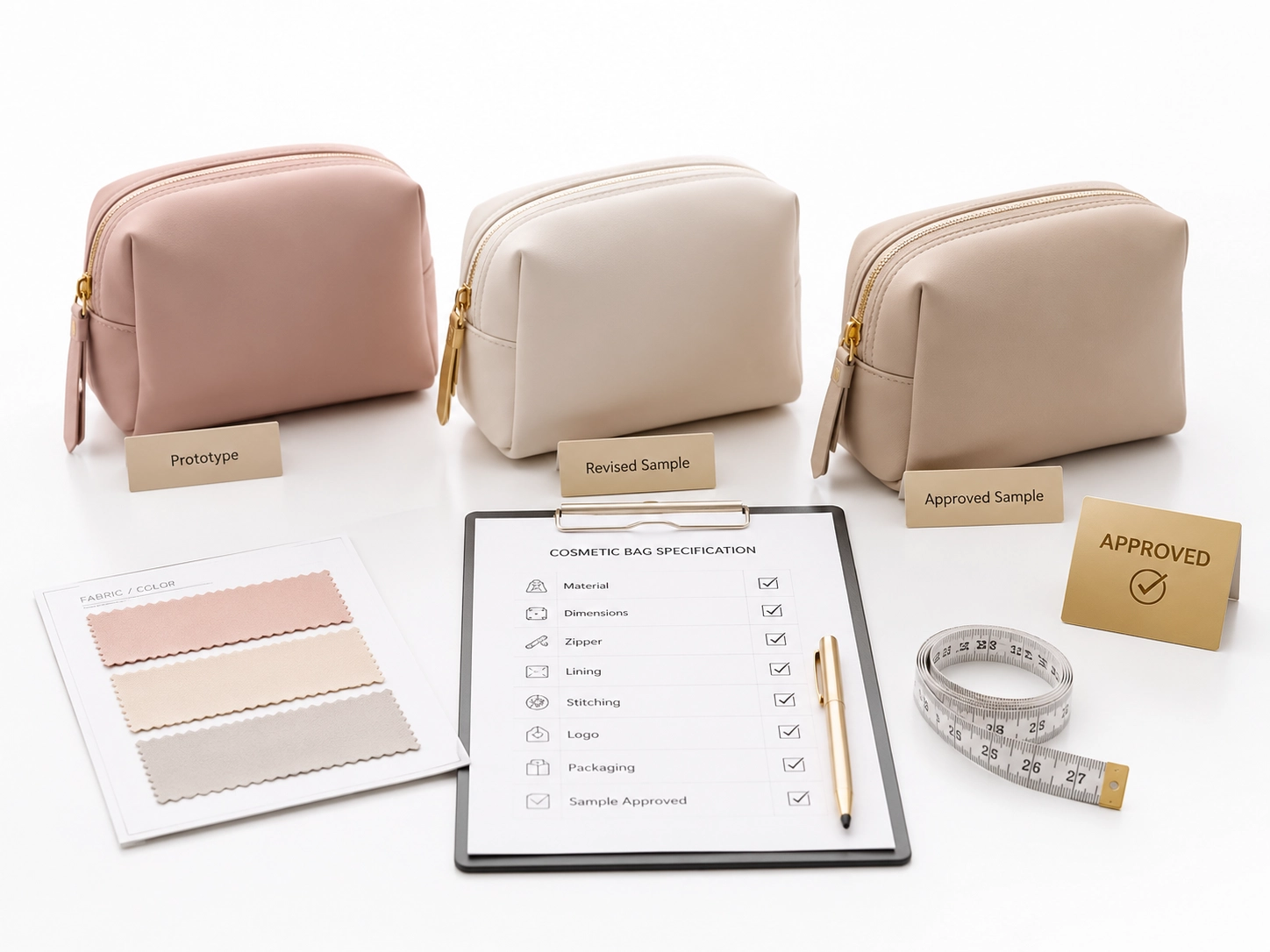
| Prototype sample | Validate shape, size, construction and basic appearance | Final or substitute materials may be used if clearly disclosed | Approve direction or issue revisions |
| Revised sample | Confirm that documented corrections were completed | Closer to final materials and components | Close change items or request another revision |
| Pre-production sample | Verify the product immediately before bulk production | Final production materials, components, branding and packaging | Authorize bulk production, subject to written approval |
| Golden sample | Serve as the approved physical quality reference | Approved final construction and presentation | Control production, inspection and dispute resolution |
The pre-production sample and golden sample may be the same unit, but the terms describe different functions. A pre-production sample is made to verify the final product before bulk production. It becomes a golden sample only after formal approval and control.
Why Sample Approval Must Be Documented
Verbal approval such as “Looks good” is insufficient. Record the sample code, version, date, dimensions, materials, colors, components, artwork, packaging and accepted deviations.
Expert manufacturing rule: The physical sample shows how the product should look and feel. The specification sheet explains what cannot be judged reliably by sight. Neither should stand alone.
Step One in the Cosmetic Bag Approval Process: Submit the Brief
Product Design and Intended Use
State the bag type, intended user and commercial purpose: retail pouch, travel organizer, professional case, subscription-box accessory, promotion or gift with purchase. Explain what must fit inside and how the bag will be displayed or shipped.
Materials, Dimensions and Construction Details
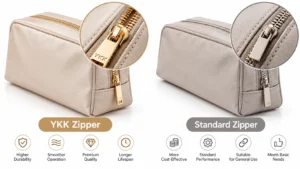
Provide finished dimensions in a consistent order and drawings for gussets, curved corners, handle drop, zipper opening and pockets. Specify the outer fabric, lining, padding, reinforcement, binding, zipper and hardware.
Logo, Color and Packaging Requirements
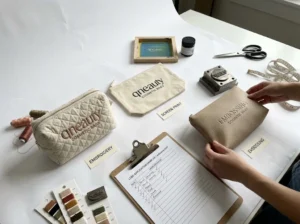
Submit vector artwork, logo size, placement measurements and Pantone references. Confirm the branding method and include retail packaging requirements before sampling begins.
| Brief Element | Weak Instruction | Approval-Ready Instruction |
|---|---|---|
| Size | Medium makeup bag | Finished size 22 × 8 × 14 cm, measured externally when empty |
| Outer material | Soft pink fabric | Matte recycled polyester, soft hand feel, physical swatch to be approved |
| Logo | Logo in the center | 45 mm wide embroidered logo, centerline 50 mm below top seam |
| Interior | Add pockets | One zipper pocket and four brush sleeves sized to the attached drawing |
| Packaging | Retail packaging | Individual recycled polybag, UPC label and two-color paper insert |
Brands that need help converting sketches into manufacturable specifications can review the OEM/ODM workflow of a custom cosmetic bag manufacturer before submitting the first brief.
Step Two: Develop the First Prototype
Material Sourcing and Color Selection
The factory checks whether materials are stocked, custom-dyed or require an approved alternative. Custom prints, recycled textiles, molded hardware and branded pullers add sourcing or tooling stages.
Pattern Making and Sample Construction
A pattern maker converts the drawing into panels, seam allowances, curves, reinforcements and assembly steps. Small pattern changes can alter zipper movement, usable capacity and symmetry.
Typical Prototype Lead Time
A practical planning range for many textile cosmetic bag prototypes is 7–14 days after materials and artwork are available. Custom colors, printing, tooling or testing can extend the schedule.
| Development Condition | Likely Effect on Lead Time | Risk-Control Action |
|---|---|---|
| Stock material and standard zipper | Shorter sample route | Confirm exact stock color and lot availability |
| Custom Pantone dyeing | Adds lab-dip approval | Approve color before cutting the final prototype |
| Custom metal puller or plate | Adds artwork, mold and plating stages | Approve 2D/3D drawing before tooling |
| Printed or embroidered artwork | Adds strike-off or embroidery test | Approve scale and stitch/ink result separately |
| Performance testing | Adds laboratory or internal test time | Define test method before sourcing materials |
Prototype timing depends more on unresolved inputs than on sewing time alone.
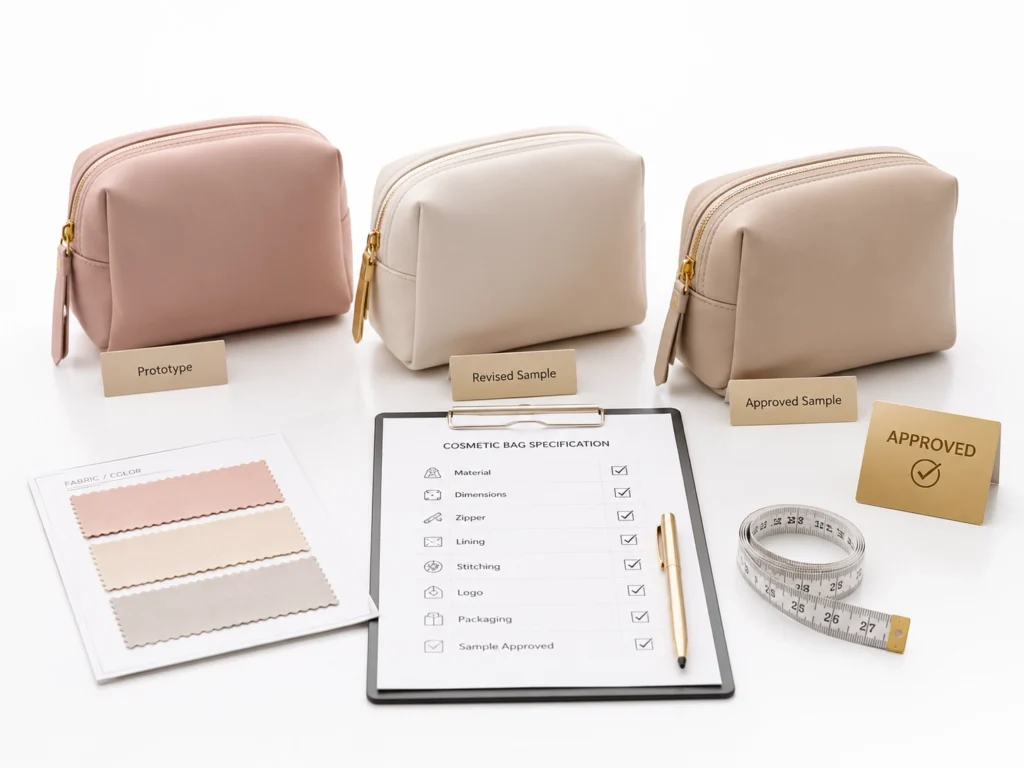
Step Three: Review the Prototype
Checking Dimensions and Product Shape
Measure the sample using the method in the specification. Check width, height, depth, handle drop, opening and pockets, then load the intended cosmetics. External dimensions alone do not prove usable capacity.
Evaluating Materials and Color Accuracy
Compare the sample with approved physical swatches under consistent lighting. Check texture, weight, stiffness, gloss, coating, print alignment and lining opacity. Review matching components together because identical color references can appear different across materials.
Testing Zippers, Seams and Compartments
Operate the zipper repeatedly, especially around curves, and apply a realistic load. Check for lining catches, hard pulling, tooth separation, weak stops, skipped stitches, raw edges and poor back-tacking. Load every compartment with its intended brushes, bottles or palettes and check retention, access and pressure on the closure.
Reviewing Logo Placement and Workmanship
Measure logo size and position from fixed seams. Check print sharpness, embroidery density, label alignment or metal attachment, including any backing that could scratch products.
| Inspection Area | Check Method | Typical Failure Signal |
|---|---|---|
| Measurements | Tape measure and approved measurement points | Capacity loss or distorted proportions |
| Zipper | Repeated operation around the full opening | Catching, waviness, separation or hard pulling |
| Seams | Visual inspection and gentle load | Skipped stitches, opening or uneven tension |
| Pockets | Fit test with intended contents | Items fall out, do not fit or deform the bag |
| Logo | Measure and compare with artwork | Wrong scale, position, color or attachment |
| Packaging | Pack-out and barcode trial | Bag is compressed, label lifts or barcode fails |
Step Four: Submit Clear Revision Comments
How to Organize Sample Feedback
Consolidate feedback from design, marketing, quality, compliance and purchasing into one controlled document. Conflicting comments from multiple email threads are a major cause of repeat samples. Number every issue and assign a required action.
Use measurable language. Replace “logo slightly higher” with “move the logo upward by 8 mm.” State whether the factory must revise, propose an alternative or provide evidence.
Using Annotated Photos and Measurement Tables
Place arrows and numbered callouts directly on photos. Add a measurement table containing the approved target, prototype result and required correction. Use one version number across the feedback sheet, artwork and email subject.
| Item | Approved Target | Prototype Result | Required Action |
|---|---|---|---|
| Finished width | 22.0 ± 0.5 cm | 21.2 cm | Increase pattern width to meet tolerance |
| Logo position | 50 ± 2 mm below top seam | 41 mm | Move logo down 9 mm |
| Brush sleeves | Four sleeves, each 28 mm wide | Four sleeves, each 23 mm wide | Increase sleeve width and reconfirm panel fit |
| Zipper corner | Smooth opening | Slider catches at right corner | Adjust curve and lining clearance |
Separating Critical Changes from Minor Adjustments
Classify feedback by business risk:
- Critical approval blockers: safety, compliance, incorrect capacity, failed closure, wrong material or unusable packaging.
- Major corrections: dimensions outside tolerance, poor workmanship, incorrect logo, unstable shape or missing features.
- Minor refinements: small aesthetic improvements that do not affect function or legal requirements.
Expert advice: Do not spend a full revision round correcting a two-millimeter aesthetic preference while leaving the zipper construction or final material unresolved. Close high-risk decisions first.
Step Five: Produce and Approve the Revised Sample
Confirming Corrected Specifications
The revised sample should arrive with a change log showing how each numbered comment was handled. Review it against the revision document, not from memory. Mark every item as passed, failed, conditionally accepted or pending evidence.
Comparing the Revised Sample with the Original Brief
Corrections can introduce new problems. Increasing pocket width may reduce the main compartment. Moving a metal plate may interfere with reinforcement. Changing foam thickness may alter dimensions. Re-check the complete product rather than inspecting only the edited feature.
Deciding Whether Another Revision Is Required
Require another physical revision when the issue affects function, brand identity, compliance or repeatability. Photo confirmation may be sufficient for a measurable, low-risk correction if the final pre-production sample will still be reviewed.
| Remaining Issue | Recommended Approval Route | Reason |
|---|---|---|
| Zipper still catches | Require another physical sample | Functional risk cannot be judged reliably from a photo |
| Logo moved to measured position | Annotated photo may be acceptable | Low-risk change if scale and reference seam are visible |
| New outer fabric proposed | Require swatch and physical sample | Hand feel, structure and color may change |
| Barcode orientation corrected | Artwork and packed-unit scan check | Approval depends on final configuration |
| Minor loose thread removed | Written workmanship standard | Issue should be controlled in production, not only one sample |
Step Six: Create the Pre-Production Sample
Using Final Production Materials
The pre-production sample should use the approved production fabric, lining, foam, zipper, thread, hardware, branding and packaging. Do not issue unrestricted approval while a key component remains substituted.
Confirming Final Colors and Components
Review components as a coordinated set. Confirm zipper tape, thread, lining, binding, labels and hardware. Check plating finish for shade, scratches and attachment. Confirm that custom molds and artwork versions match the approved files.
Verifying Retail Packaging and Labels
Pack the sample exactly as it will be sold. Review folding, compression, inserts, bags, tags, labels, barcodes and carton marks. GS1 recommends verifying barcode quality as close as possible to the final configuration.
Step Seven: Approve the Golden Sample
What Makes a Sample a Golden Sample?
A golden sample is the formally approved physical reference for bulk production. It should represent final construction, materials, branding and packaging, but it does not replace the contract, testing or technical file.
Signing and Sealing the Approved Sample
Attach a tag with the project, style, version, date, approver and accepted exceptions. Seal and photograph the approved unit so it cannot be replaced or altered without notice.
Creating a Final Specification Sheet
Freeze the specification pack at the same time, including tolerances, bill of materials, construction notes, colors, artwork, packaging, tests and defect criteria.
| Golden Sample Control | Minimum Record | Why It Matters |
|---|---|---|
| Identity | Style, color, version and approval date | Prevents comparison with the wrong sample |
| Physical security | Signature, seal and retained location | Reduces unauthorized replacement or alteration |
| Specification link | Matching document revision number | Connects visual standard to measurable requirements |
| Accepted deviations | Written exceptions with limits | Prevents temporary concessions becoming permanent standards |
| Retention period | Defined period after final shipment | Supports claims, repeat orders and comparison |
How the Golden Sample Controls Bulk Production
Production-Line Reference Standards
The factory should convert the golden sample into operator instructions, component boards, measurement guides and workmanship references. Keep the sealed master under control rather than circulating it on the line.
In-Line Quality Inspection
Initial and during-production inspections should compare early units with the golden sample and specification. Intertek describes these checks as verifying materials and identifying defects while corrective action is still practical.
Final Inspection and Shipment Approval
Final inspection determines whether the shipment meets the approved standard. ISO 2859-1:2026 defines AQL-indexed acceptance sampling systems for inspection by attributes and replaces the former 1999 edition.
SGS states that final random inspection is normally conducted when production is complete and at least 80% is packed. Checks can include workmanship, function, quantity, packaging, labels, shipping marks and barcodes.
Sample Approval Methods: Pros and Cons
| Approval Method | Pros | Cons | Best Use |
|---|---|---|---|
| Physical sample approval | Allows evaluation of hand feel, structure, fit, zipper action and true scale | Courier cost and transit time | Final materials, complex construction and golden sample approval |
| Photo and video approval | Fast for visible, measurable corrections | Color, texture, stiffness and hidden defects may be misjudged | Low-risk revisions after a physical sample has been reviewed |
| Live video review | Buyer can request angles, measurements and function tests in real time | Lighting, connection and camera quality limit accuracy | Interim review and urgent clarification |
| Digital rendering only | Efficient for exploring shape, color and branding concepts | Cannot validate materials, construction or performance | Early design selection, never final manufacturing approval |
A hybrid process is usually most efficient: use digital renders for concept selection, physical prototypes for functional review, annotated media for minor corrections and a physical pre-production sample for golden-sample approval.
Case Study: Turning an AI Concept into an Approval Standard
In an anonymized real sourcing case, a startup beauty brand submitted an AI image of a compact makeup bag with a soft exterior, metal logo plate and branded zipper. The visual direction was clear, but dimensions, material, lining, pockets, hardware construction and packaging were undefined.
The manufacturer could not treat the image as an approval standard. The development review separated the project into measurable decisions:
- Confirm whether the exterior was suede-look textile, velvet or PU.
- Define the finished dimensions and products the bag must hold.
- Confirm whether both the metal plate and zipper pull required custom molds.
- Approve logo artwork, plating and attachment before tooling.
- Develop the structure prototype before authorizing branded bulk components.
- Plan a pre-production sample using final materials before the 1,000-piece customized order.
The factory explained that custom metal branding affected tooling, MOQ and timing. Its 35–45-day bulk estimate could begin only after final sample approval and material readiness.
Case-study takeaway: Do not ask whether the sample “looks like the rendering.” Ask whether the sample satisfies the product specification that was developed from the rendering.
Common Sample Approval Mistakes
Approving Samples Without Written Comments
A casual approval message creates ambiguity about whether the buyer accepted every detail or only the overall appearance. Always attach the approved version and record exceptions.
Changing Specifications After Approval
Post-approval changes can affect purchased materials, tooling, patterns, production schedules and cost. Use formal change control. The supplier should confirm the cost, lead-time and quality impact before implementing any new requirement.
Ignoring Packaging and Label Details
Incorrect barcodes, missing legal text, weak adhesive, wrong carton marks and over-compressed packing can stop or delay a shipment even when the bag itself is correct.
Approving Substitute Materials Without Testing
A substitute may match visually but behave differently in sewing, cleaning, abrasion, color transfer or temperature exposure. Approve it as a new material, not as an invisible replacement.
Using the Golden Sample as the Only Quality Document
The sample cannot define hidden composition, tolerances, test methods or defect limits. Keep the final specification and inspection checklist with the sealed reference.
Final Cosmetic Bag Approval Process Checklist
Appearance and Measurement Approval
- Overall silhouette matches the approved design.
- Finished dimensions and measurement method are documented.
- Bag capacity has been tested with intended contents.
- Shape remains acceptable when empty and filled.
- Stitching, binding, quilting and symmetry meet the workmanship standard.
- Approved tolerances are practical for the selected materials.
Material and Component Approval
- Outer fabric, lining, padding and reinforcement are final.
- Material composition, weight or thickness and color references are recorded.
- Zipper type, gauge, tape, teeth, slider and puller are confirmed.
- Handles, pockets and compartments pass functional checks.
- Hardware finish and attachment are approved.
- Required performance or compliance tests are completed or scheduled.
Branding and Packaging Approval
- Logo method, size, color and placement are measured.
- Final artwork revision is identified.
- Care labels, country-of-origin labels and retailer labels are correct.
- Retail packaging is tested with the actual bag.
- Barcode data, placement and scan performance are checked.
- Carton quantity, shipping marks and packing method are approved.
Approval-Control Checklist
- Pre-production sample uses final production materials.
- Buyer and factory retain matched approved references.
- Golden sample is signed, dated, identified and sealed.
- Final specification sheet uses the same version number.
- Accepted deviations are listed in writing.
- Bulk production is not authorized until approval is recorded.
Frequently Asked Questions
What is a golden sample in manufacturing?
A golden sample is a formally approved physical reference for bulk production and inspection. It should be paired with a specification sheet because the sample cannot define every tolerance, test method or hidden material requirement.
What is the difference between a prototype and a pre-production sample?
A prototype tests concept and construction and may use disclosed substitutes. A pre-production sample should use final materials, components, branding and packaging; once approved, it may become the golden sample.
How many sample revisions are normally required for a cosmetic bag?
Simple bags may need one prototype and one correction. Complex structures, prints or custom hardware may need more. Continue until material, functional, branding and compliance risks are closed.
What should be checked before approving a cosmetic bag sample?
Check dimensions, usable capacity, shape, fabric, lining, color, zipper function, seams, pockets, handles, logo, labels and packaging. Test the bag with its intended contents and compare every result with the approved brief and specification sheet.
Can I approve a cosmetic bag sample by photo or video?
Photo or video approval suits low-risk visible corrections after physical review. It is unreliable for color, texture, stiffness, zipper action and capacity, so a physical pre-production sample is recommended.
Who should sign the golden sample?
The responsible buyer or authorized product developer should approve the sample, and the factory should acknowledge the same version. For larger programs, quality, compliance or an inspection agency may also sign the reference or approval record.
Does an approved golden sample guarantee that every bulk unit will be identical?
No. Textile products naturally have controlled variation, and manufacturing still requires incoming, in-line and final inspection. The golden sample defines the reference standard; tolerances, defect criteria, quality plans and statistical inspection determine how bulk variation is managed.
Cosmetic Bag Approval Process: Expert Summary
The Cosmetic Bag Approval Process should create evidence from the original brief to shipment. The prototype exposes risks, the revised sample closes corrections, the pre-production sample confirms final materials, and the golden sample controls bulk output.
Future approvals will use more digital measurements, remote inspections, traceable material records and visual defect libraries. These tools improve speed but cannot replace physical checks of color, hand feel, closure performance and packed-product behavior.
Before authorizing production, make sure the supplier can answer one question clearly: Which exact sample and document version will the production line and final inspector use?
For prototype development, structured revision support, pre-production sampling and OEM/ODM cosmetic bag manufacturing, submit your project to Q&N Bags for a manufacturing review and quotation.
Sources and Further Reading
GS1: Barcode Implementation and Verification
Statista: Beauty & Personal Care Market Worldwide
Grand View Research: U.S. Beauty and Personal Care Products Market
ISO 2859-1:2026: Sampling Procedures for Inspection by Attributes
Intertek: Textile and Apparel Inspection
Aries Gu is the founder of Q&N. With over 17 years of experience in cosmetic bag OEM/ODM source factory. He focuses on quality control, efficient communication, and on-time delivery for global cosmetic bag projects.