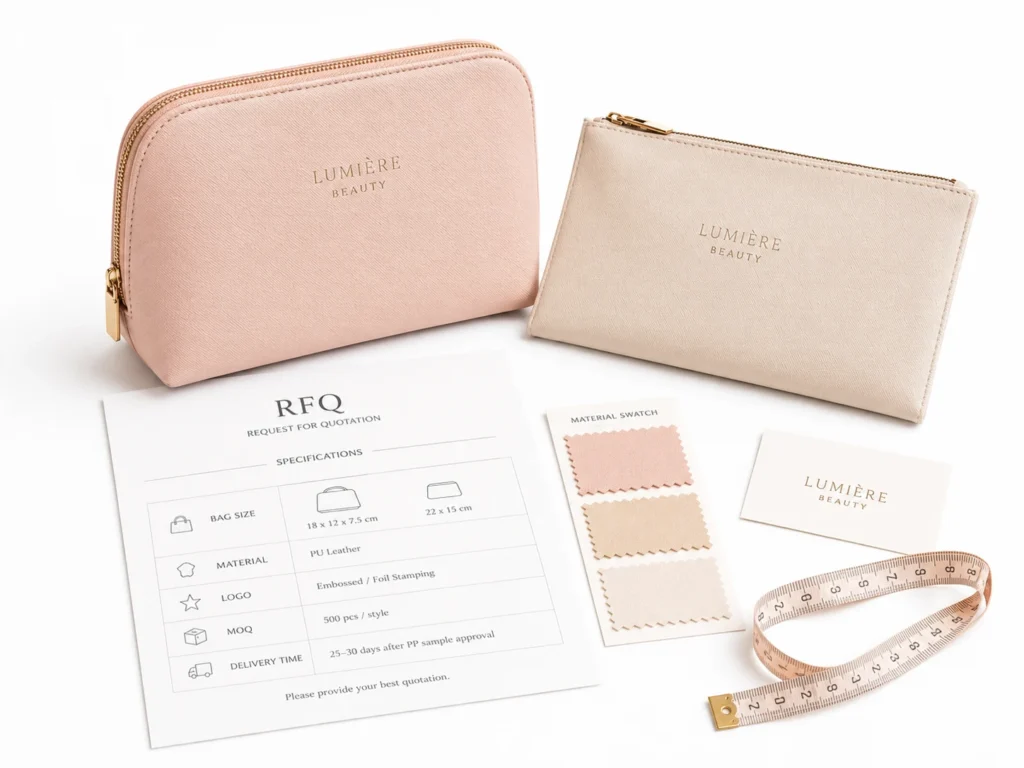
A Custom Makeup Bag RFQ should do more than ask, “How much is this bag?” It should give a manufacturer enough technical, commercial, branding, compliance, and delivery information to calculate a realistic quotation. When important details are missing, buyers often receive a price that later changes after material selection, sample development, logo confirmation, packaging review, or freight calculation.
This matters in a fast-growing beauty economy. Statista projects that the worldwide beauty and personal care market will generate approximately US$698.38 billion in 2026, while Grand View Research estimates the U.S. beauty and personal care products market at US$117.05 billion in 2026. Cosmetic bags are only one supporting product category within that wider market, but they increasingly function as retail merchandise, travel accessories, subscription-box components, promotional gifts, and gift-with-purchase packaging.
This guide explains exactly what to include before requesting a custom cosmetic bag quote. It covers specifications, branding, order quantities, testing, packaging, samples, shipping terms, reference files, common mistakes, and a final checklist that can be copied into your next sourcing project.
It also covers private label makeup bags, cosmetic pouch specifications, the bag sampling process, custom bag MOQ planning, and Incoterms for bag sourcing.
Table of Contents
- What Does a Custom Makeup Bag RFQ Mean?
- Why a Complete Custom Makeup Bag RFQ Matters
- Define the Product in Your Custom Makeup Bag RFQ
- Provide the Main Product Specifications
- Explain the Custom Branding Requirements
- Include the Commercial Order Details
- Confirm Sampling, Delivery and Shipping Terms
- Attach the Required Reference Files
- Case Study: From AI Concept to Quote-Ready RFQ
- Final Custom Makeup Bag RFQ Checklist
- Frequently Asked Questions
- Expert Summary and Next Steps
What Does a Custom Makeup Bag RFQ Mean?
RFQ: Request for Quotation
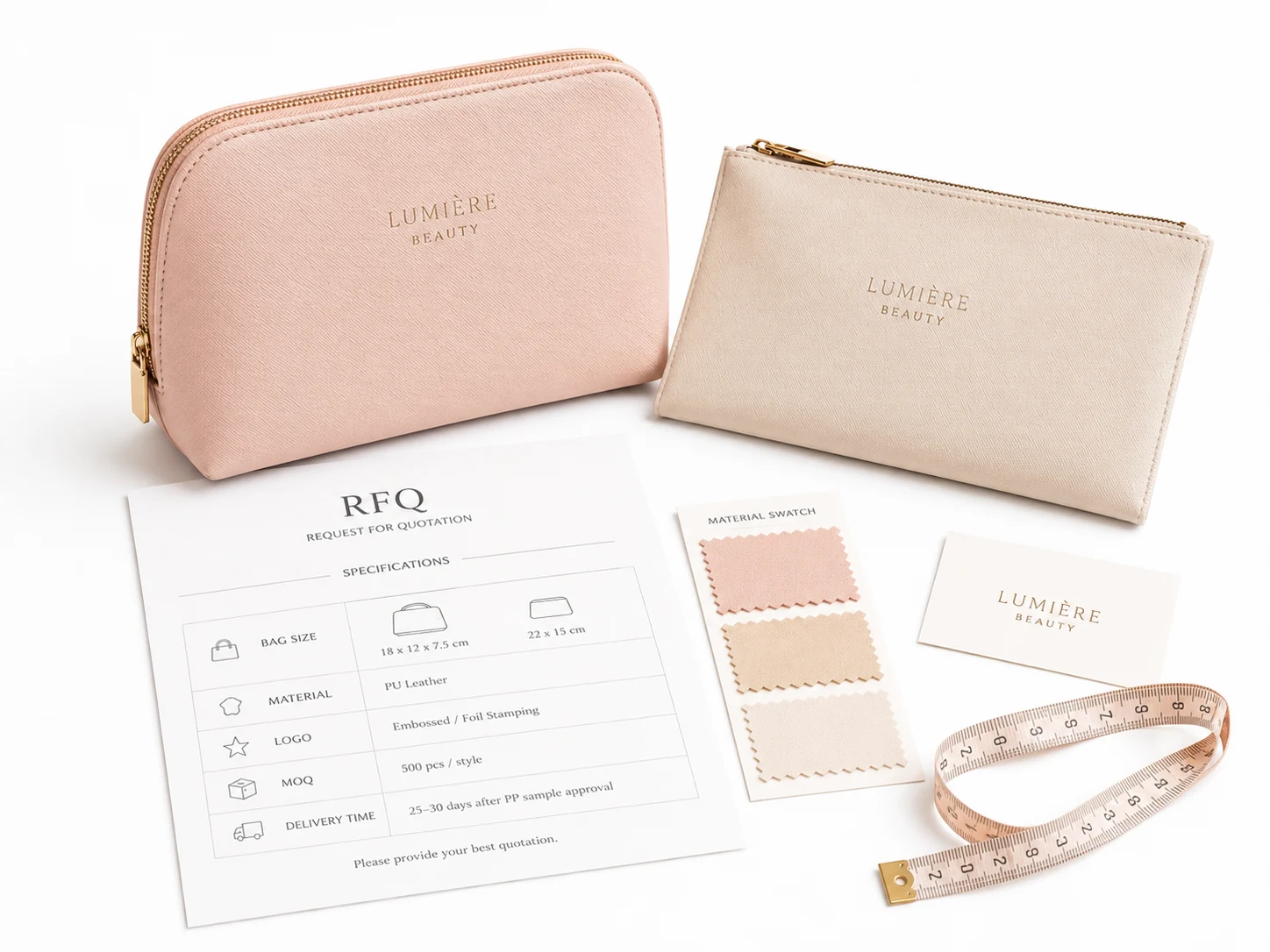
RFQ stands for Request for Quotation. In custom bag manufacturing, it is a structured request that asks qualified suppliers to price a defined product under defined commercial conditions. A useful RFQ allows competing manufacturers to quote the same specification, making their prices, tooling charges, lead times, minimum order quantities, and service capabilities easier to compare.
What Information an RFQ Should Contain
| RFQ Section | Information to Provide | Why It Affects the Quote |
|---|---|---|
| Product definition | Bag type, shape, use, target customer | Determines construction method and quality level |
| Dimensions | Finished length, width, height, capacity | Controls fabric consumption, zipper length and carton size |
| Materials | Outer fabric, lining, padding, trims | Material grade can create major unit-cost differences |
| Branding | Logo method, size, position, colors | May require screens, embroidery files, molds or plating |
| Order details | Quantity by style and color, target price | Changes purchasing efficiency and MOQ feasibility |
| Packaging | Polybag, box, barcode, labels, inserts | Adds materials, labor, testing and packing time |
| Delivery | Required date, destination, Incoterm | Determines production schedule and logistics scope |
RFQ vs. a General Product Inquiry
A general inquiry opens a conversation. An RFQ supports a sourcing decision. “Can you make this?” is an inquiry. “Please quote 2,000 quilted cosmetic pouches in two Pantone colors, with a woven label, recycled polyester lining, individual barcode packaging, delivery to Los Angeles under DDP terms” is an RFQ.
| Approach | Advantages | Limitations |
|---|---|---|
| General inquiry | Fast to send; useful during early ideation | Usually produces estimates, assumptions and follow-up questions |
| Detailed RFQ | Supports comparable pricing, feasibility review and scheduling | Requires more preparation before contacting suppliers |
Factory expert note: The goal is not to make the RFQ long. The goal is to make every line commercially useful. A one-page specification with clear attachments can be more effective than a five-page email containing vague descriptions.
Why a Complete Custom Makeup Bag RFQ Matters
More Accurate Unit Pricing
A makeup bag price is the result of multiple cost drivers, not only fabric and labor. The supplier may need to calculate outer material consumption, lining, foam, binding, zipper type, puller, hardware, logo process, pocket construction, packaging, testing, wastage, quality control, carton volume and export handling.
For example, “vegan leather” could mean several PU qualities with different backing fabrics, thicknesses, surface finishes and performance levels. “Gold zipper” could mean standard plated hardware, anti-tarnish plating, a branded puller, or a fully custom zipper system. Without definitions, a quotation may be technically correct for the supplier’s assumptions but wrong for the buyer’s intended product.
Faster Supplier Evaluation
A complete RFQ reveals more than price. It shows whether a makeup bag manufacturer understands construction risks, can suggest alternative materials, identifies missing compliance information, and communicates tooling or sampling charges before development begins.
| Evaluation Factor | Suggested Weight | What to Review |
|---|---|---|
| Specification understanding | 25% | Did the supplier identify materials, construction and risks correctly? |
| Quoted cost | 25% | Is the unit price complete, conditional or missing charges? |
| Quality and compliance | 20% | Can the supplier support testing, inspection and traceability? |
| Sample capability | 15% | Can it reproduce shape, color, logo and internal organization? |
| Lead time and communication | 15% | Are milestones realistic and responses technically clear? |
Fewer Specification Changes and Hidden Costs
Late changes are expensive because they can affect purchased materials, patterns, molds, packaging artwork and production reservations. A logo plate added after sample approval may require a new mold and revised front-panel reinforcement. A barcode label added after cartons are packed can require reopening and repacking. A delivery date communicated after the order is placed may force air freight.
A strong RFQ separates three categories:
- Fixed requirements: features that cannot change, such as dimensions, brand color, compliance standard or launch date.
- Preferred requirements: features the supplier may optimize, such as foam thickness, lining weight or pocket construction.
- Open alternatives: areas where the supplier may quote options, such as recycled versus conventional fabric or stock versus custom hardware.
Define the Product in Your Custom Makeup Bag RFQ
Bag Type and Product Style
Start by naming the product in practical manufacturing language. Common options include a flat cosmetic pouch, boxy makeup bag, vanity case, train case, drawstring beauty bag, hanging toiletry organizer, brush case, clear PVC pouch, quilted travel bag, thermal cosmetic bag or multi-compartment beauty organizer.
Buyers comparing construction options can also review the capabilities of an experienced custom makeup bag manufacturer before finalizing the RFQ.
Retail, Promotional or Gift-with-Purchase Use
The intended sales model affects the specification. A retail bag must justify its shelf price, withstand repeated use and present well in photography. A promotional bag may prioritize budget, logo visibility and a fixed campaign deadline. A gift-with-purchase bag often needs to fit specific cosmetics, align with a seasonal collection and meet strict packaging dimensions for distribution.
| Use Case | Typical Priorities | RFQ Questions |
|---|---|---|
| Retail merchandise | Durability, premium finish, consumer packaging | What retail price and quality perception must the bag support? |
| Gift with purchase | Campaign timing, product fit, visual impact | Which products must fit, and when does the promotion launch? |
| Subscription box | Compact packing, repeatability, cost control | What are the box dimensions and fulfillment requirements? |
| Corporate promotion | Logo visibility, budget, distribution efficiency | Will the bag be mailed, handed out or packed with another item? |
| Travel or professional kit | Organization, cleanability, load performance | What tools, bottles or brushes will users carry? |
Target Market and End-User Needs
State the destination market and user profile. An adult skincare pouch sold in the United States may have different labeling and chemical-testing expectations from a children’s cosmetic bag, an EU promotional pouch, or a professional makeup artist case.
Do not list CPSIA automatically for every bag. The U.S. Consumer Product Safety Commission explains that CPSIA includes requirements involving lead, phthalates, testing and certification for relevant children’s products. It also distinguishes products intended for children from general-use products. Your RFQ should therefore state the intended age group and ask the supplier or compliance specialist to confirm the applicable test plan.
Expert advice: Describe the user’s problem, not only the bag’s appearance. “Holds eight brushes without staining the main compartment” gives the factory a functional target. “Luxury interior” does not.
Provide the Main Product Specifications
Dimensions, Shape and Capacity
Provide finished dimensions in a consistent order, such as length × width × height, and state whether measurements are taken externally or internally. For soft bags, explain whether the bag should be measured empty, laid flat or filled. Add tolerance requirements only where they matter.
Outer Material, Lining and Padding
Specify material composition, surface, weight or thickness, color, performance and preferred certification. Instead of “canvas,” state “heavy cotton canvas with a dry matte hand feel.” Instead of “waterproof lining,” clarify whether you require a wipe-clean coated polyester, TPU film, PEVA, PVC or another construction.
| Material Area | Basic RFQ | Quote-Ready RFQ |
|---|---|---|
| Outer | Pink fabric | Recycled 600D polyester, matte finish, Pantone 705 C reference |
| Lining | Waterproof lining | Cream wipe-clean coated polyester; no visible print-through |
| Padding | Soft padding | Approximately 2–3 mm padding; structured but not bulky |
| Trim | Brown leather | Camel PU trim with smooth grain and matching edge paint |
Zippers, Handles, Pockets and Compartments
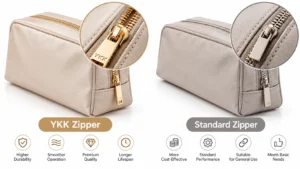
Construction details can change labor time substantially. Confirm zipper type, gauge, tape color, teeth color, puller style and opening direction. For handles, specify material, finished length, width, attachment method and required drop. For internal organization, provide pocket dimensions and intended contents.
Color and Acceptable Tolerances
Use physical swatches or recognized color references whenever color is commercially important. Screen images are not reliable production standards. State whether you will approve a lab dip, strike-off, printed sample or material cutting before the prototype.
Explain the Custom Branding Requirements
Logo Method, Size and Placement
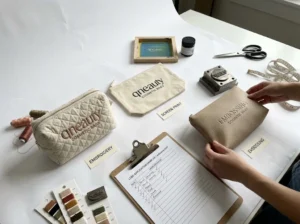
Provide the logo process, final dimensions and exact position. Common methods include screen printing, heat transfer, embroidery, woven labels, rubber patches, debossed PU labels, foil stamping and metal plates. Each method has different minimum line widths, color limitations, setup costs and durability characteristics.
Include a placement measurement from fixed seams or edges. “Centered on front” can be interpreted differently after the bag gains volume. “Logo center positioned 45 mm below the top zipper seam” is more precise.
Pantone Color Matching
Use Pantone references for critical brand colors and approve physical swatches. Fabric, ink, thread and plating can look different even when matched to one target.
Custom Zipper Pulls, Labels and Metal Plates
Custom hardware often creates one-time tooling costs and higher MOQs. Your RFQ should state:
- Finished dimensions and thickness
- Logo orientation and relief
- Base metal or material preference
- Plating color and surface finish
- Attachment method
- Required corrosion, pull or colorfastness testing
- Whether tooling ownership must be documented
| Branding Method | Pros | Cons | Best Use |
|---|---|---|---|
| Screen print | Cost-effective, clear solid colors | Less suitable for complex gradients | Promotional and volume programs |
| Embroidery | Textured, durable, premium feel | Can distort light fabric or very small details | Canvas, quilted and textile bags |
| Woven label | Consistent, lightweight, flexible placement | May feel less prominent than hardware | Interior branding and minimalist designs |
| Debossed PU patch | Subtle, modern, suitable for tonal branding | Requires compatible material and edge finishing | Travel and lifestyle collections |
| Custom metal plate | Strong luxury signal and high visibility | Tooling, plating control and reinforcement may be required | Premium retail launches |
Include the Commercial Order Details
Quantity by Style and Color
State total quantity and the breakdown by style, size and color. “1,000 pieces in four colors” can mean 250 pieces per color or 1,000 pieces per color. These are different purchasing conditions because material minimums, dye-lot requirements and setup labor may apply per color.
Target Price and Required MOQ
State whether the target price is EXW, FOB or delivered. Request quantity-tier pricing because material minimums, custom colors, hardware and packaging often determine the workable MOQ.
Packaging, Barcode and Label Requirements
Specify every component, including polybag, insert, hangtag, barcode, care label, gift box and carton marks. Confirm who supplies final artwork and barcode data.
Packaging regulations are becoming more important. Regulation (EU) 2025/40 on packaging and packaging waste entered into force in 2025 and generally applies from August 12, 2026. Buyers selling into the EU should review packaging choices, documentation and future recyclability obligations with qualified compliance advisers rather than treating packaging as an afterthought.
Testing and Compliance Standards
List the destination market, intended age group, retailer protocol and required test reports. Ask the supplier to identify applicable materials, components and laboratory costs before sampling.
For California sales, Proposition 65 focuses on exposures to listed chemicals and may require a clear and reasonable warning when applicable. A listed chemical’s presence does not automatically mean every product needs a warning; exposure and applicable safe-harbor provisions matter. Obtain legal or laboratory guidance for the specific product.
Factory expert note: Testing should be discussed before materials are approved. Replacing a failed PU, ink or metal component after the pre-production sample can affect color, appearance, cost and delivery.
Confirm Sampling, Delivery and Shipping Terms
Prototype and Pre-Production Sample Requirements
Clarify which samples are required. A prototype checks shape and construction. A material sample confirms fabric or color. A pre-production sample should represent approved bulk materials, branding, packaging and workmanship before mass production begins.
Target Production and Delivery Dates
Give two dates: the required arrival date and the preferred order-confirmation date. The supplier can then work backward through material purchasing, sampling, approval, production, inspection and transport.
Shipping Destination and Preferred Incoterm
Provide the city, country, postal code and delivery type, such as commercial warehouse, Amazon fulfillment center, port or residential address. Ask for the quote under a named Incoterm and location.
The International Chamber of Commerce describes Incoterms 2020 as the current set of 11 trade terms used to clarify tasks, costs and risks between buyer and seller. Write the rule and named place clearly, such as “FOB Yantian, Incoterms 2020” or “DDP Los Angeles, California, Incoterms 2020.”
| Term | Useful When | Buyer Should Confirm |
|---|---|---|
| EXW | Buyer controls pickup and export arrangement | Who handles loading and export clearance? |
| FCA | Buyer has a forwarder and wants a defined handover point | Exact named place and carrier handover |
| FOB | Sea shipment with buyer-controlled main freight | Named port, booking responsibilities and local charges |
| CIF | Seller arranges sea freight and minimum insurance to destination port | Destination charges, insurance scope and risk transfer |
| DDP | Buyer wants a delivered price | Import compliance, duties, taxes, exclusions and final address |
Sample Revision and Approval Process
- Supplier reviews RFQ and confirms feasibility questions.
- Buyer approves material and branding direction.
- Supplier creates prototype or development sample.
- Buyer submits one consolidated revision list.
- Supplier issues revised sample or documented corrections.
- Buyer approves the pre-production sample and specification sheet.
- Supplier begins bulk production under the approved standard.
Attach the Required Reference Files
Technical Drawing or Measurement Sheet
Show front, side, base and interior views with finished dimensions, zipper length, handle drop, pockets, logo position and construction callouts.
Product Photos and Material References
Label each image by purpose, such as shape, texture, quilting or color reference, and clearly identify features that should not be copied.
Logo and Packaging Artwork
Provide vector logo files and print-ready packaging artwork with fonts outlined, Pantone colors, dielines, bleed, barcode placement and a dated final-version label.
| File | Preferred Format | Minimum Content |
|---|---|---|
| Product specification | PDF or spreadsheet | Dimensions, materials, construction, color and quantity |
| Technical drawing | PDF, AI or CAD export | Views, measurements and callouts |
| Logo artwork | AI, EPS, SVG or outlined PDF | Vector paths and color references |
| Packaging artwork | AI or print-ready PDF | Dieline, bleed, copy, barcode and finishes |
| Reference images | JPG or PNG | Clear labels explaining what to follow |
Case Study: From AI Concept to Quote-Ready RFQ
An anonymized startup beauty brand contacted a manufacturer with an AI-generated image of a compact makeup bag and asked for the MOQ and production time. The concept showed a soft-touch exterior, a center metal logo plate and branded hardware, but the inquiry did not specify dimensions, exact material, lining, pocket layout, quantity split, packaging or delivery destination.
The buyer then converted the inquiry into a quote-ready RFQ by confirming:
- A suede-look textile rather than genuine leather
- Finished bag dimensions and required capacity
- A custom center metal plate
- Whether the zipper pull also required a logo
- A 1,000-piece initial order
- Expected production timing and destination market
Once those decisions were made, the supplier could separate unit cost, sample development, metal tooling and production lead time. The important lesson is not that AI concept images are unsuitable. They are useful for communicating style. However, they become commercially actionable only after the buyer adds manufacturing specifications.
Case study takeaway: A reference image answers “What should it look like?” A professional RFQ must also answer “What is it made from, how is it built, how is it branded, how many are needed, what must it comply with, and where must it arrive?”
Final Custom Makeup Bag RFQ Checklist Before Sending
Product Specification Checklist
- Product name, bag type and intended use
- Target user, age group and destination market
- Finished dimensions and measurement method
- Items to be stored and capacity requirements
- Outer fabric, lining, padding and trim
- Zipper, puller, handle, pocket and compartment details
- Color standards and approval method
- Logo process, size, placement and artwork
Order and Delivery Checklist
- Quantity by style, size and color
- Target price and requested quotation tiers
- Acceptable MOQ or trial-order quantity
- Packaging, barcode, labels and carton marks
- Testing and compliance requirements
- Required arrival date and partial-shipment policy
- Full destination and preferred Incoterm
- Payment expectations and quotation validity
Documents and Artwork Checklist
- Technical drawing or measurement sheet
- Reference photos with clear annotations
- Material swatches or material specification
- Vector logo file and Pantone references
- Packaging dieline and print artwork
- Barcode data and required legal copy
- Sample approval form or revision template
Before sending, ask one final question: Could a supplier quote this project without inventing a major assumption? If the answer is no, mark the unknown item as “supplier to propose” rather than leaving it unexplained.
Frequently Asked Questions
What is an RFQ in manufacturing?
An RFQ, or Request for Quotation, is a structured document used to obtain pricing and commercial terms for a defined product. In custom manufacturing, it normally includes specifications, quantity, branding, packaging, testing, delivery and shipping information so suppliers can quote on a comparable basis.
What information should I send a makeup bag supplier?
Send the bag type, dimensions, material, lining, color, logo method, internal features, quantity by color, packaging, destination, delivery date and reference files. Also state the intended market and user so the supplier can identify relevant compliance questions.
Can a manufacturer quote a custom makeup bag from a photo?
A manufacturer can often provide a preliminary estimate from a clear photo, but the estimate will depend on assumptions. A final quotation normally requires confirmed dimensions, materials, construction, branding, quantity and packaging. Label which features in the photo must be followed.
What is the typical MOQ for custom makeup bags?
MOQ varies by material, color, printing, hardware and packaging. A project using stock fabric and a simple printed logo may support a lower quantity than one requiring custom-dyed fabric, plated hardware and printed gift boxes. Ask for quantity-tier pricing instead of assuming one universal MOQ.
Do I need a Pantone color for every component?
Use Pantone references for critical brand colors, but also approve physical samples. Fabric, PU, zipper tape, embroidery thread, printing ink and metal plating reflect light differently. In some designs, a coordinated tonal match is more realistic than an identical visual match across all components.
Which Incoterm should I use for a bag quotation?
The right term depends on who controls freight, customs and delivery. FCA or FOB may suit experienced importers with forwarders. DDP may be easier for buyers seeking a delivered price, but exclusions, duties, tax treatment and importer responsibilities must be confirmed. Always include the named place and “Incoterms 2020.”
Custom Makeup Bag RFQ: Expert Summary and Next Steps
A successful Custom Makeup Bag RFQ converts a visual idea into a production decision. It defines the product, separates fixed requirements from supplier recommendations, identifies the commercial conditions behind the target price, and creates a clear path from prototype to delivery.
The strongest RFQs are not necessarily the most technical. They are the most explicit about what matters. They tell the manufacturer where precision is required, where alternatives are welcome, which approvals are mandatory and which date controls the project.
Future RFQs will emphasize traceable materials, lower-impact packaging, verified compliance and better digital version control. For brands selling into Europe, packaging decisions should be reviewed earlier because the EU packaging regulation generally applies from August 2026.
Prepare the specification, attach the artwork, define the quantity and destination, and ask suppliers to identify assumptions in writing. For material recommendations, sampling support and an OEM/ODM quotation, contact Q&N Bags about your custom makeup bag project.
Sources and Further Reading
- Statista: Beauty & Personal Care Market Worldwide
- Grand View Research: U.S. Beauty and Personal Care Products Market
- U.S. CPSC: Consumer Product Safety Improvement Act
- California OEHHA: Proposition 65 Guidance for Businesses
- International Chamber of Commerce: Incoterms 2020
- EUR-Lex: Packaging and Packaging Waste from 2026
Aries Gu is the founder of Q&N. With over 17 years of experience in cosmetic bag OEM/ODM source factory. He focuses on quality control, efficient communication, and on-time delivery for global cosmetic bag projects.