For startup founders, boutique owners, and procurement managers launching a new beauty accessory line, navigating minimum order quantities (MOQs) is often the most frustrating hurdle. Many traditional overseas factories demand MOQs of 3,000 to 5,000 pieces per color, effectively locking emerging brands out of high-quality OEM/ODM customization.
As a source factory with over 15 years of manufacturing experience, QNBags recognizes that forcing massive inventory commitments on startups stifles innovation. The modern B2B landscape requires agile supply chains. This comprehensive guide will decode how factory MOQs are calculated, reveal the hidden costs of production, and explain how our factory supports customized cosmetic bag wholesale orders starting at just 500 pieces.
1. What is MOQ in Cosmetic Bag Manufacturing?
Understanding the mechanics behind minimum orders is crucial for negotiating better terms and protecting your brand’s cash flow.
1.1 Defining Minimum Order Quantity in B2B Sourcing
In B2B manufacturing, the Minimum Order Quantity (MOQ) is the smallest number of units a factory is willing to produce for a single production run. For customized cosmetic bags, this number isn’t arbitrarily chosen to annoy buyers; it is a mathematical calculation based on the break-even point of production labor and material waste.
1.2 Why Factories Require MOQs (The Manufacturing Perspective)
From a factory standpoint, setting up a production line is highly labor-intensive. It requires calibrating heavy machinery, installing specific cutting dies, threading sewing machines with color-matched yarn, and training assembly workers on your specific product structure. If a factory only produces 50 bags, the setup time vastly outweighs the actual production time, resulting in massive financial losses.
1.3 How MOQ Affects Unit Price and Margins
There is an inverse relationship between MOQ and unit cost. Larger orders spread the fixed costs of machine setup and custom molds across thousands of bags, lowering the price per piece. For startups, the goal is to find a supplier whose production floor is optimized to keep unit prices competitive even at lower volumes.
2. The Hidden Costs Dictating Cosmetic Bag MOQs
To truly master B2B sourcing, buyers must look beyond the assembly line. Often, it is not the bag manufacturer demanding high MOQs, but rather the upstream material suppliers.
2.1 Raw Material Purchasing Minimums (MOQ vs. MCV)
Textile mills rarely sell fabric by the yard. They sell by the roll, typically requiring a Minimum Color Volume (MCV) of 1,000 to 3,000 yards per custom color. If your custom cosmetic bag requires a highly specific, custom-dyed PU leather, the factory must buy the entire roll, which naturally pushes the final product MOQ into the thousands.
[Insert Image: A factory warehouse shelf showing massive, color-coded rolls of PU leather and nylon fabrics, illustrating raw material volume requirements.]
2.2 Machine Setup and Die-Cutting Costs
Before a single stitch is sewn, your bag’s pattern must be stamped out of raw fabric using steel cutting dies. Fabricating these heavy metal molds costs time and money. For small orders, the cost of manufacturing the die-cut molds significantly inflates the overall cost per bag.
2.3 Custom Hardware and Dyeing (Pantone Matching) Constraints
If your design requires zippers, pullers, or linings dyed to a specific Pantone matching system color, the MOQ will inevitably rise. Hardware suppliers (like alloy molding factories) also require high minimums to cast a bespoke zipper pull shaped like your brand’s logo.
3. High MOQ vs. Low MOQ: Which Strategy Fits Your Brand?
Choosing your initial order volume is a balancing act between inventory risk and unit profitability. A misstep here can severely impact a startup’s runway.
3.1 The Risks of High MOQ for Startup Brands
Committing to 5,000 units of an untested design ties up vital capital in inventory and storage costs. If the market rejects the color or the sizing doesn’t fit standard makeup brushes perfectly, you are left with “dead stock” that must be heavily discounted.
3.2 The “Low MOQ” Trap: Beware of Off-the-Shelf Compromises
Many trading companies on platforms like Alibaba advertise “MOQ 50 pcs.” However, this is rarely true OEM manufacturing. Usually, they are simply heat-pressing your logo onto pre-made, low-quality stock bags. You forfeit the ability to customize the bag’s dimensions, interior lining, or zipper quality.
3.3 Striking the Balance: Why 500 Pieces is the Startup Sweet Spot
Through 15 years of refining our production lines, we have found that an MOQ of 500 pieces is the ultimate sweet spot. It allows for genuine structural customization, premium material selection, and rigorous quality control, while keeping the buyer’s financial risk strictly contained.
4. How We Make a 500 MOQ Viable for Custom Cosmetic Bags
So, how does a source factory offer low MOQs without compromising on true OEM/ODM capabilities? It requires strategic internal management and a highly agile factory floor.
4.1 Streamlined Material Sourcing and In-House Inventory
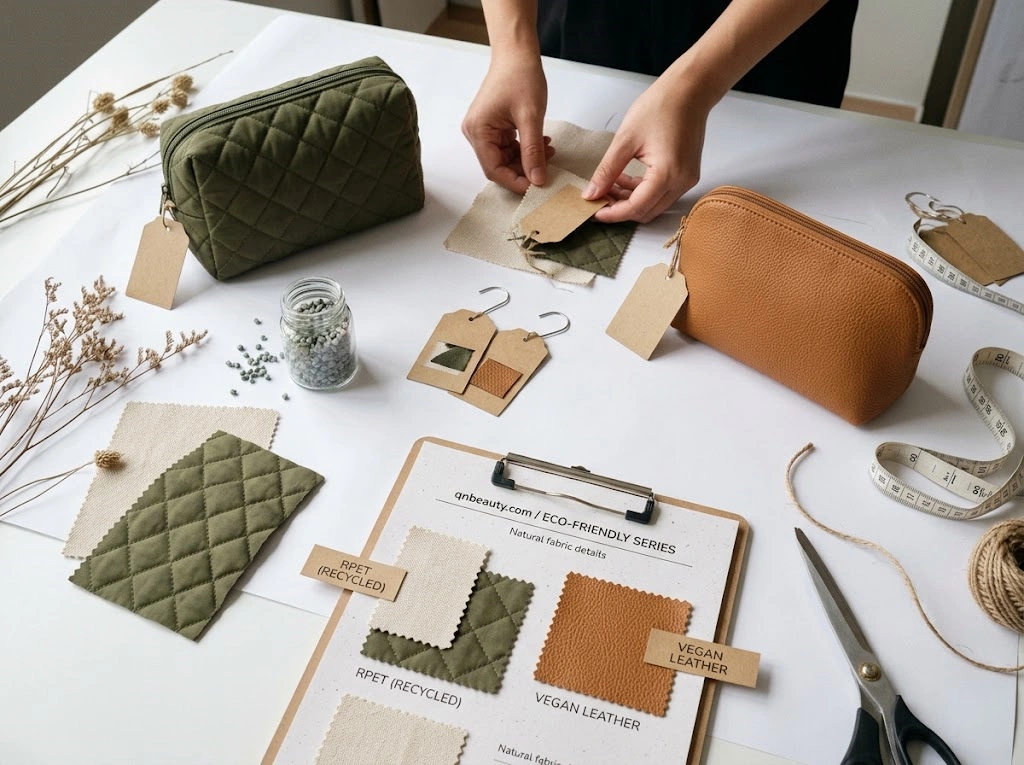
Instead of forcing buyers to meet the 3,000-yard textile mill minimums, QNBags maintains a massive in-house inventory of premium fabrics. By stocking thousands of yards of popular, high-quality materials—such as 210D nylon, clear TPU, and vegan leather—we bypass the raw material MOQ barrier entirely.
4.2 Efficient Die-Cutting and Sewing Line Adjustments
Our facility utilizes advanced, computerized CNC fabric cutting alongside traditional die-cutting. For orders of 500 pieces, we deploy flexible manufacturing cells—small, highly skilled teams of 5 to 8 sewers who specialize in rapid assembly line changeovers, drastically reducing setup downtime.
[Insert Image: A small, highly focused team of factory sewers working on a production line of premium PU leather cosmetic bags.]
4.3 Supporting Multi-SKU Launches Within a Single Run
To help you hit the 500 MOQ, we frequently allow buyers to split the order across two colors (e.g., 250 black, 250 blush pink) provided they share the exact same structural design and tooling. This flexibility is perfect for A/B testing retail preferences.
5. Maximizing Customization within a Low MOQ Framework
Even with an accessible MOQ, your cosmetic pouch must stand out on boutique shelves. Here is how B2B buyers can maximize brand impact without triggering astronomical tooling costs.
5.1 Logo Applications: Embossing, Silk-Screen, and Embroidery
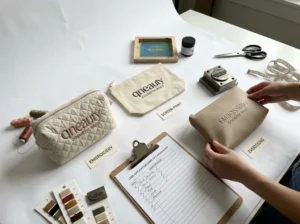
Logo application is the most cost-effective way to elevate a 500-piece order. We recommend blind debossing for PU leather bags, yielding a subtle, luxury finish. For waterproof nylon bags, durable silk-screen printing or heat transfer offers vibrant, multi-color branding without requiring high setup minimums.
5.2 Selecting Premium Fabrics: Nylon, Vegan Leather, and TPU
Stick to our vast catalog of in-stock premium fabrics. We source eco-friendly options, including materials aligned with Textile Exchange standards, ensuring your startup can promote sustainable values from day one without needing to custom-weave fabrics from scratch.
5.3 Standardizing Hardware to Allocate Budget to Structural Design
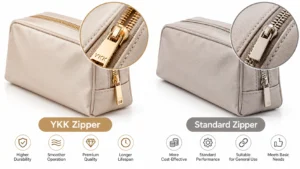
Instead of ordering custom-molded alloy zipper pulls (which often require 5,000+ piece MOQs), we advise startups to utilize premium standardized hardware from trusted partners like YKK Zippers. We pair these world-class zippers with custom-cut leather pull-tabs matching the bag’s exterior—a clever, high-end workaround.
6. Factory-Level Quality Control (QC) for Startup Orders
A smaller order volume does not mean relaxed standards. In fact, for startups relying on initial customer reviews, flawless execution is paramount.
6.1 Incoming Material Quality Control (IQC)
Before assembly begins, our IQC team tests all materials for colorfastness, abrasion resistance, and tensile strength. We also verify that linings are genuinely waterproof or easy-wipe, ensuring your final cosmetic bag withstands liquid foundation leaks.
6.2 In-Line Stitching Inspection and Thread Tension Management
During the sewing phase, IPQC (In-Process Quality Control) inspectors monitor the assembly lines. We enforce strict standards on Stitches Per Inch (SPI) and thread tension to prevent puckering on curved half-moon pouches or thick canvas materials.
6.3 Final Needle Detection and Packaging Checks
Safety is critical for products handled daily. Every single bag passes through an industrial needle detection machine to ensure no broken sewing needles remain hidden within the lining. This aligns with rigorous international safety protocols similar to those audited by SGS.
7. Shipping and Logistics Optimization for 500-Piece Orders
Freight costs can quickly erode a startup’s margins. As a direct manufacturer, we engineer packaging solutions to optimize your B2B logistics.
7.1 Vacuum Packaging to Reduce Dimensional Weight
Cosmetic bags ship full of empty air, which drastically inflates your dimensional weight (CBM). For soft-structured nylon or canvas bags, we utilize industrial vacuum packaging. This compression can reduce freight costs by up to 30%, saving you significant money on air shipments.
[Insert Image: A comparison graphic showing standard stuffed bags taking up a whole master carton versus vacuum-sealed bags tightly packed, demonstrating CBM savings.]
7.2 Consolidated Shipping: LCL vs. Air Freight
For a 500-piece order, full container loads (FCL) are unnecessary. We assist buyers in navigating Less than Container Load (LCL) sea freight for maximum savings, or expedited DDP (Delivered Duty Paid) air freight if you need to hit a tight holiday launch window.
7.3 Preparing for FBA and Direct-to-Retail Delivery
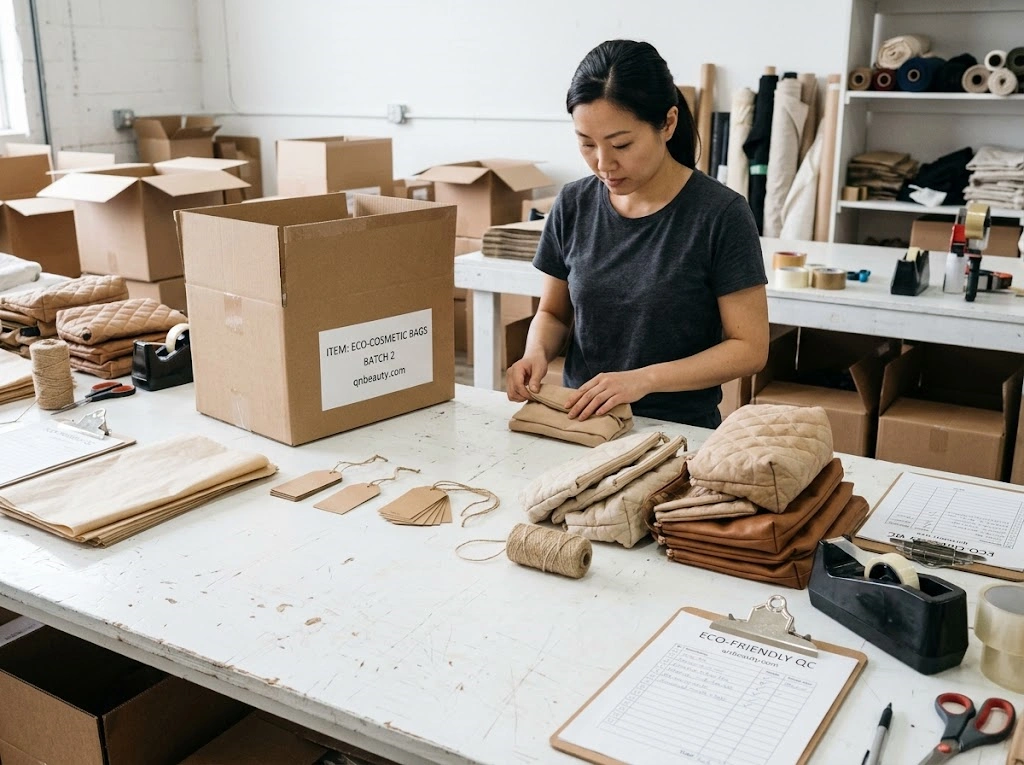
We streamline your supply chain by offering source-level prep. From attaching Amazon FNSKU barcodes and suffocation warning labels to assembling individual retail display boxes, your goods arrive at the fulfillment center ready to sell immediately.
8. Navigating Your First Wholesale Cosmetic Bag Order
Taking the leap from concept to physical product requires clear communication. Here is how to ensure your first order is a resounding success.
8.1 Preparing a Clear Tech Pack and Bill of Materials (BOM)
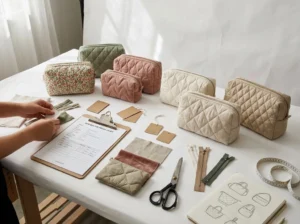
Do not rely on vague descriptions. Provide a detailed “Tech Pack” that includes exact dimensional drawings, Pantone color codes, material preferences, and logo placements. A clear blueprint guarantees the factory understands your vision perfectly.
8.2 The Importance of the Pre-Production Sample (PPS)
Never authorize bulk production without a physical Pre-Production Sample (PPS). Our sample room creates a perfect 1:1 prototype within 7 to 10 days. This allows you to test the zipper smoothness, verify the internal volume with actual makeup bottles, and approve the final craftsmanship.
8.3 Building a Long-Term Manufacturing Partnership
Your first 500-piece order is just the beginning. By partnering with a true source factory like QNBags, you secure a scalable supply chain. As your brand grows to require 5,000 or 50,000 pieces, our production lines scale seamlessly with you.
Ready to launch your custom cosmetic bag line without the massive inventory risk? Let us turn your vision into a premium, retail-ready reality. Contact our B2B sales team today to request a material swatch book, discuss your project details, and get a rapid quotation for your 500 MOQ custom order.
Aries Gu is the founder of Q&N. With over 17 years of experience in cosmetic bag OEM/ODM source factory. He focuses on quality control, efficient communication, and on-time delivery for global cosmetic bag projects.