Tyvek cosmetic pouches offer a rare combination: the crisp visual language of paper with the low weight and wet-strength performance of a synthetic nonwoven. That makes them attractive for discovery sets, travel kits and minimalist beauty campaigns. It also creates sourcing risks. Tyvek® is often called “paper,” grades are quoted without style numbers, and recyclable-material claims are repeated without checking the finished pouch or local collection access.
This guide covers Tyvek® construction, hard and soft grades, weight, bag design, printing, seam control and responsible environmental claims. The goal is a pouch that looks intentionally lightweight rather than fragile or misleadingly marketed.
Market context: Grand View Research values the global cosmetic packaging market at US$32.67 billion in 2023 and forecasts US$44.28 billion by 2030. Plastics represented 60.8% of 2023 revenue, while paper is forecast to grow at the fastest material CAGR. Tyvek® sits in an unusual design position: it is an HDPE nonwoven, not paper, but its paper-like versions can answer demand for lightweight, tactile and visually differentiated secondary packaging.
Source: Grand View Research cosmetic packaging market.
Table of Contents
- What Are Tyvek Cosmetic Pouches?
- Why Beauty Brands Choose Tyvek Cosmetic Pouches
- Best Uses for Tyvek Cosmetic Pouches
- Tyvek Material Options
- How to Design a Tyvek Cosmetic Pouch
- Printing and Branding on Tyvek
- Production Challenges with Tyvek
- Sustainability Considerations for Tyvek Pouches
- How to Source Custom Tyvek Cosmetic Pouches
- Are Tyvek Cosmetic Pouches Right for Your Brand?
- Frequently Asked Questions
- Expert Recommendations and Conclusion
What Are Tyvek Cosmetic Pouches?
A Tyvek cosmetic pouch is made with DuPont™ Tyvek®, a nonwoven sheet formed from continuous, fine high-density polyethylene fibers. DuPont explains that these fibers are spun into a sheet and bonded with heat and pressure. No woven warp-and-weft structure is required, and the finished material can be paper-like or textile-like depending on the bonding process.
How Tyvek Material Is Made
Its fiber network behaves differently from paper and woven fabric. Paper can weaken when saturated, while woven cloth may fray at cut edges. The interconnected HDPE sheet gives Tyvek® high strength for its weight and wet tear resistance.
Tyvek® is vapor permeable while resisting liquid water at the sheet level. A sewn pouch is not automatically waterproof because holes, zippers and seams create entry paths.
Main Performance Characteristics
DuPont describes Tyvek® as lightweight, durable, water resistant, abrasion resistant and low linting. Its technical guide gives hard structure a density of about 0.38 g/cm³ and roughly half the weight of paper by equal volume, with strong dimensional stability across humidity changes.
Technical references: DuPont: What is Tyvek®? and DuPont Tyvek® product structures.
Tyvek Pouches vs. Paper and Fabric Pouches
| Decision factor | Tyvek® pouch | Paper pouch | Woven fabric pouch |
|---|---|---|---|
| Material identity | HDPE nonwoven | Cellulose-based sheet | Interlaced textile yarns |
| Wet performance | Retains sheet strength when wet | Varies; many papers weaken or deform | Fiber dependent; may absorb water |
| Edge behavior | Does not fray like woven cloth | May tear from cuts or folds | Raw edges often require finishing |
| Appearance | Paper-like or fabric-like with intentional creasing | Familiar print and folding surface | Soft, woven and textile-led |
| Recycling route | Flexible HDPE route where accepted | Paper route if coatings and trims allow | Depends on fiber blends, coatings and trims |
Expert view: Use “made with DuPont™ Tyvek®” only when the approved material is genuine branded Tyvek®. “Tyvek-like paper” and generic HDPE nonwoven should not be presented as the same material.
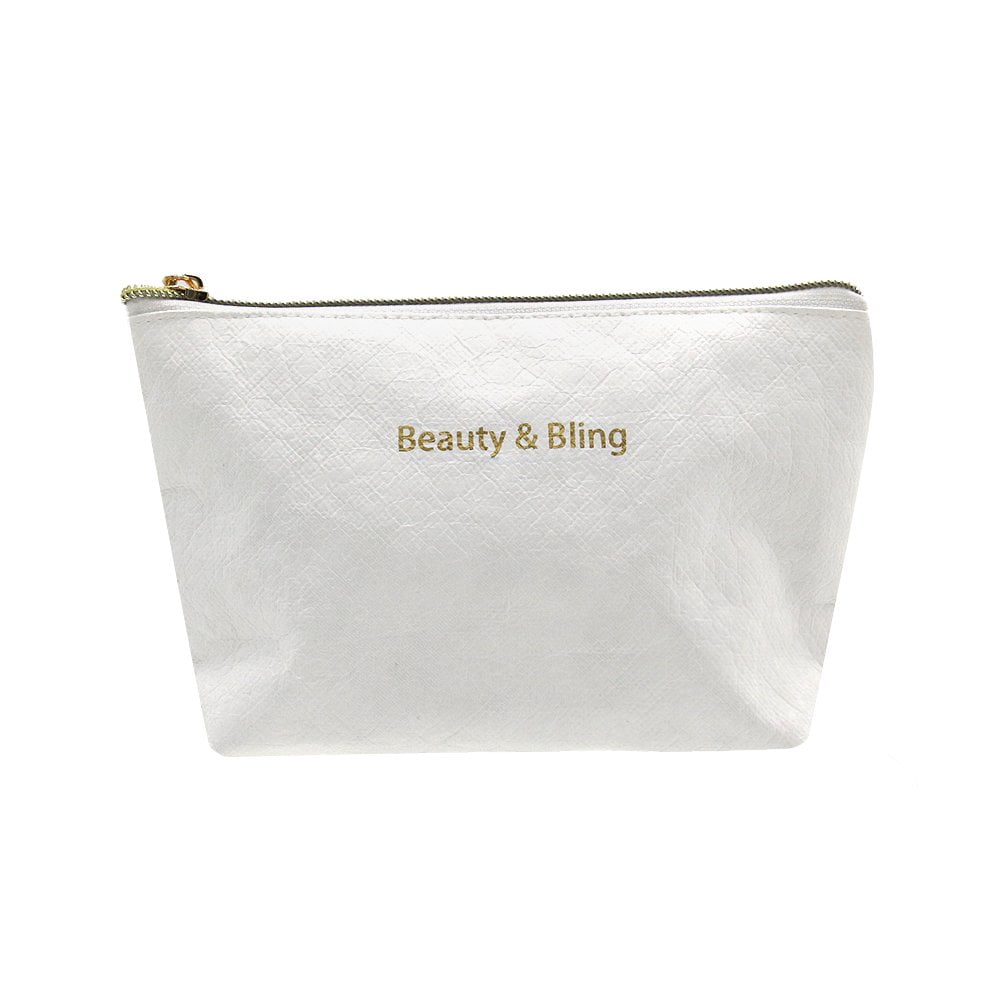
Why Beauty Brands Choose Tyvek Cosmetic Pouches
Lightweight Construction
Low weight supports samples and travel programs and can reduce freight against padded or rigid formats. Calculate the finished specification: a 10-gram unit reduction equals 100 kilograms across 10,000 pouches before carton effects.
Water and Tear Resistance
Tyvek® has better wet integrity than ordinary uncoated paper and resists tearing from an undamaged edge. Sewing perforations, cutouts and sharp notches still require reinforcement and controlled stitching.
Modern Paper-Like Appearance
Wrinkling is part of the design language. Crisp white can feel clinical and architectural, while crumpled effects look casual. Black typography and exposed seams suit minimalist skincare and unisex grooming.
Lower Shipping and Packaging Weight
Tyvek® can replace heavy outer textile when primary containers already protect the products. Optimize the pouch, retail band and carton together; heavy lining, metal hardware, foam and rigid boxes can cancel the weight benefit.
Real Product Case Study: Braasi Tyvek® Cosmetic Bags
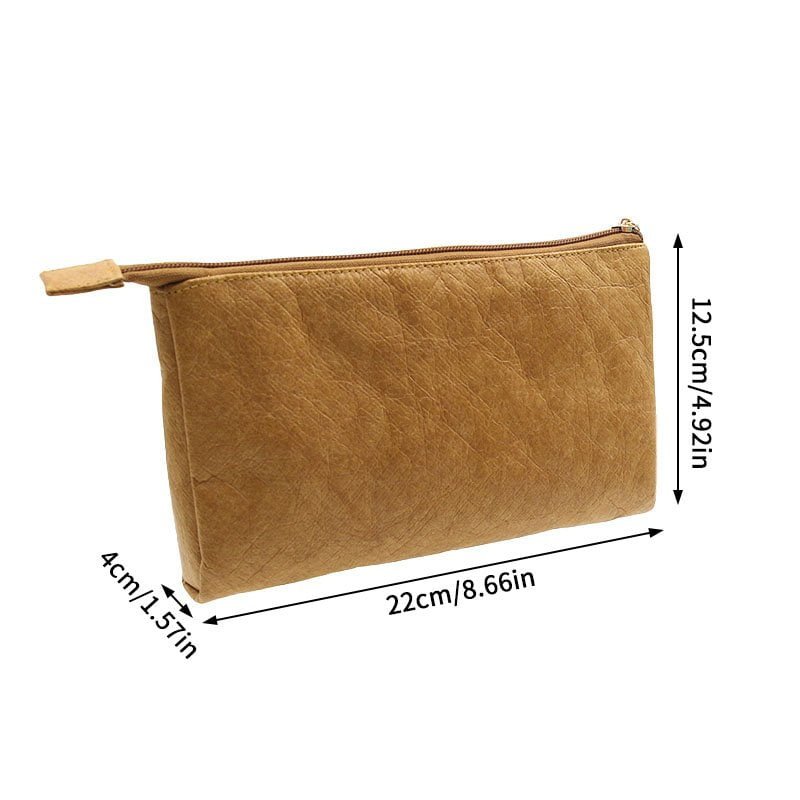
Braasi sells Tyvek® cosmetic bags from slim to gusseted formats, specifying DuPont™ Tyvek®, YKK zippers, Czech production and a water-resistant paper-like surface. Its care instructions warn that washing accelerates wrinkling, showing why brands must define capacity, care and crease expectations.
Source: Braasi Tyvek® Cosmetic range.
Design-for-Disassembly Case: TYBAG
DuPont documents Romi Inbar’s TYBAG, which uses simple cuts, soldered connections and removable straps. Although not a beauty pouch, it shows how fewer incompatible layers can simplify production and clarify end-of-life separation.
Source: DuPont Tyvek® Design: TYBAG.
Best Uses for Tyvek Cosmetic Pouches
Sample and Discovery Sets
Flat pouches suit sachets, mini tubes and fragrance samples. Add a light insert or lining when sharp carton corners could puncture the sheet.
Lightweight Travel Kits
A gusseted travel pouch holds small bottles and personal-care essentials. Test the loaded base and opening; glass or pressed makeup may still need sleeves or padding.
Promotional Beauty Campaigns
Large printable panels suit event kits and gifts with purchase. A standard body can be refreshed through graphics, but each ink system still requires adhesion testing.
Minimalist Retail Packaging
For minimalist retail sets, use a removable band for barcodes and information. Avoid unnecessary permanent laminations when recycling is an objective.
Tyvek Material Options
Soft-Structure Tyvek
Type 14 is fabric-like and drapeable. Representative consumer grades include 1442R and 1473R at about 43 and 73 g/m², suitable for foldable travel and drawstring designs.
Stiffer Paper-Like Tyvek
Type 10 and 41 are smooth, paper-like hard structures that retain folds and sewn form. Representative graphics weights include about 42.5, 55, 75 and 105 g/m². Heavier material still requires correct seams and load control.
White, Colored and Printed Tyvek
White Tyvek® is a bright printing surface. Color may come from printing, coating, dyeing or converted material, each affecting rub resistance, touch and recycling. Confirm how color is applied.
Different Material Weights and Finishes
| Material direction | Representative weight range | Bag behavior | Good starting application |
|---|---|---|---|
| Light hard structure | About 42.5–55 g/m² | Crisp, very light and easy to crease | Flat promotional and sample pouch |
| Medium hard structure | About 68–75 g/m² | Better body and print presence | Gusseted retail or travel pouch |
| Heavy hard structure | Around 105 g/m² | Substantial, fold-retaining surface | Structured concept after seam testing |
| Soft structure | About 43–73 g/m² | Drapeable, fabric-like and compressible | Soft cosmetic or drawstring pouch |
| Converted/coated Tyvek® | Supplier specific | Can change color, touch and print behavior | Premium branded effects after compatibility testing |
The listed weights are examples from DuPont’s technical guide, not a complete global catalog. Confirm current regional availability and the exact style number before quotation.
How to Design a Tyvek Cosmetic Pouch
Choosing Flat or Gusseted Construction
Flat pouches minimize weight and suit samples. Gussets hold bottles but concentrate stress at corners and zipper ends. Prototype with real contents before approving graphics.
Adding Lining and Internal Support
A lining hides seams and manages residue, but adds weight and recycling complexity. Reinforce only high-load areas such as zipper ends, handles, pockets and corners.
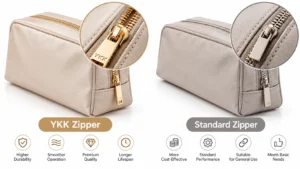
Selecting Zippers and Closures
Nylon coil zippers are light; metal zippers add weight. Snaps create concentrated pull points. Selected grades may support heat or ultrasonic sealing, but pilot production is essential.
Balancing Lightweight Design and Durability
Durability depends on load paths. Generous seam allowance, moderate stitch density, rounded corners and reinforced handles matter more than weight alone; dense holes can create a postage-stamp tear line.
| Design decision | Recommended control | Common mistake |
|---|---|---|
| Finished capacity | Load the sample with actual products | Using only external dimensions |
| Grade | Specify style number, structure and basis weight | Ordering generic “Tyvek paper” |
| Seam placement | Keep stress and handles away from weak edges | Placing dense stitches close to a cut edge |
| Lining | Add only for cleaning, opacity or support needs | Adding heavy layers without weight analysis |
| Creasing | Define acceptable wrinkles in the approved sample | Treating every crease as either a defect or a design feature |
| Water claim | Test the finished pouch | Transferring sheet performance directly to sewn construction |
Build a Production-Ready Lightweight Pouch
Q&N Bags develops custom cosmetic pouches with material selection, lining, zipper engineering, printing, woven labels and retail packaging. Review the custom bag development process, explore the cosmetic bag factory capabilities or visit Q&N Bags before preparing your RFQ.
Printing and Branding on Tyvek
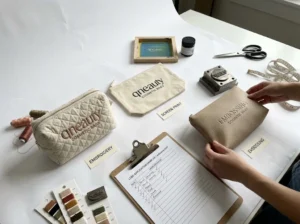
Screen Printing
Screen printing suits bold spot colors. Use a compatible ink with adhesion, flexibility and wet-rub resistance; some high-solvent systems can distort the sheet.
Digital and Heat Transfer Printing
Many hard grades support digital printing, but printer and coating compatibility vary. Use inks for HDPE or synthetic substrates and run a pilot because drying is slower than on paper.
Thermal transfer suits selected hard grades and codes. Textile transfer artwork needs separate trials because excess heat can distort Tyvek®, which melts at about 135°C.
Woven Labels
Woven labels give repeatable small-logo detail without broad ink coverage. They introduce another material, so sustainability-led designs should consider removability.
Custom Printed Patterns
Full-surface graphics create strong differentiation but can increase curl, drying time and variation. Approve a full-size strike-off and test folds after curing.
Printing reference: DuPont Tyvek® Printing Guide.
Production Challenges with Tyvek
Visible Needle Holes
Needle holes remain visible, and excessive density creates a tear path. DuPont recommends low tension and the smallest practical needle: roughly 1.2–2 stitches/cm for Type 10 and 2.4–3.1 stitches/cm for strong Type 14 seams.
Wrinkling and Surface Creasing
Wrinkles are expected, especially in hard structure. Define acceptable creasing through a golden sample under normal packing instead of demanding a permanently paper-flat surface.
Seam Strength and Reinforcement
Reinforce handles, snaps and zipper ends. Rounded corners distribute load, while smooth machine-feed surfaces avoid impressions that knurled rollers can leave.
Printing Adhesion and Color Accuracy
Corona treatment improves adhesion, but ink chemistry, drying, surface side and coverage still matter. Retain a signed strike-off and test printing after folding.
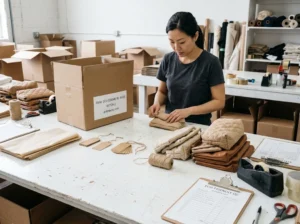
| QC stage | What to inspect | Recommended evidence |
|---|---|---|
| Incoming material | Brand/grade, basis weight, color, treatment and defects | Approved swatch and roll record |
| Printing | Color, adhesion, drying, rub and distortion | Full-size strike-off and cure record |
| Cutting | Clean edges, dimensions, curl and heat damage | First-cut approval |
| Sewing | Stitch density, tension, edge distance and perforation | Golden seam sample and pull test |
| Assembly | Zipper movement, handle strength, loaded shape and lining | Function and loading report |
| Packing | Creases, carton pressure, odor and finished presentation | Final inspection and packing photos |
Technical sewing and converting reference: DuPont Tyvek® Graphics Printing & Technical Guide.
Sustainability Considerations for Tyvek Pouches
Material Efficiency and Lightweight Shipping
Low basis weight can reduce material and freight against heavier structures. Compare the complete bill of materials, unit weight, carton quantity and transport mode before making impact claims.
Reusability
A durable zipper, useful size and cleanable interior support reuse. Survival alone is not enough; an awkward pouch may still be discarded.
Recycling Limitations
DuPont operates partner recycling options for qualifying printed and unprinted Tyvek®. A 100% Tyvek® product may be accepted where flexible-HDPE recycling exists, but a finished pouch often includes lining, zipper, thread, coating and adhesive.
“Recyclable material” is not the same as a widely recyclable finished bag. Check local collection and design removable components.
How to Avoid Unsupported Environmental Claims
The FTC advises qualifying recyclable claims when suitable facilities reach less than 60% of consumers or communities. Avoid “plastic-free,” “zero waste” and vague “eco-friendly” language; Tyvek® is HDPE.
| Claim | Evidence needed | Safer wording direction |
|---|---|---|
| Lightweight | Finished unit weight or comparison method | “Finished pouch weighs X g” |
| Reusable | Function, durability and care validation | “Designed for repeated storage use” |
| Recyclable | Finished composition and local facility access | “Tyvek® body is HDPE; check local flexible-HDPE acceptance” |
| Mono-material | Complete component audit | Use only when zipper, thread, coating and labels qualify |
| Lower-impact | Defined life-cycle comparison | Avoid without a substantiated comparative study |
References: DuPont Tyvek® recycling program and FTC Green Guides summary.
How to Source Custom Tyvek Cosmetic Pouches
1. Confirm Material Grade and Weight
Specify genuine Tyvek® or an approved alternative, structure, style number, weight, treatment and color. Retain a physical swatch and traceability.
2. Test Printing and Seam Construction
Approve ink on production material, then test the sewn construction for stitch density, edge distance, handle pull and zipper-end strength. Use a pilot run for unfamiliar grades.
3. Approve Packaging and Finished Shape
Pack real products with the final band or insert, apply expected carton pressure and inspect creasing. Confirm whether bags ship flat, supported or boxed.
4. Confirm MOQ and Production Lead Time
MOQ depends on grade, print, zipper, lining and packaging. Custom projects are often efficient near 1,000 pieces per design or color. Sampling commonly takes 7–14 days and production 30–45 days after approval, subject to material and complexity.
| RFQ item | Information to provide |
|---|---|
| Bag structure | Reference image or drawing: flat, gusseted, boxy or drawstring |
| Finished dimensions | Length × height × depth and measurement method |
| Contents | Product dimensions, weights, quantities and arrangement |
| Tyvek® specification | Hard/soft structure, style, weight, treatment and color |
| Construction | Lining, reinforcement, handle, pockets, zipper and seam finish |
| Artwork | Vector file, print process, coverage, colors and placement |
| Claims | Approved wording and required supporting documents |
| Commercial details | Quantity, destination, packaging, testing and arrival date |
Request a Custom Tyvek Pouch Quote
Send Q&N Bags your reference image, dimensions, quantity, intended contents, logo artwork, material preference, packaging and required arrival date. The development team can evaluate grade, structure, reinforcement and printing against your target cost and use case.
Review the OEM/ODM process or contact Q&N Bags for a custom quotation.
Are Tyvek Cosmetic Pouches Right for Your Brand?
Advantages and Disadvantages
| Advantages | Disadvantages |
|---|---|
| Very light with strong wet integrity | Finished sewn pouch is not automatically waterproof |
| Distinct paper-like or fabric-like appearance | Creases and needle holes remain visible |
| Large surface for custom printing | Ink and heat settings require specialist testing |
| Does not fray like woven fabric | Dense stitches can create a perforated tear line |
| HDPE body may have a recycling route | Mixed trims and limited local access complicate recycling |
Best Product Applications
Tyvek® suits indie skincare, travel, samples, promotions and unisex wellness. It is less suitable for plush luxury, heavy unprotected glass or brands seeking paper-based or plastic-free claims.
Final Buyer Checklist
- Is the supplied material genuine Tyvek® and is the style identified?
- Has the hard or soft structure been chosen for the intended shape?
- Is the basis weight appropriate for the loaded products?
- Has printing been tested for adhesion, rub and distortion?
- Are stitch density and edge distance approved?
- Does the finished bag meet the intended water-resistance claim?
- Are wrinkles defined through a golden sample?
- Can lining, zipper and labels be separated where recycling is claimed?
- Does the target market have a relevant collection route?
- Has the complete packed configuration been approved?
Frequently Asked Questions
Is Tyvek suitable for cosmetic pouches?
Yes. Tyvek® is lightweight, tear resistant and water resistant at the sheet level. It suits sample, travel and promotional pouches when the grade, seam, zipper and reinforcement are matched to the contents.
Are Tyvek cosmetic pouches waterproof?
Not automatically. The material resists liquid-water penetration, but sewing holes, zippers and openings can leak. Use a finished-product test before making a waterproof claim. “Water-resistant pouch” is more accurate for most sewn designs.
Can Tyvek pouches be printed with a custom design?
Yes. Screen, digital and other commercial processes can be used on compatible grades. Select inks for HDPE or synthetic substrates, allow adequate drying and test adhesion after folding and wet rubbing.
Which Tyvek grade is best for a cosmetic pouch?
Soft Type 14 is suitable for flexible, fabric-like bags. Hard Type 10 or 41 creates a crisper paper-like form. The final choice depends on basis weight, bag size, load, printing and crease expectations.
Can a Tyvek pouch be lined?
Yes. Lining improves cleanliness, opacity and structure. Polyester or coated fabric are common, but the added layer increases weight and can complicate recycling. Use it only when the product needs it.
Is Tyvek recyclable?
Tyvek® is an HDPE material and may be accepted by specialist or flexible-HDPE recycling routes. Local access varies, and mixed components can prevent the finished pouch from being accepted. Check the destination market and qualify the claim.
How should Tyvek cosmetic pouches be cleaned?
Care depends on grade, print, lining and trims. Gentle wiping or hand cleaning may be appropriate for some designs, but washing can increase wrinkles. Validate the finished product before publishing care instructions.
Expert Recommendations and Conclusion
Future lightweight packaging will emphasize measurable material efficiency, removable components, flexible printing and verified collection routes. Tyvek® can support that direction when brands identify it accurately as an HDPE nonwoven.
Google’s 2026 AI-search guidance prioritizes unique, useful content and established SEO fundamentals. Product pages should publish grade, dimensions, capacity, care, tests and claim limitations instead of generic adjectives.
SEO reference: Google Search Central guidance for generative AI search.
Successful Tyvek cosmetic pouches combine a verified grade, efficient pattern, controlled seam perforation, compatible printing and a realistic end-of-life message. When buyers approve those details before mass production, the material can create a lightweight beauty package that is visually distinctive, durable enough for reuse and honest about its environmental limitations.
Final expert recommendation: Approve four physical references: the identified Tyvek® swatch, the printed strike-off, a fully loaded pre-production pouch and the final packed carton. These controls prevent most disputes involving grade substitution, color, needle holes, creasing and capacity.
Develop Your Custom Lightweight Beauty Pouch
Prepare your bag reference, product dimensions, order quantity, artwork, target material weight, retail packaging and required arrival date. Q&N Bags can then build a production proposal around your actual discovery set, travel kit or promotional campaign.
Explore custom bag development or request a Tyvek cosmetic pouch quotation.
Aries Gu is the founder of Q&N. With over 17 years of experience in cosmetic bag OEM/ODM source factory. He focuses on quality control, efficient communication, and on-time delivery for global cosmetic bag projects.