Many shoppers assume a cosmetic bag is waterproof just because it looks glossy, feels smooth, or is described as travel-friendly. In reality, many cosmetic bags are only water-resistant, and that difference matters. A bag can survive light splashes, steam, or a damp bathroom counter and still fail when a serum bottle leaks, a zipper sits in pooled water, or a beach tote gets soaked. If you carry skincare, makeup, or toiletries regularly, understanding whether a cosmetic bag is truly waterproof or merely water-resistant can save your products, your luggage, and a lot of cleaning time.
That question has become more important as beauty remains strong, travel-size products stay popular, and portable storage becomes part of the beauty experience. Circana reported that the U.S. prestige beauty market reached $16 billion in the first half of 2025, while mass beauty sales at mass merchants grew to $34.6 billion. Grand View Research also estimated the global cosmetic packaging market at $32.67 billion in 2023, with projected growth through 2030. As more consumers travel with mini serums, sunscreen, and liquid makeup, the difference between waterproof and water-resistant cosmetic bags becomes a practical buying issue, not just a product description detail. In this guide, you will learn what waterproof really means, how to judge bag materials and construction, when water resistance is enough, and how to choose the right cosmetic bag for your real use case.
Table of Contents
- What Does Waterproof Really Mean for a Cosmetic Bag?
- Are Cosmetic Bags Usually Waterproof?
- Which Materials Make a Cosmetic Bag More Water-Safe?
- How to Tell If a Cosmetic Bag Is Really Waterproof
- Best Uses for Waterproof Cosmetic Bags
- When a Water-Resistant Bag Is Enough
- How to Choose the Right Cosmetic Bag for Your Needs
- Explore More Bag Options at QN Bags
- Conclusion and CTA
- FAQ
1. What Does Waterproof Really Mean for a Cosmetic Bag?
Why “waterproof” and “water-resistant” are not the same
When people ask whether cosmetic bags are waterproof, they often mean one of two things. First, they may want to know whether the outer surface repels water. Second, they may want to know whether the bag can actually keep liquid from entering or escaping. Those are very different performance levels. GOREWEAR explains that waterproof and water-resistant gear differ in both construction and the level of protection they provide. In simple terms, water-resistant products handle light moisture. Waterproof products are built to block more serious water exposure.
That distinction is important because many beauty bags are made from water-friendly materials but are not sealed as systems. A PVC or TPU panel may resist water on its own, yet the stitched seams, zipper, or fabric trim may still allow leakage. In other words, material alone does not make the whole bag waterproof.
What makes a bag truly more waterproof in practice?
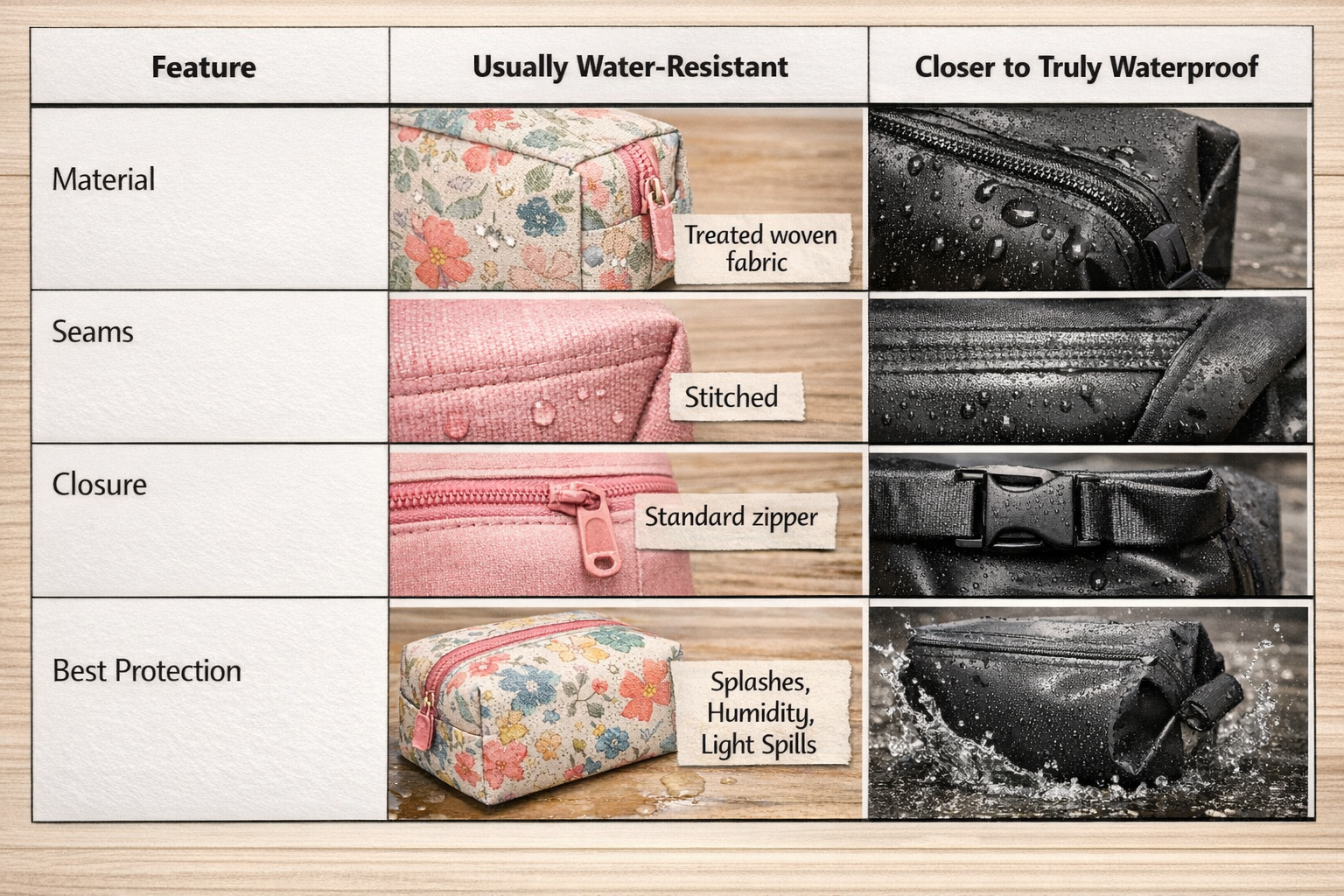
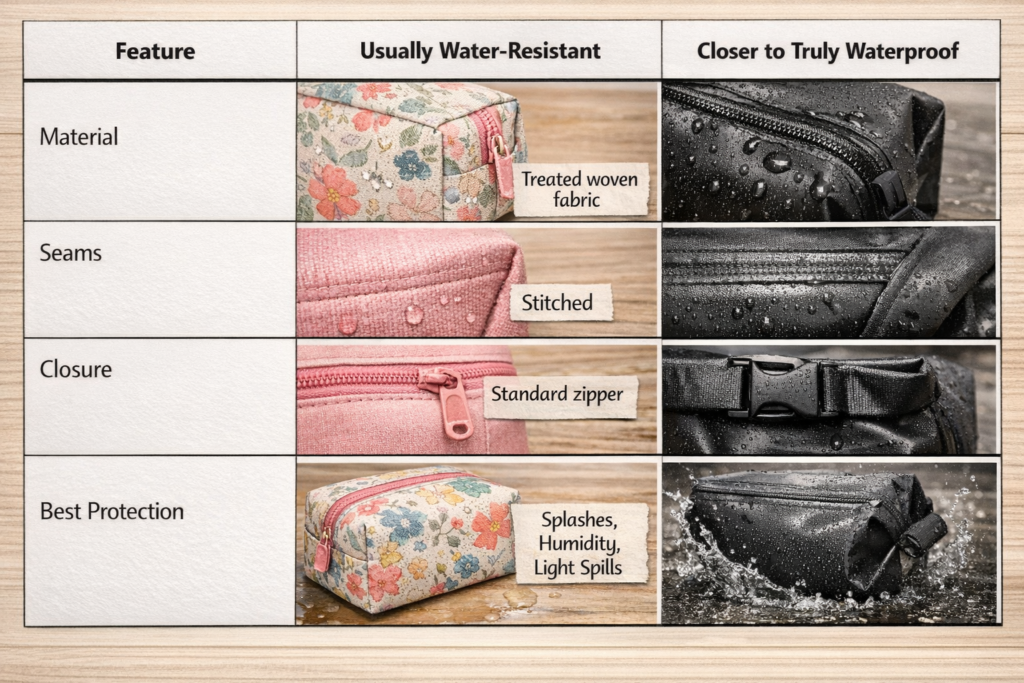
A bag becomes more genuinely waterproof when three things work together: an impermeable or coated material, seams that are welded or taped rather than simply stitched, and a closure that reduces water entry. Sea to Summit notes that gear designed to be waterproof typically has seam-taped or welded construction, while products without that seam construction are usually water-resistant rather than waterproof. ORTLIEB goes even further, explaining that its waterproof performance is achieved through coated fabrics and high-frequency welded seams.
| Feature | Usually Water-Resistant | Closer to Truly Waterproof |
|---|---|---|
| Material | Treated woven fabric or splash-resistant surface | Coated, laminated, or fully impermeable material |
| Seams | Stitched | Welded or seam-taped |
| Closure | Standard zipper | Water-resistant zipper, roll-top, or sealed closure |
| Best Protection | Splashes, humidity, light spills | Heavy splashes, leaks, very wet conditions |
Why the distinction matters for beauty storage
Cosmetic bags do not only face outside water. They also face inside liquid failure: leaking toner, cracked compact foundations, broken serum pumps, and sunscreen caps that loosen in transit. A bag that only repels rain on the outside may still fail the moment one product bursts open internally. That is why beauty buyers should think about waterproofing from both directions: protection from the environment and containment of their own products.
Case Study: Waterproof outdoor bag makers offer a useful benchmark. ORTLIEB says its welded-seam materials can resist a 100,000 mm water column, while Sea to Summit uses welded construction and waterproof closures on dry storage ranges meant for boating and marine exposure. Most cosmetic bags are not engineered to that level. That does not make them bad. It simply means the word “waterproof” should be used carefully.
Suggested image alt: “Waterproof versus water-resistant cosmetic bag construction showing material seams and zipper differences”
2. Are Cosmetic Bags Usually Waterproof?
Most cosmetic bags are not fully waterproof
The honest answer is that most cosmetic bags are not fully waterproof. They may be splash-resistant, wipe-clean, or made from materials that resist moisture better than plain cotton, but many are not built with welded seams or watertight closures. A typical zipper pouch with stitched seams is better described as water-resistant or spill-tolerant rather than waterproof.
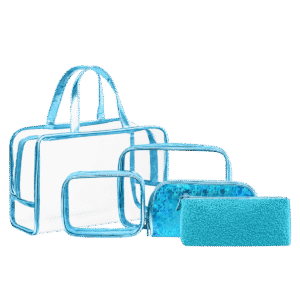
This is where consumers often get confused. A transparent cosmetic bag may look highly protective because it is shiny and plastic-like. A coated fabric pouch may feel technical. But unless the full construction supports it, that visual cue can be misleading.
Why brands still use “waterproof” loosely in listings
In ecommerce, “waterproof” is sometimes used as a convenience term to mean wipeable, splash-safe, or suitable for damp environments. That is understandable from a marketing standpoint but not ideal from a product-performance standpoint. A buyer may assume shower-room proof, poolside proof, or leak-proof performance when the bag only offers surface resistance.
As the broader bags and containers market grows with travel and higher demand for premium baggage, product positioning becomes more competitive. Grand View Research estimates that the global bags and containers market was worth more than $48 billion in 2024 and is projected to keep growing through 2030. As consumer expectations rise, bag descriptions that blur waterproof and water-resistant can create disappointment and returns.
Why travel beauty growth makes this question more important
Portable beauty is not a niche anymore. Circana’s 2025 reporting showed that beauty continued to perform well in both prestige and mass channels, and travel-size formats remained meaningful within beauty shopping behavior. As routines become more mobile, buyers are more likely to carry cleanser, sunscreen, serums, and liquid makeup in smaller bags. That makes moisture protection, spill control, and cleanability far more relevant than they used to be.
Practical takeaway: If a cosmetic bag product page does not clearly mention welded or taped seams, sealed closures, or a tested waterproof construction, assume it is probably water-resistant rather than fully waterproof.
Suggested image alt: “Common cosmetic bags made of fabric plastic and coated materials compared for likely waterproof performance”
3. Which Materials Make a Cosmetic Bag More Water-Safe?
PVC, TPU, coated nylon, and laminated fabrics
Some materials are much better suited to moisture exposure than others. Vinyl and PVC-based surfaces are widely valued for their waterproof quality. Sailrite describes vinyl fabrics as waterproof and weatherproof, which is one reason they are used in marine and protective applications. TPU-coated or TPU-laminated materials are also common in waterproof gear because they combine flexibility with strong water resistance. Sea to Summit uses TPU fused to laminated nylon in certain clear dry-bag constructions, and NRS lists TPU-coated nylon with welded seams in several waterproof dry bag products.
For cosmetic bags, this means PVC and TPU are often strong candidates if your priority is wipeability, splash resistance, and better containment. TPU usually feels softer and more flexible, while PVC often delivers a firmer, glossier feel.
Are fabric cosmetic bags waterproof?
Plain fabric bags are usually not waterproof. Cotton canvas, quilted cotton, and standard woven polyester may be durable and attractive, but they generally absorb moisture unless they are coated, laminated, or specially treated. Even performance textiles can stop short of full waterproofing. Sunbrella, for example, describes its performance fabrics as water-resistant rather than waterproof. That is an important distinction: a fabric can perform well around splashes and still not form a waterproof barrier.
How structure and lining change the result
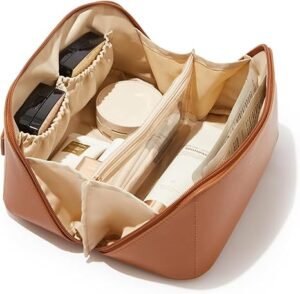
A cosmetic bag’s outer material is only part of the story. A fabric outer shell paired with a coated or wipeable lining may be enough for bathroom use and everyday beauty storage. By contrast, a coated outside with absorbent inner seams can still become messy after leaks. Structure also matters. A standing boxy bag with a firm base may keep products upright better than a soft pouch, indirectly reducing leakage risk even if both bags use similar materials.
| Material | Water Behavior | Main Strength | Main Limitation |
|---|---|---|---|
| PVC / vinyl | Often highly water-blocking at the material level | Easy to wipe, structured look | Can feel stiffer and less premium to some users |
| TPU | Strong water resistance with flexibility | Softer, clear, durable, often PVC-free | Bag still needs proper seams and closure |
| Coated nylon / polyester | Good splash protection | Lightweight and travel-friendly | Usually not fully waterproof without seam work |
| Cotton / canvas | Low natural water protection | Soft, classic look, easy sewing | Absorbs spills unless treated or lined |
Expert buying tip: When comparing two bags that both claim “waterproof,” give more weight to construction details than to the material name alone. PVC or TPU is helpful, but stitched seams and ordinary zippers can still be the weak point.
Suggested image alt: “PVC TPU coated nylon and canvas cosmetic bag materials compared for waterproof performance”
4. How to Tell If a Cosmetic Bag Is Really Waterproof
What keywords matter when you read the product description?
The safest product listings are specific. Look for terms such as welded seams, seam taped, laminated, coated lining, waterproof zipper, watertight zipper, roll-top closure, or tested water resistance. Vague phrases such as “travel-friendly,” “easy to clean,” or “durable against moisture” usually point to water resistance rather than true waterproof performance.
One good clue comes from outdoor bag standards. Sea to Summit says waterproof gear generally uses seam-taped or welded seams, and ORTLIEB attributes extreme waterproof performance to coated materials and high-frequency welding. Those are the kinds of manufacturing terms that suggest more than surface-level splash resistance.
What details can you judge from product photos?
Images can reveal more than many shoppers realize. First, inspect the seams. Visible stitched seams usually indicate a weaker barrier than welded seams. Second, examine the zipper. A regular exposed coil zipper is convenient, but it is rarely the best waterproof solution. Third, look at the material finish. A coated, bonded, or laminated surface often appears smoother and more uniform than absorbent woven fabric. Fourth, check the shape. Bags that are marketed for higher water performance often have fewer construction interruptions and cleaner joins.
| Photo Clue | What It Usually Suggests |
|---|---|
| Visible stitched seams | Likely water-resistant, not fully waterproof |
| Smooth welded seam lines | Better waterproof potential |
| Ordinary zipper without flap or seal | Likely entry point for water |
| Clear TPU or coated shell with minimal joins | Better containment and easy cleaning |
How can you test a bag after it arrives?
For consumer use, the best test is a controlled splash and wipe test, not full submersion. Place tissue inside the empty bag, zip it closed, lightly splash or mist the outside, then check whether the tissue stays dry. For internal containment, place a few drops of water in a sealed mini bottle and shake it in the bag, or use a damp cloth inside to see how the lining handles moisture. Avoid destructive tests unless the bag is marketed for heavy waterproof duty.
Case Study: Sea to Summit’s clear dry bag range uses a TPU window RF-welded into laminated nylon, and the brand positions the fully welded construction as suitable for boating and marine environments. That is a useful benchmark. If a cosmetic bag listing shows ordinary stitched seams and a standard zipper, it should not be assumed to perform like a marine dry bag just because it uses clear plastic.
Suggested image alt: “How to inspect a cosmetic bag for waterproof clues including seams zipper and coated surface”
5. Best Uses for Waterproof Cosmetic Bags
Why travel washrooms and bathroom counters benefit more from waterproof bags
Travel is one of the strongest reasons to choose a more waterproof cosmetic bag. Hotel bathroom counters are often wet. Shared sinks can be messy. Steam, splashes, and rushed packing create a higher chance of moisture exposure than at home. A bag with stronger water protection helps keep packaging clean and reduces the chance that outside moisture reaches powders, cotton items, or paper labels inside.
TSA’s liquids rule also reinforces the logic of better containment. In carry-on travel, liquids, gels, creams, and pastes must fit within the 3-1-1 rule. When multiple small liquid containers are grouped closely together, even a minor cap failure can spread quickly. A more water-safe cosmetic bag becomes not just a storage item, but a spill-management layer.
Why beach, gym, and pool environments are especially suitable
Beach bags, gym lockers, and poolside benches are classic splash zones. Sunscreen, wet swimsuits, damp towels, and humid locker rooms all increase the chance of accidental moisture contact. In these settings, waterproof or strongly water-resistant cosmetic bags are more forgiving. They protect both the cosmetics inside and the surrounding bag environment outside.
Why they are helpful for liquid skincare storage
Modern skincare routines are often liquid-heavy: essence, toner, serum, sunscreen, cleansing balm, and mini refill bottles. Even careful users experience the occasional loose cap or pump. A wipe-clean, better-sealed cosmetic bag is ideal for this type of routine because it reduces mess escalation and makes cleanup faster.
Best situations for a waterproof cosmetic bag
- Carry-on beauty kits with multiple liquids
- Beach, pool, and gym environments
- Shared bathrooms or humid travel conditions
- Skincare-heavy routines with refill bottles
- Family travel where spills are more likely
Suggested image alt: “Waterproof cosmetic bag used in travel bathroom beach and gym settings with liquid skincare inside”
6. When a Water-Resistant Bag Is Enough
Do daily commute bags really need to be fully waterproof?
Not always. If your cosmetic bag mainly lives inside a tote, sits on a dry desk, and carries a lip product, powder, mirror, and tissues, full waterproof construction may be unnecessary. In that use case, a light water-resistant fabric or lined pouch is often enough. The real benefit comes from easy wiping, moderate spill tolerance, and lighter weight.
Which users are better suited to lighter materials?
Minimalists, daily commuters, and users who carry mostly dry products often benefit more from lighter bags than from heavy-duty waterproof builds. A softer bag can be easier to fit inside handbags, less noisy, more stylish, and more comfortable in everyday use. If you do not regularly carry leaking liquids or expose the bag to wet environments, the trade-off can be worth it.
How do you balance water protection, softness, and weight?
This is the real buying decision. More waterproof construction often means more coating, more stiffness, fewer breathable textiles, and sometimes more weight. Water-resistant fabric bags usually feel softer and lighter, but they sacrifice some protection. The best choice depends on where the bag goes and what it carries.
| User Type | Better Choice | Why |
|---|---|---|
| Office commuter | Water-resistant bag | Light, soft, good enough for touch-up products |
| Frequent traveler | More waterproof bag | Better for liquids and wet environments |
| Gym or pool user | More waterproof bag | Better for splashes and damp surroundings |
| Minimal dry-product user | Water-resistant bag | No need for heavy-duty barrier features |
Expert rule of thumb: If the bag mostly protects from outside dampness, water resistance may be enough. If it must also contain internal liquid leaks, move closer to real waterproof construction.
Suggested image alt: “Lightweight water-resistant cosmetic bag compared with a heavier more waterproof travel bag”
7. How to Choose the Right Cosmetic Bag for Your Needs
Choose by use case: travel, home, or daily carry
Start with context. Travel users should prioritize wipe-clean materials, better liquid containment, and easy inspection. Home users may care more about storage capacity and shape. Daily carry users often need something softer, lighter, and easier to fit in a handbag. A good cosmetic bag is not the one with the strongest specs on paper. It is the one whose protection level matches the way you actually use it.
Choose by material: clear, stain-resistant, foldable, or structured
Clear PVC or TPU is useful for visibility and wipeability. Coated nylon offers a lighter travel option. Structured laminated materials work well for standing boxy bags. Soft fabric with treated lining can be enough for everyday use. If you care about fast visual access and spill management, clear or lightly translucent materials can be especially practical.
Choose by structure: single layer, compartmentalized, boxy, or hanging
Single-layer pouches work for minimal routines. Compartmentalized cosmetic bags are better when you carry both liquids and dry products. Boxy cosmetic bags help keep items upright and visible. Hanging bags are useful for longer travel and bathroom setups. The structure you choose can affect spill control almost as much as the material does.
Pros & Cons of waterproof vs water-resistant cosmetic bags
Waterproof-style bags: Pros
- Better for splashes, humidity, and spills
- Easier to wipe clean after leaks
- More suitable for travel and wet environments
- Often better at containing liquid product accidents
Waterproof-style bags: Cons
- Can feel stiffer and heavier
- May look more technical than fashion-oriented
- Can cost more if seams and zippers are upgraded
Water-resistant bags: Pros
- Lighter and softer for everyday use
- Often more flexible and stylish
- Enough for low-risk, dry-product routines
- Usually easier to fold and pack
Water-resistant bags: Cons
- Less reliable for liquid leaks
- May absorb moisture over time
- Harder to clean if the lining is not wipeable
If you want to compare different cosmetic bag styles, sizes, materials, or structures in one place, you can explore options at QN Bags. It is a useful reference point for buyers who want to compare transparent bags, structured bags, travel-friendly layouts, and custom solutions rather than guessing from generic marketplace photos.
Suggested image alt: “Different cosmetic bag types including clear structured foldable and hanging styles for different user needs”
8. Explore More Bag Options at QN Bags
Why material and construction options matter
If your goal is to choose the right cosmetic bag rather than simply buy the cheapest one, material and construction options matter. A transparent TPU or PVC bag solves a different problem than a quilted fabric pouch. A boxy bag with wipeable lining behaves differently from a flat cotton pouch. The more clearly you define your use case, the easier it becomes to select a bag that feels right in practice.
Why brands and buyers often need more than one type of bag
Retailers, beauty brands, and even frequent travelers often do not need one universal cosmetic bag. They may need a clear airport-friendly style, a premium daily bag, a gift-with-purchase pouch, or a structured toiletry organizer. That is why variety matters. Different materials and structures serve different moisture-risk levels.
Where to explore more cosmetic bag styles
If you want to compare a wider range of cosmetic bags by material, structure, and intended use, visit QN Bags. It is a practical starting point for anyone looking at transparent bags, stain-resistant bags, foldable pouches, structured cosmetic bags, hanging travel bags, and custom OEM or ODM possibilities.
Clear CTA: Before you buy, decide whether you need true waterproof-style protection or whether a lighter water-resistant cosmetic bag is enough. Then choose the bag around your liquids, your environment, and your travel habits—not just the product title.
Explore Cosmetic Bag Styles
Suggested image alt: “Various cosmetic bags in different materials and structures displayed for travel daily and home use”
9. Conclusion: Waterproof Depends on Material, Structure, and Construction
So, are cosmetic bags waterproof? Sometimes—but not by default. The real answer depends on material, seams, zipper type, lining, and how the bag is built as a whole. A glossy PVC pouch may resist water better than a cotton one, but it still may not be truly waterproof if the seams and zipper are ordinary. A coated fabric bag may be perfectly adequate for commuting, yet not the right choice for beach travel, humid bathrooms, or a skincare-heavy liquid routine.
The smartest way to shop is to match the bag to the job. Choose stronger waterproof-oriented construction for travel, bathroom counters, pools, gyms, and liquid-heavy kits. Choose lighter water-resistant styles for low-risk daily use. That balance gives you better performance without overpaying for protection you do not need.
Looking ahead, as beauty routines stay mobile and travel-size products continue to matter, buyers will likely care even more about wipeability, leak control, and practical construction. That makes cosmetic bag material and structure more important than ever. If you want to compare options built for different needs, start with a broader style and material reference such as QN Bags.
FAQ
1. Are cosmetic bags usually waterproof?
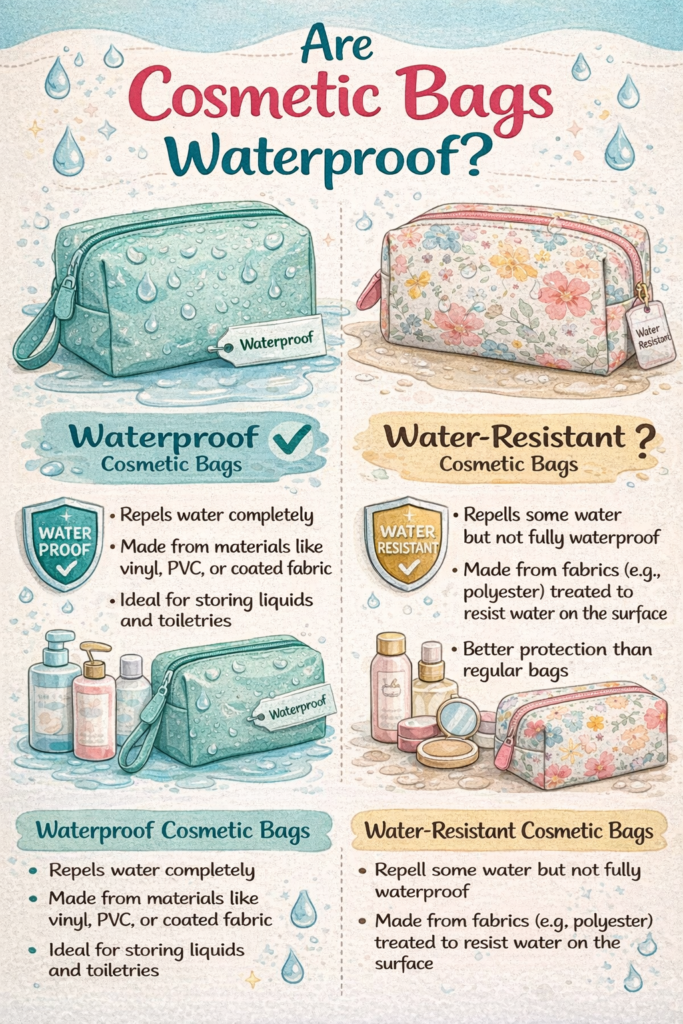
Most are not fully waterproof. Many are water-resistant or splash-resistant, which is enough for light moisture but not always enough for leaks or heavy wet conditions.
2. What is the best waterproof material for a cosmetic bag?
PVC, TPU, and some coated or laminated synthetics are strong candidates. However, the final waterproof performance still depends on seams and closures, not just the shell material.
3. Is a PVC cosmetic bag waterproof?
The PVC material itself is often highly water-blocking, but the finished bag may still not be fully waterproof if it has stitched seams or an ordinary zipper.
4. Are fabric cosmetic bags waterproof?
Usually no. Most fabric cosmetic bags are only water-resistant if treated or lined. Plain cotton and canvas are especially vulnerable to moisture absorption.
5. How can I test if a cosmetic bag is waterproof?
Place tissue inside, close the bag, and do a light splash test. Then check whether the tissue stays dry. Also inspect seams, zippers, and the inside lining after the test.
6. Is waterproof always better than water-resistant?
Not always. Waterproof-style bags are better for travel and liquids, but they may feel heavier or stiffer. Water-resistant bags can be a better fit for lighter daily routines.
7. What matters more: the material or the zipper and seams?
Both matter, but seams and zippers are often the deciding factor. A strong material can still fail if the construction lets water in or lets leaked product escape.
Suggested external source placements for your CMS:
- Introduction / market context: Circana — U.S. beauty industry growth in the first half of 2025
- Introduction / packaging context: Grand View Research — cosmetic packaging market
- Bags market context: Grand View Research — bags and containers market
- Waterproof vs water-resistant definitions: GOREWEAR
- Water-resistant fabric benchmark: Sunbrella
- Waterproof material and coated-fabric examples: Sailrite
- Welded seam and waterproof construction examples: Sea to Summit, ORTLIEB, NRS
- Travel liquid context: TSA 3-1-1 liquids rule
Tip: Insert these as contextual external links or source notes instead of filling the main body with raw URLs.
Aries Gu is the founder of Q&N. With over 17 years of experience in cosmetic bag OEM/ODM source factory. He focuses on quality control, efficient communication, and on-time delivery for global cosmetic bag projects.