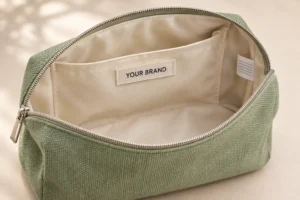
A double zip toiletry bag can give travelers a more organized way to separate skincare, grooming products, cosmetics and small accessories. For a beauty brand or private-label buyer, however, adding a second zipper is not simply a styling decision. It changes the bag’s panel layout, internal capacity, opening direction, sewing sequence, reinforcement needs and final cost.
One point often causes confusion during product development: a double-zip design does not always mean a double-compartment design. Two zipper openings may lead to two independent storage areas, or they may provide separate access points to one shared interior. A single zipper can also have two sliders, which is a different construction again.
This guide explains how to specify a double compartment toiletry bag or dual zip wash bag accurately. It covers storage layouts, zipper placement, material and lining choices, customization options, sample development and the practical checks buyers should complete before placing a bulk order.
Planning a custom design? Share a reference photo, intended contents, target dimensions and estimated quantity with the Q&N cosmetic bag development team. Clear product requirements make it easier to assess the structure before sampling.
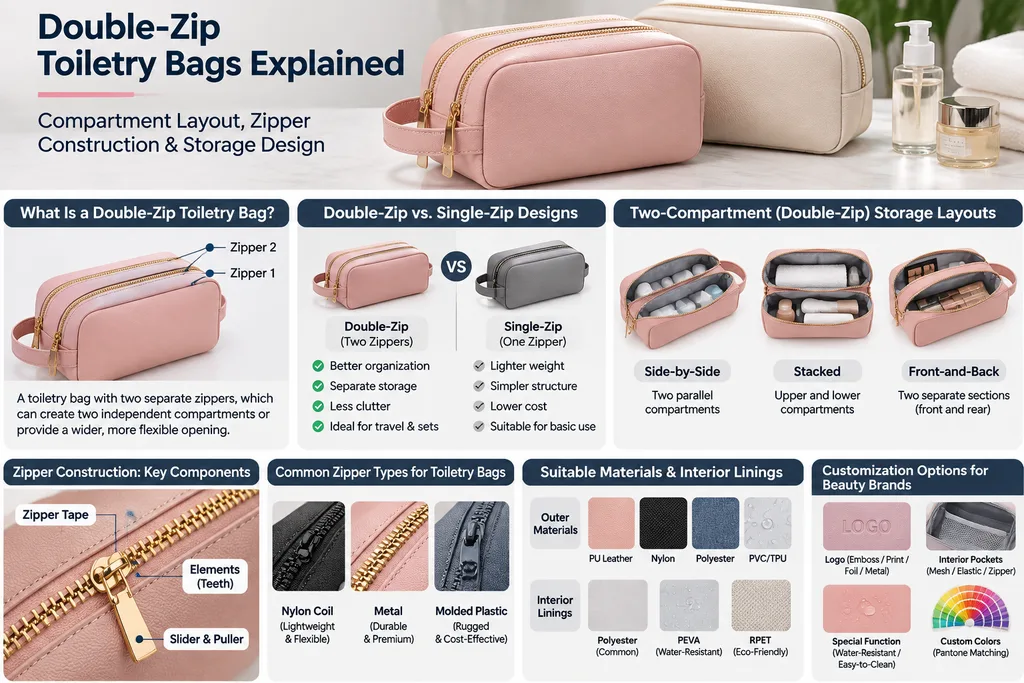
What Is a Double-Zip Toiletry Bag?
Understanding the Meaning of “Double Zip”
A double-zip toiletry bag generally has two zipper openings or tracks. They may serve separate compartments or provide access to different sections of a shared interior.
In product listings, the terms double zip toiletry bag, dual zip wash bag and two compartment toiletry bag are sometimes used loosely. Buyers should therefore describe the physical construction rather than rely on the product name alone.
In a manufacturing specification, state:
- How many zipper tracks the bag has.
- Whether each zipper opens an independent compartment.
- Whether the compartments share a divider or a common cavity.
- Where each opening is positioned.
- Whether the sliders are single-pull or double-pull.
- Whether the compartments need to remain separate when the bag is carried or laid flat.
Double Zipper, Double Compartment and Two-Way Zipper Are Different
These terms describe different features and should not be treated as interchangeable.
| Term | What It Usually Describes | What the Buyer Should Confirm |
|---|---|---|
| Double-zip bag | Two separate zipper openings or tracks on one bag | Whether the openings lead to separate or shared storage areas |
| Double-compartment bag | Two defined storage sections, which may have one or more closures | How the divider is built and whether the sections are isolated |
| Two-way zipper | One zipper track operated by two sliders, often opening from either end | Slider travel, meeting position and opening direction |
| Double-pull zipper | A zipper slider with a pull tab on both sides or two pull tabs | Whether the pull arrangement is needed for access or appearance |
A product can combine these features. For example, a toiletry bag may have two independent compartments, each fitted with a two-way zipper. That is more specific than simply calling it a double-zip bag.
Double-Zip vs. Single-Zip Designs
How the Storage Experience Changes
A single-zip toiletry bag has one main access point. It is often efficient for a simple pouch or for larger items that need one continuous storage area.
A double-zip design adds another access route. It can separate product categories or make small items easier to retrieve, provided each opening is large enough and well positioned.
| Design Factor | Single-Zip Toiletry Bag | Double-Zip Toiletry Bag |
|---|---|---|
| Access | One main opening | Two access points or separate openings |
| Organization | Usually one main storage area, with optional internal pockets | Can provide two defined storage zones |
| Construction | Generally fewer zipper and panel operations | More zipper placement, joining and reinforcement details |
| Capacity | Often offers a more continuous cavity | Capacity is divided according to the compartment layout |
| Best suited to | Simple kits, compact pouches and fewer product types | Organized travel kits, grooming sets and multi-category storage |
| Potential drawback | Contents may mix together | Dividers and zipper construction can reduce usable space |
Pros and Cons for Product Developers
Potential advantages
- Separate storage for different product categories.
- More convenient access to frequently used items.
- Better organization for travel or multi-piece gift sets.
- More opportunities to add mesh pockets, elastic loops or dedicated storage zones.
- A differentiated design for a brand’s travel accessory range.
Potential limitations
- Additional zipper components and sewing operations can raise the unit cost.
- Two compartments may reduce the usable volume of each section.
- More seams and zipper ends create additional points that need reinforcement.
- A poorly planned opening can make one compartment difficult to access.
- Extra structure can add weight or make the bag bulkier when packed.
Two-Compartment Storage Layouts
Side-by-Side Compartments
In a side-by-side layout, two sections sit next to each other with a central divider or shared panel. Each has its own opening, making the format useful when users need to separate product groups within a compact footprint.
For example, one side could hold skincare bottles while the other stores makeup, brushes or grooming accessories. The designer should check the width of each compartment after the divider, lining and seam allowances are included. The outside dimensions alone do not show the usable capacity.
Stacked or Front-and-Back Compartments
A stacked layout places one compartment above or behind another. The secondary section can hold flatter items such as cotton pads, sachets, combs or small accessories.
Consider how the bag rests on a counter. If the front pocket is heavily loaded, it may pull the bag forward. If the rear compartment is too deep, the user may have difficulty seeing or reaching items at the bottom.
Main Compartment Plus a Secondary Pocket
Not every second zipper needs to create a fully separate chamber. A main compartment plus a zippered front or side pocket may be sufficient when the purpose is to keep small items accessible.
This is often a more economical alternative to a full internal divider. It also avoids splitting the main storage volume into two smaller spaces. However, buyers should not describe this construction as two fully independent compartments if the pocket is shallow or shares the main cavity.
Wet-and-Dry or Clean-and-Used Separation
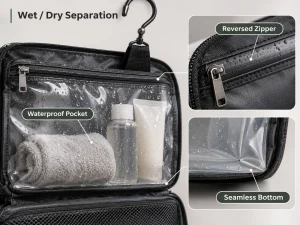
Some travel and wellness concepts use separate compartments for clean and used accessories, or for dry items and products that may be damp. This requires more than adding a second zipper. The buyer must decide whether the compartments need a water-resistant lining, a wipe-clean surface, a removable pouch or a specific closure arrangement.
A standard zipper is not automatically leakproof. If the product is intended to contain liquid or prevent leakage, the complete construction—including fabric, seams, zipper area and closure—must be evaluated against a defined test requirement.
| Layout | Typical Contents | Key Design Question |
|---|---|---|
| Side-by-side | Skincare on one side, makeup or grooming items on the other | Is each compartment wide and deep enough after the divider is sewn? |
| Stacked | Large items in the main section, small accessories in the upper section | Can the user reach the lower compartment easily? |
| Main plus front pocket | Main toiletry products plus small daily essentials | Is the secondary pocket deep enough to be useful? |
| Wet-and-dry separation | Dry products and damp accessories | What level of water resistance is actually required? |
Zipper Placement and Construction
Top, Parallel, U-Shaped and Perimeter Openings
Zipper position determines the opening width and how easily users can see the contents.
- Top opening: A straightforward option for a pouch that opens from the top. It is suitable when the contents can be reached without exposing the full side panels.
- Parallel zipper openings: Two zipper tracks run in the same general direction, often serving separate compartments. Their spacing must leave enough room for seams and structural panels.
- U-shaped opening: The zipper follows part of the bag’s perimeter, allowing a wider opening. It can improve access but requires careful corner construction.
- Perimeter or wraparound opening: The zipper travels around a larger portion of the body. This can create a clamshell-style opening, but the zipper path and panel flexibility must be tested in a sample.
For a double-zip design, check that the two zipper paths do not collide at corners, overlap awkwardly or leave too little material between them. The zipper opening should also remain usable when the bag is filled.
Know the Main Parts of a Zipper
A conventional zipper has three basic components: tape, elements or teeth, and slider. The slider engages or separates the elements, while the tape is sewn into the bag panels.
YKK explains these components and how the slider joins or separates the zipper elements in its technical introduction to zipper construction. See YKK’s guide to zipper structure.
For buyers, the practical lesson is that zipper performance is not determined by the slider alone. Tape quality, element alignment, slider compatibility, sewing accuracy and the shape of the finished opening all matter.
Coil, Metal and Molded Plastic Zippers
Different zipper types create different visual and functional effects. The best choice depends on the bag material, opening curve, intended load, brand positioning and target price.
| Zipper Type | Typical Characteristics | Potential Applications | Buyer Considerations |
|---|---|---|---|
| Nylon coil | Flexible chain that can follow curved openings | Soft toiletry bags, travel pouches and lightweight organizers | Check coil size, slider compatibility and tape color |
| Metal | Distinctive visible teeth and a more substantial appearance | Fashion-led or premium-looking cosmetic and toiletry bags | Check weight, finish, corrosion requirements and curve behavior |
| Molded plastic | Individual molded elements with a sportier or more technical look | Travel, outdoor-inspired and utility-focused designs | Check flexibility, tooth engagement and compatibility with the design |
Do not select a zipper by appearance alone. A large decorative zipper may look appropriate on a product image but could be unnecessarily heavy for a small pouch. A very small zipper may be difficult to operate when the compartment is packed tightly.
Single Slider, Double Slider and Two Separate Zippers
These configurations should be specified separately:
- One slider on each of two zipper tracks: Common when each compartment has its own opening.
- Two sliders on one zipper track: Allows the user to open the same track from either end or bring the sliders together at a selected point.
- Two independent zipper tracks with double sliders: Provides separate access to two sections, with two sliders on each track if the design requires them.
Confirm the slider count and starting position in the technical drawing. A written note such as “double zipper” is not precise enough for bulk production.
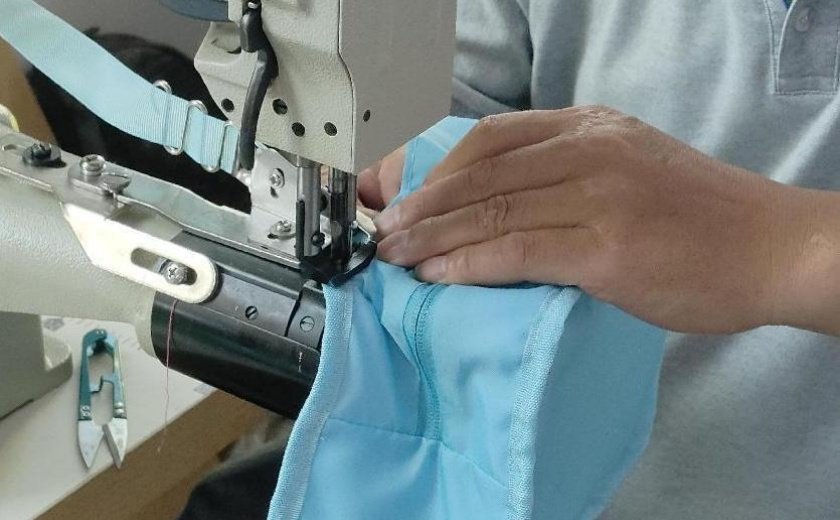
Reinforcement, Seam Allowance and Zipper-End Finishing
Two zipper openings mean more zipper ends and more points where the tape meets the bag structure. These areas should be secured so that repeated pulling does not cause the tape to separate from the panel.
Common construction considerations include:
- Reinforcing zipper ends and corners where stress is concentrated.
- Keeping the zipper tape flat without twisting or puckering.
- Preventing lining fabric from entering the slider path.
- Controlling seam bulk where two zipper panels meet.
- Checking that the opening does not distort when the compartment is filled.
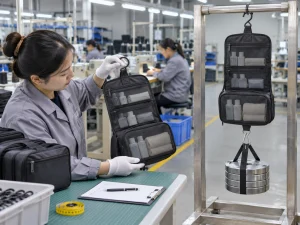
YKK’s published testing methods describe zipper strength checks such as chain crosswise strength, top-stop holding strength and slider pull-off strength. These methods illustrate why zipper and attachment performance should be evaluated as a system rather than by appearance alone. See YKK zipper testing methods.
Suitable Materials and Interior Linings
Outer Materials for Different Product Positions
Outer material affects appearance, hand feel, weight, structure and sewing behavior. A soft pouch and a structured case may need different materials even with the same compartment layout.
| Outer Material | Design Strength | Points to Review |
|---|---|---|
| Polyester | Versatile, available in different textures and weights | Confirm fabric density, coating if any, color consistency and seam performance |
| Nylon | Useful for lightweight, travel-oriented products | Check hand feel, backing, abrasion needs and compatibility with the logo method |
| PU leather | Creates a smooth, structured or premium appearance | Check flexibility around zipper curves, surface finish and needle-hole visibility |
| Canvas or cotton | Offers a natural textile appearance and can support casual or lifestyle positioning | Review weight, shrinkage, lining support and edge finishing |
| Clear PVC or TPU | Allows users to see contents and supports wipe-clean concepts | Check clarity, thickness, fold marks, seam construction and odor requirements |
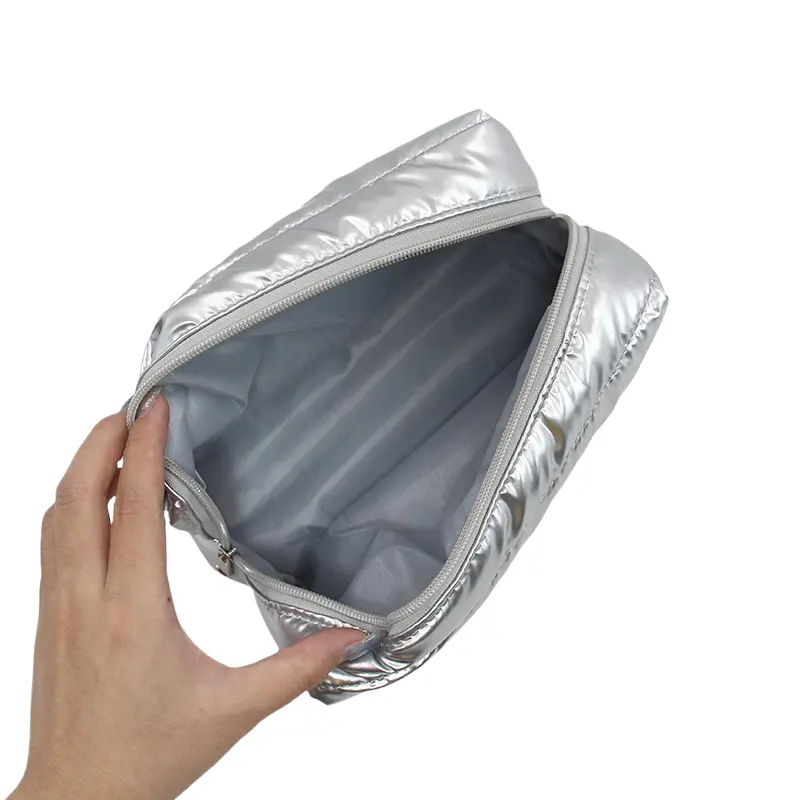
| Quilted or padded fabric | Adds softness and a more protective feel | Allow for extra thickness at zipper seams and compartment dividers |
Choosing a Lining for Each Compartment
The lining should support the intended use of the compartment. A main section designed for bottles may need a wipe-clean surface, while a secondary section for brushes or small accessories may prioritize a soft hand feel and easy cleaning.
Possible lining options include polyester, nylon, mesh and coated materials. Mesh can help users see smaller contents, but an open mesh divider does not create liquid separation. A coated lining may be easier to wipe, but its performance depends on the coating, seams and construction.
Balance Material Thickness With the Zipper Structure
Each zipper opening creates a layered seam. The outer fabric, lining, zipper tape, binding and any foam or reinforcement may all meet in the same area. A thick outer material can make the zipper edge bulky, especially where two openings sit close together.
Ask the manufacturer to evaluate the full material stack at the zipper seam. The goal is a clean edge and smooth operation, not simply the heaviest material available.
Customization Options for Beauty Brands
Compartment Dimensions and Internal Features
Start customization with the contents. Define each compartment’s purpose, then set its dimensions, divider position and opening length.
Possible features include:
- Elastic loops for travel-size bottles or grooming tools.
- Mesh pockets for small accessories.
- Flat zip pockets for cotton pads, sachets or personal items.
- Removable dividers for flexible storage.
- Clear windows for product visibility.
- Wipe-clean lining for selected sections.
- Carry handles, side tabs or hanging loops.
Every added feature uses space and may require additional sewing operations. Check the usable volume after all pockets and dividers are installed.
Logo, Zipper Puller and Trim Customization
A double-zip toiletry bag provides more than one possible branding location. A logo may be placed on the front panel, a side panel, a zipper puller or a woven label. The best position depends on the bag shape and how the two openings are arranged.
Common private-label options include screen printing, heat transfer, embroidery, woven labels, rubber patches, metal logos, embossing and debossing. A custom zipper puller can also make the product more distinctive, but it should be sized so that it remains comfortable to grip and does not catch on the adjacent zipper.
Q&N lists these logo processes and supports customization of materials, lining, zippers, pullers, handles, pockets and internal structures. Buyers can review the custom cosmetic bag OEM/ODM service and browse the custom cosmetic bag product collection before preparing a project brief.
What Buyers Should Consider Before Ordering
Prepare a Product Brief Before Requesting a Quote
A useful inquiry gives the manufacturer enough detail to assess the pattern, materials and production steps. Include:
- Product purpose: Travel toiletry bag, skincare organizer, grooming kit, hotel amenity bag or beauty gift set.
- Reference: Photos, sketches, competitor samples or an existing tech pack.
- Dimensions: Finished length, height and depth, plus the dimensions of the largest intended contents.
- Compartment layout: Two independent sections, main compartment plus front pocket, side-by-side or stacked layout.
- Zipper details: Number of tracks, zipper type, slider count, puller style and opening direction.
- Materials: Outer fabric, lining, reinforcement, binding and any transparent or coated components.
- Branding: Logo artwork, position, size and preferred technique.
- Order details: Target quantity, color assortment, packaging and delivery destination.
Confirm the Usable Capacity, Not Only the Outside Size
Identical external dimensions can hide different usable capacities because dividers, lining, foam, zipper seams and pockets all occupy space.
For bottle-based kits, create a simple product loading plan. Place the largest items first, then check whether smaller products can be added without forcing the zipper or distorting the bag. Include room for the user’s fingers to remove the items.
Approve a Sample With Both Compartments Fully Tested
Evaluate the sample as an end user would: open each zipper, load both compartments, check divider stability and confirm that neither section collapses or distorts the zipper tracks.
Do not approve a sample based only on an empty product photograph. The filled condition often reveals issues that are not visible when the bag is flat.
Build a Practical Zipper and Function Checklist
| Inspection Point | What to Check |
|---|---|
| Zipper operation | Each opening travels smoothly without catching the lining or binding at corners |
| Slider and puller | Correct slider count, secure puller attachment and comfortable grip |
| Zipper alignment | Tracks are straight or follow the approved curve without twisting |
| Zipper ends | Ends are secured and do not show open seams or loose tape |
| Compartment separation | Divider and seams create the intended storage layout |
| Capacity | Both compartments hold the approved contents without excessive distortion |
| Lining | No trapped fabric, loose lining or interference with slider movement |
| Appearance | Outer panels, logo, color and hardware match the approved sample |
Understand Sampling, MOQ and Production Timing
Sampling and bulk lead time depend on materials, custom components, construction, quantity and approvals. Two zipper tracks, a divider, custom pullers and multiple linings require more coordination than a simple pouch.
Q&N’s published company information states a regular sample lead time of 7–14 days and a typical bulk production period of 30–45 days after sample approval and deposit. The site also lists a regular MOQ that is usually 1,000 pieces per style, with final terms depending on material, color, size, logo and packaging requirements. Confirm the current schedule and MOQ for the exact double-zip design when requesting a quotation. See Q&N’s manufacturing capabilities and ordering process.
Frequently Asked Questions About Double-Zip Toiletry Bags
Is a Double-Zip Toiletry Bag the Same as a Double-Compartment Toiletry Bag?
No. A double-zip bag has two zipper openings or tracks, while a double-compartment bag has two defined storage sections. The two features can be combined, but two zipper openings do not automatically prove that the interior is fully separated.
What Is the Difference Between a Dual-Zip Wash Bag and a Two-Way Zipper Bag?
A dual-zip wash bag usually refers to a bag with two zipper openings. A two-way zipper usually means one zipper track operated by two sliders. Confirm the track count and slider count in the product specification to avoid confusion.
Are Two Compartments Better Than One for a Travel Toiletry Bag?
They can be better when users need to separate product categories or access smaller items without opening the main section. A single compartment may be more practical for bulky bottles or products that need one continuous storage space.
Which Zipper Type Is Best for a Double-Compartment Toiletry Bag?
There is no universal best option. Nylon coil zippers are flexible for many soft bag constructions; metal zippers provide a distinctive appearance; molded plastic zippers can suit utility or sporty designs. The right choice depends on the material, opening curve, product weight, appearance and required performance.
Can a Double-Zip Toiletry Bag Be Waterproof?
It can be designed with water-resistant materials and construction, but two zippers do not make a bag waterproof. Buyers must specify the intended level of protection and evaluate the outer material, lining, seams, zipper area and closure together.
Does Adding a Second Zipper Increase the Manufacturing Cost?
It usually adds components and production operations, but the exact cost impact depends on zipper type, length, compartment construction, reinforcement, lining and order quantity. A shallow secondary pocket may cost less to develop than a fully separated second compartment.
What Should I Send a Factory to Develop a Custom Double-Zip Toiletry Bag?
Send reference photos or a sketch, finished dimensions, intended contents, compartment layout, zipper configuration, material and lining preferences, logo artwork, target quantity, packaging requirements and delivery country. If possible, include physical dimensions or samples of the bottles and accessories the bag must hold.
Final Recommendations for Buyers Developing a Double-Zip Toiletry Bag
A successful double zip toiletry bag starts with a clear storage purpose. Decide whether the product needs two independent compartments, a main compartment plus a secondary pocket, or simply two access points to one interior. Then develop the zipper paths, divider, materials and lining around the actual contents.
Before approving bulk production, confirm the following:
- The zipper count, track layout and slider configuration are clearly specified.
- Each compartment has enough usable space for its intended contents.
- The divider and lining do not interfere with zipper operation.
- Zipper ends, corners and attachment seams are properly constructed.
- The filled sample is comfortable to open, close, carry and store.
- Logo, colors, hardware and packaging match the approved references.
- MOQ, sample timing, bulk lead time and inspection requirements are confirmed in writing.
For brands developing a new travel accessory range, Q&N supports OEM/ODM cosmetic and toiletry bag development, including material selection, compartment layout, lining, zipper and puller customization, logo application, sampling, bulk production and final inspection.
Request a custom development review: Send your product type, dimensions, reference photos or tech pack, material requirements, logo file, target quantity, packaging requirements, delivery country and target delivery date through the Q&N contact page. The team can review the proposed structure and advise on the next sampling and quotation steps.
Aries Gu is the founder of Q&N. With over 17 years of experience in cosmetic bag OEM/ODM source factory. He focuses on quality control, efficient communication, and on-time delivery for global cosmetic bag projects.