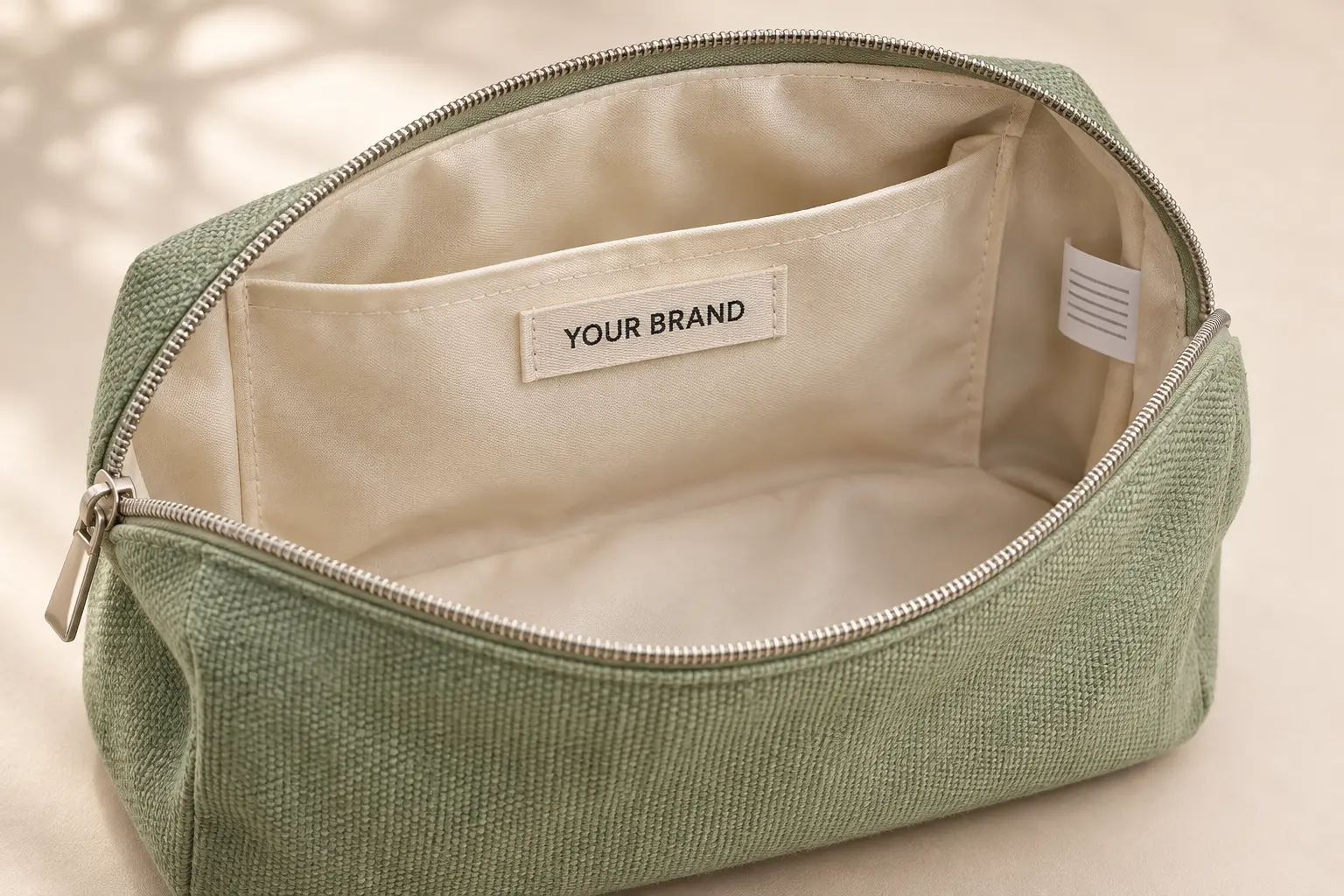
Custom cosmetic bags for brand collaborations give beauty companies a physical way to bring two brand identities together. A well-developed co-branded bag can support a product launch, create a limited retail offer, add value to a gift-with-purchase program, or become a useful keepsake after a campaign ends. The challenge is that a collaboration involves more than placing two logos on one pouch. The brands must agree on the product concept, visual hierarchy, materials, color standards, artwork rights, sample approvals, quantity, packaging and launch schedule.
For a buyer, an unclear brief can lead to repeated samples, inconsistent brand colors, artwork disputes or a product that looks attractive but does not suit the beauty items inside. This guide explains how to plan a co-branded cosmetic bag from the first concept to bulk delivery. It is written for beauty brand managers, product developers, retailers, promotional buyers and private-label teams working with an OEM/ODM manufacturer.
If you are preparing a collaboration project, start by reviewing the available custom cosmetic bag product categories. You can use existing shapes as a starting point, then adjust the material, dimensions, compartments, colors, logos and packaging to fit the campaign.
Why Beauty Brands Create Co-Branded Cosmetic Bags
Give a Collaboration a Useful Physical Product
A co-branded cosmetic bag is more than a surface for displaying two logos. It can become a reusable accessory that connects the partner brands with a daily beauty routine. Unlike a paper insert or a short-lived promotional item, a pouch can continue to be used for makeup, skincare, travel or personal-care storage after the original campaign.
That practical role matters when the collaboration includes products with different usage occasions. A skincare brand and a travel retailer, for example, may need a pouch that stores bottles upright. A makeup brand working with a fashion label may prefer a compact shape that feels like an accessory rather than secondary packaging.
Create a Distinctive Limited-Edition Offer
Limited editions can give shoppers a clear reason to pay attention to a launch. McKinsey’s 2026 State of Beauty report discusses how social commerce can benefit from perceived product scarcity, limited-edition drops and time-sensitive launches. This is a useful strategic context for collaboration planning, but it does not mean every limited-edition accessory will sell out. The concept still needs a relevant audience, a clear product proposition and a realistic quantity plan.
A custom bag can make the limited element tangible. The exclusivity may come from a special print, a seasonal color, a numbered hangtag, a unique logo treatment, a distinctive lining or a combination of details that will not be repeated in the standard collection.
Support Gift-with-Purchase and Retail Programs
Beauty brands often use accessories to make a qualifying purchase feel more complete. A co-branded pouch can be included with a selected skincare set, fragrance purchase, makeup bundle or retailer-exclusive offer.
The bag must be designed around the commercial mechanics of the offer. Confirm whether it is included with every qualifying order, reserved for a minimum spend, sold as a separate item or distributed through selected stores. These decisions influence the target unit cost, packaging, barcode needs and production quantity.
Reach a Partner’s Audience
A collaboration can introduce a beauty brand to customers who already follow a fashion label, artist, hotel group, lifestyle retailer or creator. The bag acts as a shared product touchpoint. However, the product should make sense to both audiences. A partner’s visual identity alone is not enough if the pouch does not fit the customers’ routines or the beauty products being promoted.
| Business Objective | Useful Bag Concept | Buyer Decision |
|---|---|---|
| Brand awareness | Everyday pouch with clear co-branding | Which logo or visual element should be most visible? |
| Limited-edition launch | Exclusive color, print, trim or lining | What makes this version meaningfully different? |
| Gift-with-purchase | Practical bag sized around a product bundle | What purchase threshold and unit cost must the offer support? |
| Retail-exclusive collection | Coordinated bag and beauty product set | What are the store, barcode and packaging requirements? |
| Creator or artist project | Signature artwork or recognizable motif | Who approves artwork and how may it be used? |
Popular Collaboration Models and Limited-Edition Concepts
Beauty Brand × Beauty Brand
Two beauty companies may combine complementary categories, such as skincare and makeup, haircare and body care, or fragrance and personal care. The bag can hold products from both brands in one coordinated kit.
For this model, the product architecture should reflect the contents. A brush-focused set may need a wipe-clean lining and narrow brush slots. A skincare set may need a wider gusset and a structured base for bottles. A fragrance gift may require protective inserts or a separate compartment to reduce bottle movement.
Beauty Brand × Fashion or Lifestyle Brand
A fashion or lifestyle partner can contribute a recognizable pattern, color language, illustration style or hardware detail. The beauty brand may lead the product selection while the partner contributes the visual direction.
One public example is the Sephora Collection collaboration with Brother Vellies. Sephora announced three limited-time makeup bag designs developed with the fashion brand. The project shows how a partner’s design identity can be translated into a small range of makeup bags rather than being limited to a logo placement. The announcement does not publish production volumes or sales results, so it should be treated as a design and positioning example, not evidence of a guaranteed commercial outcome.
Reference: Sephora Collection × Brother Vellies collaboration announcement.
Beauty Brand × Artist or Illustrator
An artist-led collaboration can use original illustrations, hand-painted motifs, graphic patterns or a signature color palette. In this case, the artwork itself may be the main reason customers recognize the limited edition.
Rifle Paper Co. and Clinique provide a useful public example. Their gift-with-purchase collection featured exclusive zipper pouches using 12 signature Rifle Paper Co. patterns, offered with qualifying purchases through participating retailers. The partnership demonstrates how a distinctive pattern library can create variation while keeping a consistent pouch format.
Reference: Rifle Paper Co. × Clinique gift-with-purchase collection.
Beauty Brand × Retailer or Hotel Group
A retailer-exclusive collaboration may need a product designed around a store’s customer profile, price architecture and merchandising space. A hotel or travel partner may need a compact amenity pouch, a wash bag or a travel-ready beauty kit.
These projects often require more attention to packaging and logistics. Confirm whether products will be packed individually, assembled into a kit, labeled for a specific retailer or shipped to multiple distribution locations.
Choose a Collaboration Format Before Designing
| Collaboration Model | Design Focus | Typical Product Direction | Planning Complexity |
|---|---|---|---|
| Beauty × Beauty | Complementary routines and product fit | Multi-compartment pouch or coordinated set | Medium |
| Beauty × Fashion | Distinctive visual identity and styling | Printed, textured or fashion-led cosmetic bag | Medium to high |
| Beauty × Artist | Artwork fidelity and usage rights | Exclusive print or illustrated pouch | High when artwork has many colors or details |
| Beauty × Retailer | Retail requirements and price point | Retail-ready pouch or gift set | Medium to high |
| Beauty × Hotel/Travel | Function, compact packing and durability | Amenity pouch or travel wash bag | Medium |
How to Combine Two Brand Identities in One Cosmetic Bag
Agree on Brand Roles Before Artwork Starts
Two logos do not automatically have equal importance in every collaboration. One brand may own the product concept while the other contributes the artwork. In another project, the two partners may share equal visibility.
Before creating a mockup, agree on:
- Which brand leads the product name and product description.
- Whether both logos have equal visual weight.
- Which brand controls the main color palette.
- Whether the partner’s artwork can be modified, cropped or repeated.
- Where each logo may appear: front, back, lining, zipper pull, hangtag or packaging.
- Who gives final approval for samples and production artwork.
Set a Clear Logo Hierarchy
Putting two large logos on the front panel can make a small cosmetic bag look crowded. A more controlled layout may use one primary logo on the front and a secondary mark on the back, lining or zipper pull. Another option is to use a shared graphic on the body and place both wordmarks on a woven label or hangtag.
The correct hierarchy depends on the collaboration agreement. Do not assume that the more prominent logo should always belong to the company paying for production. The brands should approve the visual relationship before sampling.
Use a Shared Design Element to Connect the Brands
A shared design element can make a collaboration feel intentional. It might be a coordinated color, a pattern that incorporates both identities, a custom zipper pull, a contrast binding or a lining that references the partner’s signature style.
For example, a skincare brand known for restrained packaging could work with an illustrator whose style is colorful. The outer bag might use a neutral base, while the lining and zipper pull introduce the artist’s colors. This creates a visible connection without forcing both identities into the same small logo area.
Protect Logo Legibility at the Actual Production Size
Artwork that looks clear on a computer screen may become difficult to reproduce on a small pouch. Fine lines, tiny text, gradients and closely spaced elements can lose definition when printed, embroidered or woven.
Ask the factory to review the artwork at the actual logo dimensions and on the intended material. A digital mockup is useful for layout approval, but a physical strike-off or sample is needed to evaluate the final effect.
Confirm Brand Approval and Usage Rights
Both parties should confirm that the project has permission to use the names, logos, illustrations and other protected assets. The written collaboration or licensing agreement should define the approved products, territory, sales channels, campaign period, permitted artwork versions and approval process.
The USPTO explains that trademarks identify the source of goods or services and help distinguish one business from another. Its trademark guidance is a useful starting point for understanding why brand marks should not be treated as freely reusable design elements. For a cross-brand project, obtain approval from the relevant rights holders and seek legal advice where the agreement or market requires it.
Reference: USPTO: What is a trademark?.
Custom Materials, Colors, Structures and Logo Placement
Select Materials According to the Collaboration’s Positioning
Material selection affects appearance, perceived value, product protection, weight, cleaning and unit cost. A premium fragrance collaboration may call for PU leather, velvet or a structured textile. A travel-focused partnership may prefer nylon, polyester or coated fabric. An artist collaboration may need a surface that reproduces detailed prints accurately.
| Material | Visual Character | Functional Considerations | Potential Collaboration Use |
|---|---|---|---|
| Polyester | Versatile, smooth and available in many finishes | Works with a broad range of prints and bag structures | GWP programs, retail pouches, seasonal collections |
| Nylon | Technical and travel-oriented | Lightweight options; coating and lining can be specified | Travel, active beauty and grooming collaborations |
| Canvas or cotton | Natural, casual and tactile | Print, weight, shrinkage and lining should be checked | Artist, lifestyle and everyday-use collaborations |
| PU leather | Structured and polished | Thickness, backing, surface finish and seam construction matter | Premium skincare, fragrance and fashion partnerships |
| Velvet or plush textile | Soft, decorative and gift-oriented | Surface direction, marking and logo clarity need sampling | Holiday, fragrance and limited-edition gift projects |
| PVC or TPU | Transparent or translucent, modern appearance | Film thickness, odor, seams and closure design need evaluation | Travel kits, visibility-led retail sets and promotional projects |
| Neoprene | Sporty, soft and padded | Thickness, edge finishing and print method affect the result | Wellness, fitness and active-lifestyle partnerships |
These are design directions rather than universal performance guarantees. The exact grade, thickness, coating, lining and construction should be confirmed with the manufacturer and tested on a representative sample.
Coordinate Brand Colors Across Different Materials
One of the most common challenges in co-branded cosmetic bags is matching the same color across materials. A Pantone reference can guide the target, but a printed polyester fabric, PU surface, webbing and metal component will not necessarily look identical. Their texture, reflectivity, base color and production process affect the final appearance.
For better control:
- Confirm the color reference and whether it is a coated or textile target where applicable.
- Identify which bag components need a close match and which can use complementary colors.
- Request material swatches or lab dips before finalizing the sample.
- Review the complete sample under consistent lighting.
- Record the approved reference and tolerance in the purchase specification.
Choose a Structure That Fits the Product Set
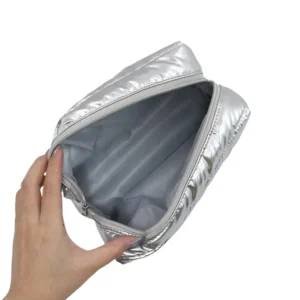
Common options include flat zipper pouches, boxy cosmetic bags, wide-opening vanity cases, double-compartment organizers, brush bags and transparent travel pouches.
A flat pouch may be suitable for a lipstick and mini-product offer. A boxy bag can hold bottles and jars more securely. A wide-opening structure improves visibility when the customer needs to access several products. A brush pouch may need a separate flap or wipe-clean section to protect the bristles.
Plan Logo Placement by Manufacturing Method
Different branding methods suit different surfaces. Screen printing works well for many flat textile or coated surfaces. Heat transfer can reproduce more detailed artwork when the material and transfer system are compatible. Embroidery creates texture but may not suit very fine artwork or thin materials. Woven labels and metal plates can add a separate brand detail without printing directly onto the main panel.
| Branding Method | Suitable Direction | Buyer Should Check |
|---|---|---|
| Screen printing | Solid logos and simple graphics | Ink adhesion, color match, print position and artwork detail |
| Heat transfer | Detailed graphics or multi-color artwork, subject to material compatibility | Heat tolerance, adhesion, edge finish and wash/abrasion expectations |
| Embroidery | Textured, premium or simple logo treatments | Stitch density, backing, puckering and small-letter legibility |
| Woven label | Small brand marks and secondary identification | Label dimensions, fold type, edge finish and attachment position |
| Rubber patch | Raised, sporty or tactile branding | Patch flexibility, edge adhesion and attachment method |
| Metal logo plate | Premium hardware-led details | Plating, sharp edges, corrosion expectations and secure fixing |
| Custom zipper pull | Subtle brand detail repeated across a collection | Puller size, mold requirements, finish and zipper compatibility |
Q&N’s OEM/ODM custom service lists polyester, nylon, canvas, cotton, PU, PVC, TPU, neoprene, recycled fabrics and other material options. Its published logo methods include printing, embroidery, embossing/debossing, woven labels, rubber patches, metal logos and zipper-pull branding. The final method should be selected after reviewing the artwork and actual bag surface.
How to Match Cosmetic Bags with Beauty Product Collections
Map the Contents Before Confirming Bag Dimensions
Start with the actual products, not an assumed standard pouch size. Ask the beauty team for the dimensions of each item, including caps, pumps, droppers and outer cartons if the products will be packed in retail packaging.
Measure the largest item and identify fragile or leak-sensitive components. Then add practical clearance for inserting and removing products. A bag that fits the products only when tightly compressed may be difficult to use and may distort during packing.
Choose Compartments Around the Beauty Routine
The internal layout should reflect how the customer uses the products. A daily makeup set may need a main compartment and a brush pocket. A skincare routine may benefit from elastic bottle holders, mesh pockets or a wipe-clean lining. A fragrance set may require individual separation to reduce contact between glass containers.
Match the Bag Format to the Offer Type
| Beauty Collection | Suggested Bag Format | Useful Internal Features |
|---|---|---|
| Mini makeup collection | Flat or small boxy pouch | Main compartment, easy-open zipper |
| Skincare routine set | Structured or wide-opening bag | Bottle holders, gusset, wipe-clean lining |
| Brush and complexion set | Brush pouch or organizer | Brush sleeves, protective flap, separate pocket |
| Fragrance gift collection | Structured pouch or presentation case | Protective insert, divided storage, secure closure |
| Travel beauty kit | Compact toiletry bag | Lightweight construction, multiple pockets, easy-clean lining |
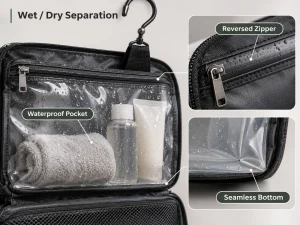
| Haircare collaboration | Medium wash bag or drawstring pouch | Room for bottles, accessories and wet/dry separation if required |
Consider the Customer’s Second Use
A bag that is useful only for the original gift set may have limited life after the campaign. Consider whether the customer could reuse it as a travel pouch, handbag organizer, brush holder or everyday skincare bag.
That second use should influence material, size and structure. A reusable travel pouch needs more attention to zipper quality, seam strength and lining than a simple outer sleeve intended only for presentation.
Review the Complete Set as a Retail Product
Before approval, assemble the actual beauty products inside the sample bag. Check whether the set closes without pressure, whether the products remain organized, whether the logo is visible and whether the bag looks balanced when displayed beside the beauty products.
Mid-project planning tip: Send the manufacturer the product list, bottle dimensions, reference images and target quantity before the first sample. Q&N can review bag shapes and material directions through its custom cosmetic bag manufacturing page.
Sampling, Artwork Approval and Product Quality Control
Prepare a Collaboration Brief
A complete brief helps both brand teams and the manufacturer work from the same information. It should include:
- Names of the participating brands and the project owner.
- Target customer, sales channel and campaign purpose.
- Bag type, finished dimensions and reference images.
- Beauty products or accessories that the bag must hold.
- Outer material, lining, padding, zipper and hardware preferences.
- Color references for each component.
- Approved logos, artwork files and logo placement.
- Packaging, barcode, hangtag and carton requirements.
- Target quantity, destination country and required delivery date.
Separate Artwork Approval from Physical Sample Approval
Artwork approval confirms the visual file, colors, scale and placement. Physical sample approval confirms how that artwork and the chosen materials look on the actual bag.
These are different decisions. A logo may be approved on a digital mockup but appear too small on a textured fabric. A printed pattern may look balanced on a flat artwork sheet but become misaligned where the bag panels meet.
Use a Clear Sample Approval Sequence
- Concept review: Agree on the bag format, collaboration model and visual direction.
- Artwork review: Confirm both brand marks, print files, color references and placement.
- Material review: Check fabric, lining, zipper, trim and hardware swatches.
- Prototype sample: Evaluate size, structure, opening, capacity and overall appearance.
- Branded sample: Review the actual logo method, artwork scale and color reproduction.
- Pre-production approval: Sign off the complete sample and written specifications before bulk production.
Build Quality Checks Around the Product’s Main Risks
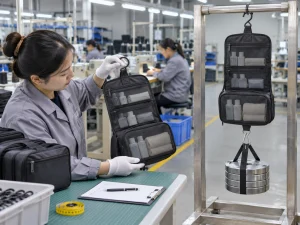
For a co-branded cosmetic bag, inspection should cover both functional construction and brand presentation. The two can be equally important: a bag may work well but fail the collaboration if the artwork is incorrect, while a beautiful bag may still create complaints if the zipper or seams fail.
| Inspection Area | What to Check | Approval Reference |
|---|---|---|
| Dimensions | Length, height, depth, gusset and compartment size | Approved specification sheet |
| Materials | Color, texture, thickness, coating and lining | Approved swatches and sample |
| Artwork | Correct logos, spelling, scale, color and placement | Final artwork file and signed approval |
| Construction | Stitching, seams, edge binding, shape and symmetry | Approved pre-production sample |
| Components | Zipper movement, pullers, hardware and labels | Approved component specification |
| Capacity | Fit of the actual beauty products and ease of closure | Product fit test |
| Packaging | Individual packing, inserts, barcode and carton marks | Approved packing specification |
Control Changes After Approval
One frequent risk in collaboration projects is an unrecorded change after the sample is approved. A brand may update a logo, switch a color, change a bottle size or request a different packaging insert close to production.
Use a revision log. Record the date, revision number, changed component, responsible approver and impact on cost or schedule. Any change that affects fit, artwork, material or construction should be reviewed before the factory proceeds.
Bulk Production, MOQ, Cost Factors and Launch Planning
Build the Timeline Backward from the Launch Date
Do not plan production only from the date the bags are expected to leave the factory. Work backward from the retail launch, campaign photography, influencer seeding, retailer delivery window or event date.
The project schedule should include concept approval, artwork delivery, material confirmation, sample making, sample review, revisions, pre-production approval, bulk manufacturing, final inspection, packing and transportation. Add contingency time for artwork revisions, material availability and shipping changes.
Understand What Drives the Unit Cost
The cost of a collaboration bag depends on more than the outside fabric. The structure, dimensions, lining, padding, number of compartments, zipper type, logo process, special hardware and packaging can all affect the quotation.
| Cost Driver | Why It Changes Cost | How Buyers Can Control It |
|---|---|---|
| Material | Different fabrics, coatings, weights and finishes have different costs and sourcing conditions | Choose materials that support the target positioning without unnecessary upgrades |
| Bag size and structure | Larger panels, gussets, dividers and reinforcement use more material and labor | Size the bag around the actual product set |
| Logo and artwork | Multiple print colors, embroidery, patches or metal details may add setup and processing steps | Use a clear brand hierarchy and limit low-value decorative elements |
| Hardware | Custom zipper pulls, plates and special finishes can require extra development or sourcing | Use standard components where a custom detail does not add meaningful value |
| Packaging | Printed boxes, inserts, belly bands and retail labels add materials and assembly | Confirm which packaging elements are essential for the sales channel |
| Order quantity | Material minimums and production setup are spread across the order quantity | Forecast demand realistically and consolidate compatible variants where possible |
| Delivery plan | Split shipments, special packing or urgent freight can affect landed cost | Confirm destinations and required dates before production starts |
Confirm MOQ by Style, Color and Custom Component
MOQ should be discussed at the start of the project, not after the sample is approved. A standard fabric bag may have different minimums from a custom-dyed material, exclusive print, custom-woven label or special metal component.
Ask whether the supplier’s MOQ applies per style, per color, per logo design or per order. If the collaboration includes multiple designs, clarify whether they can share the same base material or production setup.
Q&N’s published custom cosmetic bag page lists a standard MOQ of 1,000 pieces per style and color, with the final requirement subject to material, color, logo method and packaging. Its published typical sample time is 7–10 days after details are confirmed, and typical bulk production is 35–45 days after sample approval and deposit. These are reference figures, not a promise for every collaboration; confirm the exact schedule for the selected structure and components.
Plan Variants Without Creating Unnecessary Complexity
A collaboration may include several colors, prints or bag sizes. More variants can create stronger merchandising options, but they also increase artwork approvals, material control, SKU management and packing complexity.
One practical approach is to keep the base construction consistent and vary only the approved artwork, lining or color accents. This can make the range feel varied while reducing unnecessary development differences.
Confirm Packaging and Distribution Requirements
Ask whether the bags will be sold individually, packed with beauty products, included in an outer gift box or shipped in bulk to a fulfillment center. The packaging format affects the finished dimensions, protection, carton quantity and handling process.
For multi-market programs, confirm the required barcode, country-of-origin marking, importer information and any market-specific product or packaging obligations with the responsible importer. For products placed on the EU market, the General Product Safety Regulation has applied since December 13, 2024. The European Commission’s guidance explains the responsibilities of manufacturers, importers and distributors. The precise requirements depend on the product and role in the supply chain.
Reference: Your Europe: General product compliance.
How to Choose an OEM/ODM Cosmetic Bag Manufacturer
Look for Relevant Product Development Experience
A supplier should understand more than sewing a pouch. Collaboration projects often require coordinated materials, multiple logo methods, special artwork, packaging and a tight approval process. Ask to see examples of comparable bag structures and branding methods, not only a general factory introduction.
Check Material and Branding Capabilities
Confirm whether the manufacturer can source the proposed fabric, develop the required color, apply the logo method and manage the selected trims. If a project uses a printed outer fabric with a woven label, metal plate and custom zipper pull, ask how each component will be approved and controlled.
Evaluate Sampling and Communication
Sampling is a practical test of the supplier’s ability to interpret a brief. A useful sample process should identify questions early, explain construction limitations and record changes clearly. A supplier that simply agrees to every request without checking feasibility may create problems later.
Review Quality Control and Production Visibility
Ask how incoming materials are checked, how work-in-process quality is monitored and how final inspection is carried out. For a collaboration, include artwork verification and color consistency in the inspection plan. Confirm who approves any production deviation from the signed sample.
Use a Supplier Evaluation Checklist
| Evaluation Point | Questions to Ask | Evidence to Request |
|---|---|---|
| Product experience | Have you made similar cosmetic bags or gift pouches? | Relevant product photos and sample references |
| Material sourcing | Can you source and control the selected materials and colors? | Swatches, specifications and approval records |
| Logo capability | Can you produce the required print, embroidery or hardware detail? | Logo samples or production examples |
| Sampling | How are revisions and approvals recorded? | Sample timeline and revision process |
| Quality control | What is checked before shipment? | Inspection checklist and sample QC records |
| Capacity and schedule | Can you support the target quantity and launch window? | Project-specific production plan |
| Communication | Who coordinates artwork, sampling and bulk production? | Named project contact and reporting process |
How Q&N Supports Collaboration Bag Projects
Guangzhou Q&N Cosmetic Bag Co., Limited has manufactured cosmetic bags and related textile accessories since 2010. Its published product and service information covers OEM/ODM development for makeup pouches, toiletry bags, travel organizers, brush bags and beauty gift packaging.
For a collaboration project, Q&N can support the development of bag shapes, materials, colors, linings, zippers, trims, logo methods and packaging. The available branding processes listed on its custom service page include screen printing, heat transfer, embroidery, embossing/debossing, woven labels, rubber patches, metal logos and zipper-pull logos. Sampling and bulk-production timing should be confirmed against the actual brief.
Review the Q&N manufacturer profile and customization capabilities, or send the project details through the contact page.
Frequently Asked Questions About Co-Branded Cosmetic Bags
What Are Co-Branded Cosmetic Bags?
Co-branded cosmetic bags are pouches or beauty organizers developed for a partnership between two or more brands. They may display both logos, combine brand colors, use exclusive artwork or form part of a joint beauty product set. The exact brand roles and artwork rights should be agreed before sampling.
What Is the Difference Between a Co-Branded Bag and a Gift-with-Purchase Bag?
Co-branded describes the brand partnership and shared identity. Gift-with-purchase describes how the item is offered to the customer. A bag can be both co-branded and used as a gift-with-purchase item, but a GWP bag does not have to involve two brands.
Can Two Brand Logos Be Printed on One Cosmetic Bag?
Yes. Both logos can be printed, embroidered or applied using suitable labels or hardware. The brands should approve the size, position, hierarchy and final artwork. The selected material and logo process must also be checked for legibility and durability.
What Materials Are Suitable for Limited-Edition Makeup Bags?
Polyester, nylon, canvas, cotton, PU, velvet, PVC, TPU and neoprene can all be considered, depending on the design. The right choice depends on the desired appearance, product contents, target price, intended use and branding method. Approve the actual material sample before bulk production.
What Is the Typical MOQ for Custom Cosmetic Bags?
MOQ varies by manufacturer, material, color, structure and customization. Q&N’s published standard MOQ is usually 1,000 pieces per style and color, subject to final specifications. A custom-dyed fabric, special print or exclusive hardware may affect the minimum order requirement.
How Long Does It Take to Make a Custom Collaboration Bag?
The schedule depends on material sourcing, artwork complexity, sample revisions, packaging and order quantity. Q&N publishes typical sample timing of 7–10 days after details are confirmed and bulk production of 35–45 days after sample approval and deposit. Ask for a project-specific timeline before confirming the campaign launch date.
What Files Should Buyers Send to Start a Collaboration Bag Project?
Send clear reference photos or a technical drawing, finished dimensions, product contents, material preferences, color references, vector logo files, artwork permissions, target quantity, packaging requirements, destination country and target delivery date. If two brands are involved, also identify the person authorized to approve the combined artwork.
Final Recommendations for Custom Cosmetic Bags for Brand Collaborations
Custom cosmetic bags for brand collaborations work best when the product concept, brand relationship and manufacturing plan are developed together. A limited-edition pouch should not be treated as a standard bag with two logos added at the last minute. Its material, structure, artwork, capacity and packaging should all support the collaboration’s purpose.
Before requesting a quotation, confirm these points:
- What is the collaboration objective: brand awareness, limited edition, retail-exclusive launch or gift-with-purchase?
- Which brands are involved, and who has final approval authority?
- What is the agreed logo hierarchy and artwork usage permission?
- What beauty products will the bag hold?
- Which material, color, structure and logo process best fit the target positioning?
- What are the target quantity, MOQ requirements and budget expectations?
- What packaging, barcode and distribution details are required?
- When must the finished goods arrive at the destination?
Future Direction: More Purposeful, Reusable and Channel-Specific Collaborations
Beauty collaborations are likely to become more closely connected to social commerce, creator partnerships, retail exclusives and limited product drops. McKinsey’s 2026 beauty analysis highlights the growing role of creator-led discovery and time-sensitive launches. For accessory development, this points toward more distinctive artwork, smaller coordinated product stories and bags designed to remain useful beyond the campaign.
Reusable value should be designed into the product rather than claimed without evidence. A durable zipper, appropriate lining, practical dimensions and a structure suited to everyday use can give a cosmetic bag a longer functional life. If a brand intends to make environmental claims about recycled materials or sustainability, those claims should be supported by accurate material documentation and reviewed for the destination market.
Request a Custom Collaboration Bag Review
Q&N works with beauty brands, retailers, wholesalers and promotional buyers on custom cosmetic bag development. To review your collaboration project, send the following information:
- Product type: makeup pouch, toiletry bag, vanity case, brush bag or gift set.
- Dimensions: target finished size and required capacity.
- Reference materials: product photos, sketches or a technical pack.
- Brand assets: both logos, artwork files, color references and usage approvals.
- Material requirements: preferred fabric, lining, padding, zipper and hardware.
- Target quantity: estimated total and quantity per style or color.
- Packaging requirements: individual packing, gift box, hangtag, barcode or retail label.
- Delivery information: destination country and target arrival date.
With these details, the team can review the proposed structure, branding options, sample requirements, MOQ and production schedule. Contact Q&N to discuss your custom cosmetic bag collaboration project.
References and Further Reading
- McKinsey: From Aisle to Algorithm — The Beauty Categories, Channels, and Concepts Shaping 2030 Growth.
- Sephora: Sephora Collection × Brother Vellies limited-edition makeup bag collaboration.
- Rifle Paper Co.: Clinique gift-with-purchase collaboration.
- USPTO: What Is a Trademark?.
- European Union: General Product Compliance.
- U.S. Federal Trade Commission: Endorsement Guides — Questions and Answers.
Aries Gu is the founder of Q&N. With over 17 years of experience in cosmetic bag OEM/ODM source factory. He focuses on quality control, efficient communication, and on-time delivery for global cosmetic bag projects.