A folding wash bag can look compact in a product photo yet become difficult to close when filled with bottles, brushes, and travel essentials. For travel brands and private label buyers, this creates a development problem: an attractive pocket layout does not automatically translate into usable storage. Poorly positioned compartments can collide, stiff panels can resist folding, and closures can carry more tension than intended.
This guide explains how fold types, panel construction, pocket depth, and material choices work together. Use it to define a practical product brief, compare supplier proposals, and approve a sample that performs both open and packed.
Developing a retail travel collection? Explore Q&N’s custom cosmetic bags and travel organizers, then define the contents your folding design must hold before selecting its final dimensions.
What Is a Folding Wash Bag?
A panel-based organizer that closes around its contents
A folding wash bag is a toiletry organizer with panels or flexible sections that fold together for transport and open to expose storage pockets. The folded form may be secured by a zipper, buckle, snap, or hook-and-loop closure. Some designs include a hanging hook; others are intended to lie open on a countertop.
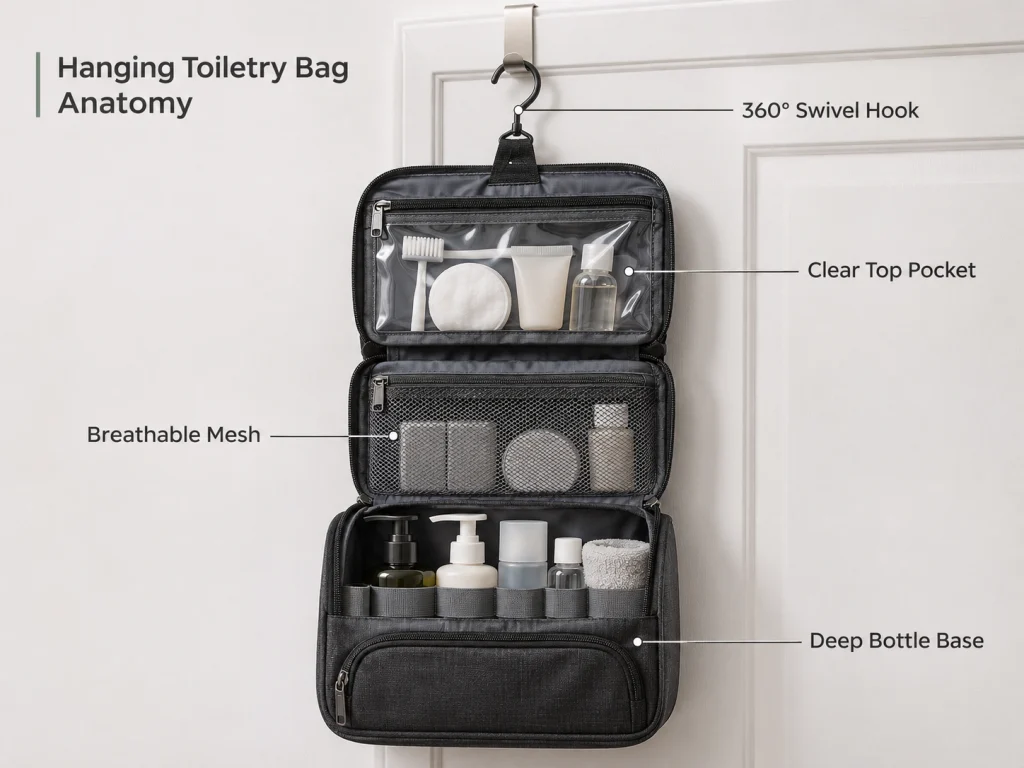
The defining feature is the folding architecture. A conventional pouch that flattens when empty is not necessarily a panel-based folding organizer. Likewise, a hanging toiletry bag may use a single deep compartment and lid rather than a bi-fold or tri-fold construction.
Define the structure instead of relying on product names
Suppliers may use “foldable toiletry bag,” “roll-up organizer,” and “hanging wash bag” for overlapping designs. Put an open-view drawing, closed-view drawing, and folding sequence in the specification. Identify which panel folds first, which becomes the exterior cover, and where the closure engages.
For this guide, bi-fold means two main panels connected by one principal fold, while tri-fold means three main panels connected by two principal folds. Additional flaps, gussets, and detachable pockets should be identified separately.
Choosing a Folding Wash Bag Structure: Bi-Fold, Tri-Fold, or Roll-Up
Bi-fold designs: direct access with fewer folding interfaces
A bi-fold layout opens like a book or folds one panel over another. It can suit a travel kit with one deeper bottle compartment and one shallower accessories panel. Fewer main folds simplify the folding sequence, although sewing complexity still depends on pockets, gussets, binding, and reinforcement.
Its limitation is the relationship between opposing compartments. Two deep pockets placed directly face-to-face can produce a thick closed package. The hinge needs enough allowance to wrap around the intended load without pulling the panels out of alignment.
Tri-fold designs: more storage zones with more interaction between panels
A tri-fold structure divides the organizer into three main sections. This can separate bottles, grooming tools, and small accessories while reducing the closed height compared with the same organizer laid open. However, it does not guarantee a smaller packed volume.
The first folded panel occupies space inside the final package. Its pocket depth affects the second fold and the closure position. Equal panel sizes may work for some layouts, but unequal panels or different hinge allowances may be needed around a deeper central compartment.
Roll-up and hybrid designs
A roll-up design wraps flexible sections around the contents, often using an adjustable strap. It can accommodate changes in the load, but rigid containers can create an uneven roll. A hybrid combines a deeper pouch with fold-out storage panels. This may suit bottle-heavy kits, provided the additional panels do not obstruct the main opening.
| Structure | Advantages | Limitations | Development priority |
|---|---|---|---|
| Bi-fold | Simple opening sequence; broad access to two zones | Opposing pockets can stack into a bulky package | Balance pocket depth across the hinge |
| Tri-fold | Multiple organized zones; shorter closed footprint than its open length | More folds and potential pocket interference | Validate folding order and loaded closure alignment |
| Roll-up | Flexible wrap; adjustable closure can accommodate different loads | Irregular packed shape; contents can press against each other | Control item movement and strap adjustment range |
| Hybrid pouch with folding panels | Deep storage plus accessible small-item organization | Additional parts, assembly work, and bulk | Keep fold-out sections clear of the main opening |
Panel Construction: Build the Fold Around the Loaded Bag
Separate storage panels from flexible hinge zones
A fold is a working part of the product. Treat it as a flexible zone between loaded compartments, not simply a line drawn across the fabric. Pocket edges, zipper ends, binding, foam, and stiffeners can all increase resistance if they overlap this zone.
In the pattern, identify where structural support should stop and bending should begin. A continuous rigid insert across the fold can prevent smooth closure. Local panel inserts may provide shape while leaving the connecting area flexible. Confirm the transitions on a physical sample because seam stacks also affect the finished bend.
Allow for pocket projection and folding order
The required hinge allowance depends on the loaded thickness, material behavior, and direction of folding. There is no single gap dimension that suits every folding travel wash bag. A design carrying flat sachets needs different clearance from one carrying cylindrical bottles.
Ask the sample maker to mark each panel and demonstrate the sequence with the intended contents inside. Check whether a pocket base, bottle cap, or zipper pull presses into the next panel. A small layout adjustment can solve a collision more effectively than increasing the entire bag size.
Manage binding and closure attachment points
Edge binding protects raw edges but also contributes thickness. Pay particular attention to intersections where binding, pocket corners, zipper tape, and reinforcement overlap. These areas may become stiff lumps when the organizer closes.
Closure anchors should transfer force into reinforced areas. A strap sewn only to a lightweight outer layer may distort that layer under load. Specify the reinforcement position and inspect both its appearance and its performance in the assembled product.
Internal Compartments and Pocket Layouts
Design around an item list, not a target pocket count
Start with the products the end customer is expected to pack. Record bottle height, maximum diameter, cap shape, brush length, and the dimensions of rigid accessories. Container volume alone is insufficient: two bottles with the same liquid capacity can have different external shapes.
A useful brief distinguishes mandatory items from optional extras. Put the mandatory set into every development sample. If a product fits only when another required item is removed, the layout has not met the brief.
Match pocket construction to the contents
| Pocket type | Practical use | What buyers should check |
|---|---|---|
| Flat zip pocket | Sachets, small accessories, slim grooming tools | Actual opening width and interference with adjacent folds |
| Gusseted pocket | Bottles and other items needing depth | Loaded projection, corner clearance, and ability to close |
| Mesh pocket | Visible storage for suitable dry items | Mesh snagging, stretch, seam strength, and item retention |
| Clear film pocket | Quick identification of small products | Film flexibility, creasing, seam construction, and closure limitations |
| Elastic loops | Holding defined bottle or tool sizes | Grip across the specified size range and ease of removal |
| Detachable pouch | A separate kit that can be removed for use | Attachment security, added thickness, and independent pouch function |
More pockets can improve separation, but they also consume space through seams, zipper tape, and dividers. Several narrow slots may be less useful than one flexible compartment if the intended contents vary substantially.
Offset bulky items and check orientation when hanging
Avoid positioning every deep pocket in the same area of the closed stack. Where the design allows, offset bottle pockets against flatter accessory zones. Verify the arrangement after folding; an attractive open layout can hide collisions that appear only when closed.
For hanging versions, open pocket mouths should retain contents in the hanging orientation. Heavy items should not cause the organizer to twist excessively or pull the upper panel away from its support. Test access to each compartment while the others remain loaded.
Compact Size vs. Expanded Size: How to Specify Usable Capacity
Record distinct measurement states
“Expanded size” can mean fully unfolded length, increased storage volume, or a gusset opened by an expansion zipper. These are different features. If the bag only unfolds, describe the measurement as “open dimensions” to avoid implying that its pockets gain capacity.
| Measurement | What to record | Why it matters |
|---|---|---|
| Closed, empty dimensions | Width, height, depth, and measurement method | Documents the unfilled product and packaging condition |
| Closed, loaded dimensions | Same axes using the agreed contents | Shows the realistic travel footprint and closure fit |
| Fully open dimensions | Overall width and length; whether the hook is included | Defines countertop or hanging space |
| Usable pocket dimensions | Clear opening, internal height, and available depth | Confirms that items can enter and sit correctly |
| Finished product weight | Empty bag, including supplied detachable components | Supports consistent specifications and shipping planning |
Do not equate the external envelope with usable liters
Multiplying external width, height, and depth gives a bounding-box volume. It includes fabric, padding, gaps between pockets, and space that may not be accessible. It is not automatically the organizer’s usable storage capacity.
If a capacity claim is needed, agree on a repeatable measurement method appropriate to the finished design. For a compartmentalized organizer, a documented packing set can be more informative during development than an unsupported liter claim. Photograph the contents separately, loaded into the pockets, and enclosed in the bag.
Illustrative manufacturing scenario: a tri-fold bag that will not close
The following is a hypothetical development example, not a customer case. A travel brand specifies a tri-fold organizer for four travel bottles, a toothbrush, a razor, and several sachets. The empty sample folds neatly, but the filled bottle pockets collide and prevent the outer flap from reaching its snap.
Potential revisions include placing sachets on the overlapping panel, increasing clearance at the affected hinge, or changing a pocket’s depth and position. An adjustable closure may accommodate variation, but it should not conceal a layout that requires excessive compression. Each revision needs another loaded fit check.
Materials, Linings, and Reinforcement
Choose the full material assembly
Assess the outer fabric, backing, lining, foam, interlining, and binding together. A flexible outer swatch can become stiff after lamination and assembly. Conversely, a soft shell may need local support to prevent loaded pockets from sagging.
- Nylon or polyester: Candidates for flexible travel constructions; compare the actual weave, weight, coating, and seam behavior.
- PU synthetic leather: An option for a refined surface appearance; evaluate backing, crease behavior, and repeated flexing at the fold.
- Canvas: Suitable for a textile-led appearance, with weight and seam bulk assessed on the selected grade.
- Quilted fabric: Adds texture and cushioning, but padding can increase the folded stack.
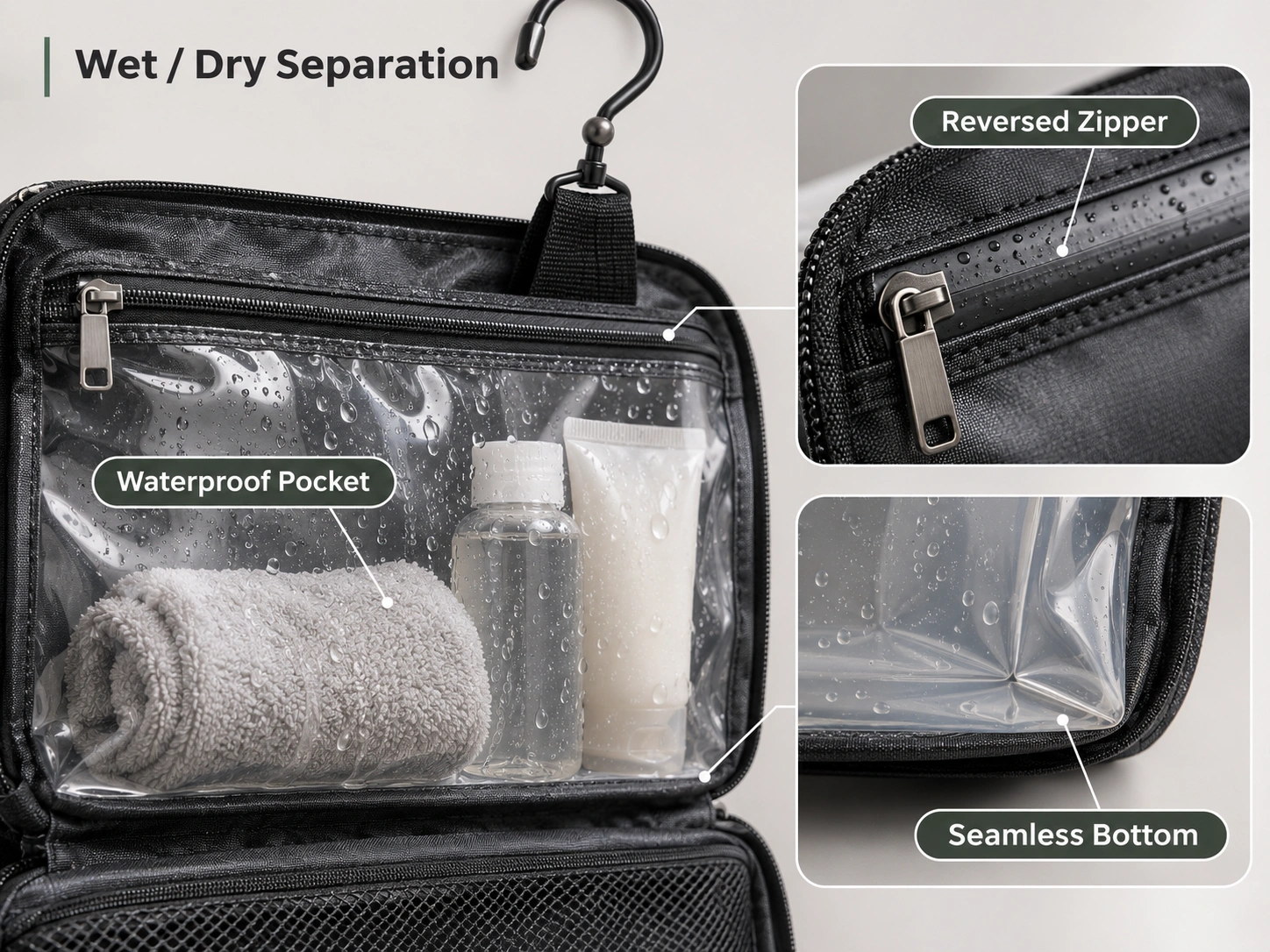
- Clear TPU or PVC film: Useful for visibility in selected pockets; evaluate the exact film grade, thickness, and assembly method.
Reinforce stress points without stiffening every panel
Typical reinforcement locations include hook anchors, carrying handles, closure straps, and heavily loaded pocket attachments. The objective is to spread force into a suitable area of the assembly. Adding more stitches or a thicker insert everywhere can create new problems, including concentrated needle perforations and restricted folding.
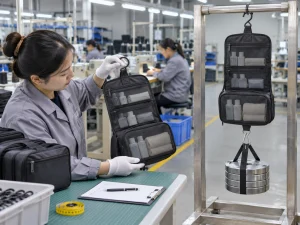
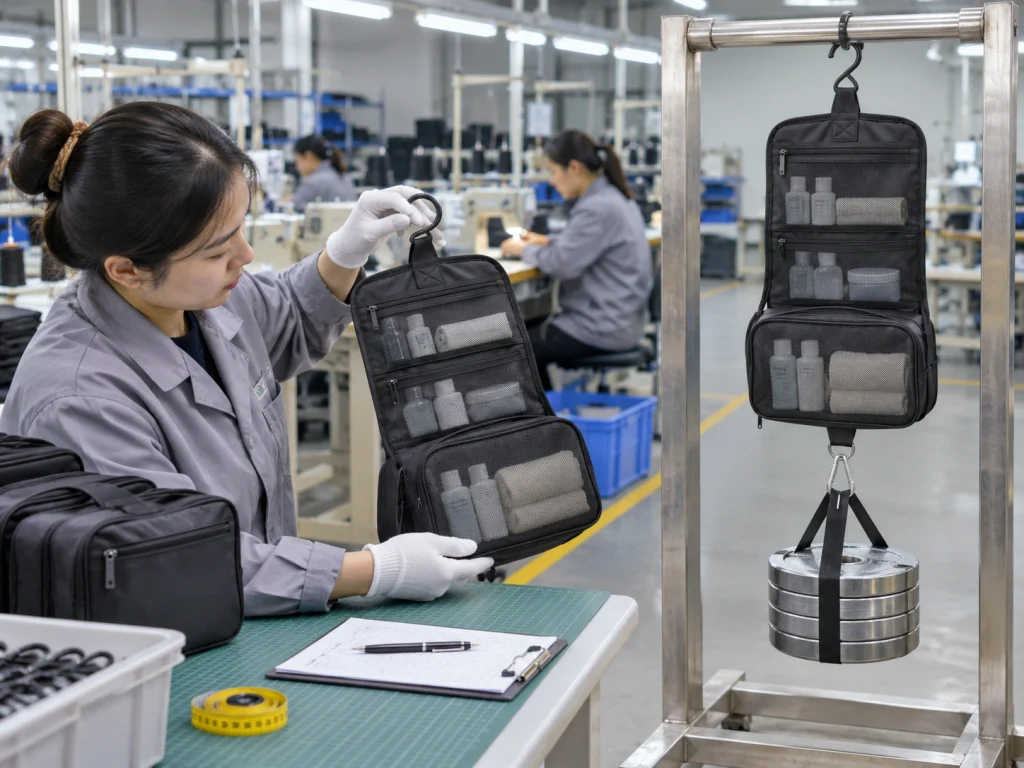
For a hanging design, test the hook, its connecting strap, reinforcement, and supporting panel as one system. Agree on the load, duration, fixture geometry, and acceptable deformation. A strong metal hook does not establish the strength of its sewn attachment.
Keep material tests separate from finished-product claims
ISO 7854 describes methods for assessing damage to coated fabrics from repeated flexing. It can inform material evaluation where applicable, but it does not replace folding tests on the assembled organizer. Ask the laboratory to select the relevant method and agree on acceptance criteria.
Similarly, ISO 811 addresses fabric resistance to water penetration using hydrostatic pressure. A fabric result does not establish that the finished bag, its needle holes, or its closures are waterproof. Define splash resistance or spill containment separately and validate the construction supporting each claim.
Custom Folding Wash Bags for Retail Brands
Position branding in both open and closed views
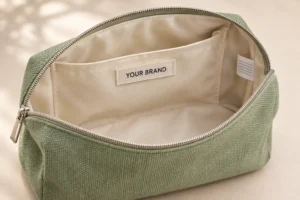
Mark the logo position on the folded exterior and the unfolded interior. Confirm reading direction when the bag is hanging. A logo that looks centered on a flat pattern can shift visually after the flap wraps around loaded pockets.
Printing and woven labels can suit textile panels; embroidery adds texture but also backing and local thickness. Debossing depends on the selected material and construction. Metal logos require appropriate attachment and placement so they do not press against bottles or scratch adjacent surfaces during folding.
Q&N’s OEM/ODM customization service lists material selection, printing, embroidery, embossing and debossing, woven labels, metal logos, and custom zipper pull branding. Request a material-and-logo sample together with the proposed folding layout so appearance and function can be evaluated together.
Choose closures for the expected load range
A perimeter zipper can create a tidy enclosed shape, but it needs sufficient clearance around the loaded contents. Adjustable straps offer more flexibility across different loads. Snaps provide a defined closure position, while hook-and-loop fastening offers positional adjustment but needs evaluation for lint collection and snagging against nearby mesh.
YKK’s zipper precautions warn that forcibly closing an overfilled bag can damage zipper elements and tape. The design implication is straightforward: evaluate closure operation with the approved packing set, and do not rely on the zipper to compress an oversized load.
Approve packaging without damaging the fold
Specify the packing orientation and whether the bag ships folded, flat, or lightly supported. Check whether hardware leaves impressions on clear pockets or exterior panels. Excessive compression may create creases that undermine the retail presentation.
For a detachable pouch, show its position in the packed unit and include it in the component count. A packaging photo standard helps keep production packing consistent with the approved sample.
Sampling, Quality Checks, and Purchasing Decisions
Use a staged sample approval process
- Confirm the brief: Define target contents, fold type, open and closed dimensions, and hanging or countertop use.
- Review the layout: Mark panel boundaries, hinge zones, pocket depth, reinforcement, and closure points.
- Check a functional prototype: Load the mandatory contents and assess folding, access, stability, and closure.
- Approve production materials: Repeat the evaluation with the intended fabric assembly, hardware, and logo process.
- Freeze the reference: Retain the approved sample, measurements, bill of materials, packing photos, and inspection criteria.
Inspect the behaviors that flat photos cannot show
| Inspection area | Check | Acceptance basis |
|---|---|---|
| Loaded folding | Panel alignment, collisions, trapped pulls, closure tension | Approved contents and folding sequence |
| Pocket access | Insertion and removal of the largest required items | Specified item dimensions and clear opening |
| Repeated use | Creasing, cracking, seam opening, closure deterioration | Agreed cycle count, load, and failure criteria |
| Hanging performance | Anchor movement, panel distortion, pocket orientation | Agreed fixture, loading arrangement, and duration |
| Workmanship | Binding, skipped stitches, loose threads, lining caught in zippers | Approved sample and defect criteria |
| Retail packing | Correct components, labels, fold direction, surface protection | Approved packaging specification |
Agree on test severity before production. There is no universal cycle count or hanging load that automatically proves every folding toiletry bag design is suitable. Sampling also needs a defined lot and inspection plan; a few attractive sample photos do not establish batch consistency.
Compare cost, MOQ, and lead time on matching specifications
Cost drivers include pocket count, zipper length, binding operations, reinforcement, custom hardware, material yield, and packaging. A tri-fold is not automatically more expensive than every bi-fold: a heavily structured bi-fold can require more work than a simple textile tri-fold.
Ask suppliers to separate finished-product quantity requirements from material-color minimums, custom hardware requirements, and packaging minimums. Request sample and production schedules tied to defined approvals. Avoid treating a generic website lead time as a confirmed delivery commitment for an unapproved design.
Q&N’s manufacturing capabilities include cutting, sewing, edge binding, zipper assembly, sample development, and inspection. For a folding project, ask the team to identify the proposed material assembly and the checks that will verify loaded folding before bulk production.
Frequently Asked Questions About Folding Toiletry Bag Design
Is a tri-fold toiletry bag more compact than a bi-fold?
Not necessarily. It can reduce the closed height relative to its open length, but the third panel and overlapping contents can increase depth. Compare both designs with the same required contents and record their loaded dimensions.
Does a folding wash bag need a hanging hook?
No. Folding describes how the organizer closes; hanging describes how it is supported during use. Include a hook only when it serves the intended use, and validate the complete attachment system.
Can a foldable toiletry bag hold full-size bottles?
Yes, if its pockets, hinge allowance, closure, and support structure are designed around those bottles. Specify external bottle dimensions and weight rather than relying on “full-size” as a technical description.
Are clear pockets leakproof?
Clear material alone does not make a pocket leakproof. Seams, closures, attachment points, and orientation determine whether liquid can escape. Request a defined containment test if this function is required.
What should buyers approve first: materials or the pocket layout?
Develop them together. An early layout prototype can reveal fit problems, but final approval needs the intended materials because stiffness, padding, and seam thickness affect folding and capacity.
Turn the Folding Design into a Production-Ready Brief
A successful folding wash bag balances accessible storage with a realistic closed footprint. Select the fold type around the contents, reserve flexible hinge zones, control overlapping pocket depth, and approve the sample fully loaded. These decisions provide a stronger basis for purchasing than pocket count or empty dimensions alone.
For your next collection, send Q&N your folding wash bag requirements for a project-specific discussion of materials, structure, branding, sampling, and production.
- Product type and preferred folding structure
- Target open and closed dimensions
- Reference photos, sketches, or a tech pack
- Required contents, including container dimensions
- Material, lining, and reinforcement requirements
- Logo file and preferred application method
- Target quantity and color breakdown
- Packaging requirements
- Delivery country and target delivery date
Aries Gu is the founder of Q&N. With over 17 years of experience in cosmetic bag OEM/ODM source factory. He focuses on quality control, efficient communication, and on-time delivery for global cosmetic bag projects.