A realistic cosmetic bag target cost should be calculated before a buyer requests final quotations—not negotiated from an arbitrary number after sampling. If the target ignores freight, duty, packaging, testing, color minimums, and the required margin, even a low factory price can produce an unprofitable product. If it is set too aggressively, suppliers may quote a different material, lighter construction, or incomplete service scope simply to reach the number.
This guide shows procurement managers, beauty brands, importers, wholesalers, retailers, product developers, and private-label buyers how to work backward from net selling price to a target landed cost and then to a supplier quotation target. It also explains the main custom cosmetic bag cost drivers, practical value-engineering options, quotation comparison, quality controls, and the information a factory needs to recommend savings.
If the product format is still open, first compare the custom cosmetic bag product options that fit the retail price, capacity, and brand position. Structure is often a bigger cost decision than a late negotiation over a few cents.
What a Cosmetic Bag Target Cost Should Include
Target Factory Price, Target Landed Cost, and Retail Margin Are Different Numbers
A supplier’s unit quote is only one layer of cost. Buyers should define three separate numbers:
- Target product price: the maximum price for the bag under a stated Incoterm and scope, such as packaging included or excluded.
- Target landed cost: the cost of getting one sellable unit to the buyer’s warehouse or other defined destination.
- Target commercial margin: the return required after applying the company’s chosen accounting definition and channel costs.
Never write only “target cost: US$X.” State the currency, destination, quantity, color split, quotation scope, and Incoterm. A target for an EXW quote cannot be compared directly with one for FOB, DAP, or DDP.
Use a Range with an Ideal Target and an Approved Ceiling
A single hard number can stop useful design discussion. A better brief contains an ideal target, a commercially acceptable ceiling, and the assumptions behind both. The ideal target guides value engineering. The ceiling tells the sourcing team when the design is no longer financially viable without a pricing, quantity, packaging, or specification change.
Keep contingency outside the supplier’s negotiable product price. It should cover forecast risk such as exchange-rate movement, freight changes, or small unexpected charges—not replace a properly built cost model.
Target Cost Is a Decision Tool, Not a Quality Specification
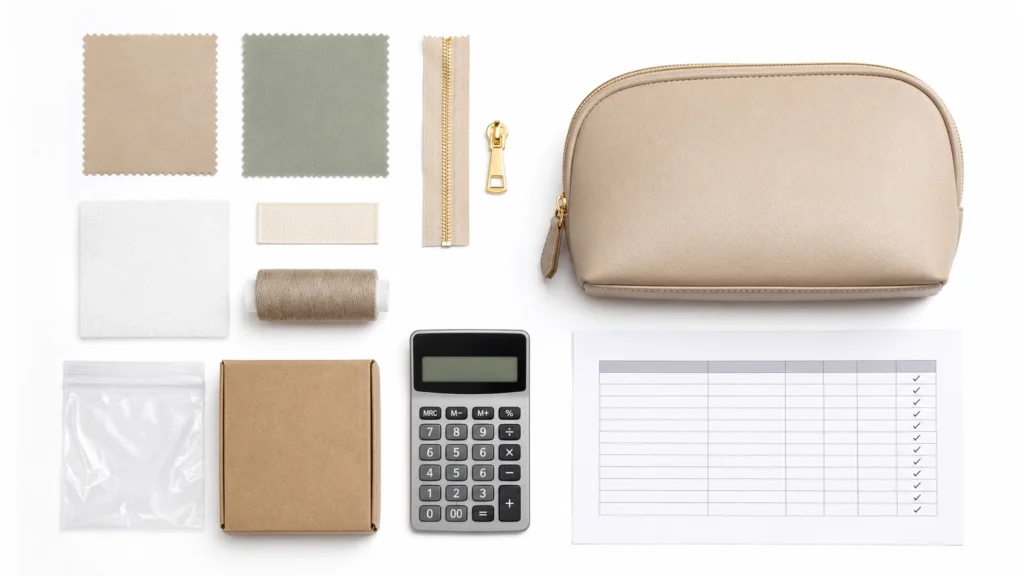
Cost and specification must travel together. A cosmetic bag target cost without a bill of materials, dimensions, construction details, branding, packaging, testing, and defect requirements invites different interpretations. Suppliers should be allowed to propose alternatives, but every alternative must identify what changes and how it affects appearance, function, compliance, MOQ, and lead time.
Calculate the Target Cost from Selling Price and Margin
Start with Net Revenue, Not the Recommended Retail Price
Begin with the revenue the business expects to retain per unit. For wholesale, this may be the invoice price after discounts and allowances. For direct-to-consumer sales, it may be the selling price after expected promotions but before or after marketplace fees depending on the company’s margin definition. A high recommended retail price is not useful if most units sell at a discount or through a distributor.
Document the channel, planned selling price, expected discount, returns allowance, and tax treatment. Use the finance team’s definitions consistently so the product team does not call contribution margin, gross margin, and markup the same thing.
Use the Gross-Margin Formula Consistently
A common product-level calculation is:
Gross margin percentage = (Net sales revenue − Cost of goods sold) ÷ Net sales revenue
When the target margin is known:
Maximum target COGS = Net sales revenue × (1 − Target gross margin percentage)
The exact contents of COGS vary by company. Decide whether inbound freight, duty, inspection, testing, and packaging development are included. If marketplace commissions, pick-and-pack fees, outbound delivery, returns, and paid advertising are treated as variable selling expenses, calculate contribution margin separately rather than hiding them inside the factory price.
Check Contribution and Break-Even Requirements
A product can meet its gross-margin target and still fail to cover fixed costs. The U.S. Small Business Administration presents the break-even formula as fixed costs divided by selling price minus variable cost per unit. Its business-planning guidance also distinguishes fixed costs, variable costs, selling price, and projected volume.
Run at least three volume cases—conservative, expected, and strong—using your own sales forecast. A custom mold, artwork setup, laboratory test, or photography cost becomes expensive per unit when divided across a small sell-through quantity, even if the purchase order itself is large.
Illustrative Manufacturing Scenario: Working Backward to a Quote Target
This is an illustrative calculation only, not a market price or Q&N quotation. Assume a buyer expects net revenue of US$20 per unit and requires a 60% gross margin using landed product cost as COGS.
Maximum landed COGS = US$20 × (1 − 60%) = US$8.00.
| Illustrative Cost Layer | Amount per Unit | Calculation Role |
|---|---|---|
| Maximum landed COGS | US$8.00 | Calculated from net revenue and target margin |
| Freight allocation | US$0.90 | Replace with a current logistics estimate |
| Duty or tariff allocation | US$0.60 | Replace after classification and origin review |
| Brokerage and inbound handling | US$0.20 | Use the buyer’s actual import and warehouse costs |
| Testing and inspection allocation | US$0.20 | Spread approved project costs across expected units |
| Cost contingency | US$0.20 | Buyer-held allowance, not a supplier quotation line |
| Target quoted product cost | US$5.90 | US$8.00 minus the listed non-product costs |
If the best technically compliant quote is US$6.40, the buyer now sees a US$0.50 gap. The team can improve the design, volume, packaging, channel price, or margin assumption. Asking the factory to “match US$5.90” without changing anything does not explain how the gap can be closed.
Build the Full Landed Cost Before Approving a Quote
Normalize Quotations Under the Same Incoterm and Named Place
Incoterms define how tasks, costs, and risks are allocated between seller and buyer. The International Chamber of Commerce’s Incoterms 2020 guidance emphasizes clear allocation of cost, risk, and obligations. A quotation should state both the rule and the named place or port, for example “FCA [named place], Incoterms 2020,” rather than only three letters.
Incoterms do not replace a sales contract or define product quality, payment timing, ownership transfer, or every local charge. Ask what the quoted price includes: export packing, inland transport, export clearance, terminal charges, main freight, insurance, import clearance, duty, and final delivery.
Estimate Duty from Product Classification, Origin, and Destination
Do not borrow a duty percentage from a different bag. Classification can depend on construction, function, and outer-surface material, while rates can depend on origin and current trade measures. U.S. buyers can research current statistical categories and rates in the USITC Harmonized Tariff Schedule. EU buyers can use the European Commission’s Access2Markets duty tool with the origin, destination, and product code.
The importer or its customs professional should confirm classification and treatment. The factory can provide composition, construction, use, outer material, and origin information, but a product description on a commercial invoice is not a binding classification decision.
Include Logistics, Receiving, and Inventory Costs
Estimate freight from packed carton dimensions and gross weight, not the unpacked sample. Add origin and destination charges, brokerage, insurance if required, inspection, warehouse receiving, relabeling, palletization, and retailer appointment fees where applicable. Air freight may protect a launch date but destroy the intended margin; ocean freight can lower transport cost yet increase inventory time and planning risk.
Ask for a packing proposal before freezing the target cost. A structured vanity case with a gift box occupies more volume than a flat pouch, and freight is often sensitive to carton cube. Packaging is both a brand decision and a logistics decision.
Main Drivers of Custom Cosmetic Bag Cost
Material Specification and Consumption
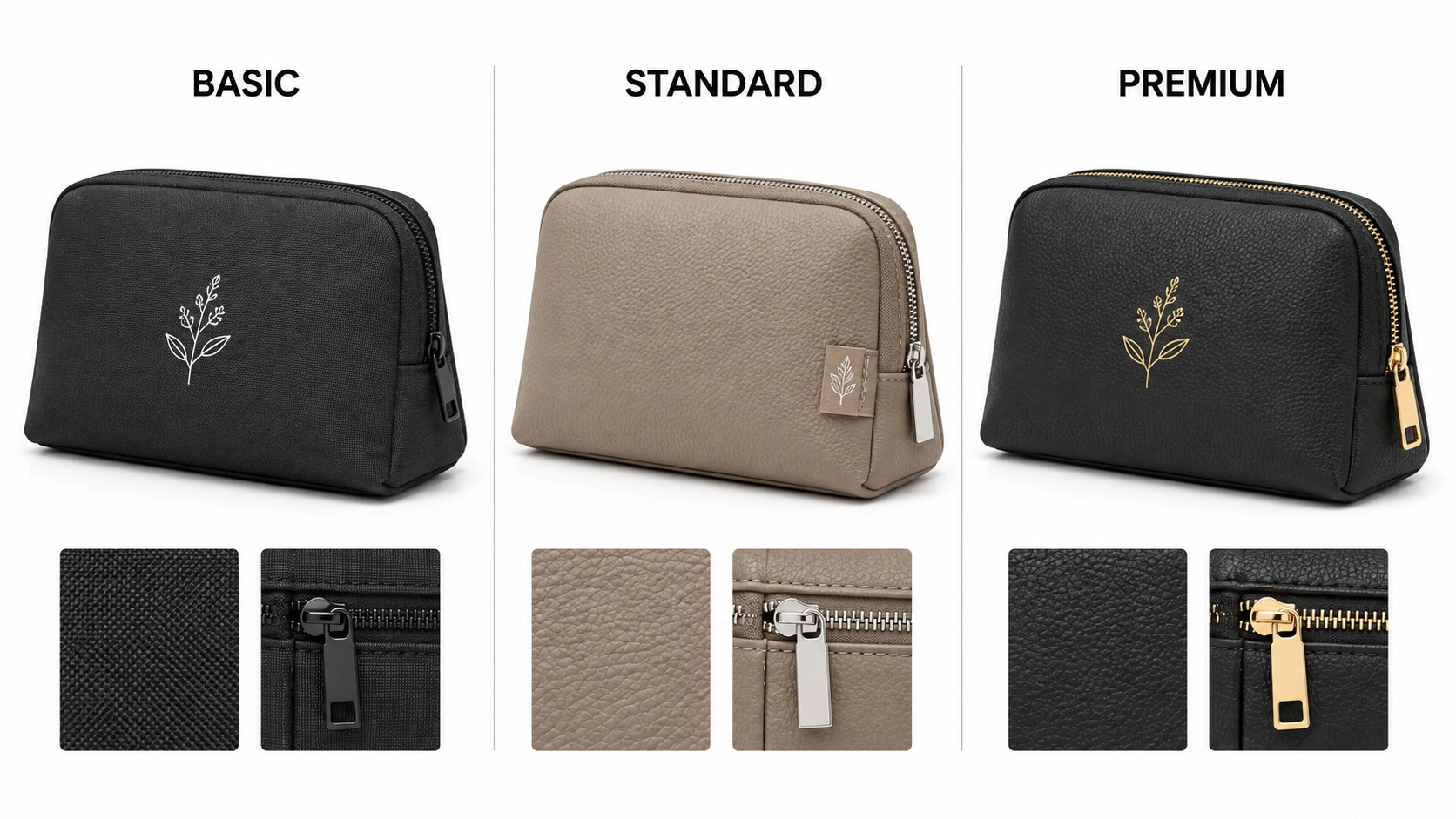
The material cost is determined by more than the fabric name. Width, weight, thickness, backing, coating, finish, color process, usable yield, cutting loss, print coverage, quilting, recycled-content documentation, and minimum purchase quantity all matter. A compact bag with inefficient pattern pieces can consume more material than expected.
Lock the approved material code or measurable performance. “Nylon,” “PU,” and “clear plastic” are not sufficient for price comparison. A cheaper sheet may have a different backing, hand feel, hydrolysis resistance, transparency, odor, or thickness.
Pattern Complexity and Sewing Operations
Labor rises with the number of panels, curved seams, piping, binding, quilt lines, internal pockets, brush slots, elastic loops, reinforcement pieces, handles, and difficult material combinations. Tight shapes and small compartments can require slower handling. A simple exterior can hide a labor-intensive interior.
Ask the factory which operations drive assembly time. Removing one decorative seam may have little effect, while changing a complex bound divider into a flat pocket may materially simplify production.
Zippers, Hardware, Logo, and Custom Components
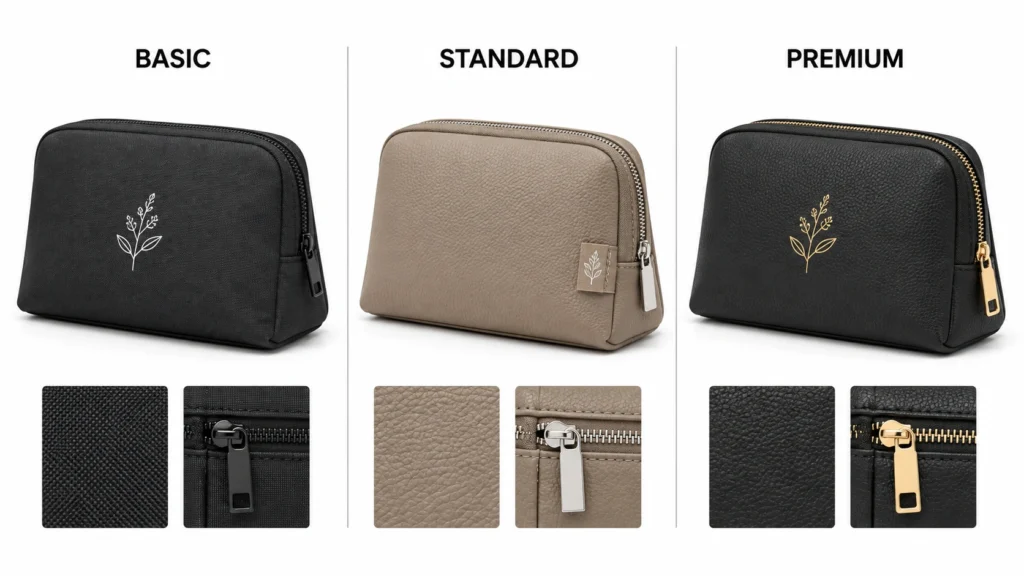
Zipper grade, tooth material, gauge, slider quantity, puller, tape color, plating, magnets, hooks, metal plates, and reinforcement affect cost. Custom-dyed trims and molded pullers may create component minimums or tooling charges.
Logo method should match the material and positioning. Screen printing, heat transfer, embroidery, woven labels, debossing, metal logos, and custom pullers have different setup, unit, testing, and rejection risks. Q&N’s custom service overview shows relevant sewing, printing, embroidery, and inspection processes, but every project still requires a specific quotation.
Packaging and Retail Presentation
A polybag, barcode, hangtag, dust bag, insert, molded tray, gift box, and shipping carton are different cost structures. Custom packaging can have separate print minimums, proofing, tooling, and assembly labor. It also changes carton volume and the risk of cosmetic damage.
Cost-Factor Comparison for Buyers
| Cost Driver | Lower-Cost Direction | Higher-Cost Direction | Risk to Check |
|---|---|---|---|
| Outer material | Stocked fabric and color | Custom finish, print, or certified input | Performance and claim evidence |
| Structure | Fewer panels and flat construction | Structured shape, piping, compartments | Capacity and product protection |
| Logo | Standard print or woven label | Metal plate or custom puller | Adhesion, plating, tooling, placement |
| Color plan | One color or shared trims | Several low-volume colorways | Component minimums and shade matching |
| Packaging | Protective bulk-ready packing | Custom retail box or gift presentation | Cube, damage, labeling, assembly |
| Quality scope | Risk-based agreed inspection | Extra tests and repeated inspections | Do not remove controls required for the market |
How to Reduce Cosmetic Bag Manufacturing Cost Without Lowering Quality
Protect the Function and Simplify Low-Value Complexity
Begin with the customer promise. If the bag is sold for travel-size bottles, keep the necessary capacity, zipper access, seam strength, and wipe-clean interior. Challenge elements that the customer is unlikely to value: duplicate pockets, decorative layers, hidden trims, excessive packaging, or a custom component that looks similar to a standard option.
Classify every feature as must-have, preferred, or optional. This gives the supplier permission to optimize the right details instead of quietly reducing material quality.
Standardize Materials, Colors, and Trims
Stocked material colors, standard zipper tapes, existing hardware, and shared lining across a collection can reduce component fragmentation and approval time. Consolidating volume into fewer colorways may be more effective than increasing total order quantity while keeping many small variants.
The limitation is differentiation. A signature color or custom puller may be important to the brand. Keep the elements that customers recognize and standardize the invisible or low-value components.
Engineer Packaging Around Product Protection and Channel Needs
Remove packaging only after checking abrasion, deformation, moisture, barcode, retailer, and e-commerce requirements. A smaller box or better nesting pattern can reduce material and freight, but under-protection may create rework, chargebacks, or returns.
Compare Value-Engineering Options and Tradeoffs
| Value-Engineering Option | Potential Advantage | Limitation | Best Used When |
|---|---|---|---|
| Use a stocked trim color | May avoid dyeing minimums and shorten sourcing | Less exact color matching | The trim is not a signature visual element |
| Replace a metal logo with debossing | Removes attachment hardware and may simplify packing | Lower contrast and material-dependent result | A subtle premium logo fits the brand |
| Simplify an internal divider | Reduces panels, binding, and sewing operations | May reduce organization | Fit testing shows the extra structure is unnecessary |
| Share lining across colorways | Consolidates material purchasing | Less color-specific coordination | The common lining suits every SKU |
| Improve carton nesting | May reduce freight volume | Can deform structured bags | Transit testing confirms protection |
Mid-project CTA: Send the current specification, target product price, mandatory features, and acceptable alternatives to the factory. Ask for an option table showing the cost effect, MOQ effect, lead-time effect, and visible or functional change for each proposal.
Use Sampling and the BOM to Control Cost Before Production
Freeze Measurable Specifications Before Final Costing
Final costing should follow confirmation of finished dimensions, material, lining, reinforcement, zipper, logo, packaging, and quality requirements. If those inputs change after the quote, the price may legitimately change. Require the quotation and bill of materials to reference the same specification revision.
Use Prototypes to Test Cost Assumptions
A prototype should verify capacity, construction feasibility, material behavior, logo result, and packaging size—not only appearance. Ask the sample maker to identify difficult operations and excess construction. One well-documented sample round can reveal cost reductions that are invisible in a rendering.
Do not treat prototype cost as the expected bulk unit price. Sample making includes one-off sourcing and setup, while production pricing depends on confirmed quantity, material minimums, line efficiency, and final packing.
Control Changes After Approval
Any proposal to substitute material, alter thickness, remove reinforcement, change zipper grade, or modify packaging should be approved in writing. Update the BOM, approved sample, price, test scope, and schedule together. Q&N’s factory profile lists 15+ years of experience and describes support from material selection and sampling through production follow-up and inspection; the buyer’s controlled documents should remain the project authority.
Balance MOQ, Tooling, Quality, and Lead Time
Understand Which Minimum Is Controlling the Order
The finished-bag MOQ may not be the binding constraint. Fabric dyeing, printed lining, zipper tape, plated hardware, woven labels, molded pullers, and custom boxes can each have their own minimum. Ask for finished-product MOQ by style and color, component minimums, and the treatment of unused custom material.
Amortize One-Time Costs Using Realistic Sell-Through Volume
Tooling, test reports, packaging dies, artwork setup, and development charges should be separated from recurring unit cost. Divide them by the volume the business realistically expects to sell, not automatically by an optimistic annual forecast. For repeat orders, confirm which charges recur and who owns reusable tooling.
Do Not Cut Prevention Costs That Protect Total Cost
Removing inspection or necessary testing can make the purchase order look cheaper while increasing the risk of rework, delayed release, returns, or noncompliance. Define defect categories and sampling in the purchase order. ISO 2859-1:2026 provides AQL-indexed acceptance-sampling plans for inspection by attributes, but the buyer and supplier must select appropriate inspection parameters for the product and risk.
Model Schedule Cost as Well as Production Cost
Late decisions can force air freight, split shipments, overtime, or missed retail windows. Build a schedule covering specification freeze, sourcing, sampling, testing, production, inspection, and transit. A lower unit price with an unrealistic schedule is not a lower total cost.
Compare Suppliers on the Same Cost and Quality Basis
Issue One RFQ Pack to Every Supplier
Provide the same drawings, BOM, quantity by color, packaging, test requirements, target destination, delivery date, and quotation term. Ask suppliers to separate unit price, sample fee, tooling, testing, packaging, freight, and other charges. Mark assumptions and exclusions.
Normalize the Commercial Comparison
| Comparison Field | Supplier A | Supplier B | Buyer Check |
|---|---|---|---|
| Specification revision | Record version | Record version | Same construction and material? |
| Incoterm and named place | Record term | Record term | Same cost boundary? |
| Quantity and color split | Record allocation | Record allocation | Same minimum assumptions? |
| Packaging | Included or separate | Included or separate | Same retail and carton scope? |
| Tooling and tests | List one-time charges | List one-time charges | What recurs or is refundable? |
| Lead time | State start condition | State start condition | Same approval assumptions? |
| Quality plan | State inspection scope | State inspection scope | Same defect and sampling rules? |
Evaluate Cost Transparency and Manufacturing Readiness
A useful supplier challenges missing specifications, explains cost drivers, offers alternatives, and discloses minimums and substitutions. Warning signs include a firm price before essential details are known, unexplained material descriptions, an unusually low quote with missing packaging or testing, and resistance to revision-controlled samples.
FAQ About Custom Cosmetic Bag Cost
How Much Does It Cost to Manufacture a Custom Cosmetic Bag?
There is no responsible universal price. Cost depends on dimensions, material specification, construction, lining, pockets, zipper and hardware, logo method, packaging, quantity, color allocation, testing, inspection, Incoterm, and delivery plan. Request quotes against one controlled specification instead of comparing product photos.
How Do I Calculate a Cosmetic Bag Target Cost?
Start with realistic net revenue and the company’s target margin. Calculate the maximum allowable landed COGS, then subtract freight, duty, brokerage, inspection, testing, and other costs not included in the supplier quote. The remainder is the target product price under a clearly stated Incoterm and scope.
Does a Higher MOQ Always Reduce Custom Cosmetic Bag Cost?
Not always. Higher volume can spread setup costs and improve purchasing or line efficiency, but savings may flatten after component minimums are met. Multiple small colorways, complex packaging, or slow operations can limit the benefit. Compare total inventory risk and expected sell-through, not unit price alone.
How Can I Reduce Cosmetic Bag Manufacturing Cost Without Reducing Quality?
Protect required function and compliance, then simplify low-value complexity. Consider stocked trims, fewer colorways, shared lining, a material-compatible logo method, simpler pockets, improved pattern yield, and lower-volume packaging. Test each change and document it in the BOM and approved sample.
Should I Tell the Manufacturer My Target Cost?
Yes, when the target is supported by quantity, specifications, packaging scope, Incoterm, market, and required delivery date. Also identify must-have features and flexible items. This helps a qualified manufacturer propose transparent options. A target number without scope encourages non-comparable quotations.
Expert Summary, Future Cost Trends, and RFQ Checklist
Future Trends in Cosmetic Bag Cost Management
Cost planning is likely to become more component-based and traceable. Digital BOM revisions, packaging-volume data, material claim documentation, and live logistics assumptions can help buyers see the effect of a change before approval. Design teams will also need to evaluate durability, material separation, reduced packaging, and compliance evidence alongside purchase price.
The practical direction is not more paperwork for its own sake. It is a single cost model connected to the current specification, approved sample, quality plan, and commercial terms.
Final Target-Cost Checklist
- Set realistic net revenue by sales channel.
- Confirm the company’s gross-margin and contribution-margin definitions.
- Calculate the maximum landed COGS.
- Estimate freight, duty, import, testing, inspection, and receiving costs.
- Convert the remainder into a product-price target under a named Incoterm.
- Freeze dimensions, BOM, logo, packaging, quantity, and color split.
- Request value-engineering options with documented tradeoffs.
- Normalize supplier quotes and retain a buyer-held contingency.
Prepare a Cost-Focused Factory Inquiry
A useful cosmetic bag target cost protects margin while giving the factory enough information to engineer the product responsibly. Q&N supports OEM/ODM development across material selection, structure, logo processes, sampling, bulk production, packaging, and inspection. To review the feasibility of your target, use the Q&N contact page and provide:
- Product type
- Finished dimensions
- Reference photos or tech pack
- Material and performance requirements
- Vector logo file and preferred logo method
- Target quantity by style and color
- Packaging requirements
- Delivery country
- Target delivery date
- Target product price or landed-cost ceiling, including currency and Incoterm
Mark requirements as must-have, preferred, or open to recommendation. That allows the factory to explain which changes can reduce cost, which changes affect quality or branding, and which target assumptions need to be revised before sampling.
Aries Gu is the founder of Q&N. With over 17 years of experience in cosmetic bag OEM/ODM source factory. He focuses on quality control, efficient communication, and on-time delivery for global cosmetic bag projects.