The right cosmetic bag lining protects the contents, supports the bag’s shape, improves cleanability, and influences how customers judge the finished product. Yet buyers often specify only “polyester lining” or “waterproof lining.” Those descriptions leave the factory to interpret weight, coating, colorfastness, seam construction, hand feel, chemical requirements, and acceptable performance.
A lining that works for a low-cost promotional pouch may fail inside a structured skincare case. A soft woven fabric may suit a premium fashion look but absorb a leaked foundation. A coated fabric may resist splashes while still allowing liquid through needle holes. Selecting the best makeup bag lining material therefore requires more than choosing a fiber name.
This guide explains how B2B buyers can compare woven fabrics, coated textiles, TPU-laminated materials, EVA or PEVA film, PVC, cotton blends, and recycled polyester. It also covers specifications, testing, compliance, MOQ, cost, sampling, and supplier evaluation.
If your bag structure is not final, review the custom cosmetic bag product range before selecting the lining. The same inner material will behave differently in a flat pouch, padded organizer, clear toiletry bag, or structured vanity case.
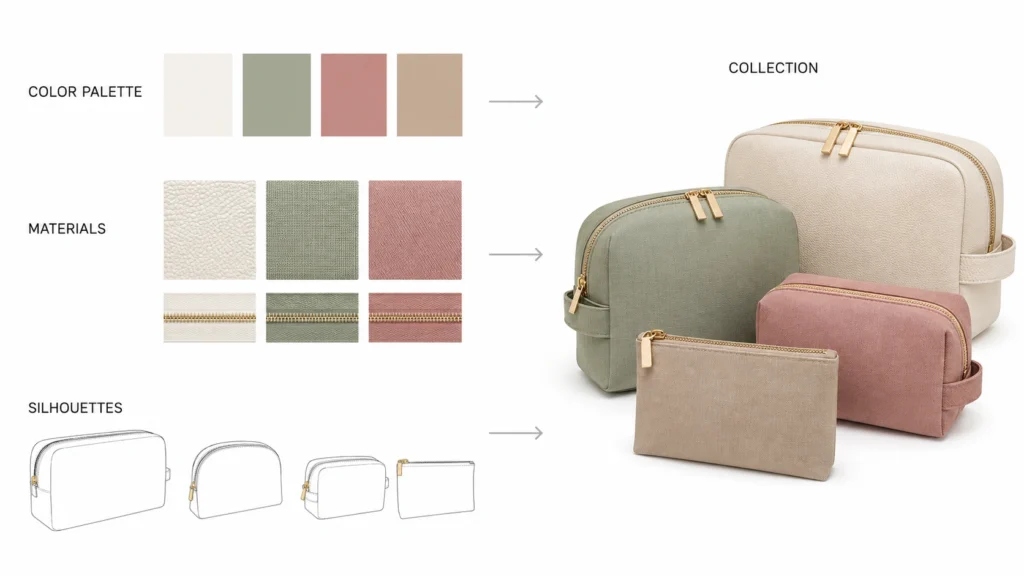
Why Cosmetic Bag Lining Is a Product Engineering Decision
The Lining Controls More Than Interior Appearance
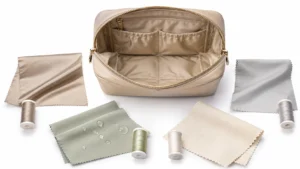
The lining comes into direct contact with bottles, brushes, palettes, and packaging. It affects stain visibility, product insertion, pocket stability, seam strength, zipper movement, and the customer’s perception of quality. It may also hide reinforcement, foam, raw seams, and attachment points.
For a lightweight pouch, the lining can supply most of the interior finish. In a structured bag, it works with interlining, foam, board, binding, and dividers. Selecting it independently from the overall construction can create puckering, sagging, excess bulk, or an interior that pulls out when products are removed.
Interior Performance Must Match the Intended Contents
A makeup pouch carrying dry cosmetics has different risks from a toiletry case holding shampoo bottles. Define whether the lining must resist powder, oil, alcohol-containing products, water-based spills, wet brushes, or sharp caps. The supplier cannot choose a meaningful lining without understanding normal use and reasonably foreseeable misuse.
“Easy to Clean” Needs a Practical Definition
Specify whether the user should be able to wipe the surface with a damp cloth, remove a loose liner for cleaning, or wash the complete bag. These are different constructions. State the cleaning method and substances used in the buyer’s evaluation. A material that wipes clean immediately may stain after a colored cosmetic remains on it for several hours.
Translate the Use Case into Lining Requirements
Start with Product Type, Price Position, and Sales Channel
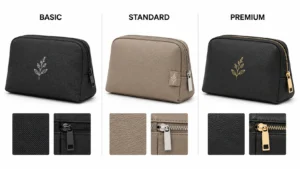
A gift-with-purchase pouch usually prioritizes light weight, printability, and volume efficiency. A premium beauty case may require a dense hand feel, precise color, clean bound seams, and reinforced pockets. A hotel amenity bag may prioritize practical cost and repeatable production, while an e-commerce item also needs to survive compression and individual fulfillment.
The sales channel affects packaging, labeling, testing, and acceptable failure risk. Record the destination market, end user, product claim, retail price position, target quantity, and delivery date before comparing linings.
Rank Performance Requirements Instead of Requesting Every Feature
Not every lining must be waterproof, washable, recycled, highly abrasion-resistant, soft, lightweight, low-cost, and available in an exact custom color. Some requirements conflict or add unnecessary cost. Rank each feature as mandatory, preferred, or optional.
| Use Case | Priority Requirements | Possible Lining Direction | Risk to Review |
|---|---|---|---|
| Promotional makeup pouch | Low bulk, stable color, efficient sewing | Light woven polyester | Thin appearance and limited spill protection |
| Premium PU vanity case | Clean hand feel, structure, wipeability | Dense polyester, nylon, or laminated fabric | Puckering, color transfer, and excess seam bulk |
| Travel toiletry bag | Spill management and easy cleaning | Coated or laminated textile, EVA, PEVA, or PVC | Needle-hole leakage and coating durability |
| Brush organizer | Abrasion resistance and stain control | Dense woven or wipe-clean coated fabric | Brush-tip wear and pigment transfer |
| Natural-look collection | Soft hand feel and brand appearance | Cotton or poly-cotton | Absorption, shrinkage, and staining |
| Recycled-material program | Documented claim and consistent performance | Recycled polyester with required evidence | Claim scope, lot traceability, and coating composition |
Consider Light and Dark Interior Colors Carefully
Light colors make products easier to find and may support a clean beauty aesthetic, but stains can be more visible. Dark linings hide some marks yet may transfer color onto light packaging if colorfastness is weak. Printed linings strengthen brand identity but add artwork control, color matching, print minimums, and possible rubbing or migration risks.
Compare Common Makeup Bag Lining Materials
Polyester Lining
Polyester is widely used because it can be lightweight, stable, printable, and available in many constructions. Taffeta, plain weave, twill, and denier-based fabrics can all be described as polyester while looking and performing differently. Buyers should specify weight or denier, weave, density, finish, coating, color, and approved hand feel.
Its advantages include broad availability and compatibility with many bag constructions. Its limitations depend on the selected fabric: an uncoated lightweight polyester may absorb through the weave, show needle damage, or feel too thin for a premium case.
Nylon Lining
Nylon can provide a smooth hand feel and good toughness for travel organizers and premium pouches. It is not automatically waterproof, and performance varies by weave, weight, coating, and finish. Color and heat response also need confirmation before printing, bonding, or pressing.
Nylon can be a strong option when softness and durability matter. Potential disadvantages include cost, shade behavior, and the need to verify compatibility with the selected coating and logo process.
Coated or TPU-Laminated Polyester and Nylon
A coating or film lamination can improve wipeability and resistance to liquid penetration. The specification should identify the base textile, coating or membrane chemistry, application side, thickness or weight, surface feel, and bonding requirement. “TPU lining” may mean a standalone film or a textile laminated with TPU; these are not the same construction.
Laminated fabric can combine a textile appearance with a more continuous barrier. It may cost more, increase seam bulk, change flexibility, and require careful folding or turning. Bond strength and aging should be evaluated so the layers do not separate during use.
EVA, PEVA, and PVC Film Linings
Film linings create a wipe-clean surface and can be transparent, translucent, frosted, or colored. EVA, PEVA, and PVC should be named separately because their formulation, feel, clarity, odor, low-temperature behavior, cost, and compliance considerations differ. Do not market one as inherently “non-toxic” or “eco-friendly” without product-specific evidence.
A film may resist liquid through its surface, but stitched seams remain penetration points. Films can also crease, scratch, block against other surfaces, or tear near stress points if thickness and reinforcement are unsuitable.
Cotton, Poly-Cotton, and Recycled Polyester
Cotton and blended linings suit natural, lifestyle, and premium textile collections. They offer a soft appearance but generally need additional treatment or construction when spill resistance is required. Test shrinkage, staining, colorfastness, and dimensional compatibility with the shell.
Recycled polyester can support a documented sourcing strategy, but recycled content does not define denier, weave, durability, coating, or water resistance. The buyer must specify both the performance requirement and the evidence needed for any environmental claim.
| Lining Option | Main Advantages | Limitations | Suitable Projects |
|---|---|---|---|
| Woven polyester | Versatile, printable, broad availability | Uncoated versions offer limited spill protection | Promotional, retail, and general makeup pouches |
| Woven nylon | Smooth hand feel and practical toughness | Cost and finish vary; not inherently waterproof | Travel organizers and premium soft bags |
| Coated textile | Improved wipeability with fabric backing | Coating wear and seam leakage need testing | Everyday toiletry and skincare bags |
| TPU-laminated textile | Continuous inner surface and premium technical feel | Higher cost, bonding control, added seam bulk | Higher-performance travel and beauty organizers |
| EVA or PEVA film | Wipe-clean surface and flexible visual effects | Creasing, odor, and sewing behavior vary by formulation | Wet-item compartments and translucent interiors |
| PVC film | Clear appearance, practical barrier, broad customization | Plasticizer, odor, cold-flex, and market requirements need review | Clear pouches and protective interior panels |
| Cotton or poly-cotton | Natural appearance and soft hand feel | Absorbs spills unless specially treated | Lifestyle and fabric-led collections |
| Recycled polyester | Supports substantiated recycled-content positioning | Claim evidence and performance still require specification | Documented responsible-material programs |
When Is a Waterproof Cosmetic Bag Lining Actually Waterproof?
Material Resistance Does Not Prove Whole-Bag Protection
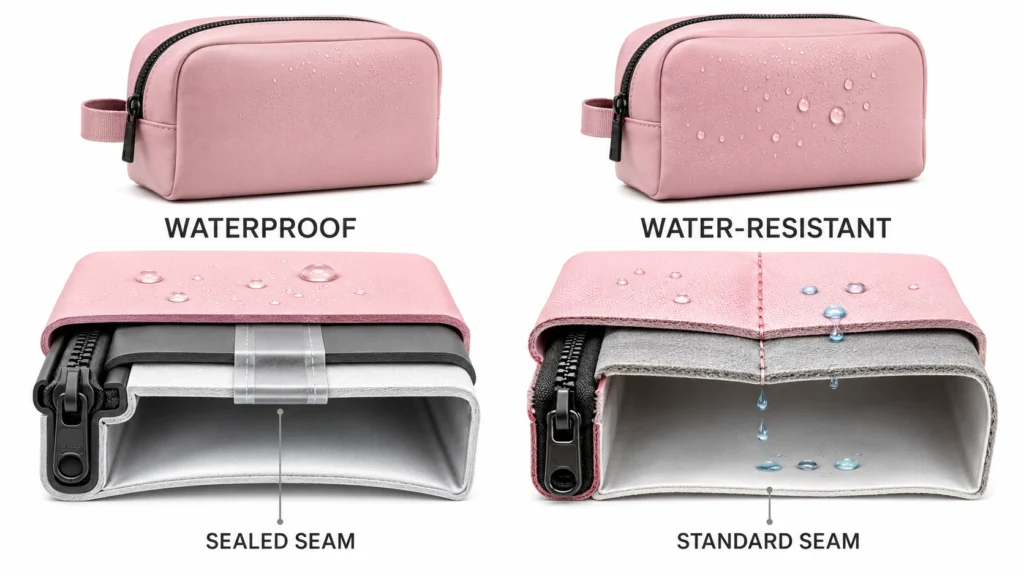
A material can resist water penetration while the completed bag leaks through stitched seams, zipper openings, binding, or attachment points. A buyer should therefore separate three requirements: resistance of the lining material, resistance of constructed seams, and performance of the finished bag.
ISO 811:2018 specifies a hydrostatic-pressure method for determining a fabric’s resistance to water penetration. This type of material test does not by itself prove that a finished cosmetic bag is waterproof.
Coatings, Laminations, and Seam Construction Work Together
Uncoated fabric may slow a small splash but usually does not create a liquid barrier. Coatings and laminations can improve surface resistance. However, sewing needles create holes. Bound seams may improve appearance without sealing those holes, while seam tape or welded construction may improve leakage control only when compatible with the material and geometry.
Ask the manufacturer whether the design will be sewn, taped, heat-sealed, high-frequency welded, or built with a removable insert. Each option has consequences for appearance, flexibility, tooling, repair, cost, and production speed.
Choose the Claim After Testing the Intended Use
If the bag is intended only to handle minor spills, “wipe-clean lining” or “water-resistant interior” may be more accurate than “waterproof bag.” Define the test orientation, liquid amount, contact time, pressure, and allowable penetration. Avoid broad claims that exceed the tested construction.
| Construction | Pros | Cons | Procurement Use |
|---|---|---|---|
| Sewn woven lining | Flexible, familiar, easy to assemble | Limited liquid barrier unless coated | Dry cosmetic storage |
| Sewn coated or laminated lining | Wipeable surface and improved material resistance | Needle holes remain; layers may delaminate | Everyday spill management |
| Seam-taped lining | Can improve constructed-seam resistance | Material and geometry compatibility are critical | Selected technical constructions |
| Welded film insert | Reduces stitched penetration points | Tooling, shape, and material limitations | Wet-item compartments |
| Removable liner | Easier separate cleaning and replacement | Adds components, attachments, and assembly | Premium reusable organizers |
How to Specify Cosmetic Bag Lining in a Tech Pack
Define the Material Beyond Its Generic Name
Give the lining a BOM code and state fiber or film type, construction, weight or denier, thickness where relevant, coating or lamination, finish, color reference, surface side, recycled-content requirement, and approved supplier swatch. Record whether substitutions require written approval.
Specify Color, Print, and Visual Tolerances
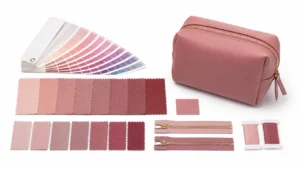
Use a physical approval swatch with a Pantone reference where appropriate. State whether the lining should match the shell, coordinate with it, or provide deliberate contrast. For printed linings, include vector artwork, repeat size, print direction, scale, registration expectations, and approved strike-off.
Document Pockets, Seam Allowance, and Attachment
Technical drawings should show the lining pattern, internal pockets, elastic, binding, zipper pocket, turning opening, attachment points, and reinforcement. Identify whether the lining is loose, drop-in, fully attached, quilted, bonded, or removable. Provide finished measurements and tolerances for pockets that must hold specific products.
Write Measurable Performance and Cleaning Requirements
Replace “high quality,” “durable,” and “waterproof” with tests and acceptance criteria. Define required abrasion behavior, colorfastness, seam strength, liquid resistance, coating adhesion, dimensional stability, odor review, and cleaning method. The final specification must reflect the destination market and intended user.
Q&N’s custom cosmetic bag service process covers material confirmation, sewing, logo application, and final inspection. Buyers should still place the exact lining code, construction, and test requirements in the approved tech pack.
Sampling, Testing, and Quality Control
Approve a Physical Lining Swatch Before Sampling
Digital images cannot confirm hand feel, noise, transparency, odor, coating tack, or shade under different lighting. Approve the actual lining with the shell, reinforcement, zipper tape, and thread. Materials that look compatible separately may pucker, discolor, or create excessive bulk when sewn together.
Test the Material and the Finished Bag
Use tests relevant to the risk. ISO 105-X12:2016 covers colorfastness to rubbing, including dry and wet procedures. ISO 12947-2:2016 addresses fabric abrasion resistance by the Martindale method through specimen breakdown. The buyer and laboratory should select methods, conditioning, sample direction, endpoints, and acceptance levels suitable for the product.
Then evaluate the complete bag for capacity, pocket use, zipper operation, lining pull-out, seam leakage, cleaning, stain visibility, and contact with actual or representative products. Passing a fabric test does not guarantee the assembled product will pass a use test.
Inspect Lining During Incoming, In-Line, and Final QC
| Inspection Stage | Lining Checks | Evidence |
|---|---|---|
| Incoming material | BOM code, color lot, width, weight or thickness, coating, visible defects | Receiving record and approved-swatch comparison |
| First article | Fit, pocket position, seam construction, bulk, color, attachment | Signed first-piece report and photos |
| In-line | Puckering, skipped stitches, raw edges, contamination, repeated defects | In-line inspection and corrective-action record |
| Final | Cleanliness, loose threads, function, measurements, pull-out, odor, appearance | Pre-shipment inspection report |
| Performance release | Applicable material and finished-product tests | Approved test reports linked to product and lot |
Common Lining Defects Buyers Should Define
- Lining pulling out or twisting during use
- Excess fabric blocking the zipper
- Puckering, skipped stitches, holes, or exposed raw edges
- Incorrect pocket size or position
- Shade variation or print misalignment
- Color transfer onto the shell or stored products
- Coating cracks, tackiness, peeling, or delamination
- Unexpected odor, contamination, or stains
- Leakage that exceeds the approved performance claim
Mid-project CTA: Ask the factory to submit two or three lining options with physical swatches, full material descriptions, MOQ implications, cost differences, recommended construction, and available compliance documents. Compare them against one written performance brief.
Compliance and Sustainability Requirements
Build Compliance Around the Destination and Intended User
A general adult cosmetic bag, a children’s makeup pouch, and a bag sold with cosmetics may require different assessments. List the destination, age grading, material components, coatings, prints, adhesives, and claims. Ask the importer or compliance professional to define the applicable chemical and product-safety requirements.
For the EU, the European Commission’s REACH overview explains the framework for registration, evaluation, authorization, and restriction of chemicals. Do not accept a generic statement such as “REACH material.” Identify the restricted substances, components, test scope, report owner, and validity required for the specific program.
Substantiate Recycled and Environmental Claims
If the lining is marketed as recycled polyester, define the claimed percentage, whether the claim applies to the lining or entire bag, and the chain-of-custody documents required. The U.S. Federal Trade Commission’s Green Guides summary says recycled-content claims should relate to materials recovered or diverted from the waste stream and partial recycled content should be qualified.
A recycled lining does not automatically make a multi-material bag recyclable. Zippers, foam, coatings, adhesives, labels, and mixed layers affect the complete product. Keep material-content and end-of-life claims separate.
Do Not Confuse Factory Audits with Product Compliance
Social audits, quality-management certificates, recycled-material certifications, and chemical test reports serve different purposes. A factory audit does not prove that a particular lining lot meets a chemical requirement. Verify the document’s scope, site, material, product reference, issuer, date, and connection to the proposed order.
Cost, MOQ, Lead Time, and Supplier Evaluation
Understand the Cost Drivers Behind the Lining
Cost is affected by base material, weight, thickness, coating, lamination, print coverage, custom dyeing, usable width, cutting yield, pocket complexity, seam finishing, and test scope. A more expensive lining may reduce cleaning complaints or increase perceived value, while an unnecessary technical laminate can over-engineer a simple pouch.
Identify the True MOQ Constraint
The lining MOQ may be driven by stock availability, custom color, printing, coating, lamination, or recycled-content sourcing rather than sewing capacity. Ask separately for the bag MOQ, lining MOQ, color MOQ, print MOQ, and treatment of excess custom material. Splitting one order across several lining colors can increase risk even when total volume appears sufficient.
Plan Lining Approval Before Bulk Material Booking
The schedule should include sourcing, swatch approval, print strike-off if used, prototype, performance testing, pre-production sample, bulk material booking, incoming inspection, and production. Late lining changes may alter pocket dimensions, seam bulk, zipper movement, cost, and delivery.
Evaluate the Supplier’s Technical Response
A capable supplier should explain why a lining suits the product, identify open risks, disclose substitutions, and connect the material to construction and testing. Q&N’s cosmetic bag factory overview shows support for material selection, structure, branding, sampling, production, and inspection. Buyers should compare suppliers using the same brief and approve the final lining through controlled documents and samples.
Common Procurement Mistakes
- Selecting lining only by color or price
- Using “210D” as a complete specification without fiber, weave, coating, and weight confirmation
- Calling a sewn bag waterproof because the lining film resists water
- Approving material from a photo instead of a physical swatch
- Ignoring wet color transfer onto light cosmetic packaging
- Changing lining after approving pockets and bag dimensions
- Requesting recycled claims without defining evidence or claim scope
- Comparing quotations based on different lining grades
FAQ About Cosmetic Bag Lining
What Is the Best Lining Material for a Cosmetic Bag?
There is no universal best material. Woven polyester suits many general projects, coated or laminated fabrics support wipeability, film linings can provide a more continuous surface barrier, and cotton blends support a natural look. The correct option depends on contents, construction, cleaning, performance, market, price, and brand position.
Is Polyester a Good Makeup Bag Lining Material?
Yes, when the correct construction and grade are selected. Polyester can be lightweight, stable, printable, and broadly available. Buyers must still define weight or denier, weave, coating, colorfastness, hand feel, and performance. Uncoated polyester should not automatically be described as waterproof.
What Lining Is Easiest to Clean?
Coated fabrics and EVA, PEVA, PVC, or TPU-based surfaces are often easier to wipe than absorbent woven cotton. Actual cleanability depends on surface texture, formulation, seam design, stain type, and contact time. Test representative cosmetics using an approved cleaning method.
Does a Waterproof Cosmetic Bag Lining Make the Entire Bag Waterproof?
No. Liquid can pass through needle holes, zipper openings, bindings, and attachment points even when the lining material resists penetration. Whole-bag performance must be assessed using the final construction and a test that reflects the intended claim.
What Information Should I Send a Manufacturer When Choosing Lining?
Send the bag type, dimensions, intended contents, target market, required cleaning and liquid performance, preferred material and color, pockets, construction drawings, quantity by color, packaging, and delivery date. Mark mandatory requirements and areas where the factory may recommend alternatives.
Expert Summary, Future Trends, and RFQ Next Steps
Future Trends in Cosmetic Bag Linings
Lining development is moving toward clearer performance claims, better component traceability, and material choices that are planned together with the complete bag. Buyers are likely to request more evidence for recycled content, coating chemistry, durability, and cleanability while also looking for lighter packaging and simpler material combinations.
Removable liners, welded inserts, mono-material concepts, and digital BOM traceability may be useful for selected projects, but they should be evaluated against cost, repairability, actual recycling systems, production feasibility, and customer value. A new material is useful only when it solves a defined product problem.
Final Lining Selection Checklist
- Define the products, liquids, stains, and loads expected inside the bag.
- Choose required cleaning, abrasion, colorfastness, and liquid performance.
- Compare physical swatches with the shell, zipper, reinforcement, and thread.
- Specify fiber or film, construction, weight, thickness, coating, color, and finish.
- Confirm seams, pockets, attachment, and whole-bag performance.
- Define market-specific tests, compliance documents, and claim evidence.
- Review MOQ, cost, lead time, and color allocation.
- Approve the final lining in the BOM, tech pack, and pre-production sample.
Request a Project-Specific Lining Recommendation
The best cosmetic bag lining is not simply the cheapest or most waterproof material. It is the material and construction that meet the product’s real use, brand position, compliance scope, manufacturing method, and target cost.
Q&N supports OEM/ODM cosmetic bag development with custom materials, linings, structures, colors, logo methods, sampling, bulk production, packaging, and quality inspection. Use the Q&N contact page and provide:
- Product type
- Finished dimensions
- Reference photos or tech pack
- Outer material and lining requirements
- Required cleaning, liquid, and durability performance
- Logo file and preferred branding method
- Target quantity by style and color
- Packaging requirements
- Delivery country
- Target delivery date
Ask for the proposed lining code, physical swatch, full specification, construction recommendation, cost and MOQ effect, sample plan, and applicable documentation. This creates a clear basis for approval before bulk materials are ordered.
Aries Gu is the founder of Q&N. With over 17 years of experience in cosmetic bag OEM/ODM source factory. He focuses on quality control, efficient communication, and on-time delivery for global cosmetic bag projects.