A cosmetic bag can look correct in a rendering yet arrive too soft, overly bulky, or permanently creased. The missing variable is often the bag interlining: the supporting layer between the exterior material and the lining. It influences silhouette, hand feel, impact protection, sewing behavior, logo appearance, packing volume, and unit cost. For a B2B buyer, “add padding” is not an adequate specification. This guide explains how to select, document, sample, test, and source interlining for a custom cosmetic bag without paying for structure the product does not need.
When preparing a brief, review custom cosmetic bag formats, then state whether the bag must stand empty, protect fragile contents, fold for shipment, or remain deliberately soft.
What Bag Interlining Does Inside a Cosmetic Bag
What Is Interlining in a Bag?
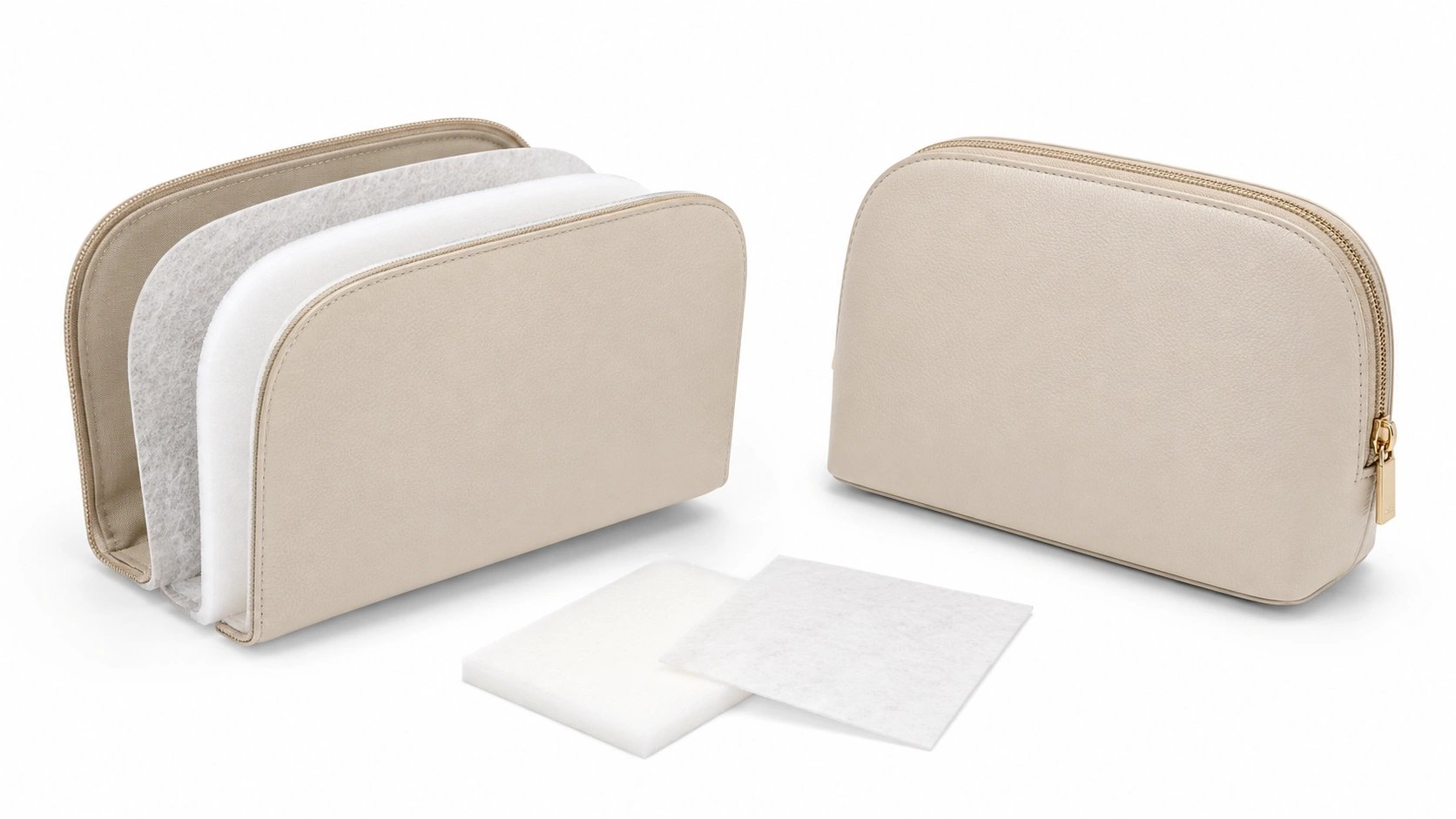
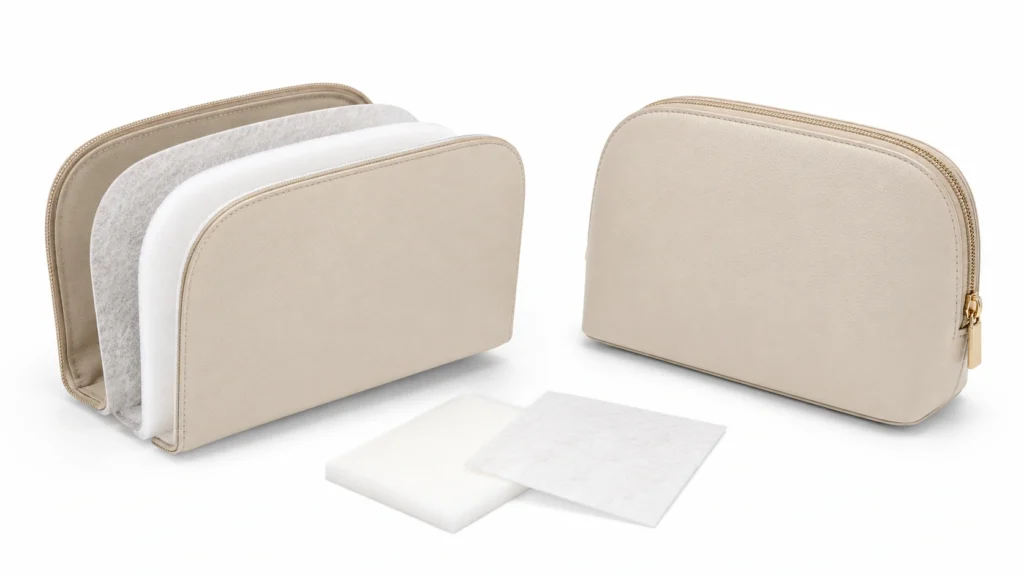
Interlining is a concealed support layer placed between a bag’s face material and interior lining. Depending on the construction, it may be fused to a textile, laminated to another layer, quilted into a panel, caught in the seams, or inserted only in selected zones. Common options include nonwoven or woven interlining, foam, felt, EVA sheet, and rigid board.
Factories may use “interlining,” “padding,” “sponge,” and “lamination” differently. Specify the actual material, construction, location, and performance rather than relying on the name alone.
Shape Retention, Hand Feel, and Product Protection
Interlining changes how a flat pattern becomes a three-dimensional bag. A resilient layer can help front and back panels recover after compression. A stiffer sheet can keep a base flat and side walls upright. A soft lofted layer can create a cushioned, premium hand, while a thin stabilizer can reduce stretching without adding obvious bulk.
These functions are not interchangeable. Stiffness helps a bag stand, cushioning protects contents, and dimensional stability limits distortion. A rigid base may offer little side protection, while soft foam may cushion bottles but still sag. Effective structures often use different reinforcement by zone.
Interlining vs. Lining vs. Makeup Bag Padding
The lining is the visible interior surface. Interlining is normally hidden and supports the shell. Makeup bag padding is a cushioning layer, often foam or felt. Bag reinforcement is broader and can also include seam tape, zipper-end patches, handle backing, binding, and base boards.
This distinction matters in an RFQ. “210D polyester lining plus foam interlining” describes two layers. “Padded lining” does not make clear whether the foam is laminated to the lining, attached to the exterior, or floating between both. That uncertainty can produce incomparable quotes.
Compare Interlining and Bag Reinforcement Options
Nonwoven Interlining: Pros and Cons
Nonwoven interlining is widely used to stabilize lightweight fabrics and reduce stretching. It can be fusible or sew-in and is available in different fiber compositions, masses, thicknesses, and stiffness levels.
- Pros: lightweight, cost-conscious, easy to cut, and useful for controlling panel distortion.
- Cons: limited cushioning, possible creasing in overly stiff grades, and potential adhesive delamination if the fusible system is poorly matched.
- Best fit: flat pouches, cotton or polyester shells, pocket reinforcement, embroidery backing, and designs needing support without a padded look.
Woven Interlining: Pros and Cons
Woven interlining has grain and directional behavior. It can support premium textile shells while retaining a more fabric-like drape than some paper-like nonwovens.
- Pros: good compatibility with woven exteriors, natural hand, and controlled support when grain direction is managed.
- Cons: typically requires more attention to cutting direction and may cost more than a basic nonwoven option.
- Best fit: structured cotton, canvas, jacquard, or other textile-led cosmetic bags where appearance and drape matter.
Foam and EVA Padding: Pros and Cons
Flexible foam adds loft, cushioning, and shape recovery. EVA sheet generally creates a firmer, more defined structure than soft foam of a comparable visual thickness, although actual performance depends on formulation and density.
- Pros: cushioning, fuller hand feel, good support for quilted effects, and useful protection for bottles or beauty tools.
- Cons: increased material and freight volume, thicker seam stacks, possible compression marks, and greater sewing difficulty around curves.
- Best fit: quilted pouches, vanity cases, brush organizers, travel sets, and bags intended to protect products in transit or daily use.
Felt, Boards, and Local Reinforcement
Felt provides moderate body and cushioning. Plastic sheet or board can keep bases, walls, lids, or dividers firm. Tape or fabric patches spread load at handles, D-rings, snaps, and zipper ends.
Rigid elements create clean geometry but reduce foldability and may reveal sharp outlines through thin exterior materials. Boards also complicate turning and assembly, so some constructions require an opening for insertion and a method for closing it neatly.
Which Option Fits the Intended Bag?
| Support option | Relative structure | Cushioning | Key procurement advantage | Main risk to control | Typical application |
|---|---|---|---|---|---|
| Nonwoven interlining | Low to medium | Low | Stabilizes with little bulk | Creasing or bond failure | Soft pouches and pockets |
| Woven interlining | Low to medium | Low | Fabric-like support and drape | Incorrect grain direction | Premium textile shells |
| Flexible foam | Medium | Medium to high | Loft and recovery | Compression set or bulky seams | Quilted and protective bags |
| EVA sheet | Medium to high | Medium | Defined shape and resilience | Edge visibility or excess stiffness | Vanity cases and shaped panels |
| Felt | Medium | Medium | Soft support | Thickness variation or moisture behavior | Dividers and padded panels |
| Plastic or fiber board | High | Low | Flat base or rigid wall | Warping, cracking, or print-through | Bases, lids, and dividers |
| Reinforcement tape or patch | Localized | Low | Adds strength only where needed | Poor placement | Handles and hardware points |
This is a sourcing framework, not a universal ranking. Test the complete layer package in a finished sample.
Define Cosmetic Bag Structure Before Choosing Support
Start With the Target Silhouette and Use Case
Translate design adjectives into observable requirements. “Structured” may mean the bag stands empty, the base stays flat when loaded, the lid does not collapse, or the corners retain a crisp radius. “Soft” may still require enough support to prevent the zipper from wavering. Write the required behavior, not only the mood.
A promotional pouch may prioritize freight efficiency, while a premium vanity case carrying bottles may justify zoned EVA, a reinforced handle, and a firm base.
Map Contents, Load, and Stress Points
Provide the dimensions and approximate filled weight of the intended contents. Tall glass bottles load the base and side walls differently from brushes or sachets. A top handle transfers force into its attachment panels; a wide-opening zipper places repeated stress at the zipper ends; an internal divider needs support if it must hold products upright.
Mark handle anchors, hinge lines, base corners, zipper terminals, and hardware points in the tech pack. These zones may need reinforcement even when the main panels remain soft.
Create a Panel-by-Panel Reinforcement Map
A single material callout for the whole style is rarely enough. Prepare a layer schedule for the front, back, gusset, base, lid, pocket, divider, and handle anchor. State where reinforcement stops before seam allowances or fold lines. This prevents unwanted ridges and makes quotations more comparable.
An efficient design might use thin stabilizer on the body, resilient foam on the front and back, board only in the base, and patches behind the handle. The buyer pays for performance where it matters rather than laminating every part.
Balance Structure With Packability
More reinforcement can increase carton volume, dimensional shipping weight, and crease risk. Review the finished silhouette and proposed packing method together.
Decide whether the bag may be folded, nested, lightly compressed, or must be packed fully formed. Define acceptable recovery time after unpacking. Packaging and bag construction should be developed together, not treated as separate purchasing decisions.
How to Specify Bag Interlining in a Tech Pack
Identify Material, Construction, and Composition
Name the material family and construction: for example, sew-in nonwoven, fusible woven, open-cell foam, closed-cell foam, EVA sheet, felt, or polypropylene board. Request composition and relevant supplier documentation where required by the destination market or brand policy. Avoid accepting “standard foam” as a final bulk specification.
For fused or laminated constructions, identify the adhesive system and the face material it must bond to. Heat-sensitive PU, PVC, coated textiles, metallic finishes, and printed surfaces may distort, discolor, shrink, or lose texture under unsuitable temperature and pressure. Approval must use the actual bulk combination.
Control Thickness, Mass, Density, and Firmness
Thickness alone does not predict performance. Two foam sheets of equal thickness can differ in density, compression response, recovery, and hand feel. Two nonwovens can share a thickness but differ in mass per area and stiffness. Record the variables relevant to the selected material and use an approved physical swatch as a visual and tactile reference.
Where objective verification is needed, the buyer and test laboratory can agree on an appropriate method. ISO 9073-2 addresses thickness measurement for normal and bulky nonwovens under specified pressure. ISO 3386-1:2025 covers compression stress/strain characteristics for low-density flexible cellular materials. These are test methods, not automatic pass/fail limits; the purchase specification must define tolerances or acceptance criteria.
Specify Application Method and Coverage
State whether the layer is full-panel, zoned, quilted, fused, laminated, basted, or free-floating. Define adhesive coverage, quilting pattern, stitch spacing if appearance depends on it, and exclusion zones around seams or folds. Also specify which side of a directional foam or fusible faces the shell.
Quote and sample a laminated composite as one defined material; lamination can alter drape, needle penetration, and end-of-life separation.
Set Tolerances and Preserve Approved References
| Specification field | What the buyer should record | Why it affects the finished bag | Approval evidence |
|---|---|---|---|
| Material identity | Construction, composition, color, supplier reference | Prevents silent substitution | Labeled swatch and data sheet |
| Thickness | Nominal value, test pressure/method, tolerance if critical | Changes loft and seam bulk | Measurement record |
| Mass or density | Applicable unit and tolerance | Affects firmness, recovery, and weight | Supplier certificate or incoming test |
| Firmness | Approved grade or agreed compression criterion | Controls stand-up behavior and hand | Test result plus approved sample |
| Coverage | Panel map and setback from edges | Prevents ridges and inconsistent shape | Marked pattern or construction sheet |
| Bonding | Fusible, laminated, sew-in, or quilted | Affects delamination and surface appearance | Peel review and aging check if required |
| Color | White, black, or matched tone where show-through is possible | Can alter light-colored shells | Layered approval swatch |
The golden sample should be retained with labeled component swatches. Photos alone cannot preserve firmness, thickness, or recovery. If the material supplier changes, require written notice and reapproval of the affected layer package.
Develop and Approve the Custom Structure
Use an OEM/ODM Development Sequence
- Define use case, filled products, target silhouette, and packing constraint.
- Review exterior material compatibility and select two or three support concepts.
- Build prototypes using production-intent layer combinations.
- Evaluate empty shape, loaded shape, recovery, zipper operation, hand feel, and seam bulk.
- Revise the panel map and approve a sealed reference sample.
- Confirm bulk material sources, QC checkpoints, packaging, and change-control rules.
Q&N’s custom cosmetic bag service connects cutting, sewing, logo application, reinforcement, and inspection. Interlining should therefore be approved with the shell, lining, zipper, and assembly method.
Compare Samples, Not Isolated Swatches
A swatch can screen options, but only a finished prototype reveals corner turning, zipper waves, edge thickness, quilting loft, and packed recovery. Ask for clearly labeled variants such as “A: nonwoven,” “B: foam,” and “C: zoned foam plus base support,” with all other variables held constant.
Evaluate samples empty and filled. Photograph the same angles and score shape, protection, feel, sewing quality, packing volume, and cost impact.
Check Effects on Logos, Zippers, and Sewing
Interlining changes the surface under a logo. Foam may improve embroidery relief but can increase puckering. Rigid layers affect application order, while metal plates need backing that prevents pull-through.
Thicker layer stacks also change zipper alignment, binding width, needle selection, stitch balance, turning radius, and seam allowance behavior. Confirm logo application order and test the actual sewing construction before approving bulk materials.
Avoid Common Product Development Mistakes
- Choosing interlining from a photo or generic verbal description.
- Specifying thickness without density, firmness, construction, or approved swatch.
- Adding full-panel foam when only the base and handle anchors need support.
- Approving an empty sample without testing the intended contents.
- Changing the exterior material after the support package is approved.
- Ignoring the packing method until production is complete.
- Allowing material substitution without a new sample or documented approval.
Mid-project CTA: send your structure brief, contents, target hand feel, and packing requirement when requesting development. A factory can then propose controlled sample variants instead of guessing what “medium padding” means.
Quality Control Tests and Common Structural Risks
Inspect Incoming Interlining and Padding
Incoming inspection should verify material identity, width, color, surface condition, thickness or mass where specified, odor, roll consistency, and contamination. Foam and felt should be checked for crushing, uneven cells, hard spots, and permanent folds. Fusible materials need clean adhesive distribution and controlled storage.
Because storage and conditioning can affect thickness and recovery, state when measurements are taken and how rolls or sheets are sampled.
Control Cutting, Bonding, Quilting, and Assembly
In-line inspectors should compare cut panels with the reinforcement map. Misplaced setbacks can create hard edges near a seam; reversed fusible material can contaminate equipment; inconsistent lamination can cause bubbles; uneven quilting tension can shrink a panel and change finished dimensions.
Check first-off units for symmetry, zipper smoothness, corner fullness, base flatness, handle alignment, and lining fit before the line continues.
Use a Finished-Bag Test Plan With Relevant Methods
There is no universal interlining test. Build a risk-based plan using relevant checks such as loaded stability, zipper operation, handle load, seam strength, packed recovery, odor, color transfer, and visual aging.
Where an objective seam method is appropriate, ISO 13935-2:2026 describes a grab method for determining maximum force to seam rupture when force is applied perpendicular to a sewn seam. Buyers and laboratories must confirm applicability to the actual composite and define their own acceptance limits. A standard method does not establish the product requirement by itself.
| Inspection point | Buyer-facing check | Typical risk detected | Control stage |
|---|---|---|---|
| Material identity | Match code and swatch to approved specification | Unapproved substitution | Incoming |
| Thickness or firmness | Measure by agreed method or compare to controlled reference | Soft or bulky production | Incoming |
| Coverage | Overlay cut part with panel map | Weak zones and visible ridges | Cutting |
| Bond quality | Check bubbles, lifting, strike-through, and surface change | Delamination or damaged shell | Lamination and in-line |
| Seam stack | Inspect skipped stitches, puckering, binding, and allowance | Weak or distorted seams | In-line |
| Empty and loaded shape | Compare with sealed sample from defined angles | Collapse, twist, or base sag | First-off and final |
| Compression recovery | Pack as specified, unpack, and inspect after agreed recovery period | Permanent dents or creases | Preproduction and final |
| Stress points | Apply agreed handle, zipper, and hardware checks | Tearing or pull-through | In-line and final |
Recognize Failure Modes Before Shipment
Frequent structural failures include panel collapse, asymmetric loft, base curling, foam showing at seam edges, puckered quilting, delamination, board migration, zipper waves, and hard reinforcement outlines visible through the shell. Odor and adhesive discoloration can also turn a structurally acceptable unit into a rejected retail product.
Packaging can also cause defects. Validate a packed-carton trial using the proposed unit packing, separators, carton size, and relevant storage conditions.
Cost, MOQ, Lead Time, and More Sustainable Choices
What Drives Interlining Cost?
The cost impact includes more than the price per square meter. Buyers should consider material yield, lamination or fusing, extra cutting, quilting, sewing time, binding width, needle wear, rework risk, added unit weight, and carton volume. Rigid inserts can also require manual insertion or special assembly access.
Cheap interlining may increase rework. Compare quotes against the same bill of materials and panel map; undefined “foam” is not comparable with a specified laminated grade.
How Do MOQ and Lead Time Change?
Final MOQ depends on grade, color, supplier stock, lamination, and order mix. Custom-color felt, special-density foam, or laminated composites may introduce separate material minimums. Styles can share a layer only when the specification is identical.
Lead time may include sourcing, lamination, conditioning, samples, testing, and replacement of rejected lots. Separate material, approval, production, inspection, and shipping milestones.
How Can Buyers Reduce Cost Without Losing Shape?
- Use zoned reinforcement instead of full coverage.
- Choose a standard available grade and color when performance permits.
- Reduce unnecessary layer duplication between shell, padding, and lining.
- Simplify tight curves or binding where thick stacks slow sewing.
- Share one approved support package across a coordinated collection.
- Optimize packing only after confirming compression recovery.
Do not reduce cost by accepting uncontrolled density, omitting stress-point patches, or removing bulk change approval. Those shortcuts can convert a small component saving into returns, rework, or missed launch dates.
Future Trends: Lighter Structures and Verifiable Material Claims
Development is moving toward lighter zoned support, recycled-content nonwovens or felts, removable inserts, and more precise digital cutting. These approaches can reduce excess material while maintaining critical reinforcement.
Sustainability claims still require evidence. Ask whether a recycled-content statement applies to the interlining alone or the entire finished bag, and retain transaction or material documentation. For EU programs, chemical requirements can extend to components and adhesives under REACH. Material innovation does not remove the need for market-specific compliance review.
How to Evaluate a Cosmetic Bag Supplier
Ask Technical Questions Before Comparing Quotes
- What exact support material and construction are included?
- Is it stocked, custom made, fused, laminated, quilted, or inserted?
- Which properties will be controlled in incoming inspection?
- Can the supplier show two sample grades using the same outer material?
- How will handle anchors, zipper ends, bases, and dividers be reinforced?
- What change-notification process applies if the component source changes?
- How will the bag be packed to preserve the approved shape?
A capable supplier should explain tradeoffs, not simply recommend the thickest option. Use Q&N’s cosmetic bag factory overview to prepare material, sampling, production, and QC questions.
Use a Supplier Evaluation Checklist
| Evaluation area | Evidence to request | Warning sign |
|---|---|---|
| Specification control | Component codes, layer schedule, tolerances, retained swatches | Only verbal descriptions |
| Development capability | Comparable prototypes and written revision record | One unexplained sample option |
| Material traceability | Supplier reference, lot control, change notification | Frequent anonymous substitutions |
| Process control | First-off approval and in-line checks for lamination and sewing | Reliance only on final inspection |
| Testing | Risk-based plan with methods and buyer-approved limits | Generic “all tests passed” statement |
| Packing validation | Packing sample, carton configuration, recovery review | Carton plan decided after production |
| Commercial clarity | Itemized assumptions for grade, coverage, MOQ, and timing | Low quote with undefined materials |
Confirm Compliance and Documentation Scope
Compliance depends on destination, consumer group, claims, and the complete material set. An exterior-fabric report does not cover foam, adhesive, board, inks, coatings, or hardware. Confirm exactly which components and lots each report covers.
For EU consumer products, the General Product Safety Regulation (EU) 2023/988 has applied since December 13, 2024. Obtain qualified advice for the product and channel; factory audits do not replace product-specific risk assessment and evidence.
Bag Interlining FAQs for B2B Buyers
What Makes a Cosmetic Bag Hold Its Shape?
Shape comes from the full construction: pattern geometry, exterior material, interlining, seams, binding, zipper installation, base support, and packing. Interlining is a major variable, but adding stiffness cannot correct an unsuitable pattern or distorted sewing.
What Padding Is Used in Makeup Bags?
Common choices include flexible foam, EVA sheet, and felt, sometimes combined with nonwoven or woven stabilizer. The right makeup bag padding depends on required cushioning, silhouette, wash or care expectations, seam thickness, cost, and packaging method.
Is Thicker Interlining Always Better?
No. Greater thickness can add loft but may create bulky seams, zipper waves, difficult corners, higher freight volume, and a hand feel that does not match the brand. Density, firmness, recovery, coverage, and compatibility are as important as thickness.
Should Interlining Cover Every Panel?
Not necessarily. Zoned construction is often more efficient. Body panels may need light support, the base may need a firm insert, and handle anchors may need local patches. A panel map should document the exact coverage.
Can a Factory Change Interlining After Sample Approval?
Only through the buyer’s documented change-control process. A replacement should be identified, compared with the approved specification and swatch, tested where necessary, and incorporated into a newly approved reference. “Equivalent” should never be accepted without evidence.
Expert Summary and RFQ Checklist
Specify Performance, Then Select the Layer Package
The best bag interlining is not the thickest or stiffest material. It is the lightest practical layer package that delivers the approved cosmetic bag structure, protects the intended contents, survives production and packing, and can be reproduced in bulk. Define observable performance, map reinforcement by panel, approve production-intent samples, and control material changes.
Send a Complete Structure Brief for a Reliable Quote
For a development review or comparable quotation, contact the Q&N cosmetic bag team and provide:
- Product type
- Finished dimensions
- Reference photos or tech pack
- Material requirements
- Target structure, hand feel, and cushioning requirement
- Contents and approximate filled weight
- Logo file and application method if known
- Target quantity by style and color
- Packaging requirements and compression limits
- Delivery country
- Target delivery date
These inputs let the OEM/ODM team review compatibility, propose reinforcement options, plan samples, flag testing needs, and confirm project-specific MOQ, pricing, and timing.
Aries Gu is the founder of Q&N. With over 17 years of experience in cosmetic bag OEM/ODM source factory. He focuses on quality control, efficient communication, and on-time delivery for global cosmetic bag projects.