A waterproof cosmetic bag and a water resistant cosmetic bag are not the same product. A coated fabric may repel splashes while water can still enter through the zipper or needle holes. A clear PVC, TPU or EVA panel may be effectively impermeable to liquid water, yet the finished bag can still leak because of sewing, binding, pockets or an ordinary zipper.
For B2B buyers, this distinction affects product claims, construction, testing, MOQ, cost and supplier selection. Calling a bag “waterproof” without defining the performance level can create disputes between the brand, factory and end customer. The better approach is to specify the actual use environment, choose the right material and seam system, then test the finished bag against the claim you intend to make.
Early sourcing CTA: Q&N Bags manufactures custom cosmetic and toiletry bags in polyester, nylon, PVC, TPU, EVA, neoprene and other materials. Buyers can compare options through the custom cosmetic bag manufacturing page before selecting a water-performance target.
What Waterproof and Water-Resistant Mean for Cosmetic Bags
Material-Level Water Resistance vs. Finished-Bag Protection
Water performance has at least two levels: the material and the assembled product. A fabric can resist wetting or water penetration in laboratory testing, but the bag introduces openings and stress points. Zippers, seams, logo stitching, pocket attachments and handle bases can all become leak paths.
This means a supplier should never justify a finished-bag waterproof claim only by showing a fabric test report. The finished construction needs its own evaluation if the claim refers to the whole bag.
Why “Waterproof” Is a Stronger Product Claim
“Water-resistant” normally communicates limited protection from splashes, short exposure or surface wetting. “Waterproof” reasonably suggests a substantially higher level of protection against water entering the product.
There is no single universal waterproof threshold that applies to every cosmetic bag. The required proof depends on what the brand promises. A pouch described as “splash resistant for bathroom use” needs a different test from a case advertised to protect contents during immersion.
For U.S. marketing, the Federal Trade Commission requires advertisers to have a reasonable basis for objective product claims before they are made. A “waterproof” performance statement should therefore be supported by evidence appropriate to the claim rather than by a material name alone. See the FTC Policy Statement Regarding Advertising Substantiation.
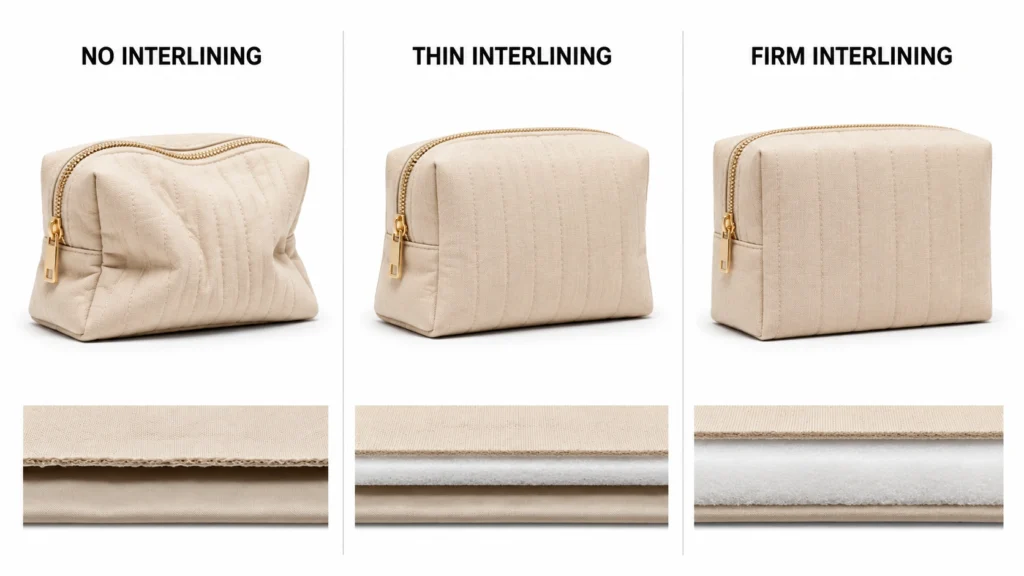
Water-Repellent, Water-Resistant, Leak-Resistant and Waterproof Compared
| Term | Typical Meaning in Bag Development | What It Does Not Automatically Prove |
|---|---|---|
| Water-repellent | Surface resists wetting and causes droplets to bead or roll off | That water cannot penetrate under pressure |
| Water-resistant | Provides limited protection from splashes or short exposure | That seams and zipper remain dry during immersion |
| Leak-resistant | Construction is designed to reduce liquid escaping or entering through seams | Full waterproof performance at the opening |
| Waterproof | Intended to prevent water penetration under a defined test condition | Unlimited protection under every depth, duration or pressure |
How Bag Materials Affect Water Performance
Coated Polyester and Nylon
Polyester and nylon can be coated or laminated to improve water resistance. Common constructions may use PU or other polymer coatings on the reverse side. The outer textile still provides color, printability and abrasion resistance while the coating reduces water penetration.
The advantages are familiar sewing processes, broad color availability and relatively low weight. The limitation is that coating performance can vary by specification, and every needle hole penetrates the barrier unless the seam is subsequently sealed.
PVC, TPU and EVA Films
Solid PVC, TPU and EVA films do not absorb water in the same way as woven textile and can provide strong sheet-level resistance. They are widely used in transparent travel and toiletry bags because the material is easy to wipe and the contents remain visible.
PVC is generally cost-effective and widely available. TPU is softer and often selected for premium projects where flexibility and abrasion performance matter. EVA is useful for lightweight, frosted or translucent pouches. Q&N’s transparent toiletry bag manufacturing page lists PVC, TPU and EVA as current clear-material options and notes that sewn or suitable sealed construction can be selected according to the project.
Neoprene and Laminated Materials
Neoprene-type composites provide cushioning and a water-resistant surface but should not automatically be called waterproof. The textile-laminated face, sewn zipper and stitched seams normally remain potential entry points. They are useful for gym, wellness and travel projects where flexibility and light protection matter more than immersion resistance.
Material Pros and Cons for Beauty and Travel Programs
| Material | Water-Performance Strength | Advantages | Limitations |
|---|---|---|---|
| Coated polyester | Good splash and penetration resistance when correctly specified | Light, printable, broad colors, familiar sewing | Needle holes and worn coatings can reduce protection |
| Coated nylon | Strong travel-oriented water resistance | Durable, technical appearance, lightweight | Higher-performing coatings can increase cost |
| PVC film | Strong sheet-level water barrier | Clear, cost-effective, easy clean | Stiffness, odor and compliance depend on formulation |
| TPU film | Strong sheet-level water barrier | Soft, flexible and premium | Higher material cost |
| EVA film | Strong sheet-level water resistance | Lightweight, soft, frosted options | Can crease or distort with heat |
| Neoprene composite | Useful surface resistance | Cushioning and sporty hand feel | Sewn construction is usually not waterproof |
Why Construction Matters More Than Material Alone
Sewn Seams and Needle Holes
Traditional cosmetic bags are usually sewn. Every stitch creates a hole through the outer material. On an ordinary textile bag this may be insignificant, but on a coated or film construction those holes interrupt the water barrier.
Close stitching does not necessarily solve the problem; more holes can create more leakage paths. Seam allowances, thread, binding and reinforcement should therefore be designed around the intended protection level.
Heat-Welded and Sealed Seams
Thermoplastic films can often be joined by heat, RF/high-frequency welding or another compatible sealing method. The correct method depends on the polymer and construction. Welding can create a continuous joint without sewing holes, which is one reason it is used for higher water-protection applications.
Seam sealing tape is another option for selected coated fabrics. The tape covers stitch holes from the inside. It adds processing time and requires compatibility between the tape, coating, temperature and seam geometry.
Standard, Water-Resistant and Sealed Zippers
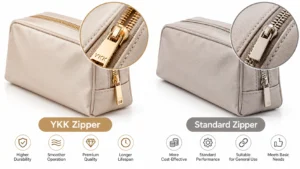
A standard nylon coil zipper is a major leak path. A coated water-resistant zipper can reduce water entry during splashes, but the teeth or coil and slider path may still permit leakage. Higher-protection projects may require specialized sealed zipper systems and carefully controlled end construction.
Do not assume a water-resistant zipper makes the whole bag waterproof. The zipper ends, seam attachment and slider garage can still fail first.
Binding, Handles, Pockets and Other Leak Paths
Fabric binding can absorb water and carry moisture toward the interior. Exterior pockets add stitch lines. Handles and logo patches create attachment holes. Drainage mesh intentionally allows water to pass through. Every feature must be evaluated against the actual use case.
Illustrative manufacturing scenario: A beauty brand requests a “waterproof” clear travel pouch but selects a sewn PVC body, fabric binding and standard coil zipper. The PVC panel itself does not absorb water, but the assembled pouch leaks during a water-fill check. The most accurate commercial solution may be to market the design as water resistant, or redesign the seams and zipper for a higher protection level. This is an illustrative manufacturing scenario, not a reported customer case.
How Waterproof vs. Water-Resistant Bags Are Tested
AATCC TM22 for Surface Water Repellency
AATCC TM22-2024 measures resistance of a textile surface to wetting by sprayed water. Water is sprayed onto a taut specimen and the wetting pattern is compared with a standard rating chart.
AATCC explicitly notes that the spray test is not intended to predict probable rain penetration because it does not measure water passing through the fabric. That distinction is highly relevant when a supplier presents a spray rating as proof that a finished cosmetic bag is waterproof.
Test reference: AATCC TM22-2024 Water Repellency: Spray Test.
ISO 811 Hydrostatic Pressure Testing
ISO 811:2018 specifies a hydrostatic pressure method for determining a fabric’s resistance to water penetration. ISO confirms that this edition remained current after review in 2025. The test applies pressure to one side of a fabric and measures resistance to water passing through it.
This is a stronger material-level evaluation for fabrics intended to resist penetration, but it is still a fabric test. It does not automatically qualify the zipper, seam or complete cosmetic bag.
Test reference: ISO 811:2018 Textiles — Resistance to Water Penetration.
Finished-Bag Splash, Fill and Leakage Tests
Finished-product testing should simulate the claim. A controlled splash test may be enough for a bathroom pouch. A water-fill test can expose pinholes or welded-seam leakage below the zipper. A rain exposure test can evaluate a travel organizer. Immersion requires a much more demanding sealed construction.
The test method should define water level, duration, orientation, pressure where relevant and what counts as failure. “No visible drops inside after a five-minute splash exposure” is more useful than “passed waterproof test” without conditions.
Match the Test Method to the Marketing Claim
| Intended Claim | Useful Evaluation Direction | Main Component to Watch |
|---|---|---|
| Water-repellent fabric | AATCC TM22 or equivalent surface-wetting method | Outer textile finish |
| Water-resistant fabric | ISO 811 or buyer-agreed penetration method | Fabric/coating barrier |
| Splash-resistant bag | Finished-bag controlled splash test | Zipper, seams and opening |
| Leak-resistant pouch | Water-fill or liquid-containment test | Seams, corners and welds |
| Waterproof bag | Finished-product test matching the stated exposure | Entire construction, especially closure |
How to Specify Water Performance in a Cosmetic Bag Tech Pack
Define the Intended Use Environment
Start with the scenario: occasional sink splashes, wet shower products, beach use, leaking skincare bottles, outdoor rain or temporary immersion. A water-performance specification without an end-use scenario is difficult for both factory and laboratory to interpret.
Specify Material, Coating, Seam and Zipper Construction
List the outer material, coating or film thickness, lining, seam method, zipper type, binding and any reinforcement. If the sample uses sealed seams, state which seams must be sealed. If only the base is welded while the zipper is sewn, record that distinction.
Set Test Conditions and Acceptance Criteria
Define the method, sample conditioning if relevant, water exposure, time and allowable leakage. For a custom program, the brand can create a finished-bag functional test that reflects the real customer use even when no single textile standard describes the assembled pouch.
Record Approved Samples and Production Tolerances
The tech pack should reference the pre-production sample and any approved material test report. Record film thickness, coating specification and seam width where those variables affect performance. Bulk inspection then has a measurable reference.
Mid-project CTA: Q&N’s custom service page covers material selection, sewing, assembly and final QC. Buyers can send the intended water-performance level together with the bag structure rather than requesting “waterproof material” as a standalone requirement.
Best Applications for Waterproof and Water-Resistant Cosmetic Bags
Travel Toiletry and Skincare Kits
Most travel toiletry bags need spill management and bathroom splash resistance rather than immersion protection. Coated nylon, polyester or clear film with a practical zipper may provide the best balance of price, weight and usability.
Shower, Gym, Pool and Beach Programs
Wet environments increase the value of easy-clean surfaces, corrosion-resistant trims and drainage. A shower pouch with mesh drainage should not be sold as leakproof because the design deliberately allows water to move through it. A pool-side beauty case may need splash resistance but not submersion protection.
Hotel, Airline and Promotional Beauty Sets
Low weight, clean appearance and pack efficiency are often more important than maximum water protection. A frosted EVA or thin clear PVC pouch may meet the use case without the extra zipper and seam cost of a fully sealed construction.
When a Fully Waterproof Construction Is Unnecessary
Over-engineering can increase cost, weight and stiffness without improving the customer experience. If the products are already in sealed primary bottles and the pouch is used only for bathroom organization, a well-made water-resistant bag may be commercially superior to a heavier waterproof design.
Cost, MOQ and Lead-Time Differences
Stock Coated Fabrics vs. Custom Functional Materials
Stock coated nylon or polyester can reduce material MOQ and sampling time. Custom coatings, special film colors or performance-specific laminations may require higher supplier minimums and separate testing.
Sewing vs. Welding and Seam-Sealing Cost
Sewing is flexible and familiar across many factories. Welding requires compatible material, tooling and suitable equipment. Seam sealing adds another production operation after sewing. These methods can improve protection but should be justified by the intended claim.
Zipper, Tooling and Testing Cost Drivers
Specialized water-resistant or sealed zippers cost more than standard coil zippers. Welding dies or electrodes may add tooling. Laboratory testing adds cost and schedule. Multiple prototypes may be needed to optimize zipper ends and corners.
When Water Resistance Gives Better Commercial Value
| Project Type | Recommended Starting Level | Commercial Reason |
|---|---|---|
| Everyday makeup pouch | Easy-clean / splash resistant | Avoid unnecessary functional cost |
| Travel toiletry bag | Water resistant | Balances bathroom use, weight and price |
| Wet shower organizer | Water-resistant materials plus drainage | Drying can matter more than containment |
| Leak-containment pouch | Sealed or welded body with defined fill test | Protects luggage from product leakage |
| True waterproof use case | Fully engineered and tested construction | Claim requires higher evidence and component control |
Q&N publicly lists a regular MOQ usually around 1,000 pieces per style/color for transparent toiletry bags, with final MOQ depending on material, film color, thickness, logo, zipper, trim and packaging. Sampling is generally listed at 7–14 days and bulk production at 30–45 days after approval. These are published starting points, not guaranteed values for every waterproof construction.
Quality Control and Common Procurement Risks
Incoming Material and Coating Checks
Verify the approved material code, film thickness or fabric coating before cutting. Check visible coating defects, delamination, pinholes, odor and color. A correct sample cannot protect the order if bulk material has changed.
Seam, Zipper and Handle Inspection
Inspect seam continuity, weld width, skipped areas, zipper attachment, corner reinforcement and handle stress points. Perform the agreed leakage or splash test on production samples rather than judging protection visually.
Common “Waterproof” Claim Mistakes
- Calling a bag waterproof because the raw fabric is water resistant.
- Using AATCC TM22 spray results as proof of water penetration resistance.
- Ignoring zipper ends and needle holes.
- Assuming PVC, TPU or EVA film automatically makes a sewn bag waterproof.
- Using “waterproof zipper” language without checking the complete closure assembly.
- Failing to define depth, duration or exposure behind a waterproof claim.
- Changing materials after testing without repeating the relevant evaluation.
Supplier Evaluation Checklist for Water-Performance Projects
| Supplier Check | What to Ask |
|---|---|
| Material knowledge | Can the supplier explain the difference between coating, film and finished-bag protection? |
| Construction capability | Does the factory sew, weld or seam-seal the required material appropriately? |
| Testing | Can the supplier follow a defined fabric or finished-product test? |
| Zipper control | Are zipper type and end construction included in the water-performance review? |
| Bulk QC | Are seam and leakage checks performed against the approved sample? |
| Claims | Will the supplier distinguish water-resistant materials from waterproof finished products? |
Q&N’s public factory profile states that incoming materials, stitching, zipper function, dimensions and final workmanship are checked through its production and inspection process, with project-based compliance support available according to the buyer’s requirements.
Frequently Asked Questions About Waterproof Cosmetic Bags
Is a Water-Resistant Cosmetic Bag Waterproof?
No. Water resistance indicates limited protection under defined or ordinary exposure. Waterproof is a stronger claim and should be supported by a complete construction and finished-product test appropriate to the intended use.
Are PVC, TPU and EVA Cosmetic Bags Waterproof?
The film itself can provide a strong water barrier, but the finished bag may leak through sewn seams, zipper tape, binding or hardware attachments. Evaluate the complete product rather than the film alone.
Does a Waterproof Zipper Make the Whole Bag Waterproof?
No. The zipper must be integrated with waterproof or sealed seams, controlled zipper ends and compatible body construction. Other attachment points can still leak.
What Test Should Be Used for a Waterproof Cosmetic Bag?
There is no single universal test for every bag claim. AATCC TM22 evaluates surface wetting of textiles, while ISO 811 evaluates fabric resistance to water penetration under hydrostatic pressure. The finished bag should also be tested under the exposure described in the product claim.
Which Material Is Best for a Waterproof Travel Cosmetic Bag?
TPU, PVC and selected coated textiles are strong starting options. The best choice depends on transparency, flexibility, durability, cost, seam method, zipper and target market. A high-performing material cannot compensate for a weak closure.
Can a Sewn Cosmetic Bag Be Waterproof?
It can achieve higher protection when compatible seam-sealing systems are applied, but ordinary untreated sewing holes allow leakage. The actual result must be verified through finished-product testing.
How Should Brands Describe Water Performance on Product Pages?
Use the narrowest accurate claim supported by the evidence: for example, “water-resistant outer fabric,” “splash-resistant toiletry bag,” or “leak-resistant welded body below the zipper.” Avoid unqualified “100% waterproof” language unless the complete product and stated use conditions support it.
Final Recommendations for Sourcing the Right Water Protection
The Minimum Specification to Approve Before Sampling
Before sampling, define the intended exposure, outer material, coating or film thickness, seam construction, zipper type, lining, handle attachments and the exact performance claim. Decide whether the target is surface repellency, splash resistance, leak containment or true waterproof protection.
Future Trends in Water-Protection Materials and Claims
Beauty and travel packaging will continue moving toward lighter functional laminates, softer clear films, more fluorine-free water-repellent textile finishes and construction-specific performance claims. Buyers are also becoming more precise about distinguishing easy-clean, water-resistant and waterproof products rather than treating them as interchangeable terms.
The global cosmetic packaging market is estimated by Grand View Research at US$37.2 billion in 2026 and projected to reach US$44.3 billion by 2030, with skincare the largest cosmetic-type segment in its 2023 base data. Functional secondary packaging sits within a broader market where material performance and user convenience remain meaningful differentiators. See Grand View Research cosmetic packaging market.
Google’s 2026 generative AI search guidance also emphasizes unique, expert-led content and confirms that established SEO fundamentals remain relevant. For product and sourcing pages, specific construction, testing and claim limitations create more value than repeating unsupported “waterproof” language. See Google’s generative AI search optimization guide.
What to Send a Manufacturer for Development and Quotation
For a waterproof or water resistant cosmetic bag project, prepare:
- Product type
- Finished dimensions
- Reference photos or tech pack
- Material requirements
- Required water-performance claim or use environment
- Preferred seam and zipper construction, if already defined
- Logo file
- Target quantity
- Packaging requirements
- Delivery country
- Target delivery date
Send the information through the Q&N contact page so the factory can review whether a sewn, coated, welded or higher-protection construction is appropriate before quotation.
Final expert recommendation: In the waterproof vs water resistant bag decision, start with the customer use case, not the marketing word. Test the material at the right level, then test the finished bag at the seam and closure level. A clearly specified water-resistant cosmetic bag is better procurement than an unverified “waterproof” bag whose construction cannot support the claim.
Aries Gu is the founder of Q&N. With over 17 years of experience in cosmetic bag OEM/ODM source factory. He focuses on quality control, efficient communication, and on-time delivery for global cosmetic bag projects.