PU leather thickness affects far more than how substantial a cosmetic bag feels in the hand. It changes how the bag holds its shape, how easily curved seams can be sewn, how cleanly corners turn, how well a debossed logo reads, how much reinforcement is needed and how the material behaves after repeated flexing.
For B2B buyers, the mistake is usually not choosing a material that is simply “too thin” or “too thick.” The larger problem is specifying thickness without defining the PU construction, backing, finish, bag structure and intended use. Two synthetic leathers with the same nominal thickness can behave very differently because one uses a woven backing while another uses a nonwoven or microfiber base, a different coating system or a different foam structure.
This guide explains how to evaluate cosmetic bag PU leather from a manufacturing perspective, how to build thickness into a tech pack and QC plan, and when a thinner or thicker material creates real value for a beauty, grooming or private-label collection.
Early sourcing CTA: Q&N Bags currently lists PU leather among its core custom cosmetic-bag materials and supports custom structure, lining, zipper, logo and packaging development. Buyers can review the custom cosmetic bags with logo page before preparing a PU material brief.
What PU Leather Thickness Actually Means
PU Coating, Backing Fabric and Total Composite Thickness
Most commercial PU synthetic leather is a composite: a woven, knitted, nonwoven or microfiber substrate supports a polyurethane surface layer, sometimes with additional foam or backing.
Kuraray describes general synthetic leather as a woven base with a polyurethane surface layer, while its CLARINO™ man-made leather uses a nonwoven microfiber structure impregnated with polyurethane. That structural difference is important because the base material contributes to tear strength, stretch, drape and edge behavior as much as the visible coating does.
Material reference: Kuraray CLARINO™ synthetic and man-made leather structure.
Why Thickness Must Be Measured Under a Defined Method
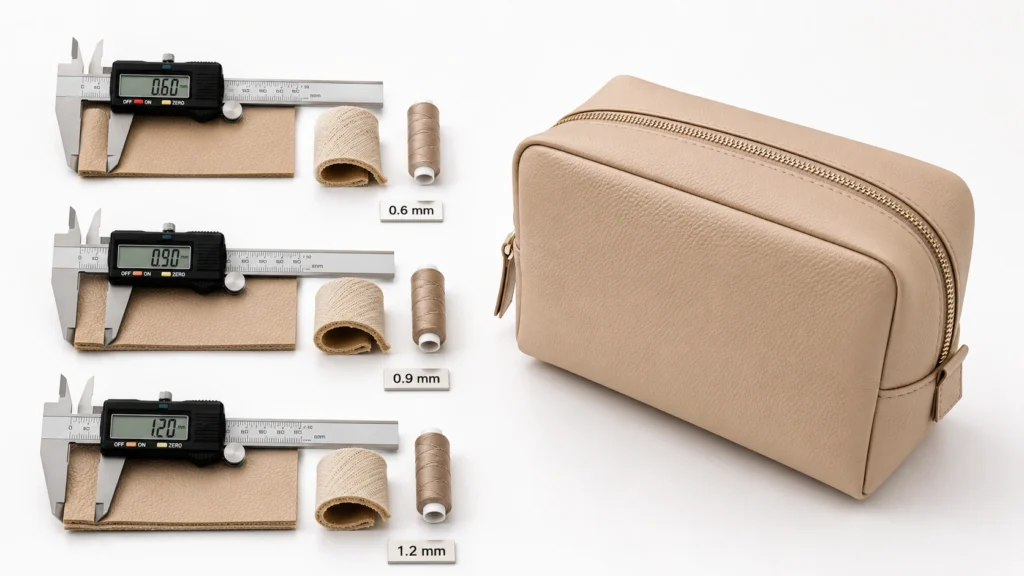
Thickness readings depend on gauge pressure. ISO 2286-3:2016 specifies thickness measurement for rubber- and plastics-coated fabrics under defined pressure and was reconfirmed in 2026.
This matters when a buyer writes “1.0 mm PU” in a tech pack. The supplier should understand whether that number refers to the complete coated composite and how it is being measured. Without a defined method or an approved physical reference, one supplier’s “1.0 mm” may not feel or perform like another supplier’s.
Technical reference: ISO 2286-3:2016 coated-fabric thickness method.
Thickness vs. Weight, Density and Hand Feel
Thickness alone does not define quality. A foamed PU can be thick yet soft, while a denser microfiber material can be thinner but more stable. Grain also changes perceived substance.
Published man-made leather examples illustrate the range. Kuraray has documented a 0.5 mm Tirrenina Nubuck material for fashion and technical applications, while another Kuraray technical sheet lists a recycled-polyester grain material at approximately 1.15 mm. These examples are not cosmetic-bag standards; they show why thickness should be evaluated together with construction and performance.
| Material Variable | What It Changes | Why Buyers Should Control It |
|---|---|---|
| Total thickness | Bulk, bending radius, seam stack and structure | Affects manufacturability and finished shape |
| Backing type | Stretch, tear behavior and edge stability | Two equal-thickness PUs may sew differently |
| Coating structure | Surface durability, hand feel and flexing | Changes logo and long-term appearance |
| Density / foam | Compression and perceived substance | Thick does not always mean rigid |
| Surface grain | Visual depth and print/deboss behavior | Changes branding result |
How PU Leather Thickness Changes Cosmetic Bag Performance
Shape Retention and Structure
Thicker or denser PU can add body, but foam, interlining, piping, base boards and lining also determine whether a bag stands upright.
For a soft makeup pouch, excess body can make the product feel stiff. For a premium vanity case, a thin flexible PU may reveal reinforcement lines or collapse around the zipper. The correct specification is the material plus the support system.
Flexibility, Folding and Corner Turning
Bag geometry determines bending demand. A heavy PU may look excellent flat but wrinkle or create bulky ridges around tight curves.
This is one reason sample development must use the actual material thickness. A substitute PU can approve general dimensions but cannot reliably approve corner behavior, fold memory or surface creasing.
Seam Bulk and Sewing Stability
At seams, thickness multiplies across PU, lining, foam, zipper tape, binding and seam allowances, creating much larger stacks at corners and zipper ends.
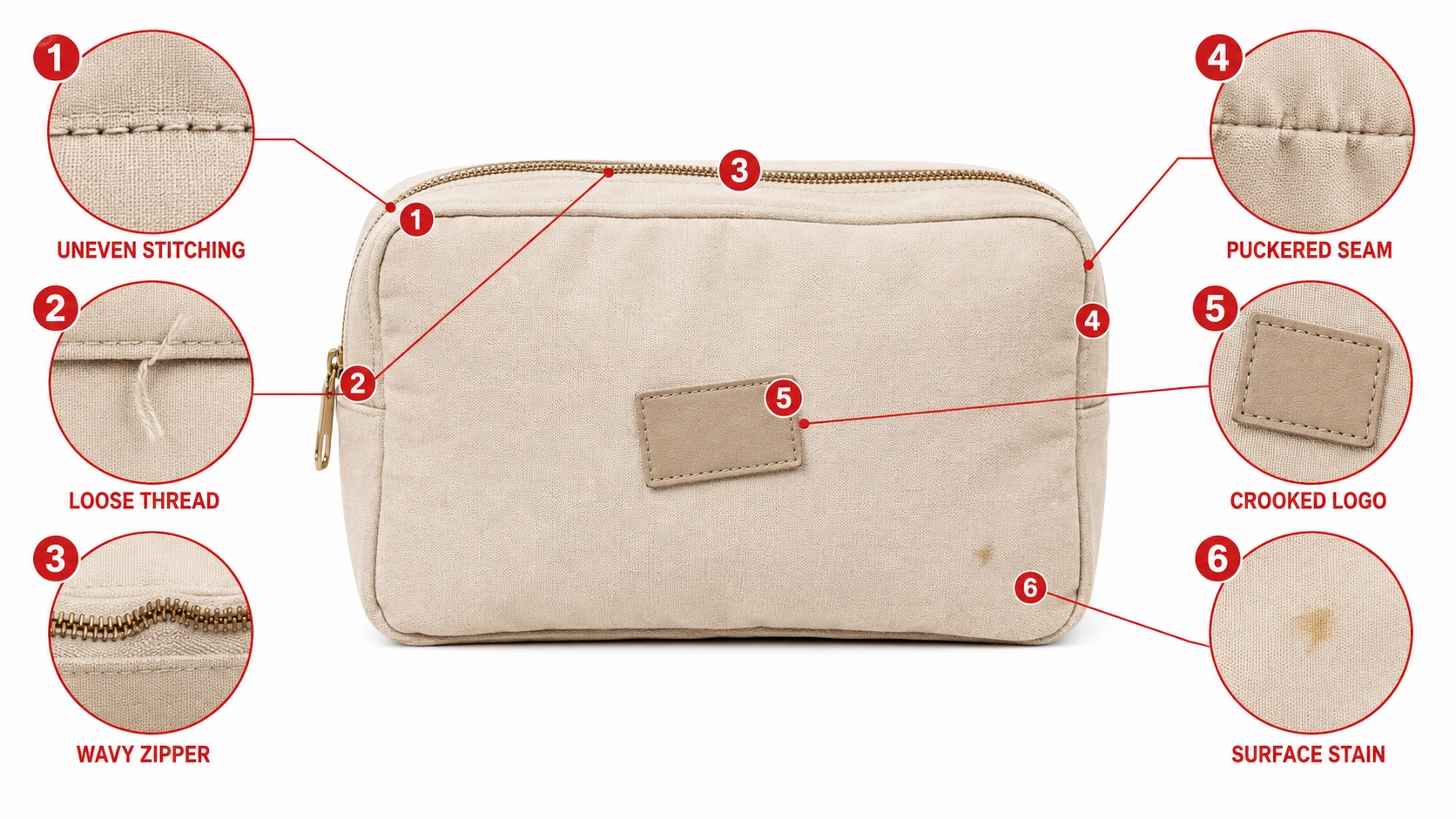
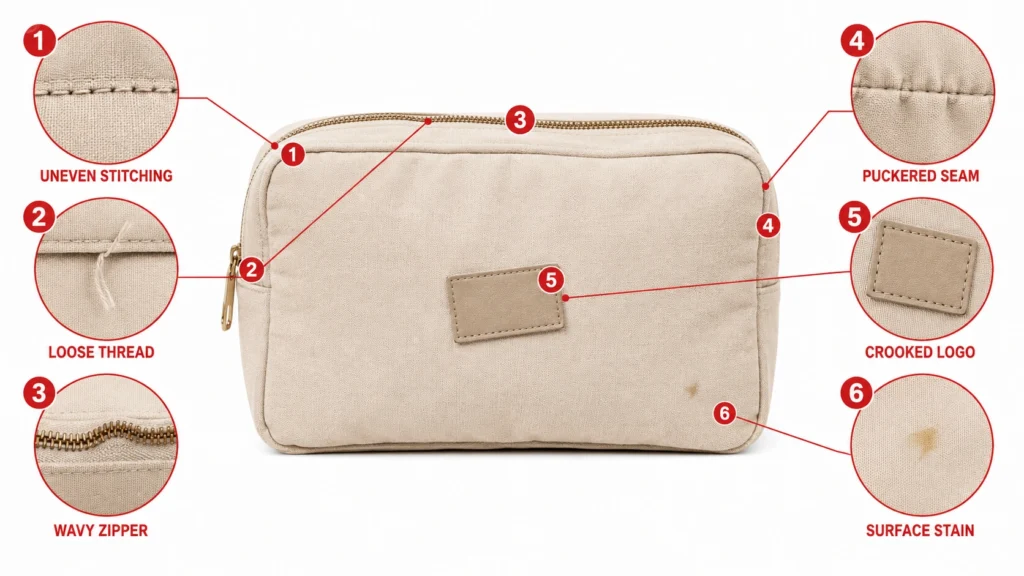
Heavy stacks can cause skipped stitches, uneven feeding and bulky corners; very thin materials can stretch, pucker or show needle holes.
Surface Durability and Long-Term Appearance
Thickness can contribute to abrasion life, but it is not a substitute for coating quality. SATRA TM31 evaluates dry and wet abrasion of materials including coated fabrics and leather, while SATRA TM55 evaluates resistance to cracking or failure under repeated flexing. These tests show why durability should be verified as performance rather than inferred from thickness.
Performance references: SATRA TM31 abrasion resistance and SATRA TM55 flexing resistance.
Choosing PU Leather Thickness for Different Bag Structures
Flat Makeup Pouches
Flat pouches need clean bending at zipper and side seams. Excessively rigid PU can make a small pouch hard to open and reduce usable volume.
If the design uses no foam, the PU may need enough body to prevent a limp appearance. If interlining is already present, a thinner outer PU may produce the same finished structure with cleaner seams.
Boxy Toiletry and Vanity Bags
Boxy bags need panel control. Too-soft PU can bow between seams; too-heavy PU can resist zipper curves and create uneven corners.
For this structure, buyers should approve the complete layered panel rather than judging an isolated PU swatch.
Cylindrical and Curved Cosmetic Bags
Curved bags depend more on bending behavior than raw thickness. Grain depth and coating flexibility matter because the material must wrap without wrinkling or cracking.
Structured Gift and Premium Retail Cases
Premium structure is often better created with controlled reinforcement behind a smoother outer PU than by increasing PU thickness alone.
| Bag Structure | Thickness Priority | Main Risk If Material Is Too Heavy | Main Risk If Material Is Too Light |
|---|---|---|---|
| Flat zipper pouch | Flexibility and clean fold | Stiff opening and bulky seams | Wrinkling and weak visual structure |
| Boxy toiletry bag | Balanced body and corner turning | Corner lumps and zipper distortion | Panel collapse and reinforcement show-through |
| Cylindrical bag | Bending and coating flexibility | Creasing around curves | Surface rippling |
| Structured vanity case | Smooth face over reinforcement | Excess weight and difficult assembly | Visible board/foam lines |
How PU Leather Construction Affects Thickness Decisions
Woven-Backed PU Synthetic Leather
Traditional synthetic PU leather often uses a woven or knitted textile base coated with polyurethane. The backing controls dimensional stability and stretch. A strong thin base can allow a relatively slim material to perform well, while a loose backing can make a thicker material feel unstable.
Nonwoven and Microfiber PU Materials
Microfiber and nonwoven constructions can create a denser, more leather-like hand. Kuraray’s CLARINO™ material uses entangled microfibers with polyurethane to create a three-dimensional structure and offers multiple thickness options. These materials may provide high strength at a lower apparent thickness than a foamed fashion PU.
Foamed, Laminated and Reinforced PU Constructions
Foamed or laminated PU may already contain structural bulk. Adding separate foam without reviewing the cross-section can create unnecessary thickness.
Why Two 1.0 mm Materials Can Perform Differently
Equal-thickness materials can differ in density, backing strength, compressibility, stretch and coating flexibility.
This is why a PU leather bag material specification should include more than nominal millimeters.
| Specification Field | What to Record in the Tech Pack |
|---|---|
| Material type | PU synthetic leather / microfiber PU / other approved construction |
| Total thickness | Target and tolerance under agreed method |
| Backing | Woven, knitted, nonwoven or supplier-defined substrate |
| Surface | Matte, glossy, pebble, saffiano, smooth, metallic, printed |
| Color | Pantone target or approved physical swatch |
| Performance | Required abrasion, flex, hydrolysis or colorfastness tests |
| Approval reference | Supplier material code and signed sample |
How Thickness Affects Logo, Hardware and Finishing
Debossing and Embossing
Debossing depends on coating thickness, backing, grain and heat response. Thin elastic PU may give weak definition, while soft foamed PU may recover after pressing.
Approve the actual logo die on the production material. A debossing result on one PU should not be used to approve another PU of the same color.
Screen Printing, Foil and Heat Transfer
Printing is influenced more by surface chemistry and grain than by total thickness, but thickness still affects how the panel stays flat under pressure. Heat-sensitive coatings can gloss, shrink or mark during transfer.
Foil and heat-transfer settings should therefore be developed on the exact production material.
Metal Plates, Patches and Custom Pullers
Metal plates concentrate load. Thin PU may need backing, while heavy PU plus reinforcement can create an overly stiff local area.
Edge Paint, Piping and Folded Construction
Folded edges, piping and binding multiply layers. Selected man-made leathers can be skived, but capability depends on substrate and coating construction.
Mid-project CTA: Q&N Bags lists debossing, embossing, screen printing, heat transfer, metal logos, woven labels and custom zipper pullers among its current OEM/ODM options. Review the custom service process before selecting a logo method for a PU material.
Production Risks When PU Leather Is Too Thin or Too Thick
Wrinkling, Collapse and Visible Reinforcement Lines
Thin PU may reveal the edge of foam, board or pocket reinforcement underneath. It can also wrinkle around zipper ends or collapse between seams if the backing lacks stability.
Bulky Seams, Uneven Corners and Zipper Distortion
Excess thickness creates multi-layer stacks that are difficult to turn and topstitch. The zipper may wave because the outer panel resists bending around the opening. Small bags are especially sensitive because their corner radius is tighter.
Needle Damage, Puckering and Delamination
PU retains needle holes, so resewing can leave visible perforations or weaken the edge. Poor feeding can also stress coating adhesion.
Flex Cracking, Abrasion and Hydrolysis Risks
Thickness does not prevent coating failure. SATRA TM344 accelerates hydrolytic aging of polyurethane materials before tests such as flex cracking, adhesion and rubbing.
Aging reference: SATRA TM344 hydrolysis of polyurethane materials.
| Observed Problem | Possible Thickness-Related Cause | Other Factors to Check |
|---|---|---|
| Bag collapses | Material too soft/light for structure | Foam density, lining, base board |
| Bulky corners | Outer material too heavy for seam stack | Seam allowance, binding, reinforcement layers |
| Wrinkles around curves | Material bending stiffness too high | Grain, coating flexibility, pattern radius |
| Logo impression weak | Material too thin or too elastic | Grain, backing, die, heat and pressure |
| Surface cracking | Not necessarily thickness-related | PU chemistry, aging, flex resistance |
How to Specify and Test PU Leather Thickness
Use ISO 2286-3 for Coated-Fabric Thickness Control
For PU-coated fabrics, ISO 2286-3 is a relevant reference because it measures coated-fabric thickness under specified pressure. This is more appropriate than applying a natural-leather thickness standard to a synthetic coated textile.
The tech pack should state the target thickness, tolerance and measurement method when thickness is critical. For less technical programs, a retained supplier swatch plus measured incoming-material checks may be sufficient.
Add Abrasion and Flex Testing Where Performance Matters
Support thickness decisions with performance tests: flex for repeated folding, abrasion for handling and hydrolysis or aging where long life matters.
Approve a Physical Swatch and Pre-Production Sample
Approve both material and finished bag: the swatch controls color, grain and hand feel; the pre-production sample validates shape, reinforcement, zipper and logo.
Build Thickness Tolerance into the Tech Pack and QC Plan
Agree a realistic thickness tolerance with the material supplier and verify incoming lots at defined points before cutting.
| QC Stage | Thickness-Related Check | Buyer Evidence |
|---|---|---|
| Material approval | Target thickness, backing, grain and hand feel | Signed swatch / supplier code |
| Incoming material | Thickness within agreed tolerance | Gauge measurements and lot record |
| Cutting | Material lies flat without abnormal stretch | First-cut approval |
| Sewing | Corner bulk, stitch quality and feeding | Golden sample comparison |
| Finished bag | Shape, zipper, logo, wrinkles and surface marks | Pre-production and final inspection |
How PU Leather Thickness Affects Cost, MOQ and Lead Time
Material Consumption, Grade and Supplier Availability
Thickness affects price, but substrate, coating chemistry, grain, custom color and testing can matter more.
Grand View Research estimates the global synthetic leather market at US$50.6 billion in 2026 and reports that PU synthetic leather represented 57.0% of synthetic-leather revenue in 2025. The report also highlights growing investment in water-based, solvent-free, microfiber and bio-based material systems. This broad range of PU constructions is another reason buyers should not compare materials only by millimeters.
Market reference: Grand View Research synthetic leather market, 2026–2033.
Reinforcement and Labor Cost Tradeoffs
Thinner PU may need extra reinforcement; thicker PU can increase sewing difficulty. Lowest raw-material price does not always mean lowest finished-bag cost.
Stock Material vs. Custom PU Development
Stock PU colors and grains usually support faster sampling and lower minimums. Custom colors, grains, backing combinations or performance specifications may be driven by the material mill’s MOQ rather than the bag factory’s sewing capacity.
When a Thinner Material Can Cost More
A premium microfiber PU can be thinner yet more expensive than a thicker foamed fashion PU because substrate quality and coating technology are different. Kuraray’s published materials show how man-made leather can be engineered for strength and formability at different thicknesses rather than relying on bulk alone.
Q&N currently publishes a standard MOQ of 1,000 pieces per style and color for custom cosmetic bags, subject to final material, size, logo and packaging specifications. Its current page lists typical sample time at 7–10 days and bulk production at 35–45 days after sample approval and deposit. Treat these as project-planning references, not guaranteed values for every custom PU development.
How to Source the Right PU Leather Bag Material
Send the Bag Structure and Intended Use, Not Only a Thickness Number
Tell the factory the bag structure, intended contents, required shape, logo method and retail positioning—not only the thickness.
A good material recommendation begins with these functions and then selects thickness, backing and reinforcement.
Compare Material Samples Under the Same Construction
Compare shortlisted PU options in sample panels or prototypes because loose swatches can hide seam bulk and corner behavior.
Supplier Evaluation Checklist for PU Cosmetic Bags
| Supplier Check | Question to Ask |
|---|---|
| Material identification | Can the supplier state PU construction, backing and measured thickness? |
| Thickness control | Is there an agreed tolerance and incoming inspection method? |
| Sampling | Will the final material be used before structure and logo are approved? |
| Performance | Can abrasion, flexing or aging tests be arranged when required? |
| Construction | Can reinforcement be adjusted rather than simply increasing PU thickness? |
| Bulk QC | Will incoming material and finished shape be checked against the approved sample? |
Q&N’s public factory profile lists PU leather among its material capabilities and describes incoming-material, production and final QC processes for custom cosmetic-bag orders.
Common Buyer Mistakes to Avoid
- Writing only “PU leather” without thickness, backing, grain or material code.
- Assuming thicker PU automatically means higher quality.
- Approving a loose swatch without testing the finished bag structure.
- Changing material thickness after the logo and pattern have been approved.
- Using heavy PU and heavy reinforcement together without checking seam bulk.
- Judging durability only from hand feel instead of abrasion, flex or aging performance.
- Failing to retain an approved bulk material standard for repeat orders.
Frequently Asked Questions About PU Leather Thickness
What Thickness of PU Leather Is Best for Cosmetic Bags?
There is no universal best thickness. A flat pouch needs different bending behavior from a structured vanity case. Select thickness together with backing, reinforcement, bag size and logo method, then approve the finished sample.
Is Thicker PU Leather Always More Durable?
No. Durability also depends on substrate strength, polyurethane chemistry, coating adhesion, abrasion resistance, flex performance and aging. A thinner engineered microfiber PU can outperform a thicker low-density material.
How Is PU Leather Thickness Measured?
PU coated fabrics can be measured under a specified pressure using a thickness gauge. ISO 2286-3 provides an international method for rubber- and plastics-coated fabrics. The method matters because compressible materials read differently under different pressure.
Does PU Leather Thickness Affect Debossing?
Yes, but thickness is only one variable. Backing, grain, coating softness, heat, pressure and die design all affect logo depth and recovery. Approve the debossing strike-off on the exact bulk material.
Why Can Two PU Materials with the Same Thickness Feel Different?
They may use different backing fabrics, coating density, foam structure, grain depth or microfiber construction. Nominal millimeters do not describe bending stiffness or compressibility.
Does Thicker PU Leather Increase MOQ or Cost?
It can, but custom color, grain, backing and supplier availability may influence MOQ and price more than thickness itself. Ask which material component creates the actual minimum.
What Should I Approve Before Bulk Production?
Approve the exact PU material code, thickness and tolerance, color, grain, backing, reinforcement, logo result, pre-production sample and any required abrasion, flexing or aging criteria before releasing bulk production.
Final Recommendations for PU Leather Cosmetic Bag Projects
The Minimum Material Specification to Approve Before Sampling
Before sampling, define shape, contents, PU construction, target thickness, backing, grain, color, reinforcement and logo. Compare alternatives in the same structure.
Future Trends in PU Leather Bag Materials
PU synthetic leather development is moving toward water-based and solvent-free coating systems, recycled textile backings, microfiber structures and bio-based feedstock. Grand View Research identifies these material and process innovations as important trends in the 2026 synthetic leather market. For beauty accessories, the practical implication is that buyers will increasingly need to compare performance, chemistry and traceability alongside thickness and price.
Google’s current 2026 search guidance also favors valuable, unique and expert-led content rather than commodity summaries. For a material page, explaining the relationship between thickness, backing, seam construction, flex testing and production risk provides more useful buyer information than simply publishing a table that says “0.8 mm is better than 0.6 mm.” See Google’s generative AI search optimization guidance.
What to Send a Manufacturer for Development and Quotation
For a PU cosmetic-bag project, prepare:
- Product type
- Finished dimensions
- Reference photos or tech pack
- Preferred PU material or physical swatch
- Target thickness or required hand feel
- Required reinforcement and lining
- Logo file and branding method
- Target quantity
- Packaging requirements
- Delivery country
- Target delivery date
Send the information through the Q&N contact page so the factory can evaluate the PU material together with the actual bag structure before quotation and sampling.
Final expert recommendation: Treat PU leather thickness as one part of a material system. Approve thickness under a defined method, but also control the backing, coating, grain, reinforcement and performance. The best cosmetic bag PU leather is not the thickest option; it is the material that gives the required shape, sewing quality, branding result and durability with the least unnecessary bulk.
Aries Gu is the founder of Q&N. With over 17 years of experience in cosmetic bag OEM/ODM source factory. He focuses on quality control, efficient communication, and on-time delivery for global cosmetic bag projects.