Cosmetic bag defects are easiest and least expensive to correct before the goods leave the factory. Once a shipment has been packed, exported and distributed, a broken zipper, wrong logo position, distorted bag shape or incorrect carton assortment becomes a customer-service, inventory and brand problem rather than a factory-floor problem.
For B2B buyers, an effective cosmetic bag inspection should do more than look for loose threads. It should compare the finished order against the approved tech pack, pre-production sample, material standards, packaging instructions and functional requirements. It should also define which defects are critical, major or minor before the inspector opens the first carton.
This guide provides a practical cosmetic bag quality checklist for beauty brands, importers, retailers, wholesalers and private-label buyers preparing to release a bulk order for shipment.
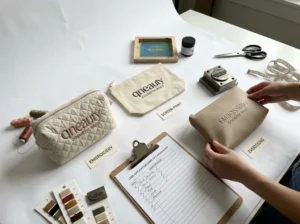
Early QC CTA: Q&N Bags publicly states that its production process includes incoming material inspection, stitching, logo, zipper, size, packing and final workmanship checks. Buyers can review the Q&N factory and quality-control process before setting inspection requirements for a custom order.
What Counts as a Cosmetic Bag Defect?
Specification Deviation vs. Workmanship Defect
A defect is not limited to visible damage. A bag can look clean and still fail the purchase specification. Examples include an incorrect finished size, wrong zipper direction, missing pocket, incorrect lining color, logo placed outside tolerance or packing that does not match the approved assortment.
Workmanship defects are problems created during production, such as skipped stitches, raw seams, puckering, scratches, stains or a broken slider. Specification deviations are differences from the approved technical requirement. Both should be included in the inspection plan.
Critical, Major and Minor Defects Explained
Most pre-shipment inspections separate defects by severity, but the exact definitions must be agreed by the buyer.
| Defect Class | Practical Meaning | Cosmetic Bag Example |
|---|---|---|
| Critical | Creates an unacceptable safety, legal or severe compliance risk | Sharp exposed hardware, prohibited material, dangerous broken metal component |
| Major | Makes the product unusable, materially different from specification or difficult to sell | Broken zipper, wrong size beyond tolerance, incorrect logo, open seam, missing compartment |
| Minor | Small appearance or workmanship issue that does not materially affect normal use | Small thread tail, slight non-prominent wrinkle, minor internal stitch irregularity |
These examples are a buyer-oriented classification framework, not universal ISO defect definitions. A premium beauty brand may classify a visible scratch as major, while a promotional buyer may treat the same size mark as minor.
Why Defect Classification Must Be Agreed Before Inspection
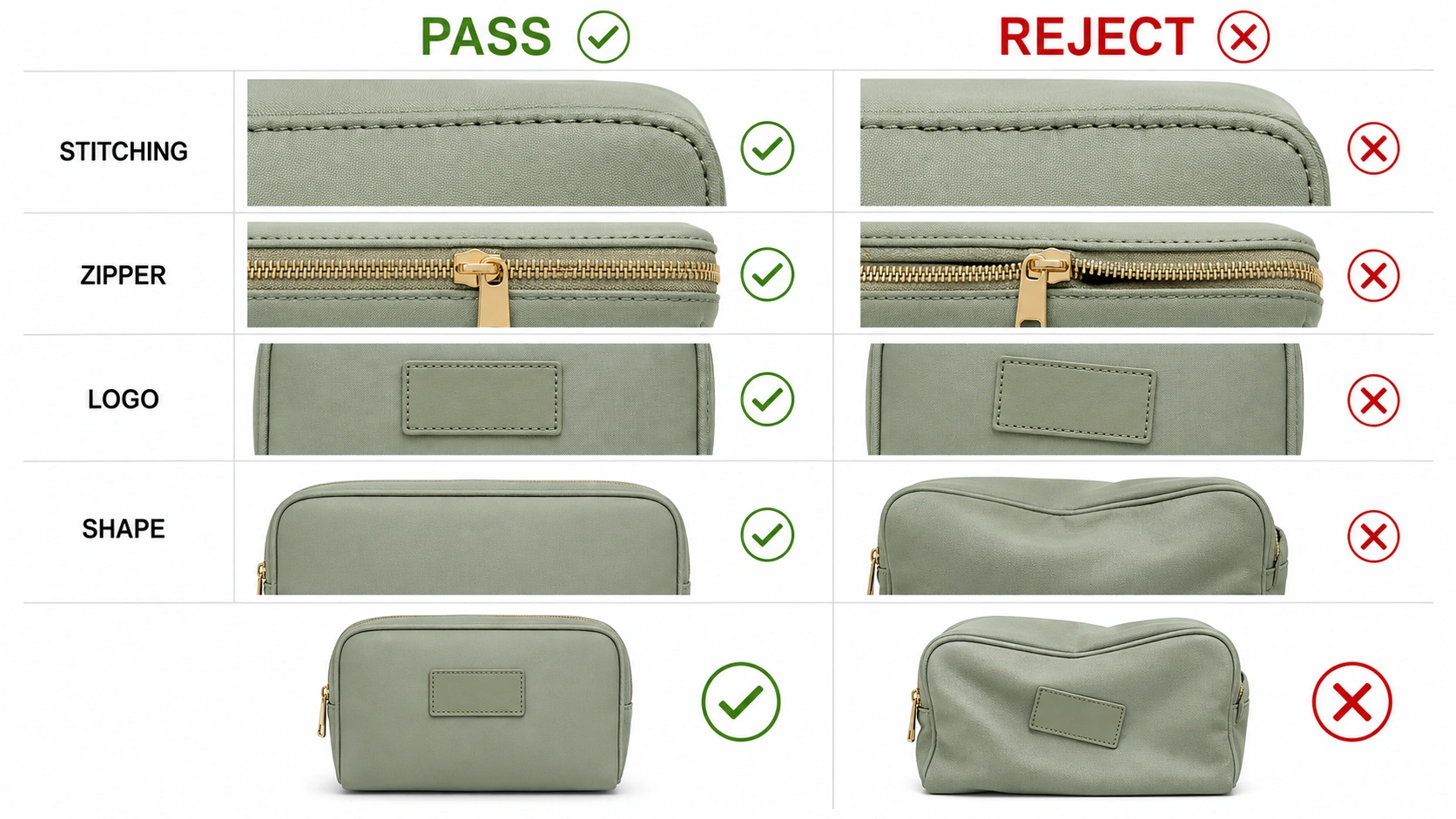
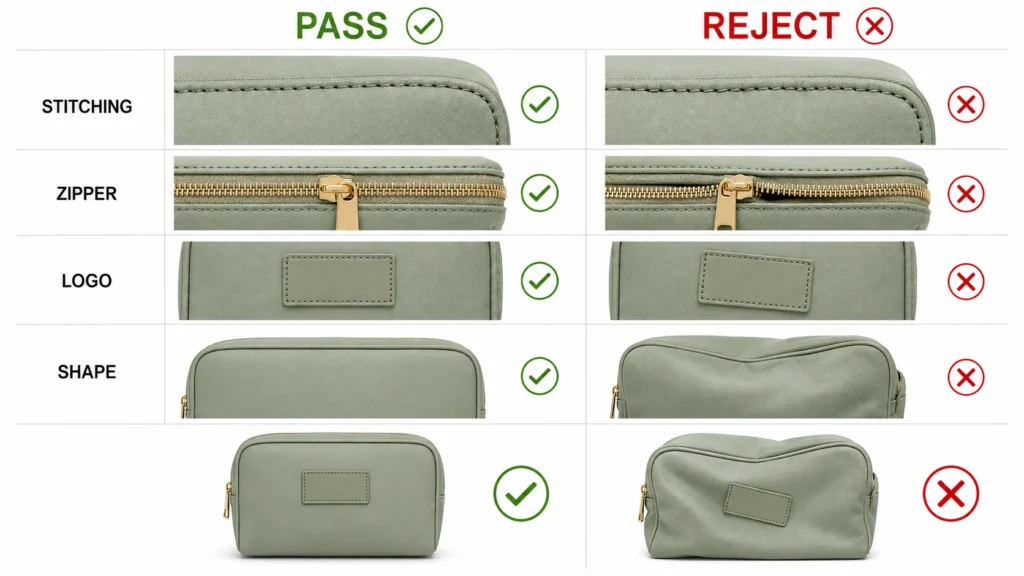
If the factory, buyer and inspector do not use the same defect standard, the final report becomes a negotiation. Build a defect list before mass production and attach reference photos where subjective appearance matters.
For example, define acceptable and unacceptable PU wrinkles, print edges, zipper waves or piping alignment using the approved sample. This creates a much stronger standard than writing “good workmanship required.”Cosmetic Bag Defects to Check on the Exterior
Fabric, PU, PVC, TPU and Surface Defects
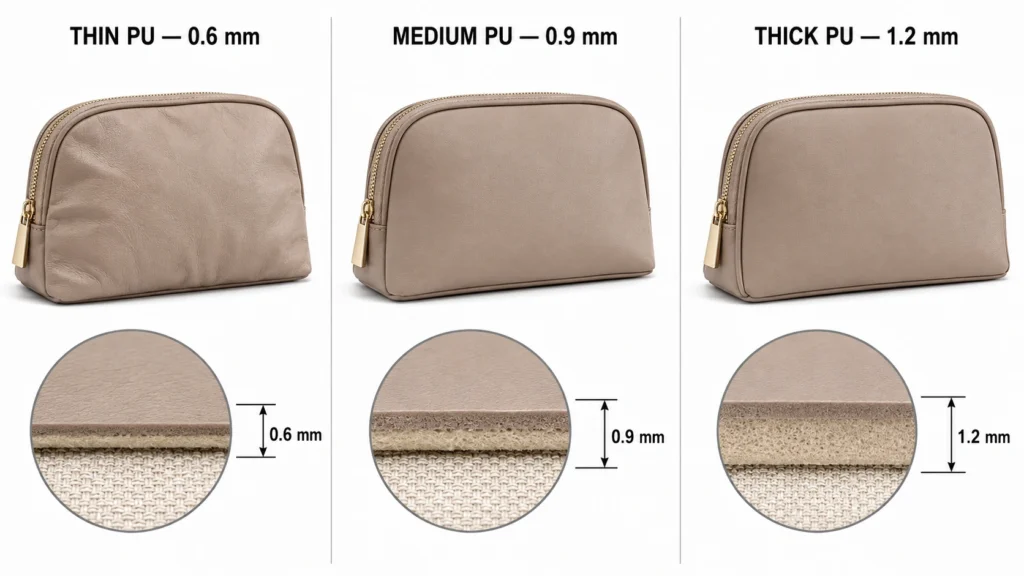
Inspect the visible panels under consistent lighting. Textile materials should be checked for stains, weaving defects, holes, excessive wrinkles, coating damage or contamination. PU surfaces may show scratches, peeling, grain inconsistency, press marks or backing show-through.
Transparent PVC, TPU and EVA require additional checks for haze, scratches, fold whitening, contamination, welding marks and distortion. A defect that is hidden on an opaque textile may become obvious on a clear bag.
Color, Shade and Material Lot Inconsistency
Compare bulk materials with the approved color standard. Also compare the front, back, gusset, lining and zipper tape within the same product. Different dye lots should not create visibly mismatched panels unless the design intentionally uses tonal variation.
Directional materials such as satin, velvet and corduroy should be viewed in the same orientation because the apparent shade can change with pile or surface reflection.
Logo Position, Print, Embroidery and Hardware Defects
Check logo dimensions, placement, orientation and color against the tech pack. Screen printing should not crack, blur or bleed. Heat-transfer edges should remain adhered. Embroidery should not show severe puckering or missing stitches.
Metal plates, rubber patches and custom pullers should be inspected for scratches, plating variation, loose attachment and incorrect logo orientation. A perfect bag with an upside-down custom puller is still a specification failure.
Shape, Symmetry and Finished Dimension Problems
Compare the finished bag with the approved pre-production sample. Check whether the body sits straight, side gussets are symmetrical, piping follows the intended shape and the opening is centered.
Measure the defined points of measure rather than choosing random locations. Soft sewn bags should have agreed tolerances because material and construction do not behave like rigid molded parts.
| Exterior Check | Defects to Look For | Reference Needed |
|---|---|---|
| Outer material | Stain, scratch, hole, coating damage, wrinkle, shade issue | Approved material swatch |
| Logo | Wrong size, color, position, orientation or poor adhesion | Artwork and approved strike-off |
| Hardware | Scratch, plating mismatch, loose plate or incorrect puller | Approved component sample |
| Dimensions | Length, height or depth outside tolerance | Tech pack POM table |
| Shape | Twisting, uneven gusset, distorted zipper line | Approved pre-production sample |
Construction and Functional Defects Buyers Should Test
Stitching, Seam and Binding Defects
Inspect skipped stitches, broken threads, unsecured seam ends, open seams and raw edges where the construction should be finished. Check stitch consistency at high-stress locations such as zipper ends, handle bases and gusset corners.
Binding should cover the raw seam evenly and should not twist into the usable interior. On premium products, severe seam puckering, uneven topstitching or visible needle damage may also be unacceptable.
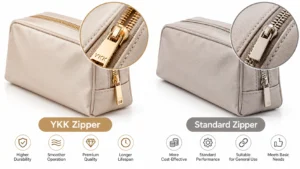
Zipper, Slider and Puller Function
Open and close the zipper repeatedly on sampled bags. The slider should move smoothly without catching the lining, separating the coil or stopping at a distorted corner.
For double zippers, confirm both sliders travel in the correct direction and meet as approved. Custom pullers should remain firmly attached. The inspector should also check whether zipper tape is sewn evenly and whether the opening provides the required usable access.
Handles, Straps and Attachment Strength
Handles and straps should be tested under a load appropriate to the intended contents. The objective is not to create an arbitrary destructive test; it is to confirm that the attachment does not pull out, stretch excessively or distort the body during normal use.
For bags containing skincare bottles, grooming tools or other heavy products, the buyer should define the target loading method before production.
Pockets, Dividers, Lining and Internal Structure
Count every pocket, elastic loop and divider. Check position, dimensions and orientation. A pocket can be beautifully sewn but still fail if it is too small for the product it was designed to hold.
Inspect the lining for stains, twisting, excessive looseness and caught fabric at the zipper. Removable dividers should attach securely and align with the approved layout.
Water-Resistance and Special Function Checks
If the product is sold as water resistant, easy clean, heat resistant or protective, add a functional check that reflects the actual claim. Do not assume a coated material automatically proves finished-bag performance.
A related sourcing guide on Q&N’s cosmetic bag blog can support material and construction planning, while project-specific test conditions should be written in the tech pack before mass production.
Cosmetic Bag Quality Checklist for Packaging and Retail Readiness
Individual Packing and Product Cleanliness
Every finished bag should be clean before packing. Check dust, loose thread, oil marks, moisture, foreign material and strong unexpected odor. Protective paper, tissue or inserts should be positioned consistently and should not deform the product.
Verify whether zippers should be open or closed during packing and whether handles or straps need protection from pressure marks.
Hangtags, Barcodes and Label Accuracy
Check SKU, barcode, product name, color, quantity and label placement against the buyer’s approved artwork. A packaging label error can be more commercially damaging than a small sewing defect because it can prevent warehouse receiving or retail scanning.
For U.S. textile products within the scope of the Textile Fiber Rule, the FTC requires certain products to disclose fiber content, manufacturer or marketer identity and country of processing or manufacture. Applicability depends on the product and exemptions, so buyers should confirm the labeling rule for their specific bag rather than assuming every cosmetic bag has identical requirements.
Regulatory reference: U.S. FTC Textile Fiber Rule.
Carton Quantity, Assortment and Shipping Marks
Confirm the number of pieces per carton, color assortment, SKU mix and carton sequence. Check shipping marks, purchase-order number, carton number, destination information and gross/net weight where required.
A correct unit packed into the wrong SKU carton can create receiving and distribution errors even when product quality is acceptable.
Carton Condition and Shape Protection
Inspect carton strength, moisture damage, crushing and sealing. Structured cosmetic bags may require tissue, inserts or controlled stacking so the body does not collapse during international transit.
For clear PVC or PU products, verify that prolonged contact with printed paper, dark materials or hardware does not create transfer marks during packed storage.
| Packaging Check | Pass Requirement | Common Defect |
|---|---|---|
| Individual packing | Correct method, clean product and approved protection | Dirty bag, wrong bag orientation, missing tissue |
| Retail label | Correct SKU, barcode and artwork | Wrong color code or unreadable barcode |
| Carton assortment | Matches PO and packing list | Mixed sizes or colors |
| Shipping marks | Correct and readable | Wrong PO, carton number or destination |
| Carton condition | Dry, intact and suitable for shipment | Crushed, wet or poorly sealed carton |
How to Use AQL for Cosmetic Bag Inspection
What ISO 2859-1:2026 Actually Controls
ISO 2859-1:2026 is the current international standard for acceptance sampling by attributes. It provides single, double and multiple sampling plans indexed by Acceptance Quality Limit for lot-by-lot inspection.
The standard helps determine how a statistical sample can be used to accept or reject a production lot. It does not tell a beauty brand whether a crooked logo is critical, major or minor. That classification must come from the buyer’s quality requirements.
Standard reference: BS ISO 2859-1:2026 overview.
Build a Buyer-Specific Defect Classification List
Create a table of known defects before inspection. Link each defect to its classification and, where useful, to an image. The classification should reflect safety, function, brand appearance and sales-channel requirements.
Do not copy another brand’s AQL values without considering your product. A promotional pouch and a high-priced retail vanity case may require different visual standards.
Random Sampling vs. 100 Percent Functional Checks
AQL is a sampling system, not a guarantee that every piece is defect free. Some attributes may justify broader checking. For example, a factory can perform 100 percent zipper-operation checks during final production while a third-party inspector later uses random sampling for the overall lot.
The inspection plan should distinguish factory-process controls from buyer acceptance sampling.
What to Do When the Inspection Lot Fails
A failed inspection should trigger a defined corrective process: identify the defect pattern, determine the affected quantity, sort or rework the lot, replace unacceptable pieces and arrange re-inspection where required.
The buyer should not automatically accept a failed lot because the shipping deadline is close. If conditional acceptance is commercially necessary, document the deviation, affected quantity and agreed remedy.
Pre-Shipment Inspection Workflow for Cosmetic Bags
Confirm Production Is Complete and Packed
Final inspection is most representative when the order is substantially complete and enough units are packed for random carton selection. Inspecting only a small early portion of production can miss later material or workmanship variation.
Compare Against the Approved Tech Pack and Golden Sample
The inspector needs the correct revision of the tech pack, approved material or color references, packaging instructions and the approved pre-production or golden sample. If the physical sample conflicts with the document, the buyer should resolve the priority before inspection begins.
Perform Visual, Measurement and Functional Checks
- Select cartons and units randomly according to the agreed sampling plan.
- Verify product identity, quantity, color and assortment.
- Inspect appearance and workmanship.
- Measure defined points of measure.
- Operate zippers, pockets, handles and removable components.
- Perform agreed load, water or special-function checks.
- Inspect individual packaging, barcodes and carton marks.
- Record defects by type and severity with clear photographs.
Review Inspection Evidence Before Shipment Release
Do not rely only on a one-line “PASS” result. Review defect photos, measurements, packing images and the inspector’s remarks. Confirm whether any accepted defects require correction before container loading.
Illustrative inspection scenario: A 3,000-piece cosmetic bag lot passes the dimensional and appearance sample, but several inspected bags have zipper sliders catching the lining. The issue is classified as major under the buyer’s approved defect list. Instead of shipping immediately, the factory opens the remaining cartons, performs a broader zipper check, repairs affected units and presents the corrected lot for verification. This is an illustrative manufacturing scenario, not a reported customer case.
Mid-inspection CTA: Q&N Bags states that its workflow includes requirement confirmation, sample development, bulk production, quality inspection, packing and shipping. Buyers can use the custom service process to define inspection requirements before the order reaches final packing.
Testing, Compliance and Market-Specific Risks
Material and Restricted-Substance Requirements
A visual inspection cannot replace chemical testing. If the destination market requires restricted-substance compliance, the test plan should cover the relevant materials, coatings, inks, adhesives and hardware before shipment release.
For EU projects, REACH and SVHC requirements may be relevant depending on material and product. Q&N publicly states that it provides project-based REACH/SVHC support, but the buyer should define the exact compliance scope for the destination market.
Fiber, Country-of-Origin and Retail Label Review
Label requirements depend on market, material and product classification. Review the applicable law, retailer manual and purchase order before printing bulk labels. Inspection should verify that the approved label is present and correctly attached; it should not be the first time the legal wording is reviewed.
Buyer-Specific Performance Testing
Functional requirements can include zipper cycling, handle loading, seam strength, colorfastness, abrasion, water resistance, odor limits or packaging drop testing. Define test conditions before the purchase order is finalized.
Tests that destroy or permanently alter products should normally be planned separately from ordinary visual AQL inspection.
When Laboratory Testing Must Be Completed Before Final Inspection
If laboratory compliance is a release requirement, schedule it early enough that results are available before shipment approval. Waiting until final inspection to begin chemical testing can create unnecessary warehouse and freight delays.
The broader cosmetic packaging market is estimated by Grand View Research at US$37.2 billion in 2026 and projected to reach US$44.3 billion by 2030. The report identifies product differentiation and increasing cosmetic demand as market drivers, reinforcing why packaging quality and presentation remain commercially important for beauty brands.
Market reference: Grand View Research cosmetic packaging market.
How Inspection Quality Affects Cost, Delivery and Supplier Performance
Rework, Sorting and Re-Inspection Costs
Defects discovered during cutting or sewing are cheaper to correct than defects found after individual packing. Once the order is boxed, sorting requires opening cartons, unpacking units, repairing products, repacking and updating inspection records.
For this reason, final inspection should be the last verification layer, not the first serious quality-control step.
Why Late Defect Discovery Delays Shipment
Rework can affect booked freight, warehouse appointments and seasonal launch dates. A rushed order is also more vulnerable to superficial repair. Build enough schedule buffer for final inspection and corrective action rather than arranging inspection on the day before cargo pickup.
Supplier Evaluation Checklist for Quality-Critical Orders
| Supplier Capability | What Buyers Should Confirm |
|---|---|
| Incoming QC | Materials and components are checked before cutting |
| In-line control | Recurring sewing, logo and construction problems are detected during production |
| Functional checking | Zippers, handles and special features are tested to an agreed procedure |
| Document control | Production uses the current tech pack and approved sample |
| Final inspection | Appearance, size, logo, zipper and packing are checked before shipment |
| Corrective action | The supplier can sort, rework and document failures before release |
Common Buyer Mistakes Before Shipment
- Sending the inspector an outdated tech pack.
- Failing to define critical, major and minor defects in advance.
- Inspecting too early, before the order is substantially complete.
- Checking appearance but not operating zippers or handles.
- Ignoring packaging and barcode accuracy.
- Relying on a fabric or material test instead of finished-product function.
- Approving defects verbally without documenting the concession.
- Scheduling inspection too close to the shipping cutoff.
Frequently Asked Questions About Cosmetic Bag Inspection
What Are the Most Common Cosmetic Bag Defects?
Common defects include stains, scratches, wrinkles, shade differences, skipped stitches, open seams, zipper problems, incorrect dimensions, distorted shape, misaligned logos, loose hardware, twisted lining, missing pockets and incorrect packaging.
What Should Be Included in a Cosmetic Bag Quality Checklist?
Include product identity, materials, color, dimensions, workmanship, zipper function, handles, logo, internal features, special performance requirements, individual packaging, barcode, carton assortment and shipping marks.
What Is AQL in Cosmetic Bag Inspection?
AQL is an Acceptance Quality Limit used within statistical sampling plans such as ISO 2859-1:2026. It helps determine sample size and acceptance or rejection of a lot. The buyer still needs to define which defects are critical, major and minor.
Should Every Cosmetic Bag Be Inspected Before Shipment?
A factory may perform full checks on important functions such as zipper operation while buyer acceptance inspection uses a statistical sample. Whether 100 percent inspection is required depends on risk, product value, defect history and contract requirements.
How Should Zippers and Handles Be Tested?
Zippers should be repeatedly opened and closed on sampled units and checked for catching, separation and puller security. Handles should be checked with an agreed static or repeated load appropriate to the intended contents.
What Happens If a Pre-Shipment Inspection Fails?
The normal response is to identify the defect pattern, sort or rework the affected lot, replace unacceptable units and perform verification or re-inspection. The exact commercial remedy should be defined in the purchase agreement.
When Should Buyers Arrange Third-Party Inspection?
Third-party inspection is useful for new suppliers, large orders, high-value retail programs, strict launch schedules or projects where the buyer cannot inspect personally. It is also useful when an independent shipment-release record is required.
Final Recommendations Before Approving Shipment
Minimum Documents and Samples to Prepare
Before inspection, provide the current purchase order, tech pack, measurement chart, approved material and color references, logo artwork, pre-production sample, defect classification, packaging specification and applicable test requirements.
The inspector should never need to guess what the buyer approved.
Future Trends in Cosmetic Bag Quality Control
Quality control is moving toward better digital traceability: revision-controlled tech packs, material-lot records, photo-based defect libraries, barcode-linked inspection data and faster sharing of inspection evidence. These tools improve consistency, but they still depend on clear specifications and trained visual judgment.
Google’s 2026 guidance for generative AI search also emphasizes unique, expert-led and non-commodity content. For a manufacturing website, a real defect taxonomy, measurable inspection process and practical QC guidance provide more value than generic claims such as “strict quality control.” See Google’s generative AI search optimization guide.
What to Send a Manufacturer Before Production and Inspection
For a custom cosmetic-bag order, prepare:
- Product type
- Finished dimensions and tolerances
- Reference photos or tech pack
- Material requirements
- Logo file and approved placement
- Target quantity
- Quality checklist and defect classifications
- Required testing or compliance information
- Packaging requirements
- Delivery country
- Target delivery date
Send the project through the Q&N contact page so material, sample, production and inspection requirements can be reviewed before the order enters bulk manufacturing.
Final expert recommendation: The most effective way to control cosmetic bag defects is not to rely on a final inspector to “find bad bags.” Define the approved product clearly, classify defects before production, inspect materials and workmanship during manufacturing, then use a disciplined pre-shipment inspection as the final release gate. That turns quality control from a last-minute search for problems into a repeatable procurement system.
Aries Gu is the founder of Q&N. With over 17 years of experience in cosmetic bag OEM/ODM source factory. He focuses on quality control, efficient communication, and on-time delivery for global cosmetic bag projects.