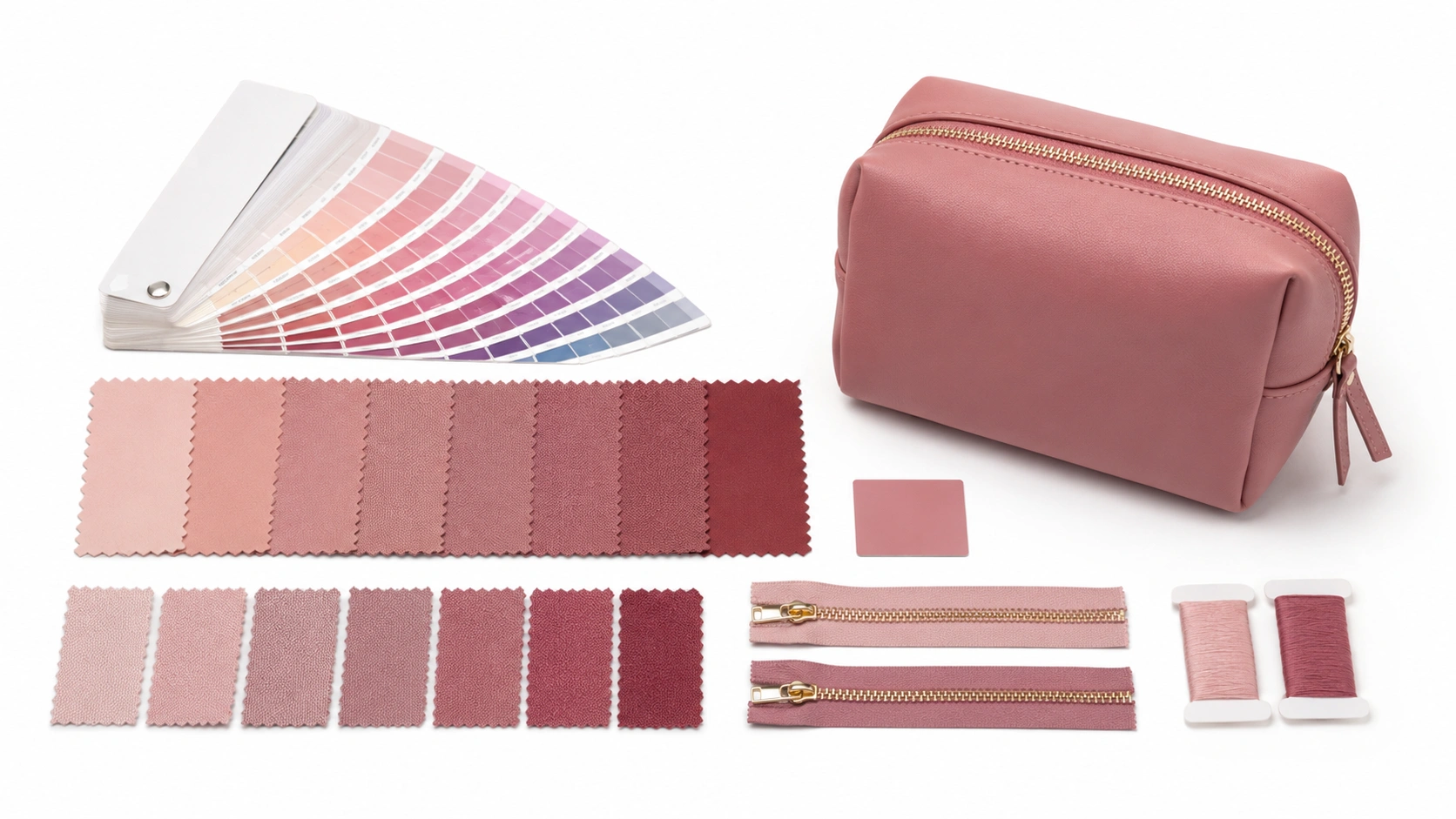
Pantone color matching is one of the most useful ways for a beauty brand and a bag factory to communicate color, but a Pantone number does not guarantee that every fabric, zipper, lining, PU panel and metal part will look identical. The same target can shift because of fiber content, surface texture, gloss, dye chemistry, coating, lighting and production lot.
For B2B buyers, the real questions are which Pantone system controls each component, what physical standard will be approved, how color difference will be judged, and when an exact match is commercially unrealistic.
This guide follows custom bag color matching from selection and lab dip through sample approval, bulk production and final inspection.
Starting a custom color project? Q&N Bags publicly offers custom materials, colors, linings, zippers and logo methods for OEM/ODM cosmetic bags. Buyers can review the custom cosmetic bag manufacturing options before sending a color brief.
How Pantone Color Matching Works in Bag Manufacturing
Pantone Is a Color Reference, Not a Universal Material Formula
Pantone provides standardized references, not one universal recipe for every substrate. Polyester, cotton, PU, EVA and plated metal all require different coloring processes.
The supplier develops the dye, pigment, coating or finish needed to approach the target on the specified substrate.
Why the Same Pantone Color Looks Different on Different Materials
Color appearance depends on both colorant and surface. Matte fabric, glossy PU, directional pile, clear film and metallic hardware all reflect light differently.
A mixed-material bag can therefore look coordinated without every component producing the same instrumental reading. Define whether the goal is exact, close visual or intentionally tonal matching.
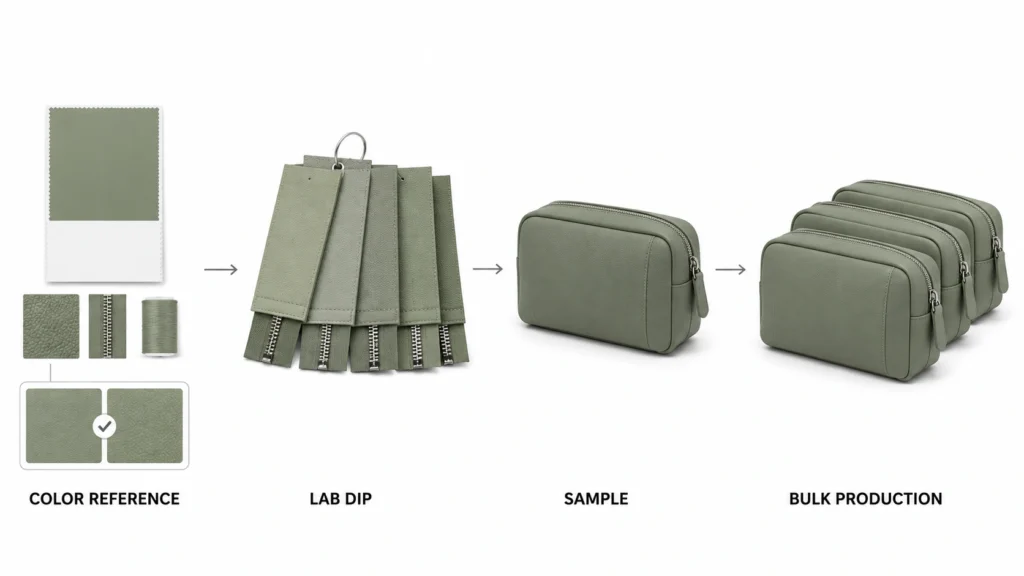
Where Pantone Matching Fits in Quotation, Sampling and Bulk Production
- Select the target color and correct Pantone system.
- Define the material, texture and finish that must match it.
- Request a stock-color option or custom lab dip/material sample.
- Approve a physical color standard under controlled lighting.
- Build the approved reference into the tech pack and pre-production sample.
- Check incoming bulk materials before cutting.
- Compare finished production against the approved standard during QC.
A quote issued before these decisions should clearly state whether pricing assumes a stock color or custom development. Custom dyeing can change material MOQ, sample cost and lead time.
Which Pantone System Should You Use for Cosmetic Bags?
Pantone TCX for Textile Fabrics
Pantone’s Fashion, Home + Interiors system is designed for products such as textiles and consumer goods. Pantone states that TCX is intended for soft surfaces such as textiles and apparel. For cosmetic bags, that makes TCX the logical starting reference for cotton, polyester, nylon, satin, velvet, corduroy and many other fabric surfaces.
A physical TCX standard is more meaningful for textile development than a monitor display. Pantone warns that computer simulations may not match physical standards.
Pantone TPG for Leather, Coated and Hard Surfaces
Pantone states that TPG is used for hard surfaces such as leather, metals, ceramics and coated products. A PU leather panel, coated accessory, rubber-like logo patch or painted metal component may therefore be better evaluated against an FHI TPG reference than a cotton TCX swatch.
Pantone states that TPG colors correspond to TCX, helping coordinate different media, although gloss, texture and process still change appearance.
Pantone Graphics Colors for Printed Packaging and Print Applications
Pantone Graphics is designed for print and packaging. Formula Guide uses spot colors, while Color Bridge compares spot colors with CMYK simulations. C and U refer to coated and uncoated paper, not textiles.
A belly band, carton or hangtag may use Graphics references while the bag fabric uses TCX. A designer’s Pantone C code should not automatically control dyed polyester.
Authoritative reference: Pantone Fashion, Home + Interiors system guidance.
How to Specify One Brand Color Across Mixed Materials
| Bag Component | Practical Starting Color Reference | Approval Method |
|---|---|---|
| Polyester or nylon body | Pantone FHI TCX | Lab dip or approved bulk fabric swatch |
| Cotton canvas or satin | Pantone FHI TCX | Physical textile swatch under controlled light |
| PU leather / coated surface | Pantone FHI TPG or approved physical master | Material strike-off / physical swatch |
| Zipper tape | Usually coordinated to textile target | Physical zipper tape card or custom-dyed sample |
| Embroidery thread | Closest thread-card shade to approved textile target | Physical thread comparison and embroidery strike-off |
| Printed paper packaging | Pantone Graphics spot color or controlled CMYK build | Printed proof on actual paper stock |
| Metal hardware | Approved plating or coating reference | Physical master sample |
Pros: using the right reference by substrate reduces avoidable color disputes. Limitation: a mixed-material bag still requires a visual approval strategy because no single Pantone chip reproduces every texture and finish.
How to Prepare a Custom Bag Color Matching Specification
Define the Pantone Code, Material and Surface Finish
A useful color instruction should read more like “Outer body: polyester twill, matte finish, target Pantone 17-xxxx TCX” than simply “Pantone pink.” Include material composition, weave or finish, target code and whether the match is custom dyed or selected from stock.
For transparent PVC, TPU or EVA, specify whether the color is transparent, translucent or opaque. Background and film thickness can change perceived color dramatically.
Add Physical Swatches, Lab Dips and Approved Samples
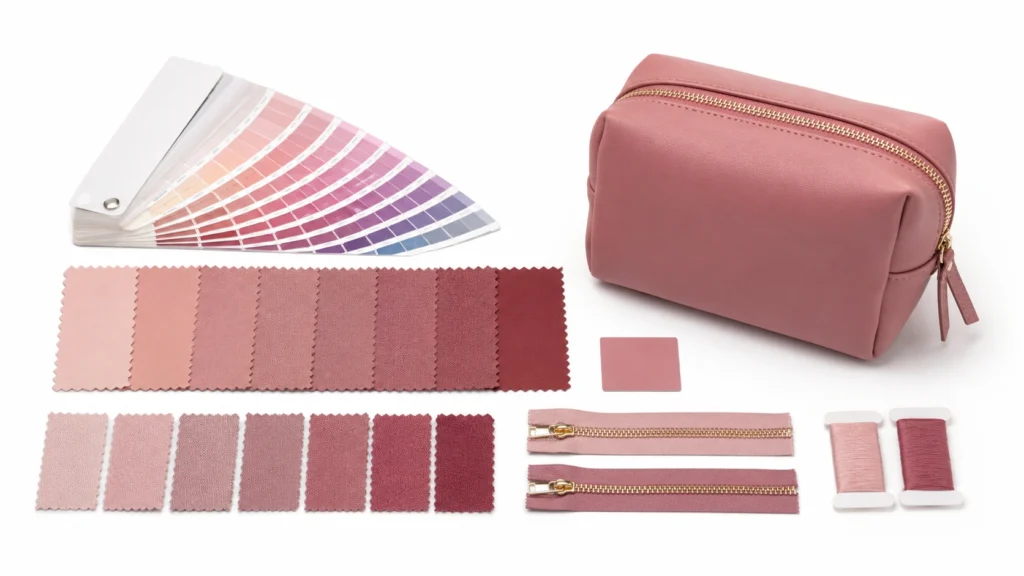
A physical standard may be an official Pantone swatch, approved lab dip, supplier shade card or signed production material. Once approved, a lab dip often becomes the practical bulk reference.
Identify each approved sample by supplier, material code, date and revision rather than informal email descriptions.
Specify Lighting Conditions and Viewing Direction
Pantone notes that colors shift under daylight, store and home lighting. Its guidance uses D65 for many textiles, hard goods and coatings, and D50 for print; controlled lighting can also reveal metamerism.
For textile bags, D65 is a practical primary condition when agreed, with retailer lighting used as a secondary check if relevant.
Reference: Pantone Light Booth and controlled lighting guidance.
Record Color Standards in the Cosmetic Bag Tech Pack
Your tech pack should list the color reference beside each BOM item. It should also state the approved lab dip or swatch reference, viewing condition and whether visual approval or instrumental tolerance controls acceptance.
| Color Specification Field | Example of Useful Buyer Information |
|---|---|
| Component | Outer body / lining / zipper tape / logo / hardware |
| Material | 210D polyester, cotton canvas, PU, TPU, etc. |
| Pantone system | TCX, TPG or Graphics reference as applicable |
| Color target | Exact Pantone code or approved physical master |
| Finish | Matte, glossy, brushed, metallic, translucent |
| Approval reference | Lab Dip LD-03 approved 2026-xx-xx |
| Viewing condition | Example: D65 primary visual assessment |
| Instrumental tolerance | Buyer/supplier-agreed method and limit, if used |
For projects that need a structured specification, see Q&N’s custom development process and include color requirements with the material, size, logo, lining and zipper brief.
How Factories Match Colors During Sampling
Stock Color Selection vs. Custom Dyeing
Stock material is usually fastest and most economical. Custom matching requires a mill, coating or trim supplier to develop the target.
A commercially acceptable stock shade can reduce MOQ and protect schedule; custom dyeing is most valuable for brand-critical colors or controlled seasonal palettes.
Lab Dips for Fabric and Custom Material Development
A lab dip is a small colored material sample developed before bulk production, often with several variants around the target.
Evaluate lab dips on the actual fiber, weave and finish; approval on plain polyester does not automatically transfer to velvet.
Color Matching for PU, PVC, TPU, EVA and Hardware
Non-textile materials use pigment, coating or film rather than textile dyeing, so suppliers may prepare strike-offs. Metal plating is normally approved with physical component samples.
A realistic Pantone cosmetic bag specification may therefore contain several approval types: TCX lab dip for fabric, TPG-oriented PU swatch, zipper tape sample, embroidery thread card and plated hardware master.
Approving the First Sample Without Creating Bulk Risk
A structure sample may use substitute colors if clearly marked “color not approved.” Approve final material and pre-production color under the same conditions used for bulk QC.
Mid-project CTA: If your project uses a specific brand palette, send Q&N the target Pantone references together with the intended materials and quantities. The contact page supports file attachments for project references.
How to Evaluate Color Accuracy and Tolerance
Visual Assessment Under Controlled Lighting
Visual assessment remains important. AATCC EP9-2025 standardizes textile color-difference evaluation against a reference, helping control illumination, orientation and viewing conditions.
Directional fabrics should be viewed in one orientation because velvet, satin and corduroy can shift visibly after rotation.
Textile reference: AATCC EP9-2025 Visual Assessment of Color Difference of Textiles.
Instrumental Measurement with CIELAB and Delta E
For color-critical production, a spectrophotometer can compare standard and sample. ISO/CIE 11664-4 defines CIELAB, while ISO/CIE 11664-6 defines CIEDE2000, commonly expressed as ΔE00.
Numerical comparison is especially useful for repeat orders and programs using multiple dye lots.
Colorimetry reference: ISO/CIE 11664-6:2022 CIEDE2000 colour-difference formula.
Why There Is No Universal Delta E Tolerance for Every Bag Material
Do not copy one ΔE limit across materials. Acceptability depends on substrate, texture, measurement geometry, color and brand expectation.
Define formula, instrument condition, sample preparation and tolerance before production; otherwise use controlled visual approval against a physical standard.
| Color-Control Method | Advantages | Limitations |
|---|---|---|
| Visual Pantone comparison | Simple, intuitive and useful during design | Depends heavily on lighting, observer and surface |
| Approved physical lab dip | Uses the actual production substrate | Can age, soil or be lost if not controlled |
| Spectrophotometer + ΔE | Objective numerical comparison and repeat-order control | Requires agreed method and does not replace all visual judgment |
| Golden sample | Shows color together with texture, logo and construction | Not ideal for measuring hidden lot variation by itself |
Metamerism, Texture, Gloss and Directional Fabrics
Metamerism occurs when two samples match under one light source but not another. Mixed materials are vulnerable because different dyes and pigments can produce similar color through different spectral responses.
Satin, velvet and PU also change with orientation and gloss, so QC should define lighting and viewing direction before judging shade.
Common Pantone Color Matching Problems in Cosmetic Bags
Screen Colors vs. Physical Pantone Standards
RGB and HEX describe digital color, not dyed textile appearance. Screenshots are useful for direction but weak as the sole manufacturing standard.
Dye-Lot Variation Between Production Batches
Approved recipes can still vary by dye lot. Reserve material strategically, identify lots and avoid mixing visibly different shades within one bag or retail set.
Color Differences Between Outer Fabric, Lining and Zipper Tape
Outer fabric, lining and zipper tape may come from different suppliers. Define whether they must match exactly, coordinate tonally or intentionally contrast.
Printing, Embroidery and Metal Hardware Color Mismatch
Embroidery, printing and plating each have different color limits. Approve each physically rather than assuming one Pantone name guarantees a universal match.
Common Buyer Mistakes and How to Prevent Them
- Sending only a screenshot, RGB value or HEX code.
- Using Pantone C/U print references for every textile without confirming the right system.
- Approving a color under uncontrolled office lighting.
- Approving fabric but forgetting zipper tape, lining and embroidery thread.
- Changing material after color approval without requesting a new lab dip.
- Demanding “zero color difference” without an agreed evaluation method.
- Failing to retain an approved physical standard for repeat orders.
How Color Matching Affects MOQ, Cost and Lead Time
Stock Colors vs. Custom-Dyed Materials
Stock colors normally avoid material-development minimums and shorten sampling. Custom dyeing can require a minimum quantity from the mill and extra time for lab dips, correction and bulk dyeing. The economic difference becomes important for a launch with several colors but low volume per SKU.
Minimums for Fabric, Zipper Tape, Lining and Hardware
MOQ may be driven by custom zipper tape, printed lining or coated PU rather than assembly capacity. Five low-volume custom colors create a different cost structure from one larger color run.
Sampling Rounds, Lab Dips and Color Approval Time
Rejected lab dips add development rounds. Use the correct Pantone system, physical reference and specific feedback rather than subjective comments.
When a Near Match Is Commercially Better Than a Custom Match
| Situation | Stock / Near Match | Custom Pantone Match |
|---|---|---|
| Small first order | Often more economical | May be limited by material MOQ |
| Brand hero color | Risk of weak brand consistency | Usually worth developing |
| Short promotional campaign | Can protect launch schedule | Use when color is central to campaign identity |
| Repeat seasonal program | May vary if stock shades change | Better basis for repeatability when standards are retained |
| Hidden lining | Near match may be sufficient | Often unnecessary unless design requires it |
Q&N’s public custom cosmetic bag page lists Pantone color matching among its customization options and notes that material, color, lining, zipper and packaging all affect a custom project. Review the available custom cosmetic bag product categories when deciding which components actually need brand-critical color control.
Color Quality Control for Bulk Cosmetic Bag Production
Approve a Physical Color Standard Before Production
Do not begin bulk production from digital approval alone. Retain the approved chip, lab dip, bulk swatch or pre-production sample and identify the controlling reference.
Control Incoming Material and Dye Lots
Inspect shade and lot identity before cutting. Segregate multiple lots and avoid combining obvious shade differences within one product.
Build Color Checks into Pre-Production and Final Inspection
Color control should occur before cutting and during production, not only at final inspection.
| Production Stage | Color Control | Buyer Risk if Skipped |
|---|---|---|
| Material approval | Approve lab dip / swatch and viewing condition | Factory develops toward an ambiguous target |
| Bulk material receipt | Compare lot against approved reference | Off-shade material enters cutting |
| Pre-production sample | Check outer, lining, zipper, logo and hardware together | Individual colors look acceptable but clash when assembled |
| In-line production | Prevent mixed lots and incorrect trim shades | Shade differences become distributed across cartons |
| Final inspection | Visual and/or instrumental comparison per agreed method | Disagreement occurs after production is complete |
Supplier Evaluation Checklist for Color-Critical Programs
- Does the supplier ask which Pantone system applies to the material?
- Can it provide physical material cards or lab dips before sampling?
- Does it identify custom-color MOQ before quotation is finalized?
- Can the team retain approved swatches and revision records?
- Are different dye lots controlled during incoming inspection?
- Can color be evaluated under a defined light source?
- For instrumental programs, can the supplier or laboratory document the agreed measurement method?
- Does the factory check assembled color harmony, not only individual materials?
Q&N Bags publicly states that its workflow includes material inspection, sample development, production and final checks for size, logo and function. More factory and QC information is available on the Q&N company and manufacturing page.
Frequently Asked Questions About Pantone Color Matching
Can a Factory Match Any Pantone Color Exactly?
Not always. Some fibers, coatings, transparent films, fluorescent shades, metallic finishes and stock components have gamut or process limitations. A factory can develop toward a Pantone target, but the achievable result should be approved on the actual material.
Should I Use Pantone TCX or TPG for a Cosmetic Bag?
Use TCX as the primary reference for soft textile surfaces such as polyester, cotton, satin or nylon. TPG is designed for hard or coated surfaces such as leather, coated goods and metals. Mixed-material bags may use both systems.
Can I Send an RGB or HEX Color Instead of a Pantone Code?
You can send RGB or HEX for design intent, but it should not be the final manufacturing standard for a color-critical product. Convert the direction to the appropriate Pantone system or approve a physical material swatch.
What Is a Lab Dip?
A lab dip is a small material sample dyed or colored to approach the buyer’s target before bulk material is produced. Buyers typically approve one option or request a correction. The approved lab dip can become the working production standard.
What Delta E Is Acceptable for Custom Bags?
There is no universal value that is correct for every cosmetic bag material. The acceptable limit depends on substrate, texture, gloss, measurement method and brand requirements. Agree the color-difference formula and tolerance with the supplier before bulk production.
Why Does the Same Pantone Color Look Different on PU and Fabric?
PU and textile fabrics reflect light differently and use different coloring processes. Gloss, texture and substrate color change visual perception. The objective is often a coordinated visual match rather than identical spectral behavior.
How Do I Keep Color Consistent on Repeat Orders?
Retain the approved physical standard, record the material code and supplier, use the same evaluation conditions and compare new dye lots against the master before cutting. If the original raw material is discontinued, treat the replacement as a new color-development approval.
Final Recommendations for a Pantone Cosmetic Bag Project
What to Approve Before Sampling
Before a color-critical sample begins, confirm the target Pantone system, code, material, finish and whether the project uses stock material or custom matching. For mixed-material bags, define which parts must match exactly and which may coordinate tonally.
Future Trends in Color Management
Digital color data and calibrated instruments are improving international color control, but physical approval remains essential for texture, gloss, transparency and metamerism. Strong sourcing systems combine instruments with controlled visual judgment.
For content quality, Google’s current guidance emphasizes original, useful, expert-led content and says established SEO fundamentals remain relevant to generative AI search. Providing real production variables—substrate, light source, lab dip process, tolerance method and limitations—creates more buyer value than repeating generic claims that a factory can “match any Pantone color.” See Google’s generative AI search optimization guidance.
What to Send a Manufacturer for Accurate Color Development
For a custom color quotation or sample, prepare:
- Product type
- Finished dimensions
- Reference photos or tech pack
- Material requirements
- Pantone code and Pantone system for each color-critical component
- Physical color swatch if available
- Logo file
- Target quantity by color
- Packaging requirements
- Delivery country
- Target delivery date
Q&N Bags can then review whether stock colors, custom lab dips or component-specific matching are appropriate before sampling. Use the project contact page to send the requirements and reference files.
Final expert recommendation: Treat Pantone color matching as a controlled approval process, not a promise that one code will look identical on every material. Specify the correct Pantone system, approve the actual substrate under controlled lighting, document the physical standard and inspect bulk dye lots before cutting. That approach gives a custom cosmetic bag a far better chance of looking like one coordinated brand product rather than a collection of individually “correct” colors.
Aries Gu is the founder of Q&N. With over 17 years of experience in cosmetic bag OEM/ODM source factory. He focuses on quality control, efficient communication, and on-time delivery for global cosmetic bag projects.