A cosmetic bag collection should work as one commercial system, not as a group of unrelated pouches chosen because each looks attractive on its own. When brands develop too many shapes, colors, materials and custom components at the same time, the consequences appear quickly: fragmented MOQs, repeated sampling, inconsistent branding, excess packaging SKUs and slower production decisions.
The better approach is to plan the assortment before requesting quotations. Decide which bag is the hero product, which styles support different price points or routines, which components can be shared, and which details deserve custom development. This article explains how beauty brands, retailers and private-label buyers can turn a collection concept into a manageable OEM/ODM manufacturing program.
Early planning CTA: Q&N Bags publicly supports custom materials, structures, logos, colors, linings, zippers and retail packaging. Buyers can review its custom cosmetic bag product categories before deciding which formats belong in the first collection.
What a Cosmetic Bag Collection Strategy Should Define
Start with the Customer, Channel and Use Case
A collection built for Sephora-style retail shelves should not be planned the same way as an Amazon assortment, hotel amenity program or gift-with-purchase campaign. Channel affects price point, packaging, barcode requirements, photography, carton efficiency and the number of variants a buyer can realistically manage.
Start with the beauty routine. Does the customer need daily makeup storage, full-size skincare organization, travel toiletries, hair accessories or a premium gift case? These use cases should determine the product architecture before trend references are selected.
McKinsey’s 2026 State of Beauty analysis expects the global beauty market to grow about 5% annually to approximately US$590 billion by 2030. It also expects e-commerce to account for most beauty sales growth through 2030. For accessory collections, this increases the value of products that photograph clearly, explain their function quickly and can be differentiated by SKU without becoming operationally confusing.
Market reference: McKinsey, State of Beauty 2026.
Define the Role of Each SKU Before Choosing Styles
Every SKU should have a job. A hero vanity case may carry the strongest brand identity. A flat pouch can provide an accessible entry price. A clear travel bag can answer airport or bathroom use. A mini pouch can support gifting or discovery sets.
If two bags target the same customer, use case, material, size and price point, they may be competing with each other rather than expanding the collection.
Set Commercial Boundaries for Price, Quantity and Launch Timing
Before design development, define target retail position, approximate sourcing budget, expected order volume by style and color, launch market and required delivery date. These boundaries determine whether custom dyeing, molded hardware, complex structures or premium gift boxes are commercially sensible.
| Collection Question | Decision to Make Before Sampling | Why It Matters |
|---|---|---|
| Target buyer | Mass, premium, travel, skincare, gifting, professional | Controls function and finish level |
| Sales channel | DTC, retail, marketplace, GWP, hotel, wholesale | Affects packaging and SKU management |
| Launch size | Number of styles × colors × markets | Controls MOQ fragmentation |
| Target price tier | Opening, core and premium | Guides material and hardware choices |
| Arrival date | Required warehouse or customer delivery date | Determines development schedule |
How to Build a Custom Makeup Bag Collection Architecture
Hero Products, Core Styles and Supporting SKUs
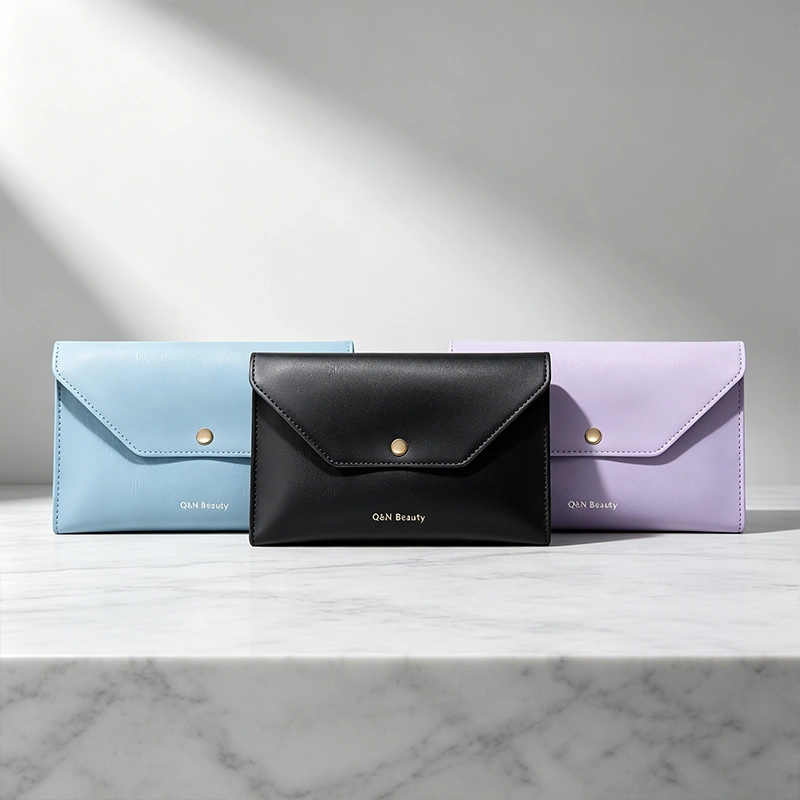
A practical custom makeup bag collection often needs fewer structures than a mood board suggests. Start with one hero style, one or two core commercial styles and supporting formats that solve different needs.
For example, a skincare brand might use a structured wide-opening vanity bag as the hero, a compact zipper pouch as the everyday item and a clear travel pouch as the functional travel SKU. The styles look different, but each has a distinct role.
Compact Capsule Collection vs. Broad Assortment
| Approach | Advantages | Limitations | Best Fit |
|---|---|---|---|
| 3–4 style capsule | Lower development complexity, easier material sharing, clearer merchandising | Fewer use cases and price points | New brands, first launches, focused seasonal campaigns |
| 5–8 style collection | Broader customer coverage and merchandising flexibility | More samples, packaging files and MOQ exposure | Established brands with proven channels |
| Large multi-SKU assortment | Strong category presence and segmentation | High operational complexity and inventory risk | Retail programs with demand forecasting and buying scale |
The correct collection size depends on demand, not a fixed industry rule. A smaller launch with repeatable materials is often more controllable than a large assortment where every SKU has unique fabric, zipper and packaging.
Plan Colorways Without Creating Unmanageable SKU Counts
Color multiplication happens quickly. Four bag styles in four colors create 16 style-color combinations before packaging variants are added. Ask whether every shape needs every color.
A useful strategy is to maintain two or three core brand colors across the collection and reserve one seasonal color for selected hero SKUs. This keeps visual consistency while limiting custom-dyeing and inventory exposure.
For retail identification, GS1 states that product variations such as different colors generally require their own unique GTINs. That means a color expansion is also a data, barcode and packaging decision—not only a design decision.
Retail reference: GS1 guidance on product sizes and color variants.
Coordinate Collection Tiers for GWP, Retail and Premium Sets
Not every bag needs the same cost structure. A brand can use a lightweight promotional pouch for GWP, a durable core retail bag and a more structured premium case for seasonal gifting. The design language can remain consistent through shared color, logo scale, lining or zipper pullers.
Choose Product Types, Materials and Construction
Match Bag Shapes to Beauty Routines and Product Formats
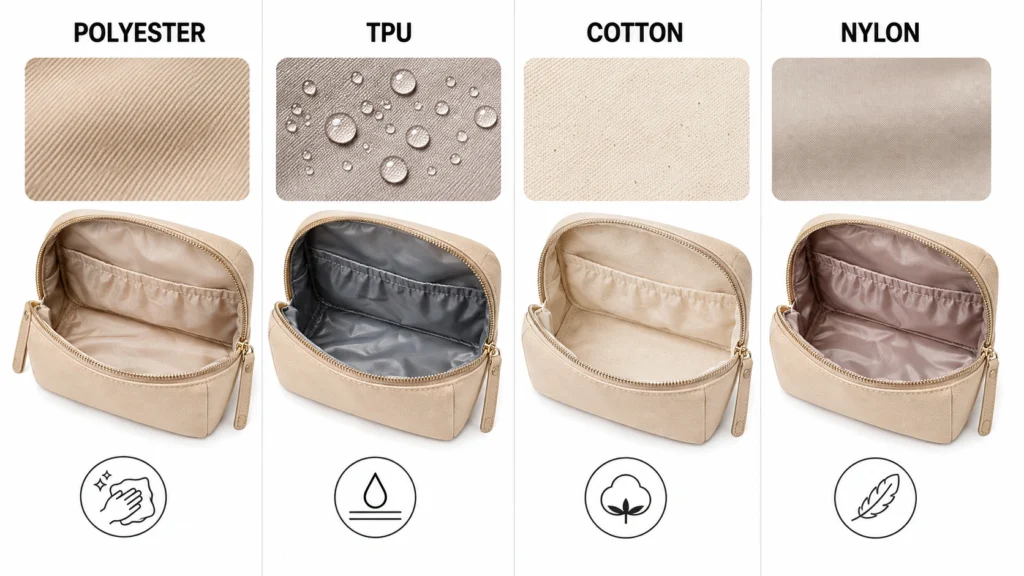
Flat pouches suit makeup, samples and compact accessories. Boxy bags suit bottles and toiletries. Wide-opening frame bags improve skincare visibility. Clear PVC, TPU or EVA formats work well for travel and bathroom use. Drawstring and soft textile pouches support gift sets and hair accessories.
Choose shapes from product dimensions and routine needs, not only trending silhouettes. The Q&N custom development page shows material and structure options that can be combined during OEM/ODM development.
Build a Shared Material and Trim Library
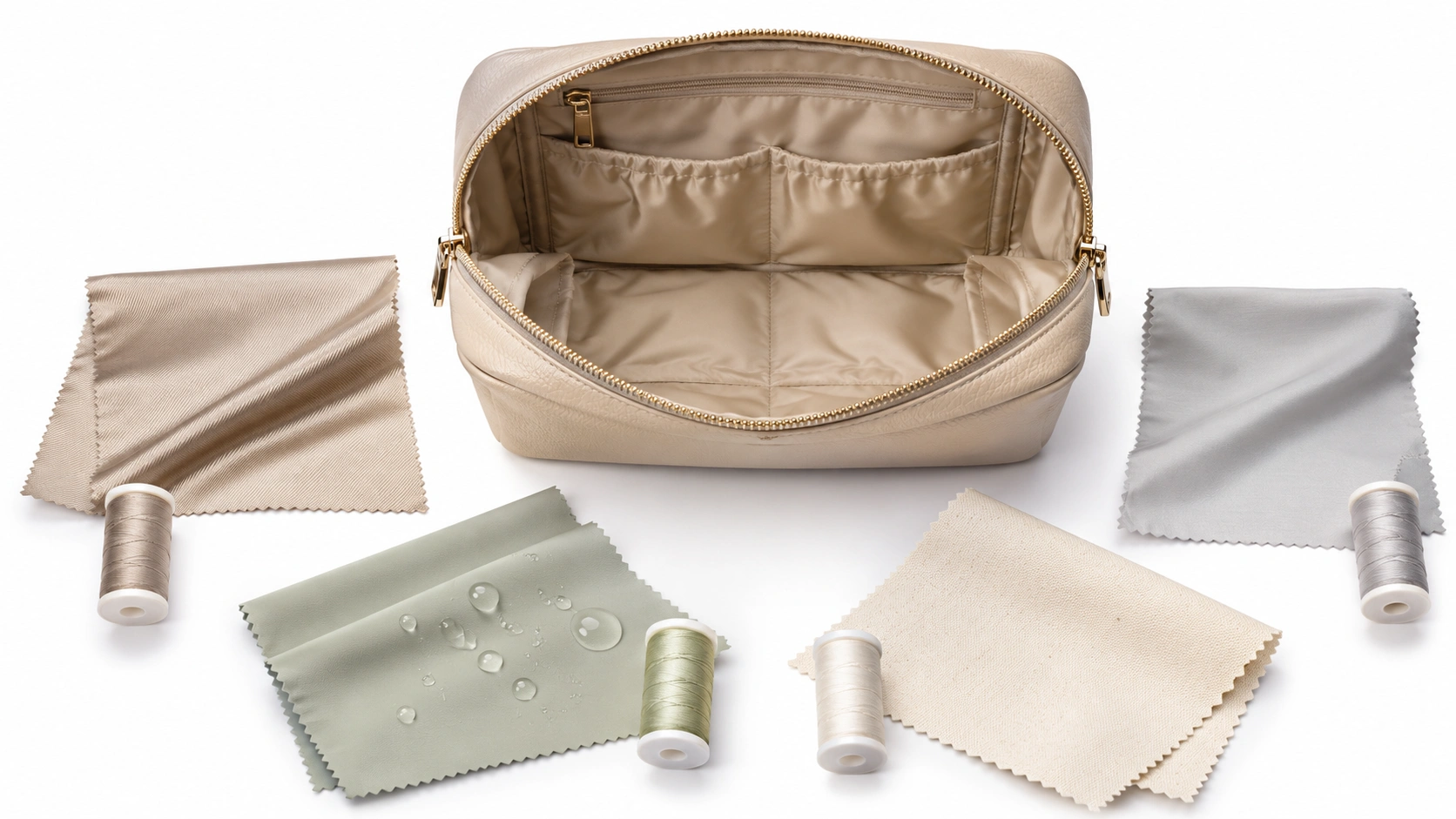
A collection becomes easier to produce when styles share materials. One nylon across three shapes, one lining across the full range and one zipper family in two sizes can reduce sourcing complexity and improve color coordination.
Shared components also make later repeat orders easier. A supplier can retain clearer material references and the buyer has fewer standards to control.
Compare Fabric, PU, Clear and Padded Construction Options
| Material Direction | Commercial Strength | Collection Risk | Good Use |
|---|---|---|---|
| Polyester / nylon | Broad colors, printing and cost flexibility | Can look generic without strong detailing | Core retail, travel, promotional |
| PU leather | Premium structure and strong logo options | Higher weight and material consistency requirements | Prestige skincare, gifting |
| PVC / TPU / EVA | Visibility and easy-clean performance | Material-specific odor, folding and compliance considerations | Travel, shower, beauty tool sets |
| Quilted / padded fabric | Soft tactile value and strong trend appeal | Higher sewing complexity and packing volume | Lifestyle, seasonal, premium GWP |
| Natural-look textiles | Warm brand storytelling | Color, shrinkage and stain-management variation | Clean beauty, wellness, spa |
Standardize Components Where Customers Will Not Notice the Difference
Customization should be spent where it creates customer value. A branded puller, signature lining or recognizable color may be worth protecting. Hidden foam density or an internal binding material may be standardized across styles if performance is equivalent.
This is one of the easiest ways to reduce unnecessary complexity without making the collection look less custom.
Create One Visual Language Across the Collection
Control Color, Logo Scale and Hardware Finish
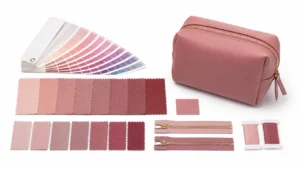
Define a collection color map before sampling. Record Pantone references or physical standards by material, then decide which hardware family—gold, silver, gunmetal or painted—belongs to each tier.
Logo scale should feel related across products. A 30 mm logo on a mini pouch may need to become 45 mm on a large vanity case, but placement logic can remain consistent.
Decide Which Details Should Repeat Across Every Style
Repeated details create recognition. Examples include the same puller shape, signature webbing, lining print, contrast piping or label position. Select one or two strong identifiers rather than forcing every customization option into every bag.
Use Packaging to Connect Different Bag Structures
Hangtags, belly bands, gift boxes and barcode labels can visually connect styles that use different materials. Packaging is especially useful when one range includes a clear travel bag, textile pouch and PU vanity case that cannot share the same surface branding method.
Pros and Cons of High Customization Across Multiple SKUs
Advantages: stronger differentiation, clearer brand ownership and more premium perceived value. Limitations: more molds, material minimums, color approvals, sample rounds and replacement-component risk. The best collection normally combines signature custom elements with repeatable production components.
Cosmetic Bag Product Development from Concept to Approved Samples
Prepare a Collection Brief and Tech Pack for Each Style
The collection brief controls the system; the style tech pack controls the individual product. The brief should list SKU role, target material, color, price tier, channel and launch date. Each tech pack should then define dimensions, BOM, logo, construction, packaging and tolerances.
Develop the Highest-Risk SKU First
Do not automatically sample the easiest pouch first. Develop the style with the greatest technical uncertainty: a custom metal frame, complex divider system, unusual fabric or molded hardware. Solving the hardest construction early can influence the rest of the collection.
Use Shared Materials to Shorten Sampling Decisions
Once a fabric color, lining or zipper family is approved on one style, carry the approved reference into related SKUs. The next sample still needs functional approval, but the buyer does not need to restart every material decision.
Lock the Pre-Production Sample and Revision History
Before bulk production, approve the final materials, color, logo, measurements, packaging and workmanship reference. Use a revision-controlled tech pack and identify the approved physical sample. A later change should trigger a documented impact review rather than an informal chat message.
Illustrative manufacturing scenario: A beauty brand develops five bags in three colors. Instead of sampling all 15 combinations, it first validates each construction in one shared core color, then approves the seasonal color on representative material swatches and selected hero styles. This may reduce redundant sample decisions, but the actual sampling plan must still be agreed with the manufacturer. This is an illustrative scenario, not a reported customer case.
Mid-development CTA: Q&N Bags publicly lists a regular sample time of 7–14 days and supports material selection, sample development, logo application and packaging. Buyers can review the factory and production process when planning sample dependencies.
Plan MOQ, Cost and Lead Time Across the Collection
Understand Which Components Actually Drive MOQ
MOQ may be driven by fabric dyeing, zipper tape, printed lining, custom hardware or retail packaging rather than sewing capacity. A collection with five unique materials can therefore create more minimum-order pressure than five shapes made from one shared material.
Q&N Bags currently publishes a regular MOQ of usually 1,000 pieces per style, with the final MOQ depending on material, color, size, logo method and packaging. Treat this as a starting point for project discussion rather than a universal rule for every component.
Build a Cost Ladder Instead of Pricing Every Bag in Isolation
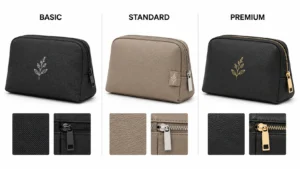
Plan an opening-price SKU, a core SKU and a premium SKU. The differences should be visible to the buyer: material, structure, hardware, internal organization or packaging. Avoid paying for expensive custom details that do not create a meaningful tier difference.
Plan Sample, Material and Production Dependencies
Some decisions are sequential. A custom-dyed fabric must be approved before a final color sample. A molded puller must be developed before the pre-production sample. Retail packaging may depend on final bag dimensions.
Create a dependency map rather than assigning the same target date to every SKU. Q&N publicly lists bulk production typically at 30–45 days after sample approval and deposit, subject to project details; a multi-SKU collection should include additional planning around material availability and synchronized packing.
When to Reduce Colors, Styles or Custom Components
Reduce complexity when a variant has no clear channel, customer or price role. If the launch is becoming too large, protect the hero products and core colors first. Secondary colors, special hardware or additional sizes can become later drops after the market response is clearer.
Quality, Compliance and Retail Readiness
Create Collection-Level Quality Standards
Shared standards make a range feel intentional. Define acceptable color coordination, zipper function, logo placement, seam workmanship, dimensions and packaging quality across all styles. Then add style-specific checks such as frame opening, waterproof seams or divider fit.
Use AQL and Critical-to-Quality Checks for Bulk Inspection
ISO 2859-1:2026 provides current lot-by-lot attribute sampling schemes indexed by Acceptance Quality Limit. The standard does not decide which defects your brand considers critical, major or minor. Define those classifications before inspection and connect them with style-specific critical-to-quality points.
Quality reference: BS ISO 2859-1:2026 overview.
Plan Packaging, Barcodes and Product Variants by Market
Each retail variation may create its own packaging file, barcode and inventory record. GS1 guidance states that different color or size variations generally require unique GTINs. Plan this while the assortment is being finalized, not after cartons are printed.
Define Market-Specific Testing Before Production
Testing depends on materials, product claims, destination and end use. A PVC bag, textile pouch and children’s promotional item may require different compliance reviews. Q&N publicly lists BSCI/SMETA factory-audit support, ISO9001 quality management and project-based REACH/SVHC/FSC support. Buyers should still define the exact tests required for their market and product.
How to Choose a Manufacturer for a Cosmetic Bag Collection
Evaluate Development Capability, Not Only Unit Price
A multi-SKU collection requires communication between design, sampling, sourcing, production and QC. A low quote has little value if every style is developed independently with inconsistent materials or revisions.
Q&N states that it has operated since 2010, works with multiple cosmetic-bag materials and provides OEM/ODM support from development through packing. Its public factory profile can be used as one reference when evaluating capabilities against your collection requirements.
Check Material Sourcing, Sampling and Multi-SKU Coordination
Ask whether the supplier can reserve shared materials, maintain approved color standards, coordinate custom components across styles and provide one consolidated development tracker. Multi-SKU control is a project-management capability as much as a sewing capability.
Supplier Evaluation Checklist for Seasonal Collections
| Evaluation Area | Questions to Ask |
|---|---|
| Collection review | Can the supplier identify duplicate or unnecessarily complex SKUs? |
| Materials | Which styles can share fabric, lining, zipper and hardware? |
| Sampling | Can samples be prioritized by technical risk? |
| MOQ | Which component creates the real minimum for each color? |
| Quality | Can one collection-level QC standard be applied across styles? |
| Packaging | Can barcode, hangtag and carton requirements be coordinated by SKU? |
| Schedule | Can the supplier map material and production dependencies? |
Common Collection Planning Mistakes to Avoid
- Launching too many style-color combinations before demand is proven.
- Using a unique material and zipper on every SKU.
- Choosing products from trend images without defining their commercial role.
- Approving individual samples without checking the assembled collection together.
- Adding packaging after final bag dimensions are already fixed.
- Assuming all styles can share one MOQ or production schedule.
- Ignoring barcode and variant management until retail artwork is due.
- Changing the hero color late in development without evaluating all dependent components.
Frequently Asked Questions About Cosmetic Bag Collections
How Many Styles Should a Cosmetic Bag Collection Include?
There is no fixed number. A new brand may benefit from a focused three- or four-style capsule, while an established retail program can manage more. Each SKU should serve a distinct customer, use case, price tier or channel.
Should Every Bag Use the Same Material?
No. Shared materials reduce complexity, but different use cases may require different performance. The goal is controlled variation. For example, a textile core range can be supported by one clear travel SKU without forcing the entire collection into the same material.
How Many Colors Should I Launch?
Start from realistic demand by SKU. Two core brand colors plus one seasonal accent can be easier to manage than giving every bag four custom colors. Each additional color may affect material MOQ, packaging, barcodes and inventory.
Can Different Styles Share the Same MOQ?
Not automatically. MOQ may depend on the specific material, color, custom component and packaging of each style. Shared fabric can improve purchasing efficiency, but factories and component suppliers still need to confirm whether quantities can be combined.
How Early Should a Seasonal Collection Start Development?
Work backward from the required arrival date and include design confirmation, sample rounds, custom material development, pre-production approval, production, inspection and shipping. Projects with custom dyeing, molded hardware or gift boxes require more buffer than stock-material pouches.
How Do I Keep a Collection Consistent Across Repeat Orders?
Retain approved swatches, material codes, tech packs, artwork, hardware masters and pre-production samples. Use revision control and compare new material lots against the original standard before cutting.
Can a Manufacturer Help Develop the Collection from References?
Yes. An experienced OEM/ODM factory can propose materials, structures and shared components based on reference photos and target use. The buyer should still control brand positioning, SKU roles, target quantities, required markets and final approvals.
Final Recommendations for a Production-Ready Cosmetic Bag Collection
The Minimum Collection Brief to Approve Before Sampling
Before sampling, define the role of every SKU, approximate dimensions, intended contents, material direction, colors, logo approach, target quantity, packaging level and delivery market. Then separate collection-level decisions from style-specific tech packs.
Future Trends in Beauty Accessory Product Development
Beauty portfolios are becoming more channel-aware and data-driven. McKinsey expects e-commerce to generate most beauty sales growth through 2030, while consumer value sensitivity remains important. For cosmetic bag programs, that favors clear product differentiation, modular assortments and launch structures that can expand without rebuilding the supply chain for every drop.
Google’s 2026 guidance for generative AI search also emphasizes unique, expert-led, non-commodity content and says established SEO fundamentals remain relevant. For a manufacturer or beauty brand, publishing real development logic—SKU planning, MOQ drivers, material tradeoffs and QC controls—provides more search value than producing dozens of nearly identical trend pages. See Google’s generative AI search optimization guide.
What to Send a Manufacturer for Collection Development
For a cosmetic bag collection quotation or development review, prepare:
- Product types and the role of each SKU
- Target dimensions
- Reference photos or tech packs
- Material requirements
- Core and seasonal color direction
- Logo file and branding method
- Target quantity by style and color
- Packaging requirements
- Delivery country or markets
- Target delivery date
Send the project brief through the Q&N contact page so the development team can review whether styles can share materials, trims or packaging before individual quotations are finalized.
Final expert recommendation: Plan the collection as a portfolio before designing every SKU. Protect the hero product, limit unnecessary style-color multiplication, share invisible components where possible, develop the highest-risk construction first and lock collection-level standards before bulk production. That creates a stronger custom makeup bag collection for customers and a more controllable manufacturing program for the buyer.
Aries Gu is the founder of Q&N. With over 17 years of experience in cosmetic bag OEM/ODM source factory. He focuses on quality control, efficient communication, and on-time delivery for global cosmetic bag projects.