A cosmetic bag specification sheet should remove guesswork before quotation, sampling, material purchasing, and bulk production. Yet many projects begin with only a reference photo, an approximate size, and a logo. Undefined dimensions, material grades, zipper performance, and defect limits then produce non-comparable quotations, repeated samples, cost changes, and inconsistent bulk goods.
This guide explains the information procurement managers, beauty brands, importers, wholesalers, retailers, product developers, and private-label buyers should place in a bag specification sheet. It also shows how to connect the document to sampling, quality inspection, compliance, packaging, price, MOQ, and delivery planning.
If your design is still being developed, you can review custom cosmetic bag formats and share a preliminary brief with the factory. A first version does not need to answer every question; it does need to distinguish confirmed requirements from items that require supplier recommendations.
Why a Cosmetic Bag Specification Sheet Matters in B2B Sourcing
One Commercial Reference for Quotation, Sampling, and Production
The specification sheet converts a visual concept into measurable purchasing requirements. Sourcing, design, the factory, and the inspection company should work from the same revision. When suppliers quote the same construction, materials, branding, packaging, and test scope, their prices become more comparable.
Separate mandatory requirements from preferences. For example, “finished width: 230 mm ± 5 mm” is fixed; “supplier may recommend a lower-cost lining with similar hand feel” is open. Otherwise, a low quote may reflect weaker construction rather than better efficiency.
Specification Sheet vs. Tech Pack vs. Approved Sample
These terms are sometimes used interchangeably, so define the document hierarchy:
- Specification sheet: the controlled summary of dimensions, materials, components, construction, branding, packaging, inspection, and commercial requirements.
- Tech pack: the broader development package, which may include the specification sheet, technical drawings, artwork, bill of materials, color standards, test methods, and revision history.
- Approved sample: the physical reference for appearance, hand feel, workmanship, and function after documented deviations have been resolved.
A sample must not silently override written requirements. Record any approved difference and issue a new revision before production.
When to Create and Update the Document
Create version 0.1 before requesting quotations. Update it after the supplier’s manufacturability review, after each prototype round, and again when the pre-production sample is approved. Freeze a production version before material purchasing. Any later change should show the date, owner, affected fields, cost or timing impact, and written approval.
Core Product Identity and Finished Dimensions
Product Identification and Intended Use
Begin with a unique style number, product name, collection, intended market, user group, target quantity, and delivery date. Describe the use case: a promotional flat pouch, a retail vanity case, or a clear travel kit. Intended use affects construction, testing, packaging, and compliance.
Include a rendering or reference image, but label it “design intent” unless every detail is binding. Images alone do not define thickness, pockets, reinforcement, seams, or color tolerance.
How to Specify Finished Dimensions and Tolerances
State finished external length × width/depth × height in one unit system, preferably millimeters. Identify orientation and measurement points. A soft pouch measured empty and flat will differ from the same pouch measured filled. Mark the start and end of curved or gusseted dimensions.
Assign realistic tolerances by feature instead of writing “size must be exact.” A logo position may need tighter control than the overall size of a soft pouch. Ask the factory to review tolerances because stretch, padding, piping, and construction affect repeatability.
Capacity, Fit, and Load Cases
External dimensions do not guarantee usable capacity. For specific bottles, palettes, brushes, or gift sets, provide dimensions, orientation, and maximum loaded weight. Require closures to operate correctly when full. Test actual products or accurate dummies before approval.
Technical Views and Measurement Method
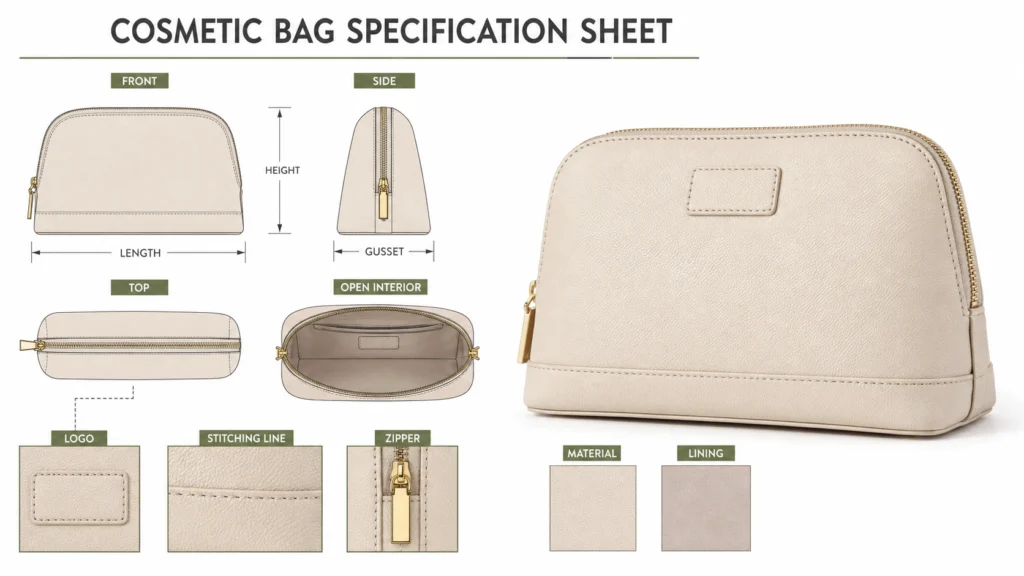
Provide front, back, side, top, bottom, and open-interior views as applicable. Number every pocket, panel, handle, zipper, and attachment point so comments are unambiguous. Add a measurement diagram and a table defining each point of measure.
| Specification Section | Required Buyer Input | Why It Matters |
|---|---|---|
| Product identity | Style number, name, revision, market, intended use | Prevents files and samples from different styles being mixed |
| Finished dimensions | Measurement points, condition, unit, tolerance | Makes size inspection repeatable |
| Capacity | Contents, orientation, loaded weight | Confirms function rather than exterior size alone |
| Drawings | All relevant views and numbered components | Clarifies structure, placement, and construction |
| Document control | Revision, date, owner, approval status | Identifies the version authorized for production |
Materials, Components, and Construction Details
Build a Complete Bill of Materials
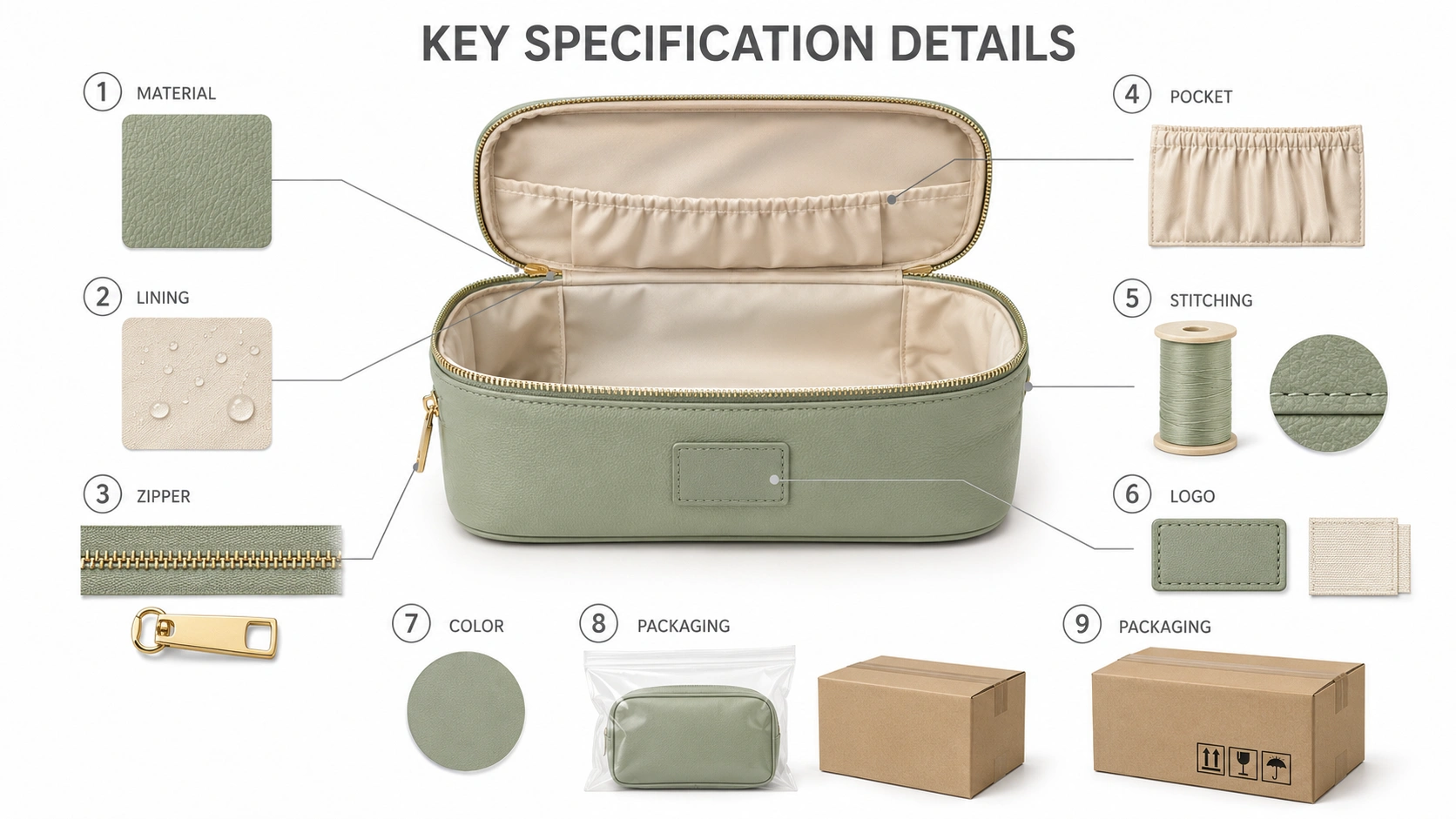
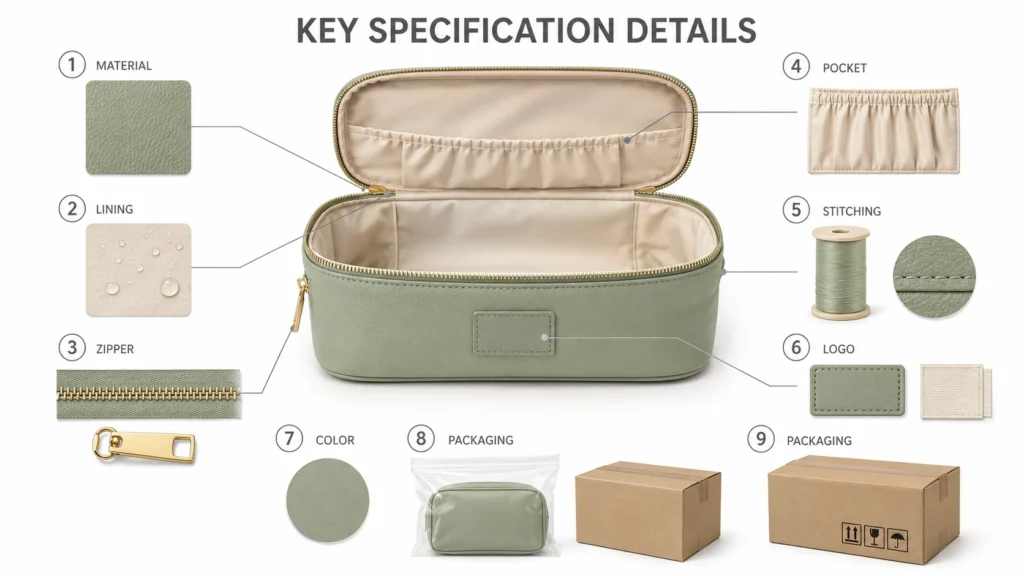
A bill of materials, or BOM, should list every component: shell, lining, interlining, foam, reinforcement, mesh, binding, zipper, slider, puller, thread, labels, elastic, hardware, handle, packaging, and adhesive. Give each item a number matching the drawing.
Do not specify only “PU,” “polyester,” or “canvas.” Add composition, weight or thickness, backing, finish, coating, color reference, recycled-content requirement, approved swatch, and required performance. If no proprietary code exists, define minimum performance and approve a submitted swatch.
Outer Material, Lining, and Reinforcement
The shell creates the first impression; lining and reinforcement determine cleanability and structure. State whether the lining must be wipe-clean, water-resistant, colorfast, or removable. Mark support for the base, handle, mirror, brush slots, and hardware.
For transparent panels, distinguish PVC, TPU, and EVA. Define thickness, clarity or frost, flexibility, odor expectation, relevant temperature performance, and color. Compare construction options on the transparent toiletry bag manufacturing page.
Zippers, Hardware, and Functional Components
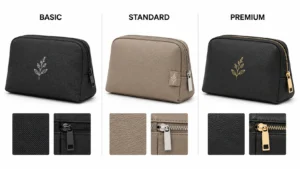
For zippers, specify type, size, tooth material, tape color, opening direction, sliders, puller, end stops, and finish. For hardware, state base material and plating color; “gold” is not a controlled finish. Record tooling needs and ownership.
Test smooth opening on curved tracks, pocket retention when inverted, handle security under load, and accessible hardware for sharp edges.
Seams, Stitching, Edge Finishing, and Assembly
Show seam type, stitch location, binding width, piping, critical seam allowance, reinforcement, bar tacks, edge finish, and thread color. Specify stitch density where it affects durability or appearance.
Material Options: Pros, Cons, and Suitable Projects
| Material | Advantages | Limitations | Common B2B Use |
|---|---|---|---|
| Polyester or nylon | Lightweight, printable, broad color range | Performance varies by denier, weave, and coating | Promotional pouches and organizers |
| PU synthetic leather | Structured, wipeable, branding-friendly | Varies by backing, finish, and hydrolysis resistance | Premium pouches and vanity cases |
| Cotton canvas | Natural hand feel and good print surface | May soil, shrink, or transfer color | Lifestyle collections and gift bags |
| PVC, TPU, or EVA film | Clear effects and wipe-clean surface | Different cost, odor, flexibility, and chemical profiles | Travel kits and clear windows |
| Quilted textile | Soft appearance and protection | More sewing; loft affects dimensions | Seasonal collections and gift sets |
The best material is the one that meets the product’s appearance, function, compliance, price, and durability target. Requesting the lowest price without locking the material parameters makes quote comparison unreliable.
Custom Logo, Color, Packaging, and Labeling Requirements
Color Standards and Shade Approval
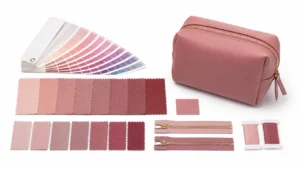
Give a Pantone reference when applicable, but approve a physical swatch because texture, transparency, gloss, and lighting change perceived color. Define which components must match and which may coordinate; PU, zipper tape, lining, and thread may need separate standards.
Record the swatch number, date, viewing condition, and shade range. For colorfastness or transfer, define a test method and acceptance criterion.
Logo Artwork, Method, Size, and Placement
Supply vector artwork and identify the method: screen print, heat transfer, embroidery, woven label, embossing, debossing, patch, metal plate, or custom puller. Specify logo dimensions, color, position from fixed edges, orientation, and tolerance. Include artwork for inner labels and packaging.
Each method has tradeoffs. Screen printing suits many flat surfaces but needs adhesion testing. Embroidery adds texture but may pucker light fabric. Debossing is subtle on compatible PU but has less contrast. Metal branding looks premium but adds attachment, plating, and testing considerations. The factory’s custom cosmetic bag service process can help assess material compatibility.
Retail Packaging and Carton Specifications
List unit packaging, inserts, dust bag, hangtag, barcode, warnings, gift box, master carton, assortment, and pallet requirements. Define barcode ownership and provide dielines, artwork, print colors, finishes, and proof-approval method.
Add maximum carton dimensions or weight when required. Define carton marks such as PO, style, color, quantity, carton number, weights, and destination. Do not assume standard factory packing meets a retailer’s routing guide.
Market Labels and Claims
Specify country-of-origin marking, importer or responsible-person details, fiber or material disclosures, warnings, care information, recycling marks, and claim substantiation according to the destination and product classification. Avoid copying an apparel label onto a bag without checking scope. For example, the European Commission’s textile labelling FAQ states that certain textile travel goods and fancy goods are exempt from mandatory fiber-composition labeling under Regulation (EU) No 1007/2011, while voluntary recycled claims must not mislead.
Classification can depend on the product and market. Ask your compliance adviser or importer of record to approve the labeling matrix before printing. The specification sheet should identify who supplies the legal text and who approves it.
From Prototype to Approved Production Standard
RFQ Sample, Development Sample, and Pre-Production Sample
Define the purpose of each sample. An RFQ or counter sample may be used to evaluate concept and construction. A development sample resolves fit, materials, logo, and usability. A pre-production sample should represent the approved production materials, colors, branding, workmanship, and packaging as closely as agreed before bulk cutting.
Require the supplier to list substitutions and open points with every sample. If the correct zipper color was unavailable for the first prototype, the sample report should state that temporary substitution. Otherwise, a reviewer may approve it unintentionally.
Approval Process and the Golden Sample
Review samples against a checklist. Measure all points, load the intended contents, run the buyer-defined zipper check, inspect branding and interior, and compare color under the agreed light source. Return one consolidated, numbered comment file.
Sign and date the retained reference sample or use another controlled approval method. Keep approved samples with the relevant parties. The “golden sample” controls hard-to-describe visual and tactile qualities; the written specification controls measurable requirements.
Revision Control and Change Authorization
Use a revision table showing what changed and why. Replace “final-final-2” with a style number and revision code. Only named roles should authorize changes. Assess alternatives for appearance, function, compliance, cost, and timing.
Production Pack and Factory Handover
Before production, issue a controlled pack containing the approved specification sheet, BOM, drawings, artwork, packaging files, color standards, sample approval report, testing plan, defect list, inspection plan, and purchase order. Ask the supplier to confirm receipt and list discrepancies. Q&N’s factory profile describes support across material selection, sample development, logo application, packaging, production follow-up, and final inspection; buyers should still place project-specific requirements in the controlled production pack.
Mid-project CTA: If your quotation has too many assumptions, send the current drawing, target quantity, material direction, logo artwork, destination, and required delivery date for a manufacturability review before paying for tooling or a production-grade sample.
Quality Control, Testing, and Compliance Requirements
Defect Classes, Tolerances, and Acceptance Sampling
Define critical, major, and minor defects for the product. A sharp edge may be critical; a broken zipper or materially wrong dimension may be major; a small, inconspicuous thread end may be minor. Add annotated photos where wording is ambiguous.
State the sampling standard, inspection level, AQLs, lot definition, and accept/reject procedure in the purchase order. ISO 2859-1:2026 defines AQL-indexed acceptance sampling plans for inspection by attributes and replaced the 1999 edition. It does not choose your defect limits; select them by risk and contract. For illustration only, Critical 0, Major 2.5, and Minor 4.0 could be a buyer-defined plan, not a universal requirement.
Functional and Performance Tests
Write repeatable tests with conditioning, load, duration or cycles, method, and pass/fail criterion. Relevant checks may include:
- Zipper operation and slider security
- Handle or strap attachment under a defined load
- Seam strength or seam slippage
- Colorfastness to rubbing and transfer
- Logo adhesion and abrasion resistance
- Coating adhesion, scratch resistance, or hydrolysis performance
- Water resistance, leakage, or wipe-clean performance where claimed
- Fit, capacity, stability, and packaging transit checks
“Durable zipper” is not inspectable. Define the test method, cycles, and acceptable separation, tooth damage, and function for the intended use.
Compliance by Market, Material, and Intended User
Do not paste a generic “REACH, CPSIA, Prop 65 compliant” line into every sheet. Create a matrix listing destination, product classification, component, rule, test method, laboratory requirement, report validity, and approval owner.
- European Union: REACH includes obligations for substances in articles. Use the European Commission’s REACH overview and current ECHA information to define restricted-substance and SVHC requirements.
- United States: CPSC guidance says product classification depends on intended use. Applying that guidance, an adult cosmetic bag should not automatically be classified as a children’s product; a design marketed primarily to children needs a different assessment. See the CPSC children’s product guidance.
- California: Proposition 65 concerns exposure to listed chemicals, not a simple detection rule. Review OEHHA’s official overview before choosing tests or warnings.
Certificates, social audits, and management-system documents answer different questions. A BSCI audit does not prove chemical compliance, and ISO 9001 does not certify an individual bag. Request current evidence relevant to the site, material, product, market, and claim.
Incoming, In-Line, and Final Inspection Checkpoints
| Stage | What to Check | Evidence to Retain |
|---|---|---|
| Incoming materials | Material code, color lot, thickness or weight, visible defects, components, documentation | Receiving record, swatch comparison, supplier documents |
| First article | Dimensions, panel alignment, logo, zipper, seam construction, fit | Signed first-piece report and photos |
| In-line production | Cutting consistency, stitching, reinforcements, repeated defects, work-in-progress quantity | In-line report and corrective-action record |
| Pre-shipment | Quantity, workmanship, function, measurements, packaging, labels, carton marks | Final inspection report under the agreed sampling plan |
| Shipment release | Approved reports, test status, packing list, carton data, authorization | Release approval and shipping documents |
Common Specification Risks and Purchasing Mistakes
- Using a competitor photo as the only technical reference
- Leaving internal pockets, reinforcement, and seam finishing undocumented
- Approving color from a screen instead of a physical swatch
- Changing dimensions without rechecking capacity, zipper length, or artwork position
- Accepting a sample made with substitute material without recording the substitution
- Ordering packaging before the finished bag and folded dimensions are confirmed
- Requesting broad compliance claims without identifying market, user, materials, or test scope
- Failing to define defect classes and who can authorize deviations
How Specification Choices Affect MOQ, Price, and Lead Time
Cost Drivers Hidden Behind a Simple Bag Shape
Cost reflects material consumption and minimums, component grade, panels, binding, pockets, reinforcement, quilting, print colors, logo processes, molds, labor, inspection, packaging, and color allocation. Bags with the same exterior size can cost differently.
| Specification Decision | Likely Cost or Timing Effect | Buyer Control |
|---|---|---|
| Custom-dyed material or zipper | May create material minimums and added preparation time | Use an available color, combine volume, or accept supplier-proposed alternatives |
| Custom metal puller or logo plate | Tooling, approval, plating, and component lead time | Use a standard puller with another branding method |
| Multiple small colorways | Lower efficiency and separate component minimums | Concentrate volume or standardize common trims |
| Complex interior organization | More material, cutting, sewing, and inspection steps | Keep features tied to actual product fit |
| Custom retail packaging | Artwork, proofing, printing minimums, manual packing | Confirm packaging early and obtain separate quotations |
| Late specification change | Possible rework, scrap, retesting, and schedule reset | Freeze the approved version before purchasing and cutting |
MOQ Is Often Component-Driven
Sewing MOQ is only one factor. Dyeing, printed lining, zipper color, plating, molded pullers, labels, and boxes may have separate minimums. Ask for finished-product MOQ by style and color, component MOQ, and excess material commitment.
Build the Lead-Time Path, Not One Total Number
Request a schedule covering specification review, sourcing, prototypes, testing, pre-production approval, material booking, production, inspection, and transport. Define when lead time starts, such as after deposit, frozen artwork, and sample approval. Include freight, customs, retailer appointments, and contingency.
Value Engineering Without Losing the Product Function
When a quote exceeds target, rank requirements as “must keep,” “preferred,” and “optional.” Consider stocked trims, simpler pockets, another logo method, shared zippers across colorways, or adjusted packaging. Review fit, durability, appearance, compliance, and retail price; document every substitution.
How to Evaluate a Cosmetic Bag Supplier’s Readiness
Ask for a Manufacturability Review
A capable supplier should identify missing dimensions, conflicting callouts, risky materials, weak attachment points, artwork limits, and component minimums before sampling. Look for a documented list of confirmed requirements, assumptions, questions, and alternatives.
Check Documentation and Material Traceability
Ask how the BOM links to purchase records, incoming inspection, production lots, tests, and packing. For recycled claims, define the required chain-of-custody evidence. Check that audit and certificate names, sites, scope, issuer, and dates match the supply chain.
Evaluate Sampling, QC, and Change Handling
Confirm who owns sample comments, approves the first piece, controls nonconforming material, and documents corrective action. Ask about in-line and independent final inspection. Look for willingness to sign the specification and disclose deviations.
Supplier Warning Signs
- A firm quotation is issued despite major missing construction or packaging details.
- Material names change between the quotation, sample, and invoice.
- The supplier will not mark substitutions or maintain revision records.
- Testing is promised without a product-specific standard, laboratory, or acceptance criterion.
- The pre-production sample is approved after bulk cutting has already started.
- Factory, certificate, and payment-recipient information cannot be reconciled.
FAQ: Cosmetic Bag and Bag Specification Sheet
What Information Should Be Included in a Cosmetic Bag Specification Sheet?
Include identity, intended use, views, dimensions and tolerances, capacity, BOM, materials, construction, components, branding, colors, labels, packaging, testing, compliance scope, defects, inspection plan, sample status, and revision history. Add quantity, destination, and delivery date.
What Is the Difference Between a Cosmetic Bag Specification Sheet and a Tech Pack?
A specification sheet is the controlled product summary. A tech pack is the wider package, often including drawings, BOM, artwork, tests, packaging files, and approvals. Define which file is contractually controlling.
How Should Cosmetic Bag Dimensions Be Measured?
Use a drawing to identify orientation, measurement points, and whether the bag is empty, flat, standing, or filled. Separate external from usable internal size. Curves, gussets, piping, and padding need explicit points and achievable tolerances.
Do I Need Exact Materials Before Requesting a Quotation?
No, but mark open material decisions clearly. Provide the desired appearance, hand feel, performance, market, quantity, and target cost level, then request itemized options. The quotation should state the assumed material composition, weight or thickness, finish, backing, and key components so competing offers can be normalized before selection.
Who Should Approve the Final Bag Specification Sheet?
The buyer’s product, procurement, and quality/compliance owners plus the supplier’s authorized technical representative should approve relevant sections. Packaging and logistics teams approve their fields. Record names, dates, revision, and exceptions.
Expert Summary, Future Trends, and RFQ Next Steps
Future Trends in Bag Specifications
Specifications are becoming more evidence-based. Buyers increasingly need component-level traceability for recycled-content and chemical claims, digital revision control, and packaging data for retailer and waste requirements. Durability, material separation, reduced packaging, and fewer mixed-material components are moving earlier in development.
A controlled spreadsheet or PDF can work if it has stable component IDs, linked evidence, clear approval ownership, and a revision log. The goal is a reliable decision record, not a decorative document.
Final Buyer Checklist
- Give the product a unique style and revision number.
- Define intended use, market, user, quantity, and arrival date.
- Show all views and state finished measurement methods and tolerances.
- List every material and component in the BOM.
- Control colors, logos, labels, packaging, and artwork versions.
- Define sample stages and record every approved deviation.
- Set functional tests, compliance responsibilities, defects, and inspection plan.
- Freeze and sign the production version before material purchasing and cutting.
Prepare a Quotation-Ready Inquiry
A strong cosmetic bag specification sheet protects product intent while giving the manufacturer enough clarity to quote accurately and plan production. It does not eliminate development decisions; it makes those decisions visible, testable, and controlled.
For an OEM/ODM review, send the following:
- Product type
- Finished dimensions and measurement method
- Reference photos, drawing, or tech pack
- Material requirements or desired performance
- Vector logo file and branding method
- Target quantity by style and color
- Packaging and labeling requirements
- Delivery country
- Target delivery date
Q&N supports custom materials, structures, logo methods, sampling, bulk production, packaging, and quality inspection for cosmetic bag programs. Use the Q&N cosmetic bag factory contact page to submit your current specification or preliminary brief. Requirements that are not yet confirmed can be marked “supplier to recommend” so the engineering discussion begins without disguising assumptions as final specifications.
Aries Gu is the founder of Q&N. With over 17 years of experience in cosmetic bag OEM/ODM source factory. He focuses on quality control, efficient communication, and on-time delivery for global cosmetic bag projects.