Cosmetic bag hardware can look like a small purchasing detail, but it often determines whether a bag feels premium, opens smoothly, survives repeated use, and passes retailer inspection. A zipper puller that detaches, a rivet that spins, or a metal logo that scratches the fabric can turn an otherwise well-made pouch into a return, complaint, or compliance problem.
This cosmetic bag hardware guide explains how beauty brands, importers, product developers, and sourcing teams should evaluate zipper pullers, rivets, buckles, D-rings, swivel hooks, and custom metal logos. It covers materials, finishes, attachment methods, tooling, quality tests, regulatory risks, and approval checkpoints.
The commercial context is significant. Statista projects the worldwide beauty and personal care market to generate about US$698.38 billion in 2026, while Grand View Research estimates the U.S. beauty and personal care market at US$117.05 billion in 2026. As beauty brands compete through packaging, gifting, travel formats, and premium accessories, hardware becomes part of the product experience rather than a purely functional component.
Industry sources: Statista Beauty & Personal Care Market Outlook and Grand View Research U.S. Beauty and Personal Care Market.
Table of Contents
- What Is Cosmetic Bag Hardware?
- Cosmetic Bag Zipper Puller Options
- Rivets and Reinforcement Hardware
- Buckles, D-Rings, and Strap Hardware
- Custom Metal Logos and Logo Plates
- How to Choose the Right Hardware Finish
- Cosmetic Bag Hardware Quality Tests
- Cosmetic Bag Hardware Approval Checklist
- Real-World Recall Lessons
- Frequently Asked Questions
What Is Cosmetic Bag Hardware?
Cosmetic bag hardware covers the rigid or semi-rigid parts used to open, close, reinforce, carry, adjust, decorate, or identify the bag. Typical components include zipper sliders and pullers, rivets, snaps, buckles, rings, hooks, adjusters, frames, and logo plates.
Functional Hardware vs Decorative Hardware
Functional hardware carries load or enables movement: a swivel hook holds a removable strap, a D-ring transfers force into a side tab, and a slider operates the zipper chain. Decorative hardware, such as a logo badge or stud, mainly creates visual identity. Functional parts need stronger attachment and more repeat-use testing.
How Hardware Affects Bag Appearance and Performance
Hardware influences perceived value through weight, sound, plating consistency, edge quality, and movement. A balanced puller can elevate a simple pouch, while a heavy logo plate can make thin fabric sag. Expert view: evaluate hardware and textile as one system; strong metal still fails when the surrounding material or attachment is weak.
Common Hardware Materials and Finishes
| Material | Common Uses | Main Advantages | Main Risks |
|---|---|---|---|
| Zinc alloy | Pullers, logo plates, buckles | Detailed casting, wide finish range | Weight, plating defects, brittle thin sections |
| Brass | Rivets, snaps, premium fittings | Good formability and premium feel | Higher cost, possible tarnishing |
| Stainless steel | Rings, hooks, specialty parts | Strength and corrosion resistance | Harder to shape; finish options may be limited |
| Aluminum | Lightweight tags and fittings | Low weight | Can dent or deform under high load |
| Engineering plastic | Buckles, adjusters, lightweight pullers | Light, quiet, corrosion-free | Can look less premium; may crack in cold or under impact |
Practical example: a promotional pouch may only need a standard puller, while a loaded travel case requires reinforced rings, hooks, and strap anchors.
Cosmetic Bag Hardware: Zipper Puller Options
Standard Metal Zipper Pullers
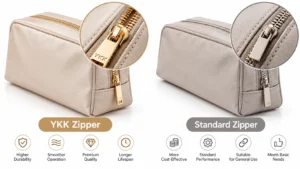
Standard pullers are available without custom tooling and are usually the fastest route for sampling and lower minimum orders. They work well for gift-with-purchase bags, private-label programs, and collections where branding appears elsewhere.
Do not approve a puller only by its face shape. Check the connection point, thickness, edge smoothness, finger clearance, weight, and compatibility with the selected slider. A puller that is too heavy can drag the slider downward. One that is too thin can feel sharp or bend during use.
Custom Logo Zipper Pullers
Custom pullers create repeated brand exposure. They may be die-cast, stamped, engraved, enamel-filled, or cut out. Artwork must remain recognizable at small scale because fine serifs and narrow bridges can disappear during casting or plating. Before tooling, approve a dimensioned drawing covering size, thickness, relief, connection opening, and weight.
Fabric, PU Leather, and Webbing Pull Tabs
Soft pull tabs reduce metal weight and can match the bag body. Fabric tabs suit casual cotton, nylon, quilted, and outdoor-inspired designs. PU tabs create a more structured look. Webbing tabs are durable and easy to grip.
The weak point is usually the fold or stitched connection. Specify whether the tab is folded, edge-painted, heat-cut, turned, riveted, or bar-tacked. Test both the tab material and the attachment to the slider.
Rubber, Silicone, and Molded Pullers
Molded pullers support bright colors, dimensional branding, and a soft grip. Review color migration, odor, dust attraction, and tearing around the connection hole.
| Puller Type | Best For | Pros | Cons |
|---|---|---|---|
| Standard metal | Fast development, classic designs | No custom mold; reliable appearance | Limited brand distinction |
| Custom metal | Premium private label | Strong branding; high perceived value | Tooling, MOQ, plating control |
| Fabric or PU tab | Soft, casual, coordinated bags | Lightweight; easy color matching | Stitching and edge durability risks |
| Molded soft puller | Sport, youth, promotional collections | Colorful and tactile | Tear, odor, and migration concerns |
Case evidence: in May 2025, the CPSC recalled about 2,900 Primark plush bags because a zipper pull could detach and create choking or ingestion hazards. Attachment security is therefore a safety issue for children’s products.
View the 2025 CPSC zipper-pull recall notice.
Cosmetic Bag Hardware: Rivets and Reinforcement
Decorative Rivets vs Structural Rivets
A decorative rivet adds a visual accent. A structural rivet helps secure a handle tab, strap anchor, logo plate, or layered panel. Structural use demands control over cap diameter, post length, material thickness, backing, hole size, and setting pressure.
Using one rivet specification across different fabric stacks is risky. A post that works through thin PU and lining may be too short for padded nylon, or too long for a flat PVC pouch. Excess post length can cause spinning; insufficient length can prevent a secure roll or lock.
Where Rivets Are Used on Cosmetic Bags
Common positions include side tabs, wristlet anchors, handle bases, frame connections, and logo plates. High-stress areas need a washer, reinforcement patch, folded webbing, or extra fabric layer to spread the load.
Choosing Rivet Size, Material, and Finish
Choose cap size according to panel scale and expected force. Small caps look refined but spread less pressure; large caps provide more coverage but may dominate a small pouch.
Preventing Loose or Scratched Rivets
Control the hole diameter, setting die alignment, post length, and pressure. Protect finished rivets during sewing and packing. For mirror-polished finishes, require protective film or interleaving material when components can rub against each other in transit.
- Measure the full material stack. Include outer fabric, reinforcement, lining, and padding.
- Select the post length. It must suit the compressed stack, not only the loose thickness.
- Run a setting trial. Check rotation, cap deformation, fabric cutting, and backside sharpness.
- Perform a pull test. Test the complete assembly, not a rivet installed on scrap alone.
Research lesson: a 2022 CPSC recall involved about 1,050 children’s handbags whose metal zipper slider, O-ring, D-ring, rivet, and stud exceeded the federal lead-content limit. This demonstrates why a supplier declaration for the “main fabric” is not enough; each accessible metal component can be a separate compliance risk.
Buckles, D-Rings, and Strap Hardware
Plastic Buckles vs Metal Buckles
Plastic buckles reduce weight and avoid plating corrosion. They are suitable for lightweight travel organizers, sporty pouches, and value-driven programs. Metal buckles feel more premium and can support a luxury look, but they add weight and may scratch adjacent panels.
D-Rings, O-Rings, and Swivel Hooks
D-rings sit neatly against side tabs and help control strap orientation. O-rings allow movement in multiple directions and suit decorative straps. Swivel hooks make straps removable and reduce twisting. The hook opening must match the ring thickness and leave enough clearance to operate without accidental release.
Hardware for Removable and Adjustable Straps
A removable strap system may include two side anchors, two hooks, a strap adjuster, and reinforced webbing or fabric tabs. Each element should be tested as part of the loaded bag. The weakest point may be the side seam, not the hook.
Matching Hardware Strength to Bag Weight
| Bag Use | Likely Load Pattern | Recommended Focus |
|---|---|---|
| Small makeup pouch | Low load; frequent opening | Smooth edges, low weight, zipper compatibility |
| Brush organizer | Moderate load; repeated handling | Ring closure, tab reinforcement, abrasion resistance |
| Travel vanity case | Higher load; lifting and carrying | Hook strength, strap anchors, handle pull testing |
| Promotional gift bag | Cost-sensitive; high volume | Simple parts, consistent assembly, low defect rate |
Expert view: avoid selecting hardware from an isolated supplier catalog. Build a loaded prototype and carry it by the intended handle or strap. Look for tab distortion, ring rotation, seam opening, hook interference, and surface scratching after realistic use.
Custom Metal Logos and Logo Plates
Flat Metal Plates and Raised Metal Logos
Flat plates provide a clean branding surface and suit minimalist beauty collections. Raised logos create stronger depth and light reflection. A separate metal wordmark can look highly premium, but individual letters increase placement and attachment complexity.
Engraved, Embossed, and Enamel-Filled Logos
Engraving removes material to create recessed detail. Embossed or raised designs create relief. Enamel filling adds controlled brand color but introduces another process that must be checked for overflow, pinholes, uneven fill, and color consistency.
Sew-On, Riveted, and Adhesive Logo Attachment
Sew-on plates suit fabrics that can support visible stitching. Riveted plates provide a mechanical connection but need backside protection. Adhesive attachment keeps the interior clean but requires surface compatibility and aging tests.
| Attachment | Advantages | Limitations | Best Application |
|---|---|---|---|
| Sewn | Repairable; no hidden sharp post | Visible stitching; needs accurate positioning | Fabric, canvas, quilted panels |
| Riveted or pronged | Strong mechanical hold | Backside must be protected; may distort thin fabric | PU, structured fabric, reinforced panels |
| Adhesive | Clean interior; simple appearance | Requires aging and peel validation | Flat, stable, compatible surfaces |
| Heat-applied badge | Low profile; soft-goods friendly | Heat can mark sensitive fabrics | Nylon, polyester, technical styles |
Mold Fees and Minimum Order Requirements
Custom metal hardware usually requires tooling plus a component MOQ. Ask whether unused parts can be stored, who owns the mold, how long it will be retained, and whether future replating or remolding fees apply.
Case example: a brand ordering several bag colors can often reduce tooling duplication by using one logo mold and one metal finish across the collection. However, mixing gold, silver, and gunmetal may create separate plating minimums even when the shape is unchanged.
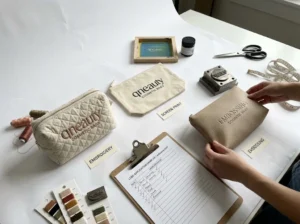
For support with construction, branding, and production planning, review Q&N Bags’ custom cosmetic bag manufacturing capabilities.
How to Choose the Right Hardware Finish
Gold, Rose Gold, Silver, Gunmetal, and Matte Black
Finish names are descriptive, not precise color specifications. “Light gold” from one plater may appear yellow, champagne, pale brass, or slightly pink. Approve a physical standard and record it with a supplier code, plated sample, and signed limit sample.
Shiny, Brushed, Antique, and Satin Finishes
Shiny finishes reflect defects easily but can create a luxury appearance. Brushed and satin finishes hide fingerprints and minor scratches better. Antique finishes intentionally include tonal variation, which must be defined so natural variation is not confused with poor consistency.
Matching Hardware With Zippers and Fabric Colors
Match the entire hardware family at the same time: slider, puller, rivet, ring, hook, buckle, and logo plate. These parts may come from different factories and use different base metals, so identical plating instructions may not produce identical visual results.
Preventing Color Differences Between Components
- Approve all components under neutral daylight and warm retail lighting.
- Place the parts beside the final fabric, not only on a white board.
- Define an acceptable shade range with physical limit samples.
- Ask whether the plating batch can be consolidated for the order.
- Inspect early production before the full quantity is assembled.
Research-based recommendation: salt spray testing under ISO 9227 is useful for identifying pores and discontinuities in metallic and coated surfaces, but the standard does not set one universal exposure time or pass criterion for every product. The buyer must define the duration and acceptable appearance for the intended market and use.
Reference: ISO 9227:2022 corrosion and salt spray testing.
How to Test Cosmetic Bag Hardware Quality
Pull Strength and Torque Testing
Pull testing evaluates whether a puller, rivet, ring, hook, handle base, or logo attachment separates under force. Torque testing is useful for parts that can rotate, unscrew, or loosen. The acceptance value should come from the product specification, intended use, and risk level rather than an arbitrary factory habit.
Test the complete assembly. A D-ring may be strong while the side tab tears. A logo plate may remain intact while its prongs cut the lining. Record the failure mode as well as the force.
Plating Adhesion and Corrosion Testing
Inspect for pits, bubbles, peeling, bare edges, contamination, and inconsistent tone. Adhesion may be screened through suitable tape, bend, or rub methods. Corrosion resistance can be evaluated through humidity, perspiration, or salt spray exposure.
Scratch and Abrasion Resistance
Hardware rubs against fabric, packaging, other metal parts, and retail fixtures. Conduct dry rubbing and contact simulation using the final bag. Pay special attention to mirror finishes, matte-black coatings, enamel fills, and logos positioned near folds.
Zipper Puller and Buckle Cycle Testing
Cycle testing reveals wear that one-time inspection misses. Operate the zipper through its full path and repeatedly use buckles and hooks. Check for jamming, plating wear, spring fatigue, deformation, sharp edges, and accidental opening.
| Test | What It Detects | Sample Evaluation | Buyer Must Define |
|---|---|---|---|
| Attachment pull | Detachment, fabric tearing, weak setting | Complete bag assembly | Force, direction, hold time, failure rule |
| Torque or rotation | Loose screws, spinning rivets, weak joints | Relevant hardware joint | Torque and allowed movement |
| Cycle test | Wear, jamming, fatigue | Zipper, buckle, hook | Number of cycles and pass criteria |
| Abrasion test | Finish wear and color transfer | Hardware against final material | Method, pressure, visual limit |
| Corrosion test | Plating pores, rust, discoloration | Finished components | Exposure condition and rating |
| Edge inspection | Burrs and sharp points | 100% visual/tactile check where required | Defect classification |
ISO 2859-1:2026 provides AQL-indexed sampling plans for lot-by-lot inspection. Use it with a defined defect list because a detached rivet or sharp edge requires a different classification from a slight finish variation.
Reference: ISO 2859-1:2026 acceptance sampling by attributes.
Expert view: final inspection alone is too late for custom hardware. Approve incoming components before sewing, conduct a first-production check after installation, and reserve final random inspection for confirming that the approved process remained stable.
Cosmetic Bag Hardware Approval Checklist
Confirming Dimensions and Attachment Methods
Create a hardware specification sheet for every component. Include part name, drawing, size, thickness, base material, finish, color code, weight where relevant, attachment method, supplier reference, and approved sample date.
Approving Finish and Logo Samples
Approve hardware beside the final fabric and zipper tape. For custom logos, compare the sample with the vector artwork and check spelling, spacing, relief, enamel color, edge quality, orientation, and position on the bag.
Reviewing Safety and Compliance Requirements
Define the destination market, age grading, and intended user before testing. In the United States, accessible components of children’s products must not contain more than 100 ppm total lead. Small detachable parts can also create choking hazards for products intended for young children. California Proposition 65 and EU REACH may add exposure, substance, or documentation considerations depending on the material and market.
CPSC total lead content guidance | California Proposition 65 overview | ECHA REACH restriction list
Inspecting Hardware During Mass Production
- Lock the golden sample. Keep one approved bag and one loose component set.
- Check incoming hardware. Verify dimensions, finish, quantity, burrs, and function before assembly.
- Approve the first production units. Confirm attachment pressure, position, backing, and appearance.
- Monitor the line. Inspect setting tools, protective handling, and defect trends.
- Run final inspection. Use the approved defect list and sampling plan.
- Retain records. Store test reports, component declarations, photos, and traceability information.
| Approval Stage | Required Evidence | Common Mistake |
|---|---|---|
| Design | Dimensioned drawings and load assumptions | Selecting by appearance only |
| Sampling | Physical finish and functional sample | Approving a digital rendering as the color standard |
| Compliance | Current reports for relevant components | Testing only the main fabric |
| Production | First-piece approval and process settings | Waiting until final inspection to find installation defects |
| Shipment | AQL report, carton protection, traceability | Allowing metal parts to rub during transport |
Real-World Case Study: Small Parts, Large Risk
Public recall records show how hardware decisions can create business and safety consequences.
- Bonne Bell cosmetics accessory bags, 2008: metal clasps on the handles contained excessive lead. The recall shows that a beauty accessory can create risk through hardware even when the cosmetic products themselves are not affected.
- Kelly Wynne children’s handbags, 2022: the zipper slider, O-ring, D-ring, rivet, and stud exceeded the federal lead-content ban. Multiple component types were implicated in one product.
- Primark plush bags, 2025: a detachable zipper pull created choking and ingestion hazards, leading to a recall of about 2,900 units.
The sourcing lesson is not that all metal hardware is dangerous. It is that component-level control matters. Brands should identify every accessible hardware part, confirm its supplier and material, test the appropriate risk, and verify that mass-production components match the approved sample.
Bonne Bell recall | Kelly Wynne recall | Primark recall
Frequently Asked Questions
What hardware is commonly used on cosmetic bags?
Common parts include zipper sliders and pullers, rivets, snaps, buckles, rings, hooks, adjusters, frames, and metal logo plates. Selection depends on bag weight, construction, user age, target price, and positioning.
Which zipper puller is best for a makeup bag?
Standard metal suits fast, cost-controlled development; custom metal strengthens premium branding. Fabric, PU, or webbing tabs suit soft styles, while molded pullers fit colorful collections. Always match the puller to the slider, zipper size, bag weight, and use.
Are metal buckles stronger than plastic buckles?
Not automatically. Strength depends on grade, geometry, wall thickness, quality, and load direction. A good engineering-plastic buckle may outperform a poor metal casting, so test the complete strap system.
How are metal logo plates attached to cosmetic bags?
They may be sewn, riveted, fixed with prongs, adhered, or heat-applied. Mechanical methods need reinforcement and backside protection; adhesives need compatibility and aging tests. Select the method with the outer material and lining.
Why do gold hardware parts sometimes look different?
Base metal, surface preparation, plating line, coating thickness, and batch can shift shade and gloss. Approve all components together with physical limit samples.
What tests should cosmetic bag hardware pass?
Relevant tests may include attachment pull, torque, repeated-use cycles, abrasion, plating adhesion, corrosion resistance, sharp-edge inspection, dimensional checks, and restricted-substance testing. The exact methods and pass criteria should be specified by the buyer according to use and market.
Does cosmetic bag hardware require CPSIA testing?
CPSIA requirements are especially relevant when the bag is classified as a children’s product. Accessible metal components may be subject to lead limits, and detachable small parts may require evaluation. Adult cosmetic bags are classified differently, but retailers may impose additional requirements. Confirm the age grading and test plan with an accredited laboratory.
Expert Recommendations and Future Trends
The strongest cosmetic bag hardware programs share four practices: component-level specifications, physical finish standards, assembly testing, and traceability. Buyers should avoid vague instructions such as “premium gold hardware.” A production-ready specification should identify the part, material, dimensions, finish reference, installation method, test requirement, and approved supplier sample.
Future development is moving toward lighter components, recycled metal claims supported by documentation, lower-impact plating, mono-material thinking, replaceable strap systems, tactile custom pullers, and quieter hardware for travel and wellness products. Digital prototyping will improve shape approval, but physical samples will remain essential for weight, movement, color, sound, and attachment evaluation.
Conclusion: Build Better Cosmetic Bag Hardware
Cosmetic bag hardware is where branding, usability, engineering, and compliance meet. Zipper pullers influence every opening action. Rivets and rings transfer load. Buckles define strap performance. Metal logos communicate quality before the customer touches the fabric.
Choose each component according to the finished bag, not as an isolated decoration. Approve physical samples, test the complete assembly, control every metal part in the bill of materials, and inspect hardware before and during production. This approach reduces finish mismatch, attachment failures, compliance gaps, and costly late-stage rework.
Ready to develop a custom cosmetic bag? Share your bag dimensions, target material, order quantity, logo method, hardware finish, packaging, and destination market with Q&N Bags to receive a practical construction and quotation recommendation.
Compliance note: This article provides general sourcing information and is not legal advice. Requirements vary by product classification, intended age group, destination market, retailer, and current regulation. Confirm the final test plan with an accredited laboratory or qualified compliance professional.
Aries Gu is the founder of Q&N. With over 17 years of experience in cosmetic bag OEM/ODM source factory. He focuses on quality control, efficient communication, and on-time delivery for global cosmetic bag projects.