Well-designed makeup bag compartments do more than keep beauty products tidy. They prevent bottles from tipping, protect powder palettes from impact, keep brush fibers clean, and help users find products without emptying the entire bag.
Poor internal organization creates predictable problems. Elastic loops may be too loose for slim tubes. Brush slots may be too narrow for large handles. A deep main compartment may hold many products but make smaller items difficult to retrieve. Removable dividers may look useful in a product rendering yet collapse when the bag is carried vertically.
These details matter in a large and increasingly competitive market. Statista projects worldwide beauty and personal care revenue of approximately US$698.38 billion in 2026. Grand View Research estimates that the global travel bag market will grow from about US$23.1 billion in 2026 to US$32.3 billion by 2030. As beauty routines become more portable, customers expect cosmetic bags to function as organized storage systems rather than simple zipper pouches.
Industry sources: Statista Beauty and Personal Care Market Outlook and Grand View Research Travel Bags Market Report.
This guide explains how beauty brands, importers, product developers, and sourcing teams can design compartments for brushes, bottles, palettes, tubes, jars, sponges, and makeup tools. It covers product measurement, divider systems, lining materials, construction risks, sample testing, and production approval.
Table of Contents
- Why Makeup Bag Compartments Matter
- Start With a Makeup Product Inventory
- How to Design Makeup Brush Compartments
- How to Design Bottle Compartments
- How to Design Palette Compartments
- Choosing the Right Internal Divider System
- Selecting Materials for Makeup Bag Compartments
- Creating a Practical Compartment Layout
- Real Case Study: Modular Professional Organization
- Testing Makeup Bag Compartments Before Production
- Frequently Asked Questions
- Expert Recommendations and Conclusion
Why Makeup Bag Compartments Matter
Improving Product Organization
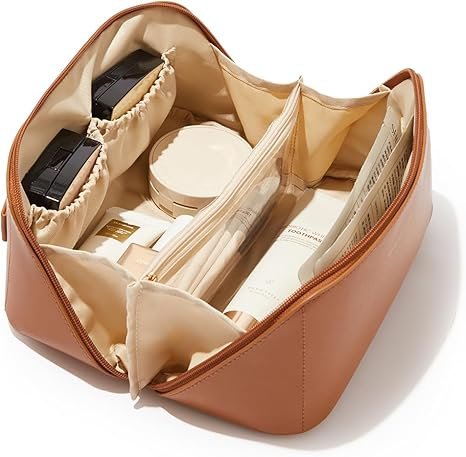
A large empty compartment provides maximum theoretical capacity, but it rarely provides the best user experience. Products settle into layers. Small items move below palettes. Brushes mix with liquid containers. Users must remove several products to reach one item at the bottom.
Effective makeup bag compartments divide the interior according to product shape, frequency of use, and risk. Frequently used items should remain visible and accessible. Fragile products need controlled movement. Liquid containers need upright support or separation from absorbent tools.
Expert recommendation: organize products by function before organizing them by size. A foundation bottle and setting spray may be similar in height, but their leakage risk and access frequency may be different.
Preventing Leakage and Product Damage
A leaking foundation bottle can contaminate brushes, fabrics, palettes, and labels. A broken pressed-powder palette can damage every other item in the bag. Internal separation limits the affected area when something fails.
Dividers also reduce impact. When a bag is dropped, products continue moving until they contact another product or the bag wall. Padded dividers, bottle loops, and fitted sleeves reduce this travel distance.
Making Products Easier to Access
Access depends on more than the number of pockets. Opening angle, pocket depth, contrast, transparency, and hand clearance all influence usability.
A pocket may technically fit a lipstick but still be difficult to use if the opening is hidden below the zipper line. A brush slot may hold the handle securely but require excessive force to remove it. A central divider may improve organization while blocking the view of products underneath it.
Matching Compartments to the Target Customer
| Target User | Typical Product Load | Recommended Compartment Strategy |
|---|---|---|
| Daily consumer | 5–12 essential products | Simple main compartment, one brush section, one small-item pocket |
| Frequent traveler | Travel bottles, skincare, makeup and tools | Upright loops, leak-resistant section, transparent pockets |
| Professional makeup artist | Multiple palettes, brushes, bottles and disposables | Modular pouches, removable dividers, high visibility |
| Beauty gift-set customer | Predetermined branded products | Product-specific fitted compartments or elastic holders |
| Premium skincare customer | Glass bottles, jars and treatment tools | Padding, structured dividers and soft lining |
The best layout is therefore not the layout with the most features. It is the layout that solves the target user’s most frequent storage problems with the least unnecessary complexity.
Start With a Makeup Product Inventory
Identifying the Products the Bag Must Hold
Compartment design should begin with physical products, not an exterior bag shape. Create an inventory of every item the finished bag is expected to carry.
Record the product category, dimensions, weight, closure type, fragility, leakage risk, and frequency of access. Include secondary items such as sharpeners, lash glue, tweezers, cotton pads, sponges, charging cables, or removable mirrors.
A phrase such as “holds a complete makeup collection” is too vague for production. A practical product list gives the designer measurable requirements.
Measuring Brushes, Bottles, Palettes, and Tools
Measure the maximum dimensions rather than the nominal product volume. A 100 ml bottle may have a larger pump, cap, or shoulder than another 100 ml bottle.
| Product | Measurements to Record | Additional Design Concern |
|---|---|---|
| Makeup brush | Total length, maximum handle diameter, ferrule width | Brush-head protection and handle retention |
| Bottle or tube | Height, maximum diameter, cap diameter | Leakage, upright stability and opening clearance |
| Palette | Length, width and closed thickness | Impact protection and removal clearance |
| Jar | Diameter, height and lid overhang | Weight concentration and stacking |
| Sponge or puff | Dry and expanded dimensions | Ventilation and hygiene |
| Beauty device | Full body dimensions, cable and attachment sizes | Impact protection and charging accessories |
Use actual products whenever possible. Digital dimensions from a website may not include caps, handles, protective sleeves, or manufacturing variation.
Separating Daily Essentials From Full Collections
A daily makeup bag usually benefits from fewer, more flexible compartments. A professional or full-collection case requires stronger segmentation and clearer product visibility.
Trying to serve both users with one internal layout often produces a compromise: too complicated for everyday use but not modular enough for professional work.
Allowing Space for Different Product Sizes
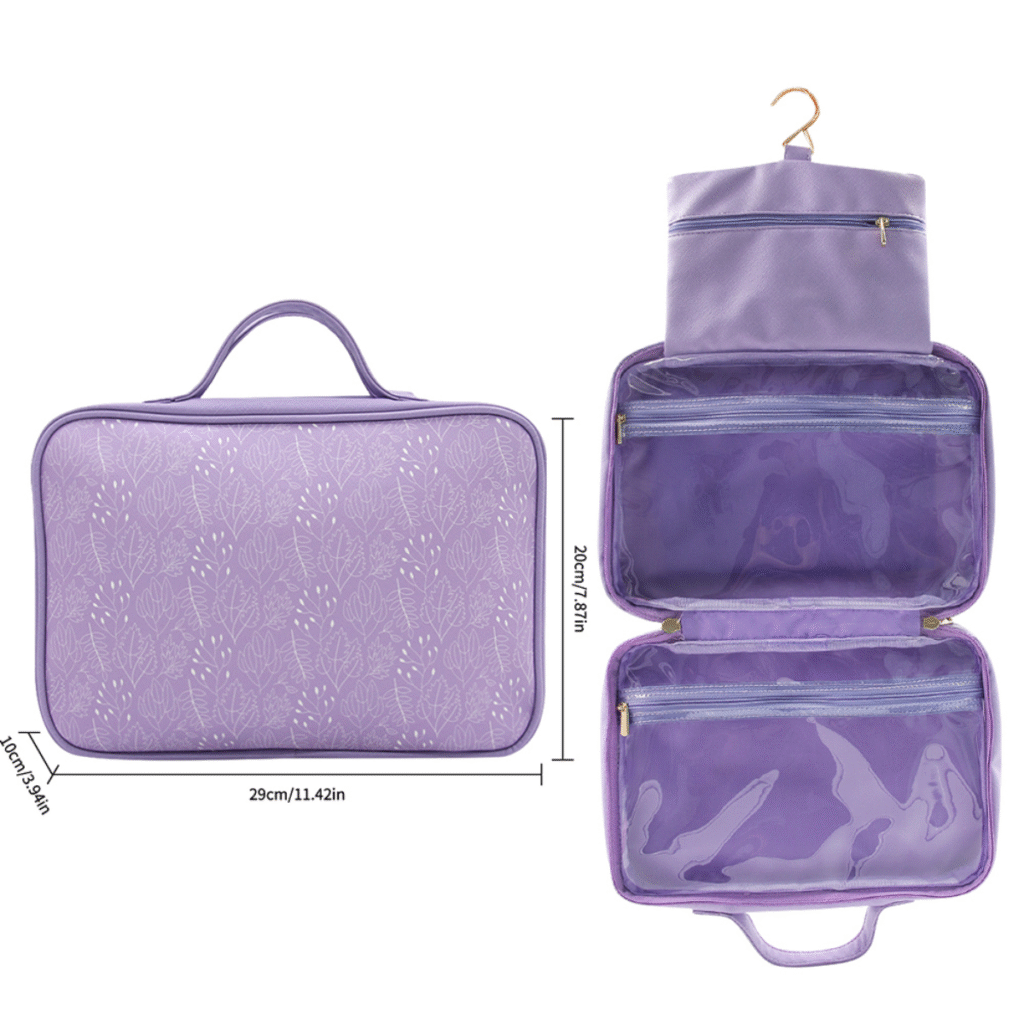
Do not make every compartment an exact fit unless the bag is sold with a fixed product set. Private-label beauty products may change packaging between seasons, suppliers, or markets.
As a development starting point, allow approximately 5–10 mm of retrieval clearance around rigid items. Padded compartments may require more space because the foam reduces usable interior dimensions. These figures are not universal standards and must be confirmed through fit testing.
How to Design Makeup Bag Compartments for Brushes
Individual Brush Slots vs Open Brush Pockets
Individual brush slots create order and help prevent handles from crossing. They are suitable for defined brush sets and premium kits. However, every slot consumes sewing space and limits flexibility.
An open brush pocket accommodates different brush quantities and handle sizes. It is faster to manufacture but provides less separation. Several brushes may lean together, and small brushes can fall below larger ones.
| Brush Storage Type | Advantages | Disadvantages | Best Use |
|---|---|---|---|
| Individual elastic slots | Clear organization and strong retention | More sewing operations; fixed sizes | Branded brush sets |
| Stitched fabric channels | Clean appearance and durable structure | Limited stretch | Uniform brush handles |
| Open brush pocket | Flexible capacity and lower cost | Less control and visibility | General consumer bags |
| Removable brush panel | Easy cleaning and workstation access | Higher material and assembly cost | Professional cases |
Choosing Elastic Width and Slot Spacing
Elastic must retain the handle without making removal difficult. Narrow elastic concentrates pressure and may twist. Wider elastic distributes pressure but occupies more wall height.
For early development, slim brush slots may begin around 20–30 mm wide, while wider tools may require 35–50 mm. These ranges are design starting points rather than fixed specifications.
Test the smallest and largest intended handles. The stretched elastic should recover after repeated use and should not pull the lining away from the outer panel.
Adding Protective Brush Covers
A fold-over brush cover separates brush fibers from other products. It also reduces powder transfer to the lining. The cover may use coated fabric, transparent TPU, soft polyester, or another wipe-clean material.
The cover should not compress long or fluffy brush heads. It must also fold without entering the zipper path.
Preventing Brush Handles From Falling Out
Brushes can escape when the bag is turned upside down or carried vertically. Common solutions include a top flap, a secondary elastic row, tapered channels, a zippered brush section, or a removable brush roll.
Real product example: MAKE UP FOR EVER’s Small Brush Pouch is designed to stand upright for easier access and zip into a more compact form for travel. The concept demonstrates how orientation and opening structure can improve brush access without relying only on additional slots.
View the MAKE UP FOR EVER Small Brush Pouch.
How to Design Makeup Bag Compartments for Bottles
Vertical Bottle Loops and Elastic Holders
Vertical loops reduce tipping and keep pumps or caps facing upward. They work best when the bag has enough height and a stable base.
Measure the largest bottle diameter at the point where the loop will contact it. The loop should provide controlled compression without activating a pump or deforming a soft tube.
A practical development method is to make the relaxed loop slightly smaller than the product circumference, then validate the compression through prototypes. The correct reduction depends on elastic construction, elongation, recovery, stitching, and product shape.
Adjustable Dividers for Different Bottle Diameters
Removable dividers serve collections containing several bottle sizes. A grid can be widened for jars and narrowed for travel tubes. However, divider walls must be stiff enough to remain upright.
Hook-and-loop attachment should extend far enough along the base and sidewalls to resist peeling. A short attachment patch may hold an empty divider but detach when a heavy bottle shifts during transport.
Waterproof Sections for Leak-Prone Products
A leak-resistant compartment should use a coated or film-based lining, limited seam penetration, and a suitable closure. Simply specifying a “waterproof fabric” does not make the finished section waterproof because liquid can pass through needle holes, zipper tape, binding seams, and corners.
For stronger containment, consider a removable transparent pouch, welded TPU section, coated zip pocket, or separate inner bag. Removable sections are also easier for the customer to clean.
Keeping Bottles Upright During Travel
TSA currently limits most liquids, aerosols, gels, creams, and pastes in carry-on baggage to containers of 3.4 ounces or 100 ml or less. A travel-focused cosmetic bag should therefore be tested with common travel-size bottles, not only full-size retail packaging.
Reference: TSA liquids, aerosols and gels rule.
- Place the tallest bottles near the bag’s structural walls.
- Position heavy jars near the base rather than in lid pockets.
- Separate pump bottles from hard palette edges.
- Leave enough headroom for caps and dispensers.
- Test the bag upright, flat, tilted and upside down.
Expert recommendation: bottle retention should be tested with both full and partially empty containers. A full bottle is heavier, while a nearly empty bottle may be more likely to slip from a loose elastic loop.
How to Design Makeup Palette Compartments
Flat Sleeves for Eyeshadow and Face Palettes
A flat sleeve keeps palettes against the lid, base, or sidewall and prevents them from occupying the center of the bag. The opening should be wide enough for easy removal without allowing the palette to fall out when the bag is vertical.
Shallow sleeves provide visibility. Deep sleeves provide stronger retention but can hide small palettes. A finger cutout, pull tab, transparent panel, or stepped pocket can improve access.
Padded Dividers for Fragile Powder Products
Pressed powders are vulnerable to shock and direct point pressure. A thin foam or batting layer can reduce contact impact, but excessive padding reduces capacity and may force the palette against the zipper.
Protect the corners as well as the large flat surfaces. Palette damage often begins when one corner contacts a hard bottle, metal component, or rigid case wall.
Accommodating Different Palette Thicknesses
One sleeve rarely fits every product equally well. Thin palettes can move inside a deep pocket, while thick palettes stretch the opening and place stress on the stitching.
Elastic-edged sleeves, gusseted pockets, removable dividers, and layered pockets can accommodate a wider range. For a fixed beauty gift set, a more precise fit may be preferable because the dimensions are known.
Preventing Palettes From Moving Inside the Bag
| Retention Method | Protection Level | Flexibility | Production Complexity |
|---|---|---|---|
| Open flat sleeve | Low to moderate | High | Low |
| Elastic-top sleeve | Moderate | High | Low to moderate |
| Padded zip pocket | High | Moderate | Moderate |
| Fitted foam cavity | Very high | Low | High |
| Removable padded divider | Moderate to high | Very high | Moderate to high |
When testing palette storage, load the bag with bottles and tools as well. An empty sleeve may perform well until the neighboring compartment is filled and pushes against it.
Choosing the Right Internal Divider System
Fixed Sewn Dividers
Fixed dividers provide predictable positioning and a clean interior. They are appropriate when the product assortment is stable. They also avoid loose components that customers may remove or lose.
The main disadvantage is inflexibility. If the brand later changes bottle dimensions, the entire internal pattern may need revision.
Removable Hook-and-Loop Dividers
Removable dividers let the customer adapt the bag to different routines. They work particularly well in professional cases and larger vanity bags.
The divider core may use PE board, EVA, foam, felt, or another semi-rigid material. The covering fabric should resist repeated attachment and removal. Hook tape should not face delicate packaging or brush fibers.
Elastic Mesh Pockets
Elastic mesh pockets offer visibility and flexible capacity. They are effective for tubes, sponges, cotton products, cables, and small tools.
Mesh selection should account for snagging, transparency, stretch recovery, and edge finishing. A pocket that stretches easily during sampling may remain permanently distorted after carrying heavy products.
Zippered and Transparent Compartments
Zippered pockets secure small items when the bag changes orientation. Transparent PVC or TPU helps users identify contents without opening every section.
Transparent materials should be checked for cold cracking, cloudiness, odor, surface scratches, and interaction with printed packaging. TPU is often selected for a softer and more flexible feel, while PVC may offer lower material cost and strong clarity depending on specification.
| Divider System | Pros | Cons | Recommended User |
|---|---|---|---|
| Fixed sewn | Stable, clean and cost-efficient | Cannot adapt to product changes | Daily users and fixed gift sets |
| Removable dividers | Highly configurable | More parts and greater development complexity | Professionals and large collections |
| Mesh pockets | Visible, lightweight and flexible | Limited impact protection | Travel and general organization |
| Transparent zip pockets | Secure and easy to identify | Added zipper cost and material-folding issues | Small items and leak-prone products |
Selecting Materials for Makeup Bag Compartments
Polyester and Nylon Linings
Polyester is widely used because it is available in many weights, colors, textures, and price levels. Nylon can provide a smoother or more technical appearance and may offer strong abrasion performance depending on construction.
Neither fiber name alone guarantees cleanability or water resistance. Review fabric density, coating, finish, colorfastness, seam behavior, and compatibility with the outer material.
PVC, TPU, and PEVA Leak-Resistant Linings
Film and coated materials are useful for sections exposed to liquids. PVC can provide clarity and structure. TPU is often softer and more flexible. PEVA is commonly considered for wipe-clean linings and promotional products.
The correct material depends on target cost, required transparency, feel, temperature conditions, restricted-substance requirements, and sewing or welding method.
Mesh for Visibility and Ventilation
Mesh can improve visibility and airflow around sponges, puffs, and brushes. It should not be treated as a hygiene solution by itself. Damp products still need cleaning and adequate drying.
Fine mesh supports smaller items, while larger openings provide more ventilation but may catch brush handles, jewelry, or caps.
Foam and Batting for Impact Protection
EVA, EPE, polyurethane foam, polyester batting, and felt may be used to cushion compartments. Density is as important as thickness. A thick, soft foam may compress completely under load, while a thinner, denser layer may provide better structure.
| Material | Visibility | Cleanability | Impact Protection | Typical Application |
|---|---|---|---|---|
| Polyester lining | Low | Moderate | Low without padding | General internal construction |
| Nylon lining | Low | Moderate to high | Low without padding | Premium and technical bags |
| Transparent TPU or PVC | High | High | Low | Visible and leak-resistant pockets |
| Mesh | High | Moderate | Low | Brushes, tools and ventilated storage |
| Foam-laminated fabric | Low | Depends on face fabric | Moderate to high | Palette and bottle dividers |
Expert view: specify the complete material structure rather than requesting a “waterproof lining” or “padded divider.” The specification should identify the face fabric, coating or film, padding type, thickness, backing, edge finish, and seam construction.
Creating a Practical Makeup Bag Compartment Layout
Balancing Capacity and Accessibility
Every pocket and divider consumes space. A bag with many internal features can hold fewer products than a simpler bag with the same exterior dimensions.
Calculate usable internal space after accounting for seam allowances, padding, binding, divider thickness, zipper tape, and curved corners. Exterior dimensions should never be treated as usable interior dimensions.
Avoiding Excessive Dividers
More compartments are not automatically better. Excessive segmentation makes the bag heavier, more expensive, and less adaptable. It also increases sewing operations and potential defects.
Prioritize the products that genuinely need control: fragile palettes, liquid bottles, long brushes, and small items that are easily lost.
Using the Lid, Sidewalls, and Base Efficiently
The lid is suitable for lightweight brush panels, flat palettes, and mesh pockets. Sidewalls can support elastic loops or narrow sleeves. The base should carry the heaviest products.
Avoid placing heavy bottles in a lid pocket unless the lid and hinges are reinforced. Otherwise, the loaded lid may pull the bag backward or cause it to collapse when open.
Maintaining the Bag’s Shape When Fully Loaded
The finished bag should remain stable when filled unevenly. Test whether it stands upright, whether the zipper closes without excessive force, and whether the walls bulge around rigid products.
- Position heavy products near the center of the base.
- Place frequently accessed items near the opening.
- Keep fragile palettes away from hard bottles.
- Use transparent pockets for small miscellaneous products.
- Reserve one flexible area for items not included in the original inventory.
- Confirm that the zipper path remains clear when every section is full.
Case Study: Modular Professional Organization
MAKE UP FOR EVER’s Professional Bag provides a useful public example of user-centered compartment design. The bag includes six removable mesh pouches in different sizes. The pouches attach using hook-and-loop material and can be removed for quick access.
This design addresses several professional-user problems:
- Different jobs require different product combinations.
- Artists need to see product categories quickly.
- Individual sections may need to be moved to a workstation.
- A single permanently divided interior would limit flexibility.
The lesson for private-label development is not to copy the product. It is to understand why the modular structure matches the user. A professional artist benefits from removable modules because the product load changes between assignments. A consumer carrying six daily essentials may find the same system unnecessarily complex.
View the MAKE UP FOR EVER Professional Bag case study.
| Observed Design Decision | User Problem Addressed | Private-Label Development Lesson |
|---|---|---|
| Six different pouch sizes | Products vary greatly in dimensions | Do not make every module identical |
| Mesh construction | Users need quick product identification | Visibility can reduce retrieval time |
| Removable attachment | Workstation needs change by job | Modularity suits variable product inventories |
| Separate closed pouches | Small products can become mixed or lost | Containment may matter more than maximum capacity |
Testing Makeup Bag Compartments Before Production
Conducting Product Fit Tests
Load the sample with the exact products listed in the design brief. Include the smallest, largest, heaviest, and most fragile items.
Record whether each item enters and exits easily, whether elastic holders provide enough retention, and whether pockets deform neighboring compartments.
Do not test each section in isolation. A bottle loop may work correctly until a full palette sleeve pushes against it from the opposite wall.
Testing the Bag in Open and Closed Positions
Open the bag on a flat table, bathroom counter, hanging hook, lap, and narrow shelf where relevant. Then close it fully loaded.
Look for zipper strain, trapped brush fibers, folded pocket edges, excessive bulging, and products contacting each other. Turn the closed bag through different orientations and reopen it to check movement.
Checking Elastic Recovery and Pocket Strength
Stretch every elastic loop repeatedly using the largest intended product. Leave products installed for a defined period, remove them, and measure whether the elastic returns to an acceptable size.
Apply load to pockets and dividers in the direction they will experience during use. Inspect stitching, bartacks, seam allowance, lining distortion, and attachment peeling.
Approving a Pre-Production Sample
The pre-production sample should use the actual bulk materials, padding, elastic, mesh, hook-and-loop tape, lining, and hardware. A sample made with substitute materials cannot fully confirm capacity or performance.
| Test | Method | Common Failure | Approval Question |
|---|---|---|---|
| Product fit | Load all intended products | Pockets become too tight when adjacent areas are filled | Can every item be inserted and removed normally? |
| Orientation | Carry upright, flat and inverted | Brushes or bottles escape from holders | Do products remain in their intended sections? |
| Closure | Close the fully loaded bag repeatedly | Zipper catches the lining or brush cover | Can the bag close without force or obstruction? |
| Elastic recovery | Repeated stretching and dwell testing | Loops remain permanently enlarged | Does retention remain acceptable after use? |
| Pocket strength | Apply load in expected directions | Mesh tears or seams open | Does the pocket support the specified product weight? |
| Controlled drop | Drop a fully loaded sample using recorded conditions | Palettes crack or dividers collapse | Are products protected under the agreed test conditions? |
ISO 2248 describes a controlled method for vertically dropping a complete filled transport package onto a rigid impact surface. It is a packaging standard rather than a cosmetic bag performance specification, but its underlying discipline is valuable: define the fill, orientation, height, surface, conditioning, and acceptance criteria before testing.
Reference: ISO 2248 vertical impact test by dropping.
Expert recommendation: retain one signed golden sample and a product-loading diagram. Without a defined loading method, the factory and buyer may evaluate the same bag using completely different product arrangements.
Frequently Asked Questions
What compartments should a makeup bag have?
A practical consumer makeup bag normally needs a main storage area, a small-item pocket, and a brush or tool section. Travel bags may also require upright bottle holders and a leak-resistant pocket. Professional cases benefit from removable dividers or modular pouches.
How wide should makeup brush slots be?
There is no universal width because brush handles vary. Slim-slot development may begin around 20–30 mm, while thicker handles or multi-brush sections may need 35–50 mm. Test the actual smallest and largest brushes before approving production.
How do you keep bottles upright in a makeup bag?
Use elastic loops, fitted sleeves, adjustable dividers, or a structured bottle grid. Place heavy bottles near the base and provide enough vertical clearance for caps and pumps. The bag itself must also have a stable base.
What is the best lining for makeup bag compartments?
Polyester and nylon work well for general-purpose interiors. TPU, PVC, coated fabric, and PEVA may be suitable for wipe-clean or leak-resistant sections. The best option depends on the required feel, price, cleanability, sewing method, market, and compliance requirements.
Are removable dividers better than fixed dividers?
Removable dividers provide flexibility and suit professional or changing product collections. Fixed dividers are usually cleaner, simpler, and more stable. The best choice depends on whether the intended product inventory will remain consistent.
How can palettes be protected inside a makeup bag?
Use padded sleeves, soft divider walls, elastic retention, or fitted cavities. Keep palettes away from hard bottles and metal components. Test the fully loaded bag because pressure from neighboring products can reduce protection.
How should a compartment design be tested?
Use the final products and bulk materials. Conduct fit, access, closure, orientation, elastic-recovery, pocket-strength, and controlled-drop tests. Approve a pre-production sample and retain a loading diagram for quality inspection.
Expert Recommendations and Future Trends
Successful makeup bag compartments begin with a clear product inventory. Measure the products, identify their risks, and decide which items require retention, padding, visibility, or liquid separation.
Do not add internal features simply to make the specification appear more premium. Every divider, elastic loop, mesh pocket, and zipper should solve a defined user problem. Unnecessary compartments reduce usable volume, increase cost, and create additional production risks.
Future cosmetic bag interiors will become more modular. Brands are increasingly exploring removable pouches, interchangeable divider panels, transparent TPU sections, washable components, adjustable elastic systems, and layouts that accommodate both travel-size and full-size products.
Sustainability will also influence compartment design. Instead of combining many permanently bonded materials, development teams may prioritize removable structures, fewer material types, repairable components, and liners that can be cleaned rather than replaced.
The final design should balance four requirements:
- Fit: every intended product can be stored without excessive force.
- Access: users can find and remove products quickly.
- Protection: liquids, palettes, brushes, and tools remain separated where necessary.
- Manufacturability: the design can be sewn and inspected consistently at the target order quantity.
For custom development, send your intended product list, maximum product dimensions, target bag size, preferred materials, logo artwork, order quantity, and destination market to an experienced cosmetic bag manufacturer.
Need help developing a compartment layout? Visit Q&N Bags to discuss custom brush slots, bottle holders, palette protection, removable dividers, lining materials, samples, and bulk cosmetic bag production.
Manufacturing note: Measurements and construction ranges in this guide are development starting points, not universal standards. Final dimensions, materials, test methods, and acceptance criteria should be confirmed using actual products and an approved pre-production sample.
Aries Gu is the founder of Q&N. With over 17 years of experience in cosmetic bag OEM/ODM source factory. He focuses on quality control, efficient communication, and on-time delivery for global cosmetic bag projects.