A waffle cosmetic bag can look simple, but developing one for a beauty launch requires more than choosing a textured fabric and adding a logo. The fabric must hold its shape, the lining must protect against product leakage, the color must remain consistent across production, and every trim must support the brand’s visual identity.
These decisions matter especially for clean beauty, skincare, spa and wellness brands. A soft waffle texture can communicate comfort and understated quality, but only when construction, branding and sourcing details are correctly specified.
Table of Contents
- What Is a Waffle Cosmetic Bag?
- Why Clean Beauty Brands Choose Waffle Cosmetic Bags
- Best Uses for Waffle Cosmetic Bags
- Waffle Fabric Options for Custom Cosmetic Bags
- How to Design a Custom Waffle Cosmetic Bag
- Branding Options for Waffle Cosmetic Bags
- Production Considerations
- How to Source Waffle Cosmetic Bags
- Is This Bag Right for Your Brand?
- Frequently Asked Questions
- Expert Recommendations and Conclusion
What Is a Waffle Cosmetic Bag?
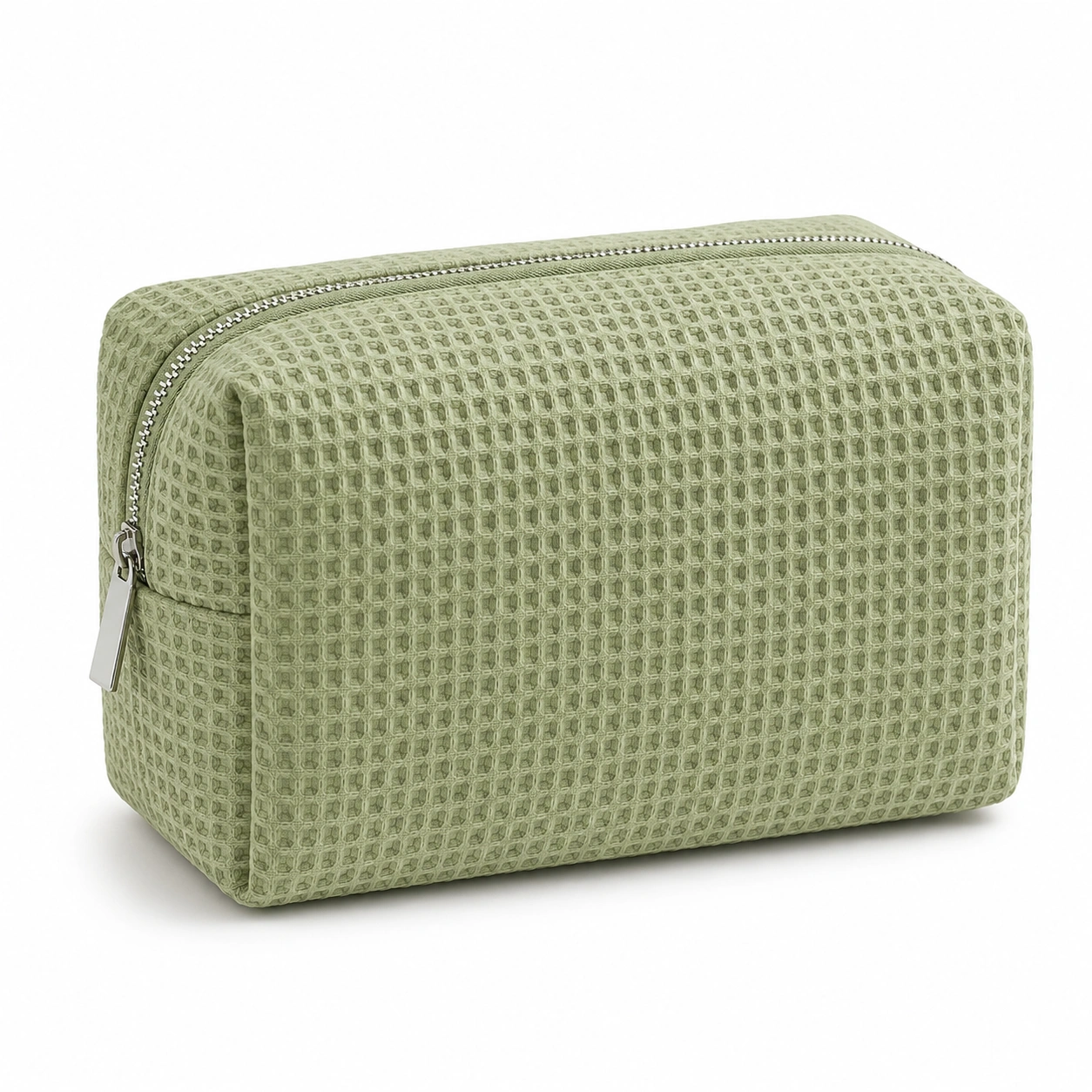
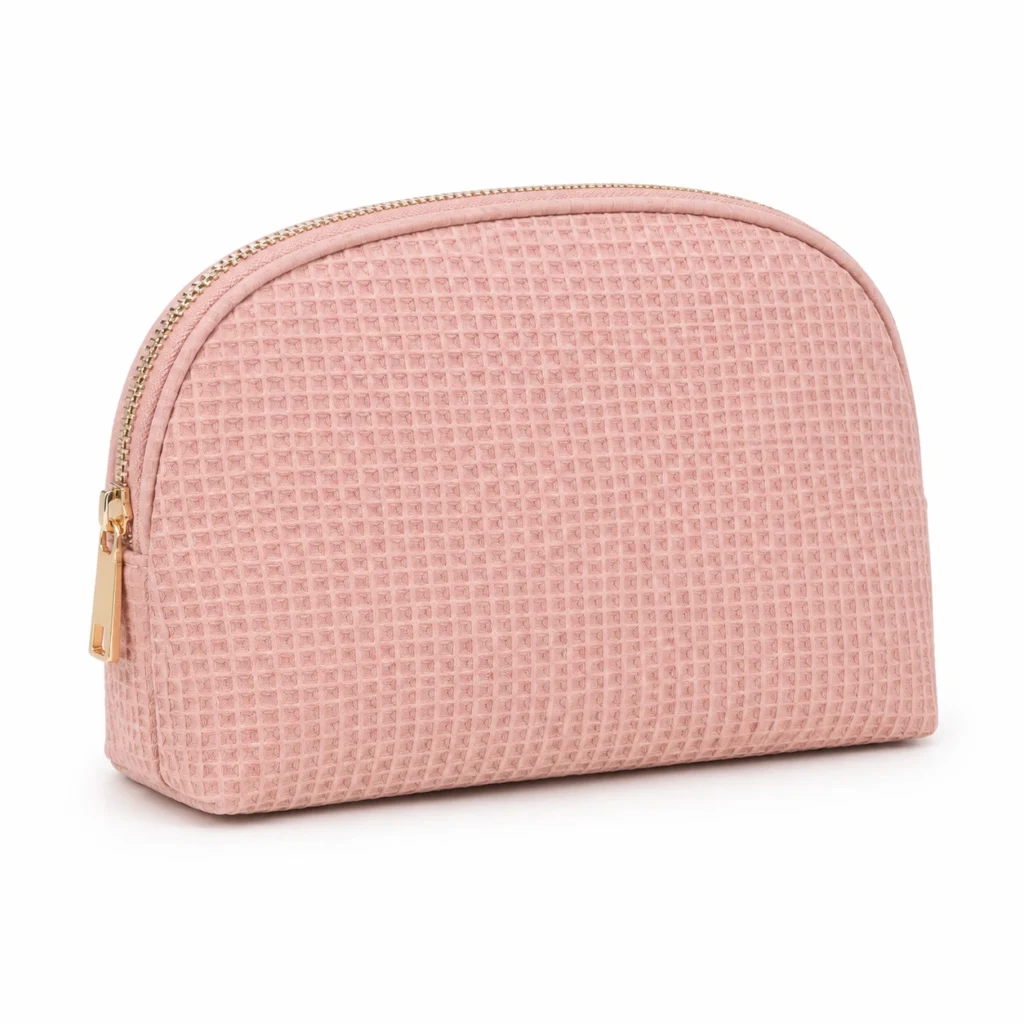
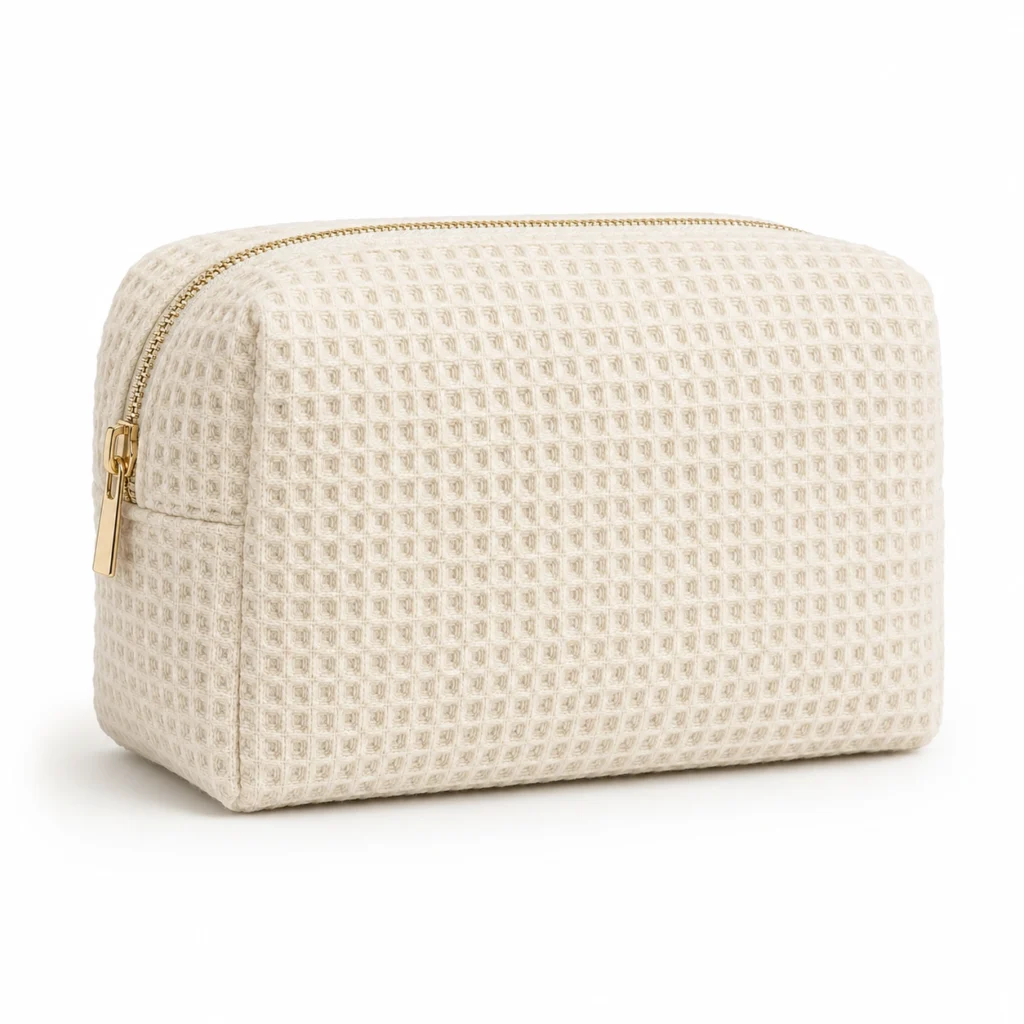
A waffle cosmetic bag is a sewn beauty pouch made from fabric with a raised square, honeycomb or grid-like surface. The texture is created through the fabric construction or finishing process rather than by printing a flat pattern. This gives the material a tactile appearance that photographs well and feels softer than many coated or smooth fabrics.
Waffle Fabric Structure and Texture
Woven or knitted waffle structures create alternating raised and recessed areas. Yarn size, density and finishing determine whether the surface appears delicate or thick and spa-like.
For cosmetic bags, the visual texture is only one consideration. The fabric must also tolerate cutting, sewing, logo application and repeated handling. A very open waffle construction may stretch or distort around seams. A dense construction is usually easier to stabilize, but it can increase weight and cost. The correct choice depends on the bag shape, finished size and intended retail price.
Common Materials Used in Waffle Cosmetic Bags
Common options include cotton, polyester and blends. Cotton offers a natural hand feel; polyester generally provides better dimensional stability and color consistency. Recycled polyester may be suitable when documentation matches the actual order.
Some buyers use “waffle fabric” as a broad visual description. Before sampling, confirm whether the reference is a true woven waffle, a knitted thermal texture, a quilted grid, an embossed surface or a jacquard imitation. These constructions behave differently during production.
Waffle Cosmetic Bags vs. Standard Fabric Pouches
| Feature | Waffle Fabric Pouch | Standard Flat Fabric Pouch |
|---|---|---|
| Visual character | Textured, soft and lifestyle-oriented | Clean, smooth and highly versatile |
| Logo performance | Best with embroidery, woven labels or patches | Suitable for printing, embroidery and labels |
| Shape control | May require lining, interfacing or padding | Usually easier to stabilize |
| Care requirements | Depends strongly on fiber and finish | Often simpler for coated polyester or nylon |
| Brand positioning | Ideal for spa, clean beauty, gifting and home rituals | Suitable for mass retail, travel, fashion and promotions |
Expert view: choose waffle fabric because the texture supports the product story, not because it is currently fashionable. If the collection is built around clinical precision, high-gloss color cosmetics or heavy travel use, a smooth nylon, coated fabric or structured case may communicate the concept more effectively.
Why Clean Beauty Brands Choose Waffle Cosmetic Bags
The clean beauty category is expanding, but it is also becoming more competitive. Grand View Research valued the global clean beauty market at USD 10.49 billion in 2025 and projects it to reach USD 35.30 billion by 2033. At the same time, reusable packaging is becoming a larger commercial category, with the global reusable packaging market projected to grow from USD 135.8 billion in 2024 to USD 190.1 billion by 2030.
Source: Grand View Research clean beauty market report and reusable packaging market report.
Natural and Minimalist Visual Appeal
Waffle fabric has an uncoated, textile-led appearance that works naturally with muted palettes, botanical graphics, simple typography and restrained logos. It can help a brand move away from disposable-looking presentation without forcing the design into a rustic aesthetic.
Controlled simplicity usually works best: one main color, a coordinated lining, a clean zipper and one clear branding method.
Soft Texture and Premium Brand Positioning
A raised waffle surface reinforces sensory language used by skincare and wellness brands: soft, calming and ritual-based. This is useful for spas, boutique retail and direct-to-consumer gift sets.
Softness alone does not equal quality. Uneven cells, distorted seams or a weak lining can quickly reduce the premium impression.
Compatibility with Sustainable Beauty Packaging
A reusable fabric pouch can support a lower-waste gifting strategy because the customer may continue using it after the original products are finished. It should not automatically be described as “sustainable,” “green” or “eco-friendly.” The US Federal Trade Commission advises marketers to avoid broad environmental benefit claims that cannot be substantiated and to state specific, qualified benefits instead.
For example, “made with 50% recycled polyester verified for this production batch” is more defensible than “planet-friendly bag.” Likewise, “designed for repeated storage use” is more precise than claiming that the accessory eliminates waste.
See the FTC summary of the Green Guides before finalizing environmental copy for the US market.
Strong Social Media and Retail Presentation
Waffle texture creates visible depth under soft studio lighting and in lifestyle photography. It can help neutral or monochrome bags remain visually interesting without large graphics. For retail, the pouch can also function as part of the bundle rather than merely containing it.
Real-World Case Study: Reusable Bags as Part of Beauty Value
Marks & Spencer has sold curated beauty edits inside a reusable bag, while Pai Skincare has explained the sourcing behind its certified organic cotton gift pouches. These examples show how a useful accessory and credible material story can strengthen gift presentation.
References: M&S reusable beauty bag and Pai Skincare gift pouch sourcing story.
Commercial lesson: the bag should be designed as a usable product with its own material, dimensions and care information—not treated as an afterthought added at the end of the gift-set project.
Best Uses for a Waffle Cosmetic Bag
Skincare Gift Sets
A medium zip pouch can hold a cleanser, serum, moisturizer and small accessory while presenting the set as one complete routine. For glass bottles, add a soft lining or light padding and check that the base depth prevents products from pressing against the zipper.
Spa and Wellness Kits
Waffle fabric naturally connects with towels, robes and treatment-room textiles. It is well suited to spa welcome kits, sleep sets, facial tools and hotel wellness programs. In these applications, quiet colors and washable linings are usually more valuable than complicated hardware.
Gift-with-Purchase Campaigns
A gift-with-purchase bag must balance perceived value with cost. Flat pouches reduce packing volume, while boxy designs offer more capacity. Calculate the landed cost of the complete set, not only the bag price.
Travel and Everyday Beauty Storage
For regular travel, the interior should manage spills. A cotton outer with a wipe-clean polyester lining is often more practical than an unlined cotton bag. Add a pull tab, wider opening or internal pocket only when these features improve actual use.
| Use Case | Recommended Shape | Suggested Construction | Main Buying Priority |
|---|---|---|---|
| Skincare launch set | Boxy or wide-base pouch | Lining plus light interfacing | Product fit and presentation |
| Spa welcome kit | Soft flat pouch | Cotton waffle with simple lining | Tactile brand experience |
| Gift with purchase | Flat or half-moon pouch | Cost-controlled polyester waffle | Perceived value at target cost |
| Travel retail set | Structured rectangular bag | Interfacing, lining and reinforced seams | Durability and capacity |
| Subscription box | Compressible flat pouch | Lightweight fabric and minimal hardware | Shipping efficiency |
Waffle Fabric Options for Custom Cosmetic Bags
Cotton Waffle Fabric
Cotton offers a soft, matte surface and familiar textile story, but it may shrink, wrinkle or change dimensions after wet processing and laundering.
Cotton Incorporated notes that dimensional stability is influenced by fiber, yarn, construction, wet processing, finishing, sewing and care conditions. For bag development, this means the factory should test the actual fabric and finished construction rather than relying on a generic statement that “cotton shrinks.”
Technical reference: CottonWorks guidance on shrinkage and skewing.
Polyester Waffle Fabric
Polyester suits programs prioritizing color repeatability, lower shrinkage risk and easier care. Hand feel varies, so approve physical swatches rather than photos alone.
Recycled Waffle Fabric
Recycled polyester can support a more specific material claim when the recycled content and chain-of-custody documents match the actual order. Ask whether documentation covers the yarn, finished fabric or complete product, and verify the percentage of recycled content. A certificate logo should not be applied without confirming authorization and scope.
Lightweight vs. Heavyweight Waffle Materials
| Material Option | Strengths | Limitations | Best Application |
|---|---|---|---|
| Light cotton waffle | Soft, natural appearance, easy to fold | May need stabilization; can wrinkle | Small pouches and spa sets |
| Heavy cotton waffle | Rich texture and stronger tactile value | Higher weight, cost and packing volume | Premium retail gift bags |
| Polyester waffle | Stable, scalable and color-consistent | May feel less natural if poorly specified | GWP and high-volume programs |
| Recycled polyester waffle | Supports verified recycled-content programs | Documentation, color and MOQ must be checked | Brand collections with material targets |
| Blended waffle | Balances hand feel and stability | Fiber claims and care instructions are more complex | Everyday cosmetic pouches |
Selection rule: approve fabric by touch, cell size, weight, color, backing and sewing performance. A fabric that looks ideal as a flat swatch may lose definition after adding interfacing or may stretch around a curved bag panel.
How to Design a Custom Waffle Cosmetic Bag
Choosing the Right Bag Shape
Begin with the products the bag must hold. Record bottle dimensions and quantity, then add clearance for loading, lining and seams. Flat pouches suit samples; gusseted or boxy bags suit bottles and complete routines.
Selecting Lining and Padding
The lining determines spill performance. Options include plain or printed polyester, coated fabric and soft brushed materials. Light interfacing improves shape; foam adds padding but increases sewing difficulty and freight volume.
Ask for the lining to be secured at critical seams so it does not pull out when users remove products. For pale outer colors, test whether a dark lining or adhesive backing changes the visible shade.
Matching Zippers, Handles and Trims
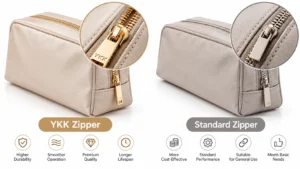
Coordinate zipper tape, teeth, slider, puller, labels and stitching under the same light. Nylon coil zippers are light and flexible; metal-look teeth add visual value but increase cost and weight.
Choosing Natural and Clean Beauty Colors
Warm cream, oatmeal, sage, clay, muted rose and mineral blue are common directions, but clean beauty does not require beige. The better approach is to choose a palette connected to the formula, ingredients, campaign photography and retail environment.
Color approval should be made on the final waffle construction. Raised and recessed areas reflect light differently, so the same dye can look deeper than it appears on flat fabric.
Five-Step Design Process
- Define the use: retail product, gift set, GWP, subscription box or travel accessory.
- Confirm contents: provide product dimensions, weights and arrangement.
- Select construction: fabric, lining, interfacing, zipper and internal organization.
- Place branding: choose a method suited to the textured surface.
- Prototype and test: check capacity, seam appearance, logo clarity, color and packaging fit.
For more structure ideas, review Q&N’s custom cosmetic bag product categories or explore the company’s private label cosmetic bag development guide.
Branding Options for Waffle Cosmetic Bags
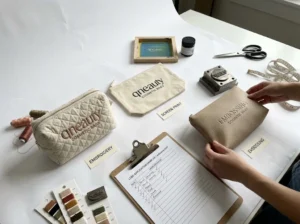
Embroidered Logos
Embroidery integrates naturally with raised cells. Use simplified artwork, controlled stitch density and adequate backing; avoid tiny text and gradients.
Woven Labels
A woven label provides sharp detail without printing on an uneven surface. It may be inserted into a seam or stitched onto the front; confirm dimensions before cutting.
Cotton Printed Labels
Printed cotton labels support a natural, handcrafted look and can include care information or a short brand message. They are less suitable when the brand needs metallic effects, extremely small detail or a glossy luxury finish.
Debossed PU Logo Patches
A PU patch creates contrast and improves logo clarity. Do not describe a mixed-material bag as fully natural or plastic-free when it includes synthetic patches, lining, zipper tape or foam.
| Logo Method | Detail Level | Effect on Waffle Texture | Best For |
|---|---|---|---|
| Embroidery | Medium | Integrates with fabric; may flatten cells locally | Premium textile branding |
| Woven label | High | Preserves the main surface | Minimalist and scalable programs |
| Printed cotton label | Medium to high | Adds a natural visual layer | Wellness and artisan positioning |
| PU patch | Medium | Creates clear contrast | Contemporary premium collections |
| Screen print | Variable | Can break across recessed cells | Large, simple artwork after testing |
Production Considerations for Waffle Cosmetic Bags
Fabric Shrinkage and Shape Control
For cotton-rich materials, ask the supplier how the fabric is finished and whether pre-production dimensional testing is available. The approved pattern should be based on the production fabric, not an unrelated stock material. If the bag is marketed as washable, laundering tests should be agreed before care instructions are printed.
Seam Strength and Edge Finishing
The raised surface can make seam lines appear uneven even when the stitching is technically straight. Review the sample at zipper ends, gusset corners, handle attachments and label insertion points. Reinforcement should be added where users repeatedly pull or load the bag.
Color Consistency Between Production Batches
Custom-dyed fabric may vary between dye lots. Approve a color standard under controlled light and state the acceptable tolerance before bulk production. Order enough fabric for the complete program when several deliveries must match closely.
MOQ, Sampling and Lead Time
MOQ depends on fabric availability, custom dyeing, logo method, bag structure and packaging. As a practical planning baseline for a fully customized program, many factory projects begin around 1,000 pieces per style and color. Sampling commonly requires about 7–14 days, while bulk production may require roughly 30–45 days after final sample approval. Custom hardware, lab testing, certified fabric sourcing or complex embroidery can extend the schedule.
These ranges are not universal quotations. A reliable supplier should confirm timing only after reviewing the specification, quantity, delivery destination and required arrival date.
Pre-Production Quality Checklist
- Approved fabric swatch, weight, fiber content and color reference
- Confirmed finished measurements and tolerances
- Product-fit test using actual bottles or accurate mock-ups
- Logo size, position, thread or label color approval
- Zipper operation and pull-strength review
- Lining attachment, seam finish and loose-thread standard
- Individual packaging, carton quantity and shipping marks
- Required test reports or material documentation
How to Source Waffle Cosmetic Bags for Your Brand
Prepare Product Specifications
A useful RFQ includes a reference image, finished dimensions, target quantity, preferred material, color, logo file, lining, zipper, packaging, destination and required arrival date. State whether the measurements are flexible and whether the supplier may propose cost-saving alternatives.
Request Material and Color Samples
Photos cannot reliably communicate softness, cell depth, fabric density or color under different lighting. Request swatches when the tactile quality is central to the brand concept. For custom colors, decide whether approval will use Pantone FHI, a physical product sample or another agreed standard.
Approve the Pre-Production Sample
Do not approve only the exterior appearance. Load the intended products, open and close the zipper repeatedly, inspect the lining, measure the bag and place it inside the final gift box or shipping carton. Record every approved detail in a sample confirmation sheet.
Confirm Packaging and Quality Standards
Packaging affects cost and freight. Confirm polybags, sleeves, hangtags, barcode labels, gift boxes and inspection standards before production begins.
| RFQ Item | Information to Provide | Why It Matters |
|---|---|---|
| Bag reference | Photo, sketch or existing sample | Clarifies shape and construction |
| Finished size | Length × height × depth | Controls capacity and material usage |
| Quantity | Units per design and color | Determines production method and price |
| Branding | Vector logo and preferred method | Allows accurate sampling and costing |
| Delivery requirement | Destination and required arrival date | Prevents unrealistic production plans |
| Compliance | Market, tests and documentation needed | Confirms feasibility before ordering |
Develop a Custom Waffle Cosmetic Bag with Q&N
Q&N supports beauty brands, retailers and private label buyers with material selection, sampling, logo development, bulk production and packaging coordination. To receive a workable proposal, send your bag reference, finished size, quantity, logo artwork, destination and required delivery date.
View Q&N custom cosmetic bag manufacturing services or visit QNBags.com to discuss your project.
Is a Waffle Cosmetic Bag Right for Your Brand?
Best Brand Types for Waffle Cosmetic Bags
This style is effective for skincare, clean beauty, bath and body, spa, wellness, natural fragrance and boutique hotel programs, especially when a soft, reusable accessory supports the set.
Advantages and Limitations
| Pros | Cons |
|---|---|
| Distinct tactile surface | Texture can complicate printing |
| Strong fit with wellness and clean aesthetics | Cotton options may shrink or wrinkle |
| Photogenic without large artwork | May require lining or interfacing for shape |
| Can become a reusable part of a gift set | Not automatically sustainable or spill-resistant |
| Supports embroidery and label branding | Cell size and color can vary by fabric supplier |
Final Sourcing Checklist
Choose this bag when the texture strengthens the product story, the target cost supports proper construction, and the customer is likely to reuse the item. Choose another material when waterproofing, rigid organization, transparent visibility or ultra-low freight volume is more important than tactile presentation.
Frequently Asked Questions
What is a waffle cosmetic bag?
It is a cosmetic pouch made from fabric with a raised grid, square or honeycomb texture. The material may be cotton, polyester, recycled polyester or a blend, and the bag can be customized with lining, zippers, embroidery, labels and retail packaging.
Is waffle fabric good for cosmetic bags?
Yes, when the intended use favors softness, visual texture and lifestyle presentation. The fabric may need lining or interfacing to improve structure. For heavy travel use or frequent spills, the interior construction should be upgraded accordingly.
Are waffle cosmetic bags washable?
Some are washable, but washability depends on the outer fiber, dye, lining, interfacing, logo, zipper and care testing. Brands should not print machine-wash instructions until the finished sample has been tested under the proposed care conditions.
Which is better: cotton or polyester waffle fabric?
Cotton offers a natural hand feel and strong spa appeal. Polyester usually provides better dimensional stability and easier color consistency. The better choice depends on brand positioning, price, care requirements and production scale.
How can a logo be added to waffle fabric?
Embroidery, woven labels, printed cotton labels and debossed patches are reliable options. Screen printing may work for large, simple graphics, but it should be tested because recessed cells can interrupt fine artwork.
What information is needed for a custom quotation?
Provide a reference image, size, quantity per color, material preference, logo file, lining, zipper, packaging, delivery destination and required arrival date. Accurate information helps the supplier recommend a realistic structure, MOQ, price and timeline.
Can waffle cosmetic bags support sustainable packaging goals?
They can support a reuse strategy when the bag is durable and useful after purchase. Any environmental claim should be specific and supported by evidence, such as verified recycled content or certified organic cotton. A fabric pouch should not be called sustainable solely because it is reusable.
Expert Recommendations and Future Trends
The strongest future direction is not simply “more natural-looking packaging.” Beauty buyers are moving toward better-defined material claims, products designed for repeated use, traceable recycled inputs and accessories that contribute real function to a gift set. McKinsey’s 2025 US packaging research found that consumers continue to prioritize recyclability, while recycled content and reusability also influence sustainability perceptions.
Industry reference: McKinsey’s 2025 US consumer packaging survey.
For a clean beauty brand, a waffle cosmetic bag is most effective when four elements are aligned: the fabric supports the visual identity, the construction protects the products, the branding method respects the textured surface, and the marketing language accurately reflects the material evidence.
Do not begin by asking only for the lowest unit price. Begin with the products, customer, sales channel and required experience. Then compare materials, construction and packaging against the complete landed budget. This approach reduces sampling revisions and produces a bag that feels intentional rather than generic.
Ready to Start Your Waffle Cosmetic Bag Project?
Send Q&N your reference image, target size, quantity, logo artwork, preferred fabric, destination and required delivery date. The team can review material options, recommend a suitable structure and prepare a custom sampling plan for your beauty collection.
Request a custom cosmetic bag quotation.
Aries Gu is the founder of Q&N. With over 17 years of experience in cosmetic bag OEM/ODM source factory. He focuses on quality control, efficient communication, and on-time delivery for global cosmetic bag projects.