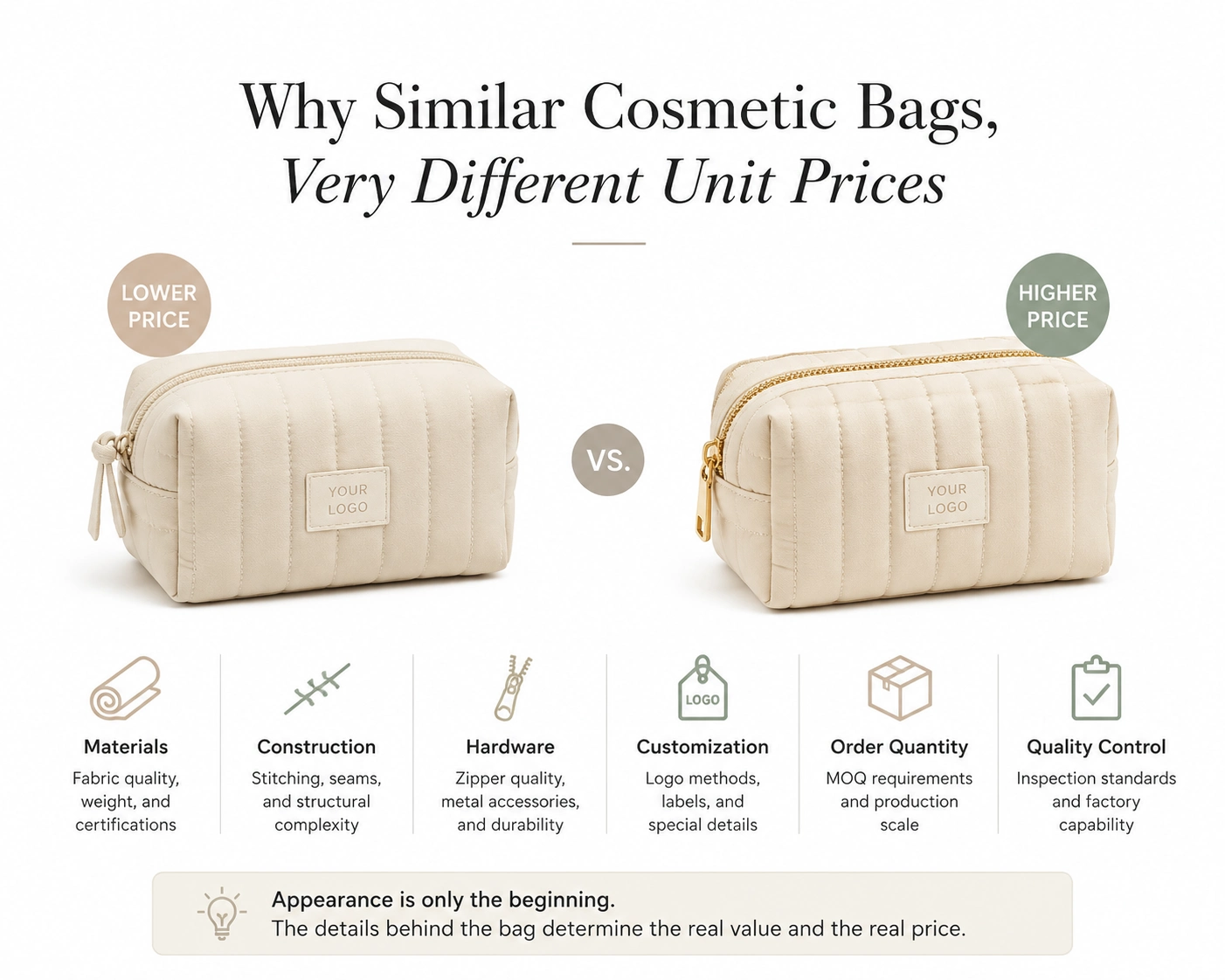
Similar cosmetic bags can have very different unit prices because the visible shape represents only a small part of the manufacturing cost. Two pouches may look nearly identical in a product photo, yet one may use heavier certified fabric, reinforced seams, a custom zipper pull, tighter tolerances, retail packaging and third-party inspection. The other may use stock materials, a simpler pattern and basic bulk packing.
This distinction matters in a large and increasingly competitive beauty market. Statista projects that the worldwide beauty and personal care market will generate approximately US$698.38 billion in 2026. Grand View Research estimates the U.S. beauty and personal care products market at US$117.05 billion in 2026. As brands launch more travel sets, gift-with-purchase programs and branded accessories, buyers need to compare quotations on specification—not appearance alone.
Table of Contents
- Why Appearance Alone Does Not Determine Unit Price
- Material Quality and Fabric Cost
- Product Size and Material Consumption
- Construction Complexity and Labor Cost
- Zippers, Hardware and Accessories
- Logo and Customization Costs
- Order Quantity and MOQ
- Packaging Requirements
- Quality Standards and Compliance Costs
- Production Location and Factory Capability
- Case Study: Similar Appearance, Different Cost Structure
- How Buyers Can Compare Quotations Accurately
- Low-Price vs. Fully Specified Quotes: Pros and Cons
- Final Price Comparison Checklist
- Frequently Asked Questions
- Conclusion and Next Steps
Why Similar Cosmetic Bags Can Have Very Different Unit Prices
Visible Design vs. Hidden Construction
A front-view photograph shows color, silhouette and logo placement. It rarely reveals fabric weight, coating, backing, foam density, seam allowance, reinforcement, zipper grade, pocket construction or packing method. Those hidden decisions control material consumption, production speed, defect risk and durability.
Product Specifications Behind the Quotation
A reliable quotation is based on a bill of materials, pattern consumption and labor estimate. It should also account for wastage, packaging, quality control, overhead, tooling and the agreed trade term. When the specification is incomplete, the supplier must either ask questions or make assumptions.
| Cost Layer | What a Product Photo May Show | What the Quotation Must Confirm |
|---|---|---|
| Outer material | Color and surface appearance | Composition, weight, thickness, finish, backing and certification |
| Construction | General shape | Panel count, seam type, reinforcement, binding and assembly sequence |
| Components | Zipper and visible hardware | Gauge, material, plating, supplier, pull strength and custom tooling |
| Interior | Sometimes not visible | Lining, padding, pockets, dividers, brush sleeves and clean finishing |
| Commercial scope | Not visible | MOQ, packaging, testing, inspection, freight term and payment conditions |
Why Photo-Based Price Comparisons Can Be Misleading
A supplier may quote a photo using the lowest-cost reasonable interpretation. Another may quote the quality level implied by the buyer’s market. Both prices can be internally logical, but they are not comparable.
Factory expert rule: A quotation is only comparable when the products, quantities, packaging, tests, delivery terms and approval standards are comparable.
Instead of asking why one photo quote is higher, ask each supplier to list its assumptions. This immediately reveals whether the difference comes from genuine efficiency or from missing specifications.
Material Quality Changes Cosmetic Bag Unit Prices
Fabric Type, Weight and Thickness
Fabric names are broad categories, not price standards. Polyester, nylon, canvas, PU, velvet, mesh and recycled textiles come in multiple weights, coatings and backing constructions. Performance and price depend on the complete specification.
Standard Materials vs. Certified Materials
Certified or traceable materials can cost more because they require controlled sourcing, records and qualified suppliers. Recycled textiles and certified paper packaging may also carry higher purchasing minimums.
Stock Colors vs. Custom-Dyed Colors
Stock color is usually faster and may support a lower MOQ. Custom dyeing can require a lab dip, minimum dye lot, color approval, additional lead time and allowance for shade variation. If the order quantity is lower than the dye-lot minimum, the buyer may effectively pay for unused material or accept a higher unit allocation.
Lining, Padding and Reinforcement Materials
Coated or wipe-clean lining costs more than basic polyester. Padding, lamination and hidden reinforcement also add material and processing costs.
| Material Decision | Lower-Cost Route | Higher-Specification Route | Why the Price Changes |
|---|---|---|---|
| Outer fabric | Stock lightweight polyester | Heavy recycled polyester with controlled finish | Higher material price, MOQ and documentation |
| Color | Available stock shade | Custom Pantone dye lot | Lab dip, minimum dyeing quantity and approval work |
| Lining | Basic polyester | Wipe-clean coated lining | Coating cost and more difficult sewing |
| Structure | No padding | Foam-laminated panels with reinforcement | Additional material, lamination and cutting |
| Paper packaging | Uncertified card | FSC-certified printed insert | Controlled sourcing and print minimums |
Product Size and Material Consumption
Finished Dimensions and Cutting Usage
A small increase in finished size can create a larger increase in material consumption. The factory does not buy only the visible front panel. It must cut seam allowances, gussets, zipper strips, handles, pockets, lining and reinforcement. A two-centimeter increase may also change how many panels fit across the fabric width.
Pattern Efficiency and Fabric Waste
Pattern efficiency describes how effectively components nest on the material. Rectangular pouches are often efficient. Curved vanity bags, diagonal prints, directional velvet or centered motifs can create more cutting waste.
Structured Shapes vs. Simple Pouch Construction
A flat pouch may use two main outer panels and a zipper. A structured case may require front, back, base, side panels, lid, zipper gusset, piping, lining pieces, foam and board reinforcement. The structured bag also occupies more carton space, raising packaging and freight costs.
| Design Feature | Effect on Material Usage | Effect on Labor | Possible Logistics Effect |
|---|---|---|---|
| Flat rectangular pouch | Efficient panel nesting | Fewer assembly steps | Can often ship flat |
| Boxy gusset | More side and base panels | More seams and corner control | Moderate volume increase |
| Rigid vanity case | Foam, board and additional lining | Complex assembly | High carton-volume impact |
Construction Complexity and Labor Cost
Number of Panels and Sewing Steps
Labor depends on operation count, handling time and skill. Each added panel creates cutting, positioning, sewing and inspection work; curves and small parts are slower than straight seams.
Pockets, Dividers and Internal Compartments
Pockets and dividers add both components and operations. Zipper pockets, brush sleeves, elastic loops and removable pouches each require separate positioning and quality checks.
Piping, Binding and Reinforced Seams
Piping, binding and reinforcement improve shape and durability but require extra materials, controlled sewing and slower handling.
Difficult Materials and Specialized Workmanship
Slippery satin, stretch neoprene, thick foam laminates, clear PVC, velvet and coated fabrics may need special needles, feet, machines or operator experience. Clear materials expose every seam and scratch. Velvet has pile direction. Thick assemblies may require slower sewing and more manual shaping.
| Construction Element | Approximate Operation Impact | Main Quality Risk |
|---|---|---|
| Simple flat zipper pouch | Baseline | Uneven top edge or zipper waviness |
| Add full lining | Additional cutting and assembly | Lining twisting or catching in zipper |
| Add four brush sleeves | Repeated measuring and stitching | Uneven sleeve widths |
| Add piping around a curved case | Specialized curved sewing | Wavy piping or distorted corners |
| Add structured foam and board | Lamination, positioning and shaping | Bulk, wrinkles or inconsistent silhouette |
The number of visible features understates the number of manufacturing operations.
Zippers, Hardware and Accessories
Nylon, Molded Plastic and Metal Zippers
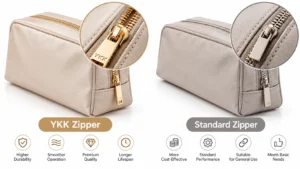
Zipper cost depends on material, gauge, tape, slider, puller, length and color. Nylon coil, molded plastic and metal zippers also create different sewing, weight and plating requirements.
Standard Pullers vs. Custom Zipper Pulls
A stock puller uses existing tooling. A custom puller requires artwork review, mold development, sampling, plating approval and often a component MOQ. If two zipper sliders are used, the tooling may be the same but the component quantity doubles.
Metal Plates, Buckles and Decorative Hardware
Component Plating and Color Matching
“Gold” is not one universal finish. Matching sliders, rings, pullers and logo plates may require controlled plating batches and approved color tolerances.
Logo and Customization Costs
Screen Printing and Heat Transfer
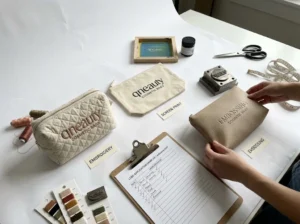
Screen printing is efficient for solid colors and larger quantities. Setup may be charged per color, artwork or position. Heat transfer can reproduce more detailed graphics but requires suitable film, temperature and pressure control.
Embroidery and Woven Labels
Embroidery cost depends on stitch count, size, thread colors, density and stabilizer. A small dense logo can cost more than a larger open design. Woven labels usually require a label MOQ and may include folding, cutting and sewing costs.
Debossed Logos and Metal Branding
Debossed PU patches need a mold or die, suitable material thickness and controlled heat or pressure. Metal plates add tooling, plating and attachment. They may also increase the inspection requirement because scratches, uneven color and loose fixing are visible defects.
Tooling and Mold Charges
Tooling should be separated from unit price whenever possible. A supplier may amortize tooling into a small order, producing a high unit price, or quote it as a one-time charge. Buyers should confirm ownership, storage period, reuse conditions and the cost of future changes.
Order Quantity and MOQ
Material Purchasing Minimums
The bag factory’s sewing MOQ is only one part of the calculation. Fabric mills, dye houses, zipper suppliers, label makers, printers and hardware factories may have separate minimums. The highest or least flexible minimum often controls the commercial MOQ.
Setup Costs Per Production Run
Pattern setup, cutting preparation, printing screens and line changeovers occur for every run. Dividing these fixed costs across 300 units instead of 3,000 raises the unit allocation.
Price Differences Between Trial and Bulk Orders
Quantity Allocation Across Multiple Colors
A 2,000-piece order in one color is not equivalent to 2,000 pieces split across ten colors. Each color may require separate material purchasing, cutting control, thread matching, labels, packing identification and production changeover.
Packaging Requirements Affect Unit Price
Basic Polybag Packaging
Basic packaging may include one bag per protective polybag and bulk export cartons. Even this must define polybag size, material, warning text, sealing method and carton quantity.
Hangtags, Belly Bands and Retail Boxes
Retail packaging adds artwork, printing, assembly and inspection. Gift boxes and fitted bands also require dielines, material specifications and minimum print runs.
Barcode and Label Application
Barcode labels require correct data, position, print contrast and application. GS1 notes that barcode quality depends on factors such as quiet zones, contrast, color and construction, while verification is recommended to confirm that the code is likely to scan as intended.
Protective Packaging for Structured Bags
Structured bags may need shape holders or boxes and use more carton volume. A low EXW price can therefore produce a higher landed cost.
Quality Standards and Compliance Costs
Standard Inspection vs. Third-Party Inspection
Factory inspection is part of normal production, but some buyers require an independent final random inspection. SGS describes final random inspection as an on-site check conducted when production is complete and typically 80–100% export packed, using an agreed sampling and AQL approach.
Material Testing and Certification
Testing costs depend on materials, colors, components, age grading and destination market. A complete test on every color and component can cost more than testing a representative material group, but grouping is only appropriate when a qualified laboratory or compliance adviser accepts the rationale.
Restricted Substance and Market Compliance
For the EU, REACH restrictions and information duties may affect textiles, coatings, prints, plastics and metal components. For California, Proposition 65 requires a clear and reasonable warning before certain significant exposures to listed chemicals unless an applicable exposure exception or safe-harbor position is established.
CPSIA should not be added automatically to every adult cosmetic bag. The U.S. Consumer Product Safety Commission defines a children’s product as one designed or intended primarily for children aged 12 or younger. Product age grading therefore affects testing and certification scope.
Acceptable Quality Limit Requirements
ISO 2859-1:2026 specifies acceptance sampling systems for inspection by attributes. It does not mean that one AQL setting is correct for every order. The buyer must define defect categories, inspection level and acceptance criteria.
A buyer might specify Critical 0, Major AQL 2.5 and Minor AQL 4.0, while premium programs may require stricter criteria or extra functional tests. Tighter controls can increase inspection and rework costs.
| Quality Requirement | Possible Direct Cost | Possible Indirect Cost |
|---|---|---|
| Third-party final inspection | Inspection service and travel fee | Factory preparation and possible reinspection |
| Chemical testing | Laboratory charges | Material replacement if a component fails |
| Tight measurement tolerance | More checking and potential rework | Slower production output |
| Stricter AQL | Potentially larger or more detailed inspection | Higher rejection and sorting risk |
| Traceable certified material | Higher sourcing and documentation cost | Longer lead time and fewer supplier options |
Production Location and Factory Capability
Skilled Labor and Equipment
Experienced pattern makers, specialized equipment and trained operators may cost more, but they can reduce revisions, defects and delay.
Factory Certification and Quality Systems
Maintaining quality systems, social audits, safety controls and document management creates overhead. Sedex describes SMETA as a widely used audit methodology for evaluating working conditions and environmental performance. Amfori describes BSCI as a system for identifying, assessing and mitigating social risks; it should not be misrepresented as a product-quality certificate.
Subcontracted Production vs. In-House Manufacturing
Specialized printing, embroidery, plating and testing are often outsourced. What matters is whether the lead factory controls approval, traceability, timing and quality.
Case Study: Similar Appearance, Different Cost Structure
An anonymized 2026 inquiry from a startup beauty brand illustrates why similar cosmetic bags can have very different unit prices. The brand submitted an AI-generated image of a compact, soft-touch cosmetic pouch. From the front, it resembled many standard zip pouches available in the market.
The brief required a suede-look exterior, structured shape, center metal plate, possible branded zipper pull and dimensions suited to a specific beauty set.
A basic estimate assumed stock fabric, standard zipper and printed logo. The production-ready quote included custom metal tooling, plating approval, reinforcement, controlled material selection and component minimums.
| Quotation Item | Basic Photo Interpretation | Approved Brand Specification |
|---|---|---|
| Outer | Available soft polyester | Selected suede-look textile with approved hand feel |
| Logo | One-color screen print | Custom metal center plate |
| Zipper | Stock slider and puller | Possible branded metal puller requiring separate tooling |
| Structure | Soft flat pouch | Controlled silhouette with reinforcement |
| MOQ basis | Stock components | Custom hardware and material minimums |
Case-study lesson: A visual concept can start a quotation, but it cannot finish one. The price becomes meaningful only when the hidden construction and commercial scope are documented.
How Buyers Can Compare Quotations Accurately
Use the Same Specification Sheet
Send every supplier the same revision-controlled specification. Include dimensions, materials, components, workmanship, branding, quantities, packaging, tests, destination and requested Incoterm. Ask suppliers to highlight deviations instead of silently substituting.
Buyers can also review the capabilities of an experienced custom cosmetic bag manufacturer before finalizing the quotation package.
Separate Unit Price from Tooling Charges
Request separate lines for molds, print screens, sampling, testing, inspection and shipping. This prevents a one-time charge from distorting repeat-order economics.
Confirm Packaging and Testing Inclusions
Ask whether the price includes individual polybags, hangtags, barcode application, retail boxes, carton marks, laboratory testing or third-party inspection. “Standard packing included” is not specific enough.
Request a Cost Breakdown for Major Differences
Compare Total Landed Cost
EXW, FOB and DDP allocate costs and responsibilities differently. Compare quotations under the same Incoterms 2020 rule and named location.
| Comparison Layer | Questions to Ask |
|---|---|
| Product | Are dimensions, materials, structure, logo and components identical? |
| Quantity | Is the total and per-color allocation the same? |
| One-time charges | Are molds, screens and samples separate or amortized? |
| Quality | Are inspection standards, tests and defect criteria included? |
| Packaging | Is retail and export packing fully defined? |
| Trade terms | Are both quotes EXW, FOB, DAP or DDP at the same named place? |
| Risk | What happens after material failure, inspection failure or delay? |
Low-Price vs. Fully Specified Quotes: Pros and Cons
| Quotation Approach | Pros | Cons | Best Use |
|---|---|---|---|
| Fast photo-based estimate | Quick, useful for early budget screening | Relies on assumptions and often changes later | Concept-stage feasibility |
| Lowest-cost specification | Supports price-sensitive promotions | May sacrifice durability, branding or packaging | Clearly defined short-term promotional use |
| Fully specified quotation | More accurate, comparable and production-ready | Requires more preparation and supplier review | Retail launches and repeat programs |
| Delivered or landed quotation | Shows a broader commercial cost | Must clarify duties, taxes, exclusions and importer responsibility | Buyers without established freight arrangements |
Final Price Comparison Checklist
Product Specification Comparison
- Finished dimensions and measurement method match.
- Outer fabric composition, weight, thickness and finish match.
- Lining, padding and reinforcement are fully defined.
- Panel count, pockets, dividers, piping and binding match.
- Zipper type, gauge, slider and puller match.
Commercial Terms Comparison
- Total quantity and quantity per color are identical.
- MOQ and material-purchasing assumptions are stated.
- Sample, tooling and setup charges are separated.
- Payment terms and quotation validity are stated.
- Production lead time begins from the same approval milestone.
Quality and Compliance Comparison
- Destination market and intended age group are stated.
- Required material tests and reports are included or excluded clearly.
- Factory and third-party inspection responsibilities are defined.
- AQL, defect categories and functional tests are agreed.
- Social-audit or retailer-approval requirements are confirmed.
Total Landed Cost Comparison
- Retail and export packaging costs are included.
- Carton dimensions and units per carton are estimated.
- Freight is based on realistic packed volume and weight.
- Duty, tax and customs assumptions are identified.
- Warehousing, relabeling or fulfillment charges are considered.
Frequently Asked Questions
Why are two similar makeup bags priced differently?
They may differ in fabric grade, weight, lining, padding, construction, zipper quality, hardware, logo process, MOQ, packaging, testing and delivery terms. A photograph does not reveal most of these cost drivers.
What affects the price of a custom cosmetic bag most?
The largest drivers are usually material specification, size and consumption, labor complexity, custom hardware, quantity per color, packaging and compliance scope. The dominant factor changes by design.
Does MOQ change the unit price of cosmetic bags?
Yes. Fixed setup costs are spread across fewer pieces at a low MOQ. Small orders may also fall below fabric, dyeing, printing or hardware minimums, causing higher purchasing costs or minimum-lot charges.
Is a heavier fabric always better?
No. The correct fabric depends on structure, use, cleanability, hand feel and cost target. A heavy fabric can make a small pouch bulky, while a lighter fabric with appropriate backing may perform better. Compare performance requirements rather than weight alone.
Should tooling be included in the unit price?
Either approach can work, but the quotation should show it clearly. Separating tooling makes repeat-order pricing easier to understand. Confirm mold ownership, storage, reuse and modification conditions.
How can I compare cosmetic bag supplier quotations?
Use one specification sheet, one quantity breakdown, one packaging standard and one trade term. Then separate unit price, tooling, testing, inspection and freight. Ask suppliers to disclose substitutions and exclusions.
Is the lowest cosmetic bag quotation usually the best?
Not necessarily. It may be the best when scope and quality are truly identical. It is not the best comparison when the lower quote excludes final materials, reinforcement, retail packaging, testing or realistic logistics.
Why Similar Cosmetic Bags Have Different Unit Prices
Similar cosmetic bags can have very different unit prices because buyers are rarely comparing only a shape. They are comparing material systems, production operations, component supply chains, order structures, quality controls, packaging programs and delivery responsibilities.
Future pricing will place greater emphasis on traceability, chemical compliance, packaging efficiency and digital specification control. Early documentation will reduce quotation revisions.
Prepare the dimensions, materials, quantity split, logo files, packaging requirements, compliance scope and delivery term before requesting a final quote. For specification review, material options, sampling and transparent OEM/ODM pricing, submit your cosmetic bag project to Q&N Bags.
Sources and Further Reading
- Statista: Beauty & Personal Care Market Worldwide
- Grand View Research: U.S. Beauty and Personal Care Products Market
- Google Search Central: Creating Helpful, Reliable, People-First Content
- ISO 2859-1:2026: Sampling Procedures for Inspection by Attributes
- U.S. CPSC: Children’s Products
- California OEHHA: Businesses and Proposition 65
- SGS: Final Random Inspection
- International Chamber of Commerce: Incoterms 2020
- Sedex: SMETA Audit
- amfori: BSCI Due Diligence System
Aries Gu is the founder of Q&N. With over 17 years of experience in cosmetic bag OEM/ODM source factory. He focuses on quality control, efficient communication, and on-time delivery for global cosmetic bag projects.