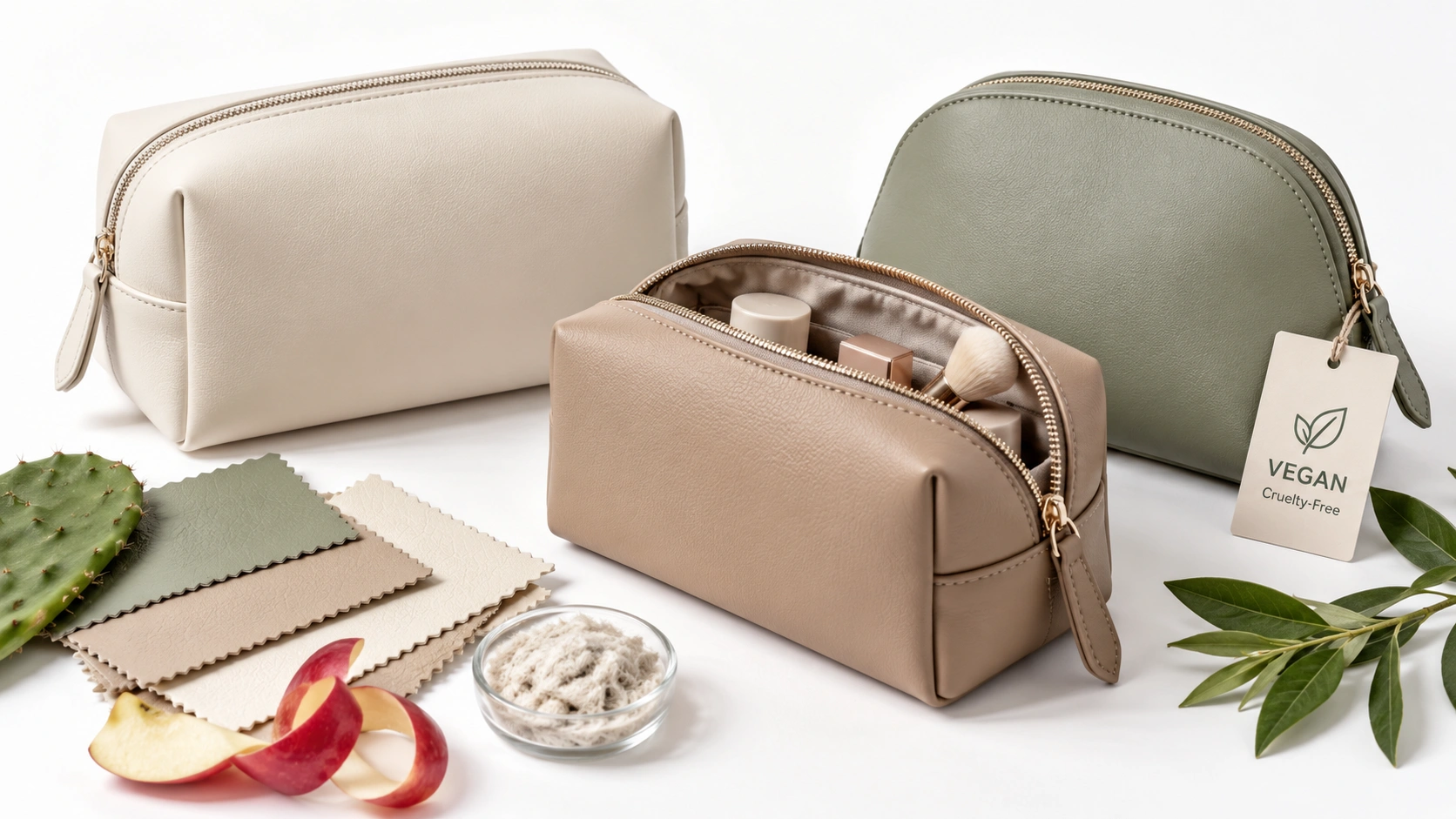
As the global beauty industry aggressively pivots toward ethical consumption, sourcing vegan leather cosmetic bags is no longer just a niche trend; it is a mandatory procurement strategy for 2026. For B2B buyers, boutique owners, and indie cosmetic brands, replacing genuine leather with cruelty-free alternatives aligns your product with modern consumer values while drastically improving your profit margins.
However, navigating the complex world of synthetic and bio-based leathers requires deep manufacturing knowledge. Sourcing the wrong material leads to peeling bags, toxic chemical odors, and high retail return rates. As a source factory with over 15 years of OEM/ODM expertise, QNBags understands the exact chemical and structural requirements needed to produce premium beauty packaging. This comprehensive guide will walk you through the factory floor realities of sourcing wholesale cruelty-free makeup bags.
1. The B2B Shift Towards Cruelty-Free Beauty Accessories in 2026
Procurement teams must align their supply chains with shifting retail expectations. Understanding the commercial advantages of cruelty-free sourcing protects your brand equity and inventory investment.
1.1 Consumer Demand Driving Retail Procurement
Modern consumers actively search for certifications from organizations like PETA before purchasing beauty products. A cruelty-free skincare line loses all its credibility if it is packaged in a genuine animal leather toiletry bag. By sourcing 100% vegan leather pouches, B2B buyers ensure their secondary packaging perfectly matches the ethical marketing of the cosmetics inside.
1.2 Navigating Greenwashing: What “Vegan” Actually Means
From a factory perspective, “vegan” simply means the absence of animal products. It does not automatically mean “eco-friendly.” Many cheap vegan leathers are heavily reliant on petroleum-based PVC, which is toxic to produce. We help our B2B clients navigate this by offering cleaner polyurethane (PU) options and emerging bio-based materials that genuinely reflect sustainable values.
1.3 Margin Protection: Vegan vs. Genuine Leather Costs
Genuine leather requires expensive tanning processes, suffers from high material waste due to natural hide scars, and incurs massive shipping weights. Premium PU vegan leather offers a consistent, flawless surface on continuous rolls, allowing our CNC cutting machines to maximize material yield. This dramatically lowers the unit cost while maintaining a luxury retail aesthetic.
2. Categorizing Vegan Leather Materials on the Factory Floor
Not all synthetic leathers are created equal. B2B buyers must specify the exact chemical composition of their materials to balance cost, texture, and environmental impact.
2.1 Traditional PU and PVC: The Baseline Standard
In the past, PVC (Polyvinyl Chloride) was the standard for cheap bags, but it cracks easily and emits strong odors. Today, our factory standard is Polyurethane (PU) leather. PU is significantly softer, more flexible, and mimics the microscopic grain of real leather with incredible accuracy, making it ideal for standard custom cosmetic bags.
2.2 Water-Borne PU (WBPU): The Eco-Friendly Upgrade
For brands targeting the premium sustainable market, we recommend Water-Borne PU (WBPU). Traditional PU manufacturing uses toxic chemical solvents (like DMF). WBPU replaces these solvents with water, drastically reducing VOC (Volatile Organic Compound) emissions. It provides a buttery-soft texture that rivals high-end calfskin.
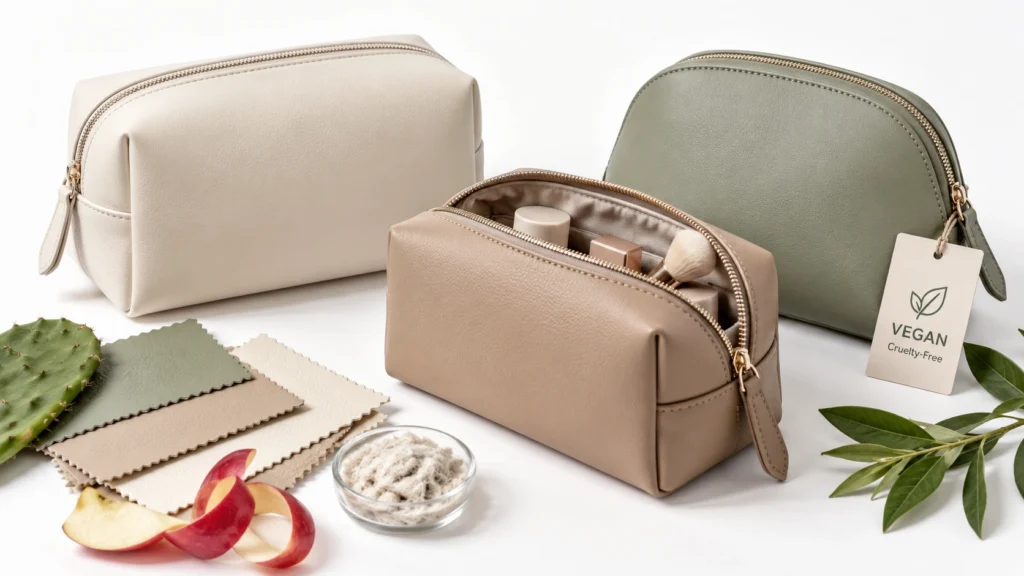
2.3 Plant-Based Bio-Leathers: Apple, Cactus, and Cork Options
The latest innovation for 2026 involves bio-based leathers derived from agricultural waste. Materials like apple leather (made from juice industry byproducts) or cactus leather offer incredible marketing narratives for indie beauty brands. While these materials command a higher unit price, they allow for a significantly higher retail markup.
[Insert Image: A side-by-side material swatch comparison showing standard PU leather, water-borne PU, and textured cork leather, demonstrating factory sourcing capabilities.]
3. Evaluating Material Durability and Performance
A cosmetic bag lives in a hostile environment: hot, steamy bathrooms and crammed luggage. Your chosen vegan leather must be engineered to withstand these precise conditions.
3.1 Hydrolysis Resistance for Humid Bathroom Environments
The biggest threat to PU leather is hydrolysis—a chemical reaction where humidity causes the material to flake and peel over time. We source advanced anti-hydrolysis PU leather specifically formulated for bathroom use, ensuring your vegan leather toiletry bags maintain their flawless appearance for years.
3.2 Scratch and Peel Resistance Testing
During the material procurement phase, our Incoming Quality Control (IQC) team conducts rigorous abrasion testing. We ensure the top color layer of the vegan leather bonds permanently to its fabric backing, preventing the surface from scratching when rubbing against keys or zippers inside a handbag.
3.3 Pairing with Easy-Wipe Spill-Proof Linings
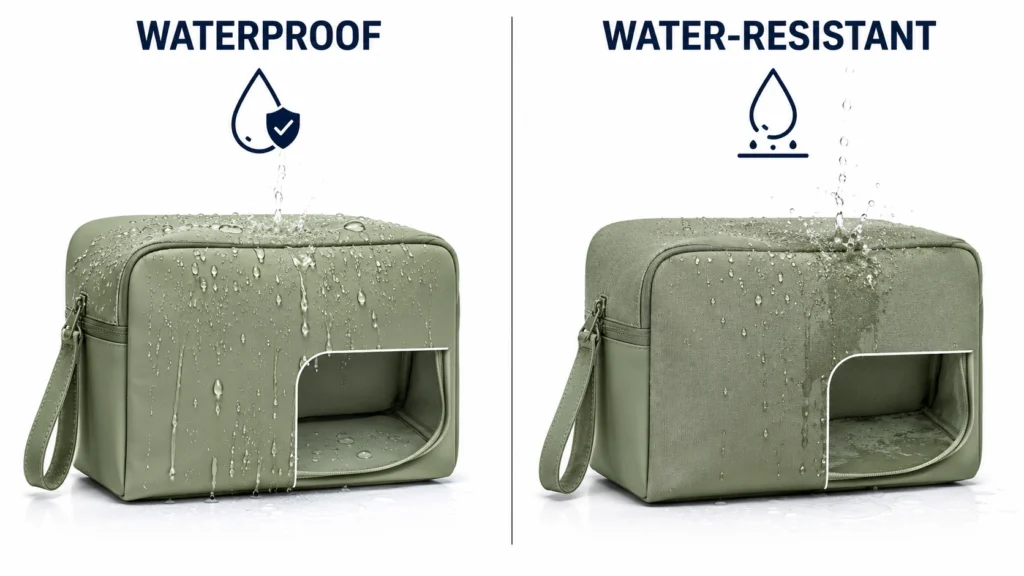
A premium vegan leather exterior is useless if the interior stains permanently from a leaked foundation bottle. We strictly pair our synthetic leathers with PU-coated polyester or eco-friendly PEVA linings. These non-porous barriers allow end-users to effortlessly wipe the interior clean with a damp cloth.
4. Manufacturing Nuances for Vegan Leather Bags
Working with synthetic leather requires entirely different sewing and assembly techniques than working with canvas or nylon. Our factory floor is optimized for these specific structural demands.
4.1 Die-Cutting Consistency and Material Yield
Because vegan leather comes in massive, uniform rolls without the natural flaws of animal hide, our production managers achieve exceptional cutting efficiency. By using advanced CNC nesting software, we tightly group the bag patterns to minimize raw material waste, passing those B2B cost savings directly to your bottom line.
[Insert Image: A factory CNC cutting machine rapidly slicing precise, interlocking patterns from a large roll of vegan leather, highlighting material efficiency.]
4.2 Skiving and Edge Painting for a Luxury Finish
Thick PU leather creates bulky, ugly seams if folded directly. To achieve a sleek, high-end boutique look, our workers perform skiving—carefully shaving down the thickness of the leather edges before sewing. For unlined edges, we apply multiple coats of color-matched edge paint to seal the material, mimicking the craftsmanship of luxury European handbags.
4.3 Stitching Tension (SPI) to Prevent Fabric Tearing
Vegan leather does not “heal” from needle punctures like genuine leather. If a sewing machine operator makes a mistake, the panel is ruined. We enforce strict Stitches Per Inch (SPI) protocols and calibrate thread tension meticulously to ensure the needle holes do not weaken the material and cause tearing during daily use.
5. Custom Branding and OEM/ODM Logo Application
Your branding is the focal point of the product. Vegan leather offers unique, highly premium methods for logo application that elevate the perceived retail value.
5.1 Blind Debossing vs. Hot Foil Stamping on PU
Vegan leather responds beautifully to heat and pressure.
- Blind Debossing: Presses your logo deeply into the PU without color, creating a subtle, sophisticated shadow effect favored by minimalist skincare brands.
- Hot Foil Stamping: Inserts a layer of metallic gold, silver, or rose-gold foil between the heated brass mold and the bag, delivering a striking luxury aesthetic.
5.2 Custom Hardware and Alloy Zipper Integration
A premium leather bag demands premium hardware. We seamlessly integrate custom-molded alloy zipper pullers shaped like your brand’s logo. To ensure flawless operation and longevity, we partner with industry leaders like YKK Zippers, ensuring the hardware matches the high quality of the cruelty-free exterior.
5.3 Sizing Adjustments for Skincare Gift Sets (GWP)
An Illustrative Manufacturing Scenario: A boutique brand needed a vegan leather train case to house a specific 4-step glass bottle regimen. Standard sizes left too much empty space, risking bottle breakage. Our sample room engineered custom dimensions, providing a snug fit that elevated their “Gift With Purchase” (GWP) presentation.
6. Managing Tooling Costs and the 500 MOQ Advantage
Procuring custom vegan leather often involves navigating massive material minimums imposed by textile mills. We structure our supply chain to protect startup cash flow.
6.1 Overcoming Mill Minimums for Custom Pantone Dyeing
If you require a highly specific Pantone color, synthetic leather mills typically demand a Minimum Color Volume (MCV) of 1,000+ yards. To bypass this, we maintain a vast in-house inventory of pre-dyed premium PU leather in dozens of trending shades, allowing you to find a near-perfect match without triggering massive custom dye fees.
6.2 Why a 500-Piece MOQ is the Startup Sweet Spot
Traditional B2B suppliers demand thousands of units per order. QNBags empowers boutique brands by offering an accessible MOQ of just 500 pieces. This allows you to launch your custom-branded cosmetic bags, test market demand, and generate revenue without crippling inventory risk.
6.3 The Critical Role of the Pre-Production Sample (PPS)
Never commit to a bulk order without touching the material. Our sample room provides a 1:1 physical Pre-Production Sample (PPS) within 7 to 10 days. This allows your procurement team to verify the softness of the PU, test the zipper glide, and approve the foil-stamped logo before the 500-piece run begins.
7. Factory Quality Control (QC) for Cruelty-Free Bags
Our 15 years of factory expertise are anchored in unyielding Quality Control. We manage production risks so your brand avoids retail returns.
7.1 Incoming Material Quality Control (IQC) Protocols
Before assembly, our IQC team tests the vegan leather rolls for color consistency, thickness, and odor. We ensure our materials comply with global environmental standards, mirroring the strict testing frameworks utilized by agencies like SGS to guarantee non-toxic compliance.
7.2 Zipper Glide and Seam Stress Testing
During the In-Process Quality Control (IPQC) phase, inspectors isolate the stress points. We repeatedly test the zipper operation to ensure the PU leather edges do not jam the slider, and we apply physical tension to the gusset seams to verify structural integrity.
[Insert Image: A factory QC inspector performing a manual stress test on the stitched seams of a completed vegan leather makeup bag.]
7.3 Final Needle Detection and Surface Polishing
Consumer safety is paramount. Every bag passes through an industrial needle detection machine to ensure no broken sewing needles remain trapped in the linings. Finally, the PU surface is polished with microfiber cloths to remove any factory dust or fingerprints before packing.
8. B2B Packaging Logistics to Prevent Transit Damage
Vegan leather requires specialized handling during international freight. Improper packaging can ruin an entire shipment before it reaches your warehouse.
8.1 Avoiding Indentations: The Problem with Vacuum Sealing PU
While vacuum packaging is excellent for reducing B2B freight costs on canvas bags, it is highly dangerous for PU leather. The vacuum pressure forces zippers and hardware to press deeply into the soft synthetic leather, leaving permanent, unrecoverable indentations. We strictly prohibit aggressive vacuum sealing for premium vegan leather orders.
8.2 Tissue Wrapping and Master Carton Structuring
To protect the flawless surface, every bag is stuffed with lightweight shaping paper to maintain its 3D structure. The custom hardware and zipper pulls are individually wrapped in tissue to prevent them from scratching the PU leather of adjacent bags inside the master shipping carton.
8.3 Streamlined FBA and Retail Prep Services
We optimize your supply chain by providing source-level retail prep. Whether you need Amazon FNSKU barcodes applied, suffocation warning labels attached, or bags placed into premium frosted EVA zip pouches, your inventory arrives at your 3PL or retail shelves ready for immediate sale.
Ready to elevate your beauty brand with premium, cruelty-free packaging? Partner with a source factory that understands the exact technical demands of vegan leather manufacturing. Contact the QNBags B2B sales team today to request material swatches, discuss your tech pack, and secure a rapid quotation for your 500 MOQ custom order.
Aries Gu is the founder of Q&N. With over 17 years of experience in cosmetic bag OEM/ODM source factory. He focuses on quality control, efficient communication, and on-time delivery for global cosmetic bag projects.